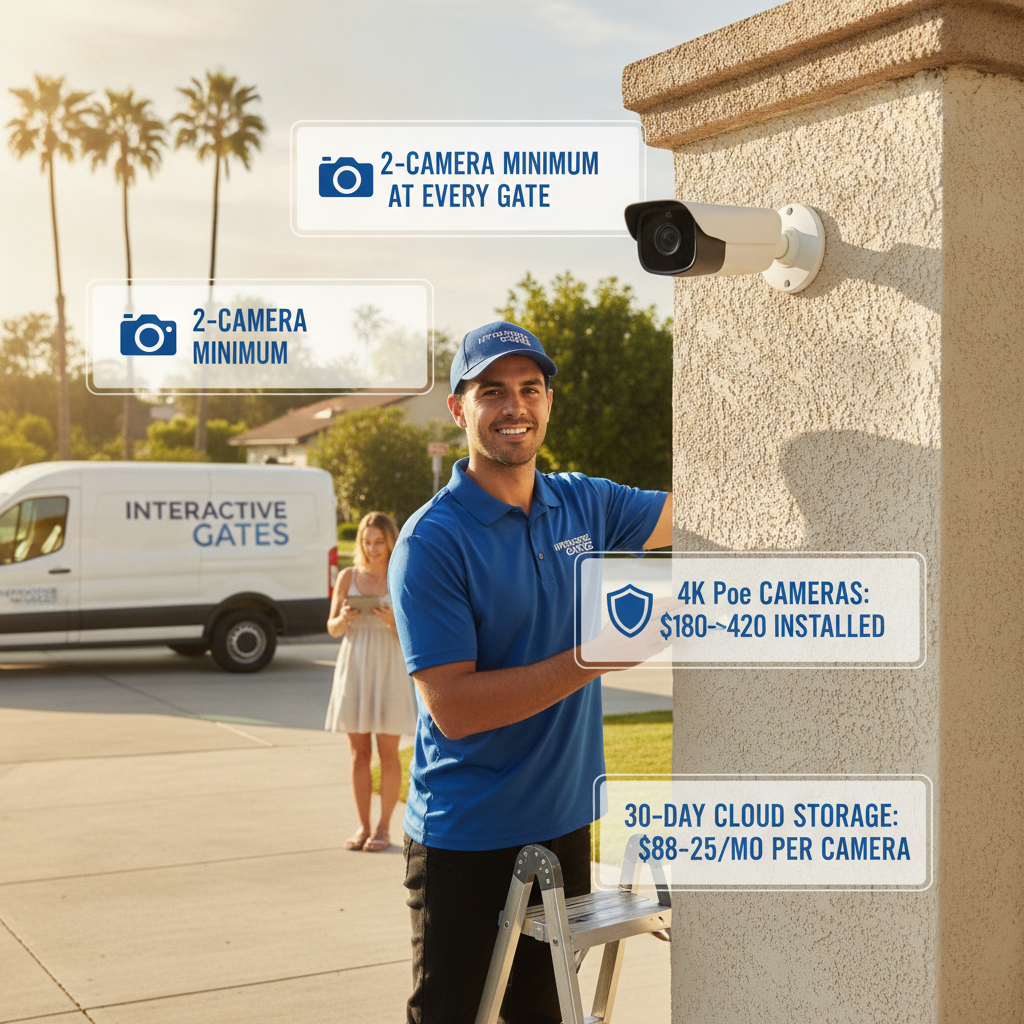
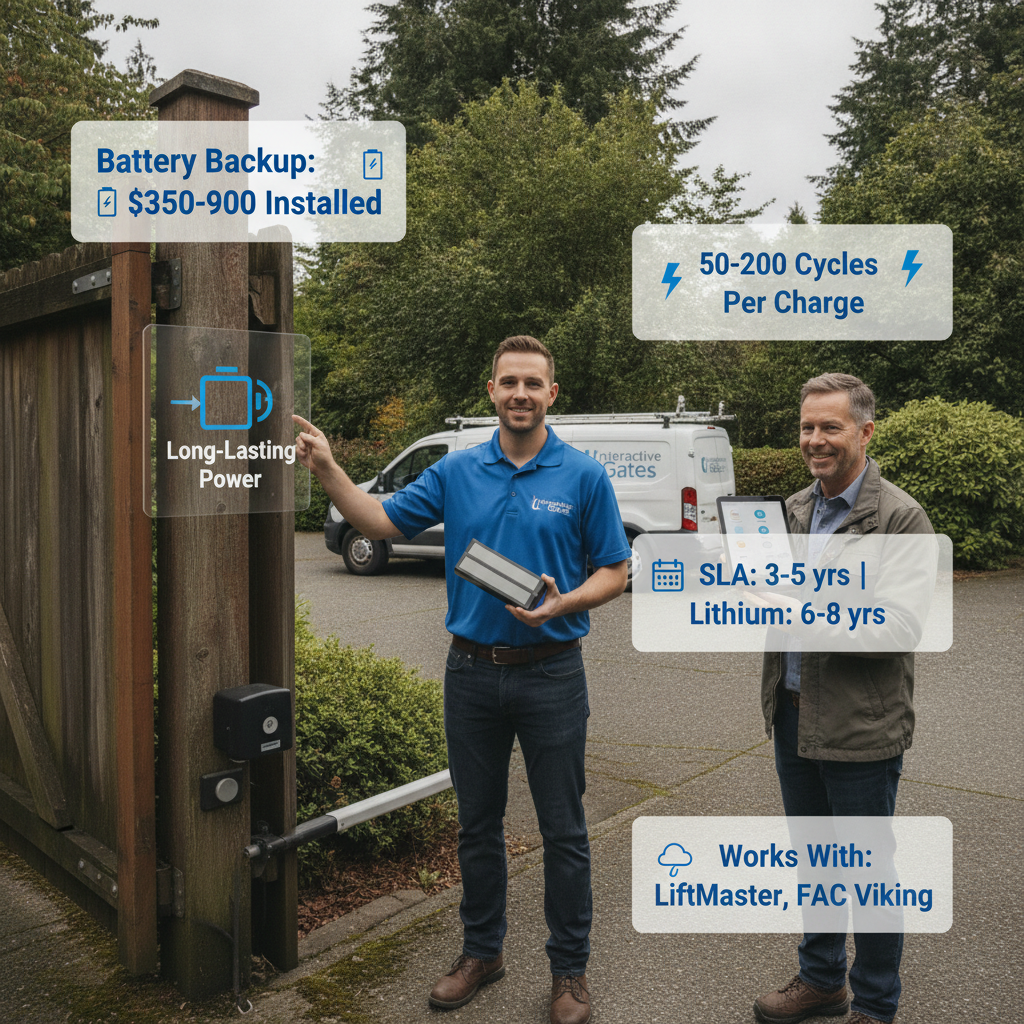
- Camera-plus-gate packages in Portland run $320–$1,100 per camera position installed, depending on resolution, night vision, and conduit work.
- Rainfall and moss growth mean every camera at a Portland gate must carry at least an IP66 weatherproof rating — IP67 or IP68 is better for exposed pillar mounts.
- The most common setup is two cameras per gate entry: one wide-angle overview and one license-plate capture (LPC) camera aimed at vehicle approach.
- LiftMaster, Dahua, Axis, and Reolink are the four brands installers reach for most often on Portland residential and HOA gate projects in 2026.
- Portland city code and most Washington County HOA CC&Rs require cameras mounted on shared gates to have visible notice signage within 10 feet of the entry point.
- Cloud storage subscriptions add $8–$35/month per camera; a local NVR eliminates that recurring cost but requires a $250–$600 one-time recorder purchase.
- Most camera additions to an existing automated gate are completed in one day; new gate-plus-camera combined installs typically take two to three days.
- Integrating cameras with a video intercom system (BAS-IP, Aiphone, or DoorBird) adds $400–$900 to the camera budget but eliminates a redundant screen at the entry.
You just watched your neighbor's package disappear off their porch for the third time this winter, and suddenly the question isn't if you should add cameras to your gate — it's which cameras, where exactly, and what's this going to cost me? Portland homeowners, property managers in Beaverton and Lake Oswego, and HOA boards from Hillsboro to Gresham are all asking the same thing in 2026: how do I turn my automatic gate into a full security checkpoint without overcomplicating it or overspending?
This guide answers every version of that question with real numbers, specific brands, local climate considerations, and practical advice from the field.
Why Do Portland Properties Need Gate-Specific Security Cameras in 2026?
An automatic gate controls who enters. A gate camera records who tried. Those two functions are complementary, and skipping the camera half leaves a significant gap in your security picture. Portland sees an average of 154 days of measurable precipitation per year, and the gray winter months — October through March — correlate with the highest residential package theft and vehicle prowl rates in Multnomah, Washington, and Clackamas counties according to Portland Police Bureau property crime data.
Beyond theft deterrence, gate cameras serve three practical functions that homeowners often overlook until they need them: (1) they create timestamped footage for insurance claims, (2) they give HOA boards documented evidence for disputes about unauthorized access, and (3) they feed video intercoms so residents can see and speak to visitors before the gate opens — without walking to the entry. In a neighborhood like Lake Oswego where driveways can run 100–300 feet from the street, that convenience factor alone is worth the investment.
What Camera Types Work Best at Automatic Gates in Portland?
Not every security camera sold at a big-box store is appropriate for a gate application. Gate cameras face specific demands: vehicle detection at distance, low-light performance for the 5 p.m. winter darkness that hits Portland by November, and weather resistance against sustained rain and the occasional hard freeze east of the Cascades foothills.
Here are the four main camera types used at Portland gate installations in 2026:
- License Plate Capture (LPC) cameras: Narrow field of view (20–30°), IR illuminators rated for 50–100 ft, optimized shutter speed to freeze plate images on moving vehicles. Brands: Dahua ITC237, Axis P1448-LE. Cost installed: $480–$750 per camera.
- Wide-angle overview cameras: 2–8MP, 90–120° FOV, captures the full entry lane, any pedestrians, and the gate leaf itself. Brands: Reolink RLC-823A, Hikvision DS-2CD2T47G2. Cost installed: $320–$550 per camera.
- PTZ (pan-tilt-zoom) cameras: Can track movement across a large approach. Overkill for most residential gates but common on commercial properties in Hillsboro industrial parks. Cost installed: $650–$1,100 per camera.
- Video intercom cameras: Integrated into entry panels from DoorBird (D2101V), BAS-IP, or Aiphone IX series. Not standalone cameras, but combine call and video into one device. Cost installed as part of an intercom system: $400–$900 above intercom base price.
For most Portland single-family driveways, the right answer is one LPC camera aimed at the approach lane and one wide-angle camera mounted higher to capture context — pedestrians, tailgaters, the gate leaf position. That two-camera setup covers the meaningful blind spots at a reasonable budget.
Where Should Cameras Be Mounted at a Portland Gate?
Mounting location is the decision that separates effective gate surveillance from expensive footage of tree branches and passing headlights. The Pacific Northwest context matters here: Portland's moss growth on untreated surfaces, winter condensation on camera housings, and the low sun angle in December and January all affect where and how you aim cameras.
Follow this location logic:
- License plate camera: Mount on the approach side of the entry pillar, 3–4 ft high, angled slightly downward, aimed at the front plate of a stopped vehicle. Avoid mounting above 5 ft — the angle becomes too steep to read plates clearly. Keep lens facing north or east when possible to prevent afternoon sun glare (Portland's low winter sun comes from the southwest).
- Overview camera: Mount 8–12 ft high on a pillar, wall, or dedicated camera post set back 10–15 ft from the gate. Face it toward the street to capture the full approach lane and any pedestrians at the entry. This camera also frames the gate itself, which is useful for reviewing whether the gate closed properly after a cycle.
- Rear-side camera (optional): On properties in Gresham or Oregon City where the driveway continues to a secondary structure, a rear-facing camera captures vehicles exiting — useful for commercial applications where truck arrivals and departures need logging.
Pro Tip: Run conduit during gate installation, not after. Retrofitting conduit through an existing masonry pillar in Portland costs $180–$340 in labor alone — often more than the camera hardware itself. If you're planning cameras even one or two years out, tell your installer now and have the conduit stubbed out at no meaningful extra cost during the main install.
What Does It Cost to Add Cameras to an Existing Gate in Portland in 2026?
Here's the full cost breakdown for adding a camera system to an already-operating automatic gate in the Portland metro:
- Single wide-angle camera (installed, wired): $320–$550
- Single LPC camera (installed, wired): $480–$750
- Standard two-camera entry package (LPC + overview): $900–$1,400 installed
- Retrofit conduit work through masonry pillar: $180–$340 extra
- Local NVR recorder (4–8 channel): $250–$600 one-time hardware cost
- Cloud subscription (per camera/month): $8–$35 depending on resolution and retention period
- Video intercom integration upgrade: $400–$900 added to camera cost
- PTZ camera (commercial, installed): $650–$1,100
Labor rates in Portland for security camera installation run $85–$130/hour in 2026. A two-camera retrofit on an existing gate with accessible conduit typically takes 3–5 hours. Add conduit work or camera post setting and you're looking at a full day of labor.
For new combined gate-plus-camera projects, the camera portion represents roughly 12–22% of total project cost. Bundling the camera install with a new gate purchase often yields a 10–15% discount on the camera labor component because the conduit and wiring runs are already open during gate construction.
Which Camera Brands Do Portland Installers Recommend in 2026?
Four brands dominate professional gate camera installations in the Portland market this year:
- Dahua: Strong LPC lineup, excellent IR performance in rain, firmware updated aggressively through 2025–2026. The ITC237-PW1B-IRZ is the go-to plate reader for residential driveways. MSRP around $280–$390 per camera.
- Axis Communications: Swedish engineering, top-tier build quality, used heavily on commercial properties in Hillsboro's tech corridor and Pearl District mixed-use developments. Higher price ($350–$700/camera) but 5-year IP66/IP67 weatherproof warranty. The P3245-V and Q6135-LE are common gate choices.
- Reolink: Budget-friendly option for residential homes in Beaverton and Oregon City. The RLC-823A hits 4K at under $100 MSRP and handles Portland rain well with IP67 rating. PoE-powered, so no separate power run needed if the gate pillar has ethernet.
- Hikvision: Workhorse brand for multi-camera HOA and apartment projects. The DS-2CD series is well-proven in wet Pacific Northwest conditions and pairs cleanly with HIKVISION NVR systems already common in HOA guardhouses from Portland to Salem.
LiftMaster's own camera-enabled intercom panels (the LiftMaster 822LM and the newer CAPXLV) are increasingly popular for residential gate operators because they integrate directly into the myQ app most Portland LiftMaster users already have on their phones — eliminating a separate app for camera management.
What Are Portland's Local Rules on Gate Cameras?
Oregon privacy law (ORS 164.061) doesn't prohibit outdoor security cameras on your own property, but several local rules come into play when cameras are mounted at a shared entry gate:
- Notice signage: Portland's Bureau of Development Services and most HOA CC&Rs require conspicuous signage at any camera-monitored entry. A laminated sign isn't sufficient — most HOA attorneys recommend a permanent metal or UV-resistant placard within 10 ft of the gate, minimum 4 inches by 6 inches, stating that the area is under video surveillance.
- Neighbor field of view: If your gate camera captures significant portions of a neighbor's property or public sidewalk, Oregon does not prohibit this — but documentation that the camera is security-purpose and not targeted surveillance protects you in neighborly disputes.
- HOA board approval: Even if you own the gate, if it's on common property in a planned community, most Oregon HOA bylaws require board approval before hardware is added to shared gates. Submit specs and camera field-of-view diagrams before installation.
- Electrical permit: Hardwired camera systems typically fall under low-voltage permits in Portland. Your installer should pull the appropriate City of Portland or Washington County low-voltage permit — confirm this before work begins.
How Do Gate Cameras Integrate With Access Control Systems?
The most useful camera setups in 2026 aren't standalone — they're integrated with the gate's access control system so that one app or one screen shows you the camera feed, the entry log, and the gate open/close control simultaneously.
Three integration levels exist:
- Basic (camera only): Camera records independently to NVR or cloud. Gate operator and camera are on separate apps/systems. No integration. Cost: lowest. Convenience: least.
- Intercom + camera: Video intercom panel at the gate (DoorBird, BAS-IP, Aiphone) streams live video to a smartphone when a visitor presses call. Gate can be opened remotely from the same app. Camera records intercept events. This is the most popular residential setup in 2026.
- Full access control integration: Camera feeds, entry logs, keypad codes, RFID readers, and gate cycle data all pipe into one platform (commonly Verkada, Brivo, or LiftMaster's commercial portal). Standard for HOA and commercial gate systems in the Portland metro. Cost premium: $600–$2,000 above basic camera install for the integration software and hardware licenses.
Pro Tip: If your gate operator is a LiftMaster LA400, LA500, or CSW200 — extremely common in Portland residential installs — ask your installer about the myQ Commercial camera integration. It adds camera feeds directly into the myQ portal you likely already use for gate control, with zero monthly fee for basic event-triggered recording.
In One Minute: Portland Gate Camera Summary
Portland properties need gate cameras with at least IP66 weather ratings to handle 154+ annual rain days. The ideal residential setup is two cameras per entry: a license plate capture camera at vehicle height and a wide-angle overview camera at 8–12 ft. Total installed cost runs $900–$1,400 for a two-camera package, with PTZ cameras for commercial sites reaching $1,100 per position. Top brands in Portland: Dahua, Axis, Reolink, Hikvision, and LiftMaster's integrated panels. Oregon law requires visible signage at monitored entries; HOA properties also need board approval before installation. Integrating cameras with a video intercom or full access control platform adds $400–$2,000 but delivers a single-app experience for gate control and surveillance. Run conduit during gate installation to avoid a $180–$340 retrofit cost later. Most camera additions complete in one day; combined new gate-and-camera projects take two to three days.
Frequently Asked Questions: Gate Cameras in Portland
Do I need a permit to add security cameras to my gate in Portland?
Hardwired camera systems require a low-voltage electrical permit from the City of Portland or the applicable county (Washington or Clackamas depending on your location). Battery-powered or PoE cameras that use existing ethernet runs typically fall below the permit threshold, but confirm with your installer. At Interactive Gates, we pull all required permits as part of the installation scope — always ask any contractor to confirm permit handling before signing a contract.
What IP rating do gate cameras need in the Portland area?
At minimum, IP66 — which means the housing is fully dust-tight and protected against powerful water jets. For cameras mounted on exposed pillar tops or in areas with direct rain exposure (common in the West Hills and Gresham foothills), IP67 or IP68 is preferable. IP67 handles temporary submersion up to 1 meter for 30 minutes, which exceeds anything Portland weather can produce at a standard pillar-mount position.
How much does a two-camera gate setup cost in Portland in 2026?
A professionally installed two-camera entry package — one license plate capture camera and one wide-angle overview camera, with conduit wiring, mounting hardware, and a local NVR recorder — runs approximately $1,150–$2,000 total in the Portland metro in 2026. That range accounts for pillar type, conduit access, and whether you choose cloud storage or a local NVR. Cameras alone (without recorder) are $900–$1,400 installed.
Can I add cameras to my existing automatic gate without replacing the gate operator?
Yes. Cameras are independent of the gate operator in most configurations. As long as your existing operator (LiftMaster, Viking, FAAC, Apollo, or similar) is functioning properly, cameras can be added to the entry at any time without touching the operator. The only integration step that may require operator involvement is a video intercom tie-in that uses the operator's trigger input to open the gate from the intercom app.
What is the best camera brand for Portland's rainy climate?
Axis Communications leads on build quality and long-term weatherproof performance — the IP67 housings and vandal-resistant domes on the P3245 and Q6135-LE series are well-proven in Pacific Northwest conditions. For budget-conscious residential projects, Reolink's IP67-rated PoE cameras (RLC-823A) outperform their price point significantly. Dahua is the professional installer's choice for license plate capture specifically, with IR performance that cuts through Portland's winter rain and low-light conditions reliably.
How long does it take to add cameras to an existing Portland gate?
A standard two-camera retrofit on an existing gate with accessible conduit or an easy-run path takes 3–5 hours of labor, meaning most installs complete in a single morning or afternoon visit. If conduit needs to be bored through a masonry pillar or a new camera post needs to be set in concrete, add a half-day for curing time and return for final mounting. Combined new gate-and-camera projects are typically quoted as a two- to three-day installation.
Ready to Add Cameras to Your Portland Gate?
Whether you're adding a single license plate camera to an existing driveway gate in Beaverton, building a full video intercom and camera system for an HOA entry in Lake Oswego, or planning a commercial access control upgrade in Hillsboro, the right camera setup starts with an on-site look at your entry geometry, your conduit situation, and your existing operator. Take a few minutes to browse our project portfolio to see how other Portland-area properties have handled gate camera integration, or use our gate designer tool to start thinking through your entry configuration. When you're ready for a no-pressure conversation, our contact page is the fastest way to get a site visit scheduled — usually within a week for most Portland metro zip codes.