
- Power outages in Seattle average 1.5–2.5 hours per event, with Puget Sound Energy reporting roughly 4–8 outage events per customer annually in 2025–2026 — backup power is not optional in neighborhoods like Snohomish County or the Eastside foothills.
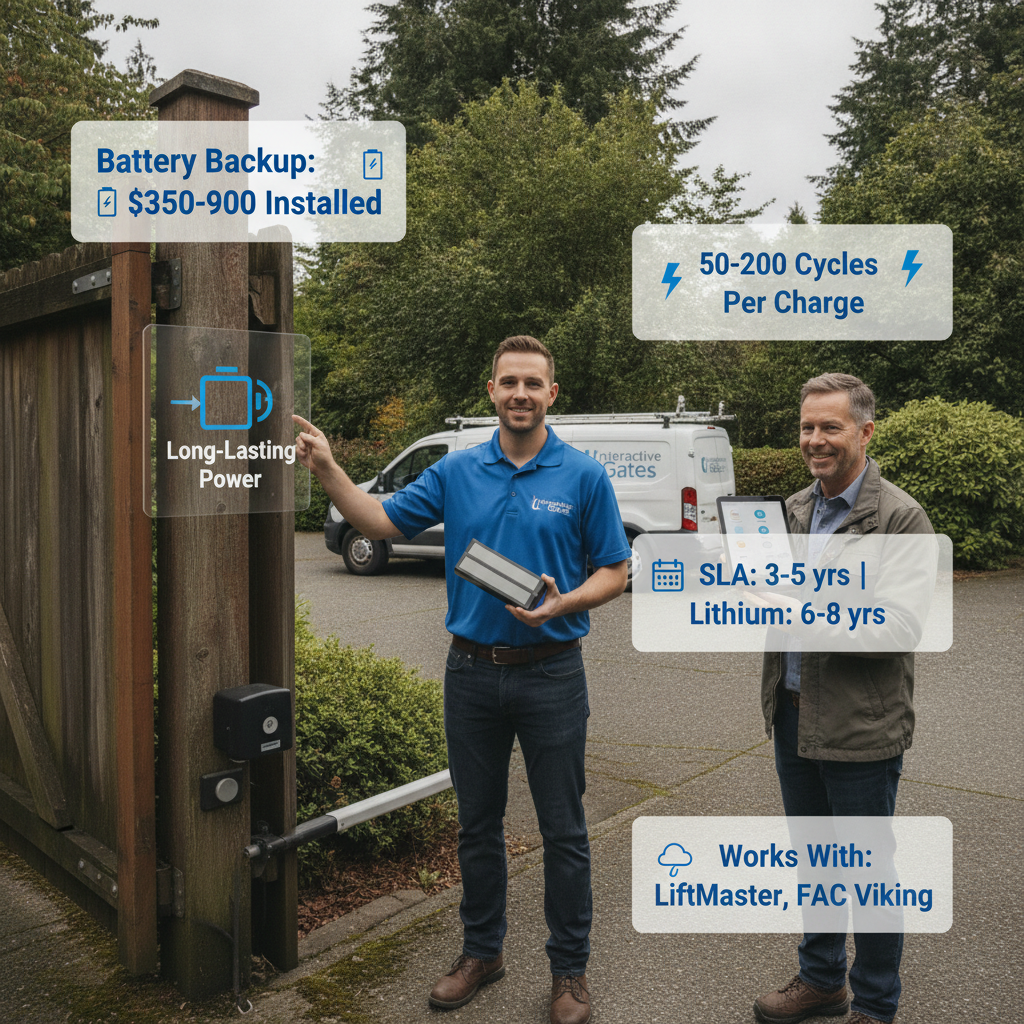
- A quality battery backup unit costs $350–$900 installed for most residential swing or slide gate operators, including labor.
- Most backup batteries deliver 50–200 gate cycles per charge, enough to last 2–5 days of normal household use after a power cut.
- LiftMaster, FAAC, and Viking all sell operator-matched backup modules — third-party units are cheaper but can void manufacturer warranties.
- Sealed lead-acid (SLA) batteries last 3–5 years; lithium-ion upgrades last 6–8 years and perform better in Seattle's cold, damp winters.
- Solar-hybrid backup combos start around $1,200–$1,800 installed, viable for properties with south-facing gate posts and minimal shading.
- Battery backup is required by some Snohomish and King County HOA bylaws for gates serving more than four units — check your CC&Rs before installation.
- Annual backup battery testing takes about 15 minutes and should be part of every fall maintenance visit before the rainy season hits.
Why Are Seattle Homeowners Suddenly Asking About Gate Battery Backup?
If you've ever been stuck outside your own driveway during a windstorm on Mercer Island or watched your electric gate go completely dark after a tree hit a transformer in Kirkland, you already understand the problem. Seattle's weather — persistent rain, heavy wind events from October through March, and occasional ice storms in areas like Snohomish and Auburn — puts more stress on the power grid than most people realize. And when the grid goes down, so does your automatic gate. Unless you have a battery backup. This guide breaks down exactly what battery backup systems for electric gates cost in the Seattle area in 2026, which gate types and brands they work with, and whether the investment makes sense for your property.
How Does a Gate Battery Backup System Actually Work?
A battery backup unit sits between your gate operator and the main power supply. Under normal conditions it stays in a float-charge or trickle-charge state, staying ready without drawing meaningful current. The moment utility power drops, the unit switches over — usually in under 100 milliseconds — and the gate continues operating on stored DC power. From the outside, you won't notice the transition at all. Your remote still works, your keypad still works, and your access control system stays active as long as the battery has charge.
Most residential operators in Seattle run on 12V or 24V DC internally, so battery backup integration is relatively straightforward. Swing gate operators like the LiftMaster LA500 or FAAC 391 can accept purpose-built backup modules that mount directly in or beside the control panel housing. Slide gate operators like the Viking SL-1000 or LiftMaster CSW24V have similar provisions. Some higher-end commercial operators like the FAAC 640 use 24V architecture that makes battery integration even cleaner.
Pro Tip: Ask your installer whether the backup module is internal (mounted inside the operator housing) or external (a separate enclosure). Internal units are neater and less exposed to moisture — important in Seattle's wet climate — but external units are easier to service and replace.
How Many Gate Cycles Does a Backup Battery Deliver?
This is the number most homeowners care about most. Cycle count per charge depends on three variables: battery amp-hour (Ah) rating, the size and weight of your gate, and ambient temperature. Here's a realistic breakdown for Seattle-area properties in 2026:
- Light single swing gate (under 300 lbs, 10–12 ft): 150–200 cycles per charge on a 7–9 Ah SLA battery. At 10 cycles per day for a family, that's 15–20 days of operation.
- Heavy dual swing gate (600–900 lbs total): 60–100 cycles per charge on a 12–18 Ah SLA battery. About 6–10 days at normal use.
- Slide gate (up to 20 ft, 800 lbs): 50–80 cycles per charge. Slide gates draw more current during acceleration, which reduces backup duration.
- Lithium-ion upgrade (same physical size): Adds roughly 30–40% more cycles compared to SLA and holds capacity better in temperatures below 40°F — common in Snohomish, Auburn, and Tacoma during January and February.
Seattle outages caused by windstorms typically last 2–8 hours. Even the lowest-end backup battery handles that comfortably. The edge cases are multi-day outages after severe ice storms — those are rare in the city core but more common in elevated neighborhoods above Bellevue and in rural Snohomish County.
What Does Gate Battery Backup Cost in Seattle in 2026?
Pricing varies by operator brand, battery chemistry, and whether the backup module was engineered for your specific operator or is a universal aftermarket unit.
- OEM backup module (LiftMaster, FAAC, Viking — matched to your operator): $350–$600 installed, including labor. These are plug-and-play and preserve your warranty.
- Universal aftermarket SLA backup kit: $220–$380 installed. Works with most 12V/24V operators but may void warranty and requires the installer to verify compatibility.
- Lithium-ion upgrade module: $500–$900 installed. Higher upfront cost, but 6–8 year battery life versus 3–5 years for SLA means lower long-term cost.
- Solar-hybrid system (solar panel + battery + charge controller): $1,200–$1,800 installed for a residential gate. Reduces grid dependence year-round, not just during outages. Most viable on south or southwest-facing gate posts with minimal tree shading — a real consideration in wooded neighborhoods like Woodinville or Gig Harbor.
- Battery-only replacement (existing backup hardware in place): $120–$220 parts and labor. Plan for this every 3–5 years with SLA, 6–8 years with lithium.
Labor in the Seattle metro typically runs $85–$130 per hour. Most battery backup installations take 1–2 hours for a straightforward retrofit on an existing operator, so labor adds $85–$260 to the total.
Which Gate Brands and Operators Support Battery Backup in Seattle?
Not every operator on the market offers a clean, manufacturer-supported backup solution. Here's how the major brands used across King, Pierce, and Snohomish counties stack up in 2026:
- LiftMaster: The LA400 and LA500 swing gate operators have OEM battery backup kits (model BATTERY-LA) that mount inside the control box. Clean, weatherproof, and widely available through local distributors. The CSW24V slide gate operator also has a compatible backup option.
- FAAC: The 391, 400, and 640 series all support FAAC's dedicated battery backup modules (E145 and E124 kits). FAAC's 24V architecture is particularly efficient under backup power, giving you more cycles per charge than equivalent 12V systems.
- Viking Access Systems: The SL-1000 and SL-2000 slide gate operators, plus the SW-2000 swing operator, accept Viking-branded battery backup kits. Viking is widely installed in commercial and HOA properties around Bellevue, Tacoma, and Everett.
- Apollo: The 1500 and 1550 swing gate series have optional battery backup provisions, though Apollo's backup modules are less commonly stocked locally and may require a longer lead time.
- Elite (Elite Gates): Older Elite operators (pre-2020) often require a universal third-party backup kit since Elite's own accessories have been discontinued or consolidated. Confirm compatibility with your installer.
Pro Tip: If your operator is more than 10 years old and doesn't have a clean backup option, this is a good time to evaluate whether a full operator replacement makes more financial sense than retrofitting aging hardware. A new operator with built-in backup provisions often runs only $800–$1,400 more than a retrofit on an aging unit that may need other repairs soon anyway.
Does Seattle's Climate Affect Battery Backup Performance?
Yes — and in ways that matter more here than in a drier climate like Southern California. Three climate factors are relevant for Seattle-area gate owners:
- Cold temperatures: SLA batteries lose 20–30% of their rated capacity at 32°F and below. In Snohomish County, Tacoma, and Auburn, sub-freezing nights during January and February are common. Lithium-ion chemistry handles cold far better, retaining 90–95% capacity at 32°F. If your gate is in an exposed, unheated location, lithium is worth the premium.
- Humidity and moisture: Battery terminals corrode faster in Seattle's high-humidity environment. Enclosures should be fully sealed and ideally include a corrosion-inhibiting terminal spray. Request this as part of your installation service.
- Power outage frequency: More outage events means more discharge-recharge cycles, which ages the battery faster. Seattle-area properties in tree-dense neighborhoods (Woodinville, Lake Forest Park, parts of Bellevue) that see 6–8 outages per year may need battery replacement on the shorter end of the 3–5 year window.
Are There Any Seattle-Area Code or HOA Requirements for Gate Battery Backup?
This is an area where requirements are evolving fast. As of 2026, here's what property owners should know:
- UL 325 compliance: All automatic gate operators sold in the U.S. must meet UL 325 safety standards. Battery backup itself is not mandated by UL 325, but any backup system must not interfere with the operator's entrapment protection features (safety loops, photoeyes, reversing edges). A UL 325-compliant backup module from the operator's own brand is the safest choice.
- HOA requirements: Some King County and Snohomish County HOAs — particularly larger gated communities in Bellevue, Sammamish, and Lynnwood — now specify battery backup as a requirement in their CC&Rs, especially for gates serving more than four residential units. Review your HOA documents or ask your board before installation.
- No Seattle city code mandating backup: As of early 2026, neither the City of Seattle nor Pierce County mandates battery backup for residential gates. Commercial properties with life-safety egress requirements are a different story — those gates typically need backup power under fire code.
Is a Solar-Powered Gate Backup Worth It in Seattle?
This question comes up constantly, especially for properties in Gig Harbor, Snohomish, and rural Auburn where utility power is less reliable and sun exposure — when it exists — is meaningful. The honest answer: solar backup is viable in Seattle, but only for specific site conditions.
A 20W–40W solar panel paired with a 20–40 Ah lithium battery can comfortably power a standard residential swing or slide gate year-round in Seattle if the panel has a clear south or southwest exposure with no significant tree shading between 10 a.m. and 2 p.m. The challenge is that Seattle's overcast winters (November through February average only 2–3 peak sun hours per day) mean you need a larger panel array or larger battery storage to ensure reliability. A 40W panel that performs great in August may leave your battery partially depleted after a week of December cloud cover with heavy use.
For most Seattle residential properties, a hybrid approach — utility power primary, battery backup secondary, with a small solar trickle panel to keep the backup battery topped up — is the most reliable configuration. This adds $300–$500 to a standard battery backup install but dramatically extends battery life and reduces the chance of a depleted backup during a prolonged outage. See real examples of how these systems look installed in the Interactive Gates portfolio.
In One Minute: Seattle Gate Battery Backup at a Glance
Seattle's combination of frequent windstorm outages, cold winters, and high humidity makes battery backup one of the most practical upgrades for any automatic gate in King, Pierce, or Snohomish County. OEM backup modules from LiftMaster, FAAC, or Viking run $350–$600 installed and deliver 50–200 cycles per charge depending on gate weight. Lithium-ion batteries outperform SLA in cold weather and last 6–8 years versus 3–5 years for standard lead-acid. Solar-hybrid systems are viable for exposed south-facing sites and cost $1,200–$1,800 installed. Some HOAs in Bellevue, Sammamish, and Lynnwood now require backup power in their CC&Rs. Annual testing before the rainy season is the single most important maintenance step. If your operator is over 10 years old, a full replacement with integrated backup may be smarter than a retrofit.
Frequently Asked Questions: Gate Battery Backup in Seattle
Will my gate remote and keypad still work when the battery backup is running?
Yes. A properly installed battery backup system keeps the entire gate operator — including the control board, radio receiver, and keypad interface — running on DC power. Your remotes, keypads, and app-based access control systems continue working exactly as they do on utility power. The only exception is video intercom systems with high-power Wi-Fi modules, which may need a separate UPS or backup provision to stay online.
How do I know when my backup battery needs to be replaced?
Most modern gate operators display a low-battery warning on the control panel or send an alert through the connected app. You can also test manually: disconnect utility power, then run the gate through 20 cycles and measure resting voltage. An SLA battery reading below 12.0V at rest (for a 12V system) after moderate cycling is approaching end of life. Plan for SLA replacement every 3–5 years in Seattle's climate, lithium every 6–8 years.
Can I add battery backup to any existing gate operator in Seattle?
Most operators manufactured after 2015 have provisions for battery backup, either through an OEM kit or a compatible universal module. Older operators — particularly those from the early 2000s — may not have a clean integration path. In those cases, your installer will evaluate whether the control board accepts a bypass backup circuit or whether a full operator replacement is the better path. Operators from LiftMaster, FAAC, Viking, and Apollo have the widest backup compatibility in the Seattle market.
Does battery backup affect my gate's safety sensors?
It should not, as long as the backup system is UL 325 compliant and properly installed. A correctly configured backup preserves all entrapment protection features: photoeyes, safety loops, and reversing edges continue functioning on backup power. An improperly installed third-party backup that bypasses the control board's safety logic is both dangerous and a code violation — always use a licensed installer and request OEM or UL-listed components.
What Seattle neighborhoods most need gate battery backup?
Properties in tree-dense or elevated areas experience the most frequent and longest outages. Snohomish County neighborhoods (Snohomish city, Monroe, Woodinville), the Issaquah highlands, parts of Bellevue and Sammamish above the plateau, Gig Harbor's rural residential areas, and Auburn's eastern foothills all see above-average outage frequency compared to central Seattle. If you're in one of these areas, backup is essentially mandatory if you want reliable gate access year-round. Residents in Snohomish, Gig Harbor, Bellevue, and Auburn benefit most from backup power given regional grid vulnerability.
Is battery backup worth it for a gate on a Seattle city property?
Even in urban Seattle — Magnolia, Queen Anne, Capitol Hill, Ballard — windstorm outages happen. The cost of being locked out of or into your own driveway once is enough frustration to justify a $350–$600 backup installation. For rental properties or ADUs where a tenant relies on the gate, backup power is particularly important. It's a one-time cost that pays for itself the first time you sail through a power cut without noticing.
Ready to Add Battery Backup to Your Seattle Gate?
If you want a recommendation matched to your specific operator, gate weight, and neighborhood, the best next step is a quick site assessment. Our team installs and services gates across King, Pierce, and Snohomish counties — from Seattle to Tacoma to Lynnwood. You can also browse residential gate options to see how backup-ready operators compare, or get in touch to schedule a no-pressure evaluation. Knowing your gate will work the next time the lights go out is a small investment with a very obvious payoff.


