- Camera-plus-gate packages in Los Angeles run $1,200–$6,500 installed, depending on camera count, resolution, and gate type.
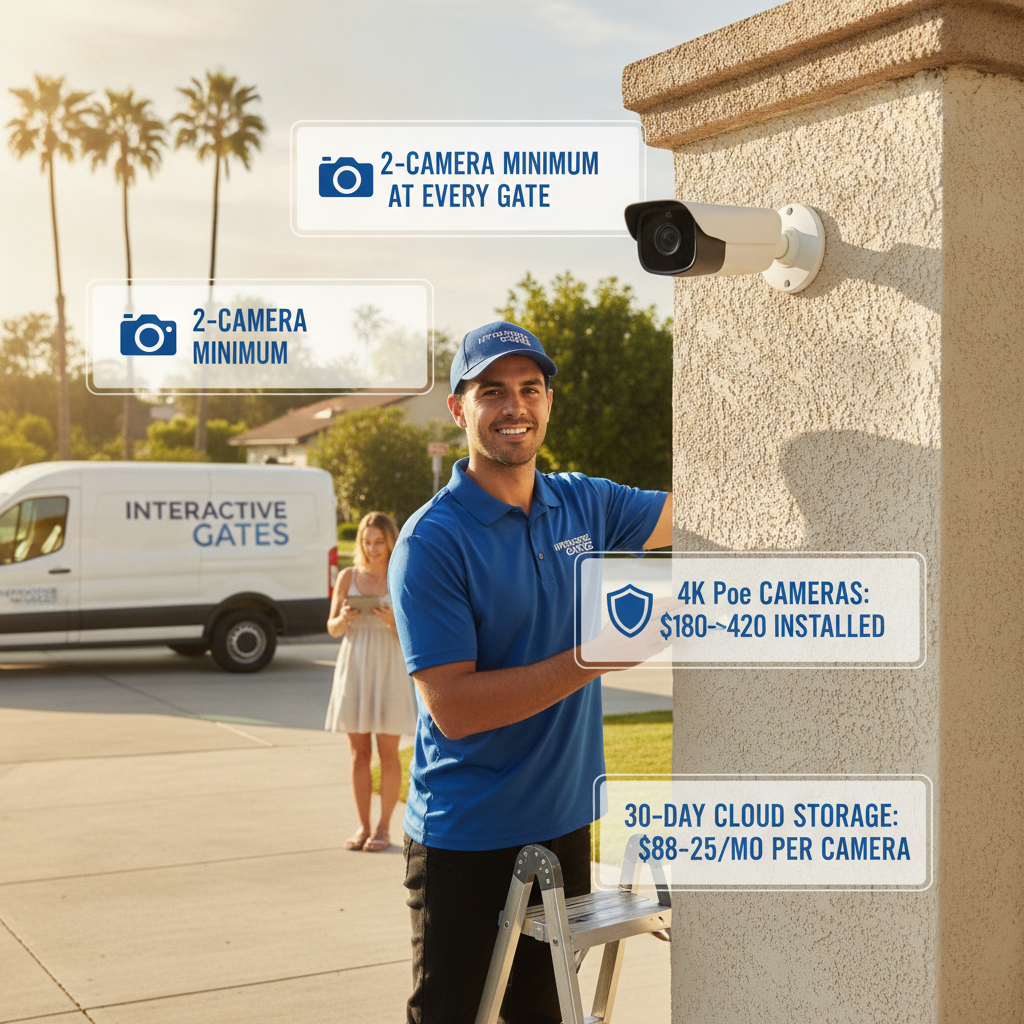
- Most LA driveways need at least two cameras: one facing the street and one covering the entry keypad or intercom panel.
- 4K PoE cameras cost $180–$420 per unit installed; LTE-cellular cameras add $30–$60/month in data fees.
- Rolling Hills and Bel Air properties often require three to five cameras due to long driveways, tight HOA rules, and landscaping blind spots.
- Local sun angle and glare are the top camera-killer in SoCal — IR night-vision cameras with WDR (wide dynamic range) are non-negotiable at west- or south-facing gates.
- LAFD and many HOAs now require cameras at controlled-access entry points in gated communities of 20+ units.
- Cloud NVR storage plans cost $8–$25/month per camera; a local NVR box with a 4-TB drive costs $280–$550 one-time.
- Camera conduit runs added during gate installation save $300–$900 versus retrofitting later.
What Security Cameras Should I Add to My Electric Gate in Los Angeles?
You just had an automatic gate installed — or you're shopping for one — and the question you can't shake is: what cameras do I actually need at the gate, where do I put them, and what is this going to cost me? Maybe you've also been Googling best camera for driveway gate Los Angeles or gate camera that works in California sun. You're not alone. In 2026, camera integration is one of the top add-on requests for LA-area gate projects, from Laguna Beach coastal estates to Orange County tract communities to Rolling Hills equestrian properties. This guide breaks down the whole picture — technology, placement, brands, real 2026 prices, and local factors that matter in Southern California.
Why Does a Gate Camera Setup in Los Angeles Have Unique Challenges?
Los Angeles isn't a one-size-fits-all camera market. Several local conditions separate an LA installation from, say, a Pacific Northwest one.
Sun angle and glare: South- and west-facing gate columns get blasted with direct afternoon sun in a way that overexposes standard cameras and washes out license plates entirely. You need cameras with Wide Dynamic Range (WDR) of at least 120 dB — anything less will give you a white blob instead of a readable plate at 3 p.m. in July.
Heat stress on electronics: Average summer highs in the San Fernando Valley and Inland Empire regularly hit 100–108°F. Camera housings rated only to 122°F (50°C) will begin to degrade within two to three summers. Look for cameras rated to at least 140°F (60°C) operating temperature.
Terrain and long driveways: Properties in Rolling Hills, the Hollywood Hills, and coastal Laguna Beach often have 80- to 300-foot driveways with curves, dense landscaping, and elevation changes. A single gate-column camera won't cover everything — a secondary mid-driveway camera or a wide-angle fisheye at the top of a column is often necessary.
HOA and city regulations: Many Los Angeles gated communities — especially those governed by HOAs — have covenants restricting camera housing color, mounting height, and whether cameras can face neighboring properties. Always check CC&Rs before mounting. HOA gate projects in particular require a site-specific camera plan submitted for board approval.
How Many Cameras Does a Driveway Gate in LA Actually Need?
The minimum functional setup for a residential driveway gate is two cameras:
- Camera 1 — Street-facing: Mounted on the gate column or fence post, aimed at the street and approaching vehicles. This camera captures license plates, faces, and delivery vehicles before they reach the gate. Optimal mounting height: 7–9 feet. Optimal angle: 15–25 degrees downward tilt.
- Camera 2 — Entry-panel facing: Aimed at your keypad, intercom, or card reader. This captures the face of whoever is at the gate even if the intercom camera fails or is blocked. Mounting height: 8–10 feet, angled toward where a person's face would be at the panel.
For larger or higher-security properties, a three- to five-camera gate zone is common:
- Camera 3 — Rear/exit facing: Covers vehicles leaving and captures plates on the exit side. Critical for HOAs tracking unauthorized vehicle tailgating.
- Camera 4 — Driveway mid-point: On long driveways with blind corners (common in Rolling Hills and Bel Air), a pole-mounted or fence-line camera 50–150 feet from the gate captures any activity between the street gate and the main structure.
- Camera 5 — Wide-angle overhead: A fisheye or varifocal camera mounted high on a column giving a full overhead view of the entry apron — popular with commercial and HOA entry plazas in Orange County communities.
Pro Tip: If your gate installer is running conduit for the gate operator wiring, ask them to run a second conduit sleeve specifically for camera cabling at the same time. The add-on cost is $80–$180 at rough-in versus $300–$900 to cut, sleeve, and patch later.
What Camera Types Work Best at an Electric Gate in Southern California?
Not all camera technologies perform equally at a gate entry in an LA climate. Here is a breakdown of the main options in 2026:
Wired PoE (Power over Ethernet) Cameras — Best Overall Choice: PoE cameras run a single Cat6 cable from the camera to a network switch, delivering both power and data over one line. They are the most reliable, lowest-latency, and highest-resolution option. In 2026, 4K (8MP) PoE cameras from brands like Hikvision ColorVu, Dahua IPC-HDW, Axis M32, and Reolink RLC-810A are the workhorse choice for LA residential and HOA gate projects. Installed cost per camera (including conduit, cable pull, and configuration): $180–$420.
Wireless Wi-Fi Cameras — Situational Use Only: Wi-Fi cameras like the Arlo Pro 5S and Ring Spotlight Cam Pro are convenient but have meaningful drawbacks at a gate: concrete and stucco columns absorb Wi-Fi signals, latency can delay alerts by 4–12 seconds, and power still needs to be run to the mount location unless battery-powered. Battery cameras need recharging every 3–8 weeks depending on traffic. Installed cost: $140–$360 per camera, but ongoing inconvenience is higher.
LTE Cellular Cameras — Remote Properties Only: For gated rural properties in the canyons above Malibu or the outskirts of San Clemente where trenching ethernet is impractical, LTE cameras like the Reolink Go PT Ultra or Cellular Trail Guard Pro run on a SIM card. They require a data plan at $30–$60/month and have lower frame rates under poor signal. Best used as a secondary camera when no wired option exists.
Integrated Intercom Cameras — Not a Substitute: Systems like DoorBird D2101V, BAS-IP, and 2N Helios have built-in cameras that handle visitor video at the intercom panel. They are excellent for two-way communication and remote unlock but are not substitutes for a dedicated security camera — their field of view is intentionally narrow (60–80 degrees), and they don't capture license plates or the full approach lane.
What Does a Gate Camera System Cost in Los Angeles in 2026?
Here are realistic all-in installed price ranges for the most common configurations in the LA market:
- Basic 2-camera wired PoE setup (4K, NVR box, 1-TB storage): $1,200–$2,100
- 3-camera system with license-plate recognition (LPR) camera, NVR, and cloud backup: $2,400–$3,800
- 4–5 camera HOA entry system with 4K cameras, managed NVR, remote access, and 30-day retention: $3,500–$6,500
- Add-on LPR (license-plate recognition) camera only, retrofitted to existing gate: $600–$1,400 installed
- Cloud NVR storage subscription (per camera): $8–$25/month depending on resolution and retention period
- Local NVR box upgrade from 1-TB to 4-TB drive: $80–$160 parts; $120–$200 installed
Labor rates for camera installation in the Los Angeles metro run $95–$160/hour in 2026, with the Canyon, Westside, and South Bay areas trending toward the higher end. Laguna Beach and coastal Orange County sites often carry a $150–$350 site-access surcharge for narrow canyon roads that require smaller work vehicles.
Where Exactly Should Cameras Be Mounted on a Gate Column?
Mounting position is frequently done wrong on DIY camera installs. Here are the placement rules that LA installers follow in 2026:
- License-plate cameras: Mount 6–9 feet high, aimed down at 10–20 degrees, with the camera axis parallel to the direction of vehicle travel (not angled across the lane). Distance from camera to plate should be 10–25 feet for best readability on a 4MP or higher camera. Use an IR or color night-vision camera rated for the full 15-foot detection range at night.
- Face/visitor cameras: Mount 7–9 feet high at the intercom column, angled toward the driver's window position (roughly 4.5 feet above ground for most vehicles). Avoid back-lighting: if the sun rises or sets behind visitors in the morning or evening, add a camera shade hood ($15–$40) or choose a WDR model.
- Wide-angle overview cameras: Mount 10–14 feet high on the tall gate pillar or on a dedicated 10-foot pole, aimed down and outward to capture the full entry apron. These work well as fisheye or varifocal models with a 2.8–4mm lens.
Pro Tip: In HOA-governed communities across Orange County and West LA, camera housings must often match the wall or column finish color — most manufacturers offer cameras in white, black, and grey, but custom paint on housings voids IP weatherproofing ratings. Opt for a factory-colored model that matches your pillar rather than painting over the housing.
What Brands Do LA Gate Installers Recommend in 2026?
Based on what professional gate and security integrators are spec'ing across the LA market this year:
- Hikvision ColorVu G2 series: Top pick for color night vision in SoCal's low-light coastal fog. The AcuSense motion detection dramatically reduces false alarms from palm trees and traffic.
- Dahua IPC-HFW series: Strong WDR performance for sun-blasted south-facing gates. Competitive on price at $95–$180 per unit before installation.
- Axis M3106-L Mk II: Premium pick for HOA and commercial entry plazas where video quality and cybersecurity certification matter. NDAA-compliant.
- Reolink RLC-823A: Budget-friendly PoE 4K option for residential single-gate setups, with solid app integration and no mandatory subscription.
- DoorBird D2101V / D2102FV: Best integrated intercom-camera combo for residential electric gate projects where a single panel needs to handle both visitor video and gate release.
In One Minute: Gate Camera Essentials for LA Properties
Here is the short version: every electric gate in Los Angeles needs at least two cameras — one street-facing for license plates and one at the access panel for faces. Budget $1,200–$2,100 for a wired 2-camera setup and up to $6,500 for a full HOA entry system. Use only cameras rated for 140°F operating temperature, with 120 dB or higher WDR to handle the brutal SoCal afternoon sun. Run camera conduit at the same time as gate wiring to save $300–$900. For HOA and commercial sites, check CC&Rs and local ordinances before finalizing the camera plan. The right camera system turns your gate from a barrier into a full situational-awareness tool — you'll know who is at the gate, what vehicle they arrived in, and when they left, all from your phone. See real gate and camera combinations in our project portfolio and read what LA-area customers say in our reviews.
Frequently Asked Questions: Gate Security Cameras in Los Angeles
Do I need a permit to install cameras at my driveway gate in Los Angeles?
In most unincorporated LA County and City of LA jurisdictions, security cameras on private property do not require a building permit as long as they are not mounted on a new structure requiring a permit. However, if cameras are part of a new gate pillar or column construction, those structural elements may need a permit. HOAs may also require an architectural review approval before installation. Always confirm with your local building department and HOA board before work begins.
Can my gate intercom camera replace a dedicated security camera?
No — not reliably. Intercom cameras like those on DoorBird, 2N, or Ring Video Doorbell Pro systems have narrow fields of view (60–80 degrees) optimized for visitor faces, not for capturing license plates or wide driveway coverage. They also typically record only when the button is pressed, not continuously. A dedicated PoE security camera running 24/7 with motion-triggered recording is a separate, necessary layer of security alongside your intercom panel.
How long do gate cameras last in the Southern California heat?
A quality PoE camera from Hikvision, Dahua, or Axis — rated for 140°F (60°C) operating temperature — typically lasts 7–12 years in an LA climate. Budget cameras rated only to 122°F (50°C) often begin showing IR LED degradation, housing warping, or lens fogging within 2–4 summers in the San Fernando Valley or Inland Empire. Investing in a heat-rated camera from the start saves a mid-lifecycle replacement.
What is the best way to store gate camera footage in Los Angeles?
A hybrid approach is recommended in 2026: a local NVR box with a 4-TB hard drive stores 30 days of continuous 4K footage from four cameras (at moderate compression), giving you fast local access with no monthly fees. A simultaneous cloud backup subscription at $8–$25 per camera per month protects footage if the NVR is stolen or damaged. For HOA entry systems, 60-day retention is a common board requirement, which typically means upgrading to an 8-TB NVR drive at $160–$280.
Can I add cameras to an existing electric gate without rewiring everything?
Yes, in most cases. If conduit already runs to the gate column, an installer can often pull new Cat6 or coax through the existing sleeve. If no conduit was installed, surface-mount conduit or micro-trenching along the driveway edge can add camera cabling at a retrofit cost of $300–$900 depending on driveway length and surface material. Battery-powered or LTE cellular cameras avoid this entirely but have the trade-offs described above.
What cameras do HOAs in gated Los Angeles communities typically require?
Requirements vary by HOA, but common specs in Orange County and West LA communities in 2026 include: minimum 2MP (1080p) resolution, 30-day video retention, cameras at both the entry and exit lanes, a license-plate recognition (LPR) capable camera on at least the entry lane, and remote access for security staff or property management. Some communities governed under California Civil Code Section 1798 also require posted notice that video surveillance is in use at the entry. Consult your HOA's CC&Rs and work with an installer familiar with HOA gate and access systems.
Ready to Add Cameras to Your Gate?
Whether you are adding cameras to a brand-new gate project or retrofitting an existing entry, the right setup makes a real difference in what you can see, record, and prove. Use our gate designer tool to start planning your gate and access system, browse completed projects in our portfolio, or reach out to our team for a no-pressure site assessment. We serve homeowners, property managers, and HOA boards throughout the Los Angeles area — from Laguna Beach to Rolling Hills to San Clemente — and we bring camera integration expertise to every gate project we touch.