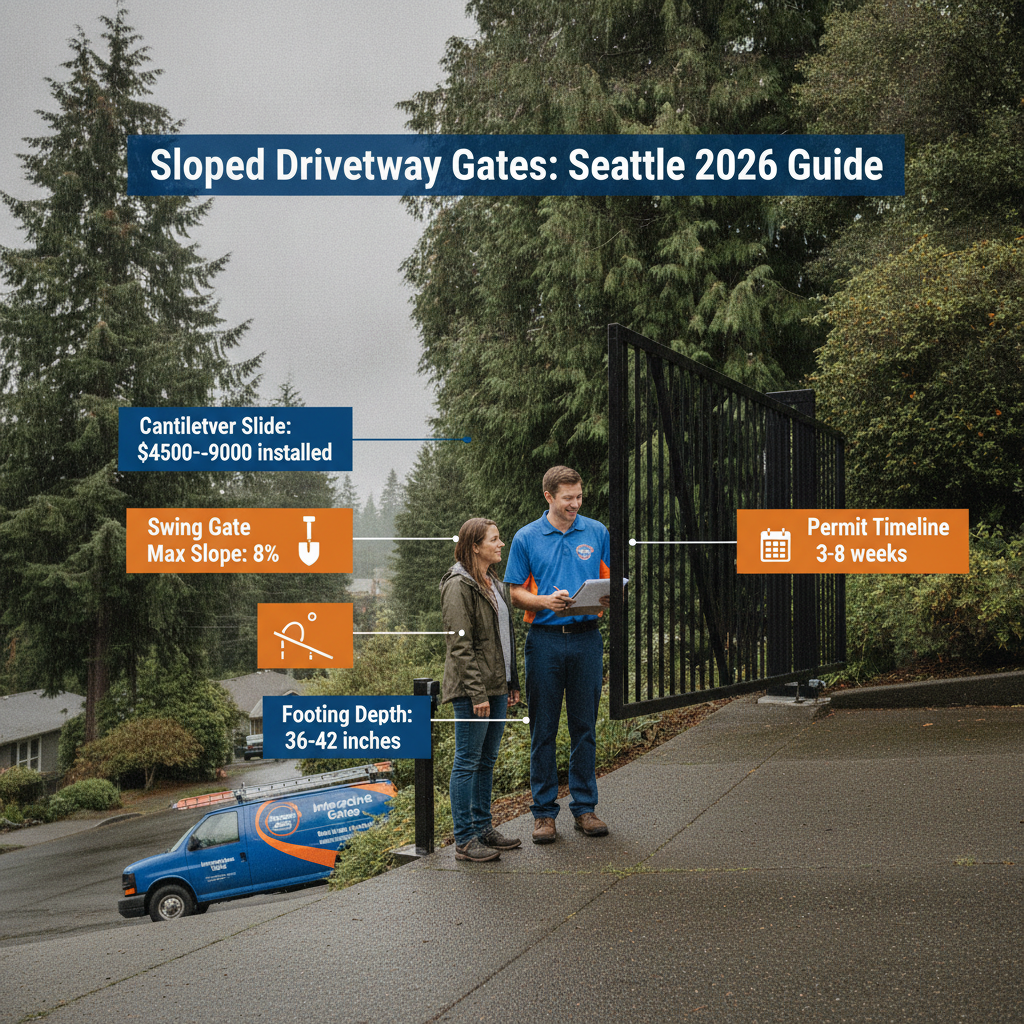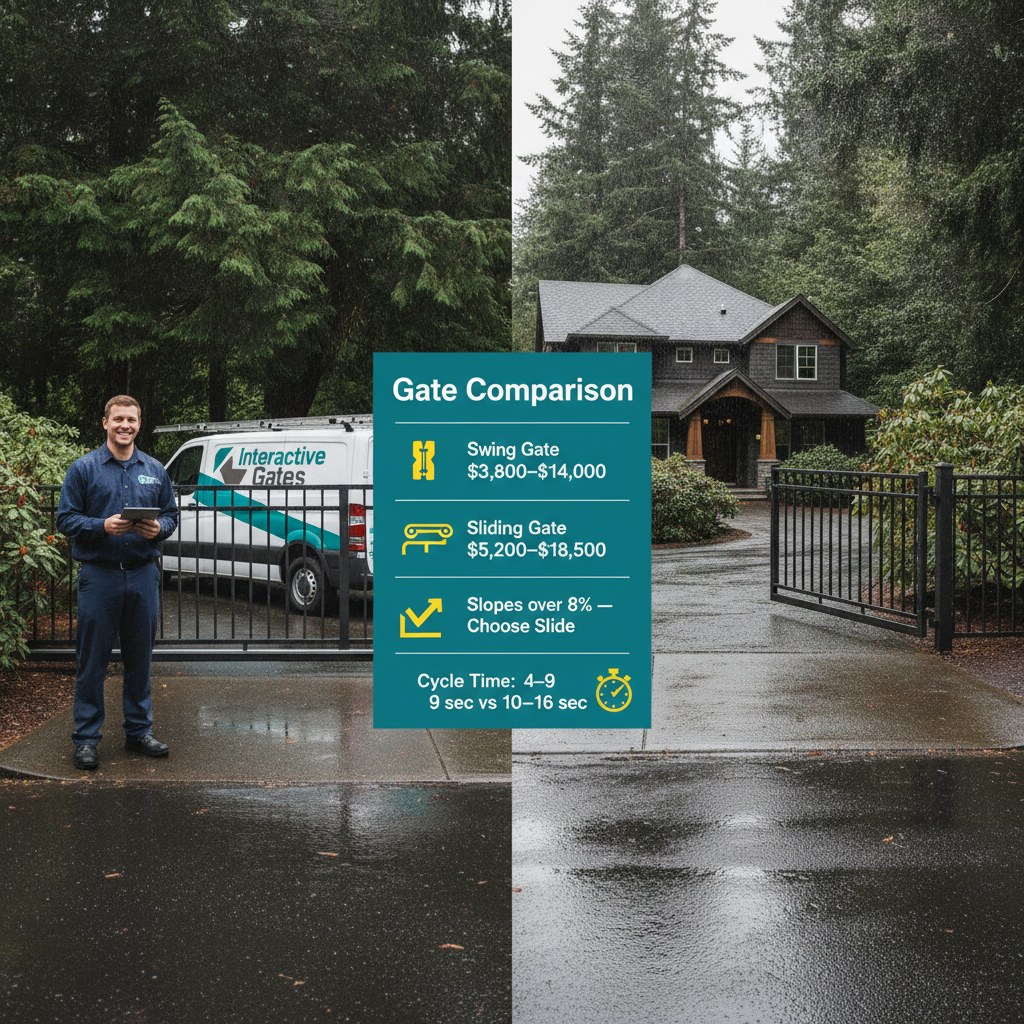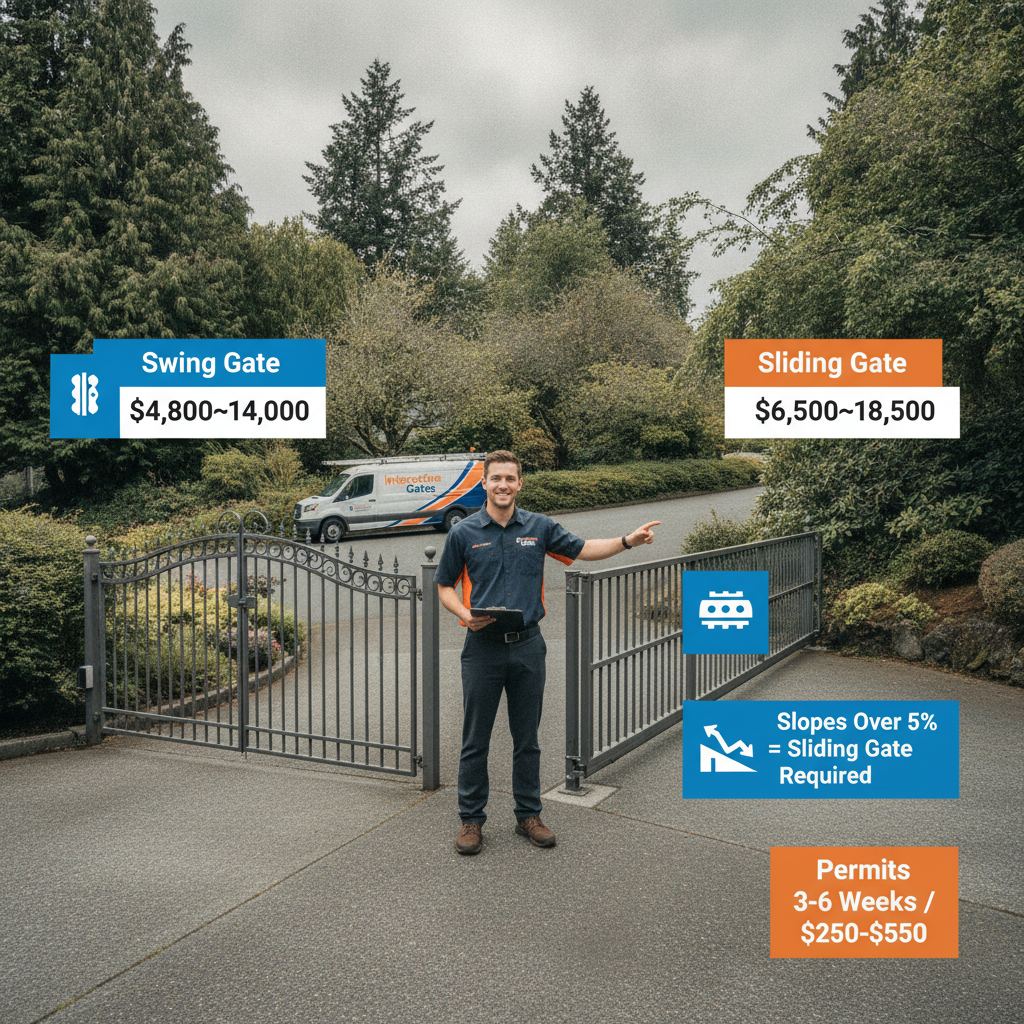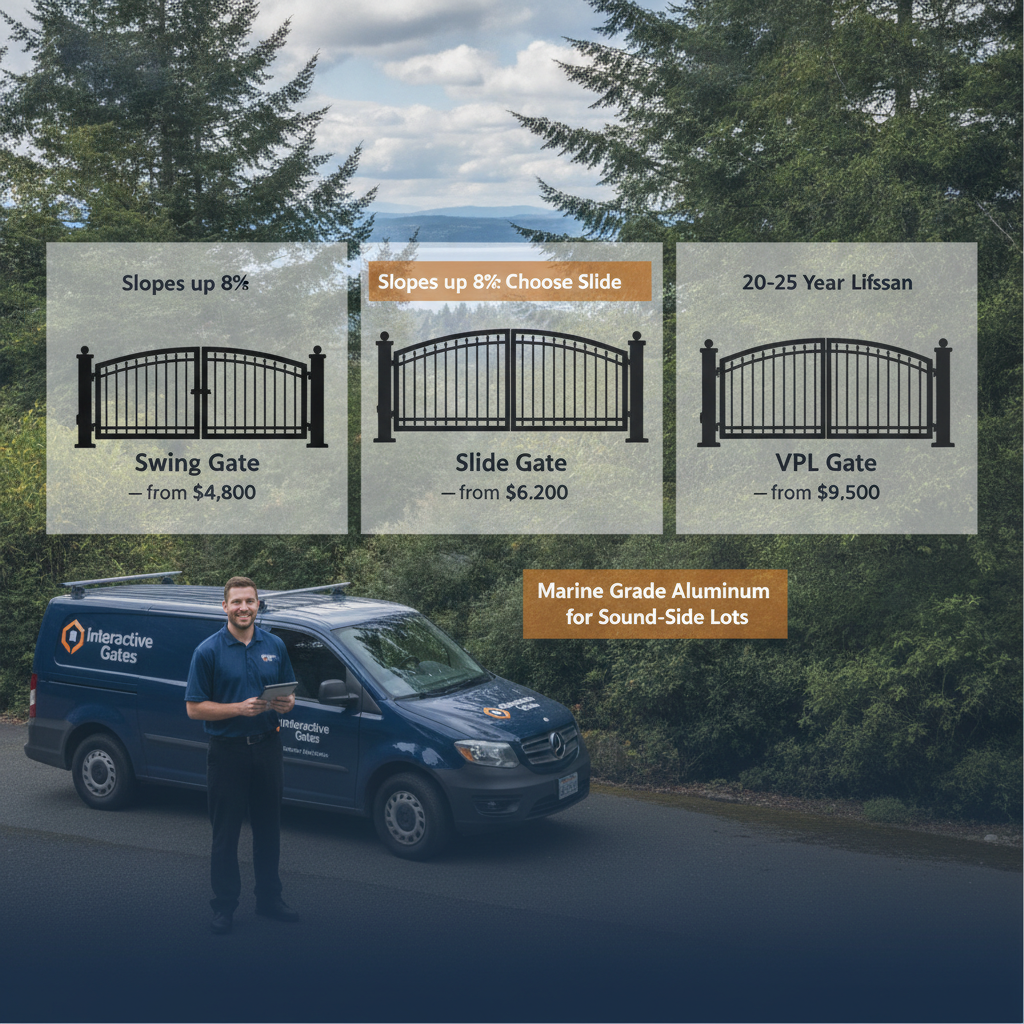
- Swing gates start at $4,800 installed in Seattle and suit flat lots with 10+ ft of clearance behind the gate leaf.
- Slide gates handle Seattle's slope problem best — they need zero swing clearance and work on grades up to 8% with a proper track kit.
- Vertical pivot lift (VPL) gates are the fastest-growing style in tight lots like Capitol Hill and Ballard, starting around $9,500 installed in 2026.
- Salt air near Puget Sound accelerates rust — powder-coated aluminum or hot-dip galvanized steel adds roughly $600–$1,200 to material costs but doubles corrosion lifespan.
- Most Seattle residential gates cycle 20–50 times per day; choose a LiftMaster LA500 or FAAC 844 motor rated for at least 15 cycles/hour for busy households.
- King County grading permits kick in when any gate structure is tied to a retaining wall or hillside excavation — budget 3–6 weeks for approval.
- HOAs in Bellevue and Mercer Island frequently restrict gate height to 6 ft and require black or bronze powder coat — always check CC&Rs before ordering.
- Wood-framed automatic gates last only 8–12 years in Seattle's wet climate vs. 20–25 years for steel or aluminum equivalents.
What Kind of Automatic Gate Works Best for a Seattle Driveway?
If you've typed 'best automatic gate for sloped driveway Seattle' or 'swing gate vs slide gate Seattle' into Google, you already know the answer is never simple. Seattle's micro-terrain — a city built on seven hills, ringed by saltwater, and soaked by 38 inches of rain annually — makes gate selection genuinely different here than in a flat Sun Belt city. The wrong gate style on a Queen Anne hillside or a Shoreline waterfront lot isn't just inconvenient; it's a safety hazard and an expensive mistake. This guide walks you through every major style with real 2026 pricing, neighborhood-specific advice, and the motor specs that actually hold up in the Pacific Northwest.
What Are the Main Automatic Gate Styles Available in Seattle in 2026?
There are four practical options for residential and light commercial driveways in the Seattle metro:
- Single or dual swing gates — the classic hinged style, swinging inward or outward on two posts.
- Cantilever slide gates — roll sideways on a ground track or hang on a cantilevered rail with no track in the driveway opening.
- Vertical pivot lift (VPL) gates — the panel tilts upward like a drawbridge rather than swinging or sliding.
- Overhead vertical lift gates — industrial-grade panels that rise straight up; rare in residential settings but appearing more in Seattle's ADU-heavy neighborhoods.
Each style has a specific terrain profile where it wins. The sections below match style to lot type, slope, and neighborhood context the way a local installer actually thinks about it.
When Does a Swing Gate Make Sense for a Seattle Home?
Swing gates are the most visually elegant option and the lowest-cost entry point — a single-leaf powder-coated steel swing gate with a LiftMaster LA500 operator runs approximately $4,800–$7,200 installed in 2026, depending on gate width (10–16 ft single leaf) and finish. Dual-leaf setups for wider openings (18–24 ft) step up to $8,500–$13,000 installed.
The critical constraint is clearance. A swing gate needs flat, open space behind it equal to the full leaf length. That rules out most sloped lots in neighborhoods like Magnolia, West Seattle, and the hilly sections of Kirkland. It also means you can't park a car right behind the gate while it's cycling — a real daily annoyance in tight urban lots.
Swing gates shine in:
- Eastside suburbs like Bellevue and Sammamish — newer subdivisions with flat pads, wide driveways, and HOA rules that favor traditional aesthetics.
- Gig Harbor waterfront properties — flat bluff-top lots with long, straight driveways where a wrought-iron swing gate photographs beautifully.
- Snohomish and Auburn acreage — rural properties with room to spare and no grade concerns.
For swing gates near the Sound (Gig Harbor, Shoreline, Edmonds), always specify 316-grade stainless hardware or hot-dip galvanized hinges. Standard zinc hardware shows surface rust within 18 months in marine environments.
Pro Tip: In wet climates, program your swing gate operator for a 2-second 'dwell and reverse' delay after the leaf reaches full open. This prevents the operator from fighting waterlogged soil that causes slow leaf drift — a common service call in Seattle winters.
When Is a Slide Gate the Right Choice for Seattle Lots?
Slide gates are the workhorse of Seattle residential installs, and for good reason: they handle slope, they're faster to cycle, and they're mechanically simpler to maintain in cold, wet conditions. A rack-and-pinion slide gate with a FAAC 844 operator on a 16-ft opening runs $6,200–$9,800 installed in 2026. Cantilever slide gates (no ground track to ice over or collect debris) add roughly $1,200–$2,000 to that price but are strongly preferred in Seattle's climate.
Slide gates are the go-to for:
- Sloped driveways in Capitol Hill, First Hill, and Queen Anne — no swing arc means the gate doesn't fight the grade.
- Narrow urban lots in Ballard, Columbia City, and Georgetown — the gate slides parallel to the fence line rather than swinging into limited space.
- Commercial and light-industrial properties in SoDo and SEATAC corridor — high cycle counts (100+ per day) favor a FAAC 746 or Viking SL2000 operator rated for heavy-duty commercial use.
One Seattle-specific note: cantilever slide gates require a setback of 1.5× the gate width on the latch post side for the counterbalance beam. On a 16-ft opening you need 24 ft of fence line. Measure this before committing to the style — it catches homeowners off guard in shorter side-yard runs common in Lynnwood and Everett ramblers.
What Is a Vertical Pivot Lift Gate and Why Is It Growing in Seattle?
A vertical pivot lift (VPL) gate — sometimes called a tilt gate or pivot gate — addresses Seattle's single biggest residential gate problem: driveways that are both sloped AND short, with no room to swing and no room to slide. The gate panel is hinged at the base and tilts upward at roughly a 45-degree angle, requiring almost no lateral footprint.
In 2026, installed VPL gate systems for residential use run $9,500–$16,000 depending on panel size and finish. The higher price reflects the more complex pivot arm hardware and the heavier structural posts required (typically 6-in square HSS steel set 48 in deep). That's a premium over swing or slide — but for a 12-ft-wide driveway on a 12% slope in a Capitol Hill or Madrona row-house neighborhood, it's often the only code-compliant option that doesn't require grading work.
Apollo and FAAC both produce VPL operators in the residential-commercial overlap range. Expect motor replacement intervals of 8–12 years with annual lubrication and limit-switch checks. The pivot arm bearings are the first wear point — budget $280–$450 for bearing replacement at year 6–8.
Pro Tip: Seattle's steep-lot homes often have UL 325 entrapment concerns unique to VPL gates — the rising panel creates a wedge hazard at the hinge base. Specify a photoelectric beam sensor at ground level AND a pressure-sensing edge on the panel face. Some installers skip one; don't let them.
How Do Seattle's Climate and Terrain Affect Gate Material Choice?
Style and material are inseparable decisions in Seattle. Here's how climate drives the choice:
- Powder-coated aluminum: Best corrosion resistance, lightest weight (easier on motors), no rust. Ideal for waterfront lots in Gig Harbor or Shoreline. Cost premium over mild steel: $800–$1,500 per gate panel. Lifespan: 25–30 years with annual wash-down.
- Galvanized + powder-coated steel: The regional standard. Hot-dip galvanizing before powder coat gives a sacrificial zinc layer. Lifespan: 18–25 years. Common in Bellevue, Tacoma, and Lakewood installs.
- Mild steel (powder coat only): Acceptable in drier Eastside neighborhoods 10+ miles from the Sound. Budget option but expect light surface rust at weld points within 5–7 years without re-coating touch-ups.
- Cedar or Douglas fir wood gates with steel frame: Attractive, but wood infill absorbs moisture and swells, throwing off operator limits. Budget yearly limit-switch re-calibration. Lifespan: 8–12 years for wood infill, though the steel frame may last 20+ years with wood replacement.
- Vinyl/PVC panels: Low maintenance, but not recommended for motorized gates heavier than 400 lbs — structural creep under repeated cycling stresses the hinge side.
What Motor and Operator Should You Choose for Each Gate Style in Seattle?
The operator is the engine of the system. Mismatching motor to gate style is the most common installation error that leads to premature failure in Seattle's wet climate.
- Swing gates, residential (under 800 lbs, up to 16 ft leaf): LiftMaster LA500 ($620–$780 unit cost), FAAC 402 ($540–$720). Both are sealed for outdoor use and handle 15 cycles/hour comfortably.
- Swing gates, heavy residential or light commercial (800–1,400 lbs): LiftMaster LA500UL or FAAC 844 ($880–$1,150). The 844 has a built-in encoder for torque sensing — critical on sloped lots where leaf weight shifts with grade.
- Slide gates, residential (under 1,200 lbs, up to 20 ft): Viking SL2000 ($740–$920), LiftMaster SL595 ($810–$990). Both run on standard 120V residential circuits.
- Slide gates, heavy commercial (up to 4,000 lbs): FAAC 746 ER ($1,400–$1,800), Viking SL3000. Require 20-amp dedicated circuit minimum.
- VPL gates: Apollo 1600 series ($1,100–$1,450), FAAC J275H ($1,200–$1,550). Always pair with battery backup — Seattle's power outages average 1.3 hours per household per year, and a VPL gate frozen mid-cycle in the UP position during a windstorm is a real liability.
All operators should include a built-in heater or thermal management system or be housed in a NEMA 4X-rated enclosure for Seattle's sustained rain events. This is non-negotiable — a $90 enclosure upgrade prevents the most common warranty-voiding failure mode: moisture infiltration into the control board.
What Do Seattle-Area Neighborhoods Actually Choose?
Based on 2026 install trends across the Seattle metro, here's what's moving in each sub-market:
- Bellevue and Sammamish: Dual swing gates, black powder-coated aluminum, LiftMaster LA500. HOA-driven demand for uniform aesthetics. See our Bellevue gate services page for neighborhood-specific notes.
- Gig Harbor and Tacoma waterfront: Cantilever slide gates in galvanized steel with intercom + LPR camera access control. Marine-grade hardware throughout. Visit our Gig Harbor service area or Tacoma gate installation page.
- Capitol Hill, First Hill, Madrona (Seattle proper): Vertical pivot lift, compact footprint. Often paired with keypad + phone app access (LiftMaster myQ or Apollo Cloud). See the Seattle city page for urban lot examples.
- Snohomish and Everett acreage: Single swing gates, cedar infill on steel frame, budget-friendly. See Snohomish and Everett service areas.
- Lynnwood and Lakewood: Slide gates for commercial/multi-unit properties; swing gates for single-family. Visit Lynnwood or Lakewood for project photos.
In One Minute: Seattle Gate Style Decision Guide
Flat lot, wide driveway, HOA-regulated neighborhood? → Dual swing gate, aluminum, LiftMaster LA500. Budget $8,500–$13,000 installed.
Sloped lot, urban neighborhood, tight side yard? → Cantilever slide gate, galvanized steel, FAAC 844 or Viking SL2000. Budget $7,400–$11,000 installed.
Steep, short driveway with no swing or slide room? → Vertical pivot lift, steel frame, Apollo 1600 or FAAC J275H. Budget $9,500–$16,000 installed.
Waterfront or near Puget Sound? → Powder-coated aluminum + 316 stainless hardware on any style. Add $800–$1,500 to material line.
Want to visualize your gate before committing? Use the Interactive Gates gate designer tool to see swing, slide, and VPL styles on your own driveway photo.
Frequently Asked Questions: Electric Gate Styles in Seattle
Can a swing gate work on a sloped Seattle driveway?
A swing gate can work on mild slopes (under 5%) with an articulating hinge kit ($180–$320 extra) that allows the leaf to track the grade. Beyond 5% slope, the leaf binds at the latch post as it closes, causing premature motor strain and misalignment. For slopes of 8% or more, slide or VPL gates are the professional recommendation in Seattle installs.
How long does a cantilever slide gate last in Seattle's climate?
A well-built cantilever slide gate in hot-dip galvanized steel with powder coat will last 20–25 years structurally in Seattle's climate. The operator (motor and control board) typically needs replacement at 10–15 years depending on cycle count and how well the enclosure keeps moisture out. Annual lubrication of the roller carriage and v-groove track cuts service calls dramatically.
Do Seattle permit rules require a specific gate style?
King County and City of Seattle building codes do not mandate a specific gate style, but they do regulate height (typically 6 ft max in front yard setbacks, 8 ft in side/rear yards), setback from property lines, and any grading or structural wall connections. Gates installed on hillside lots that require retaining wall attachment trigger a separate grading permit. Always pull a permit for motorized gates — unpermitted gates complicate home sales and insurance claims.
What is the best gate material for a home near Puget Sound?
Powder-coated marine-grade aluminum (6063 alloy) is the top performer for saltwater-adjacent properties within 2 miles of Puget Sound. It will not rust regardless of exposure. Hot-dip galvanized steel is the second-best option. Avoid standard mild steel with powder coat only — the coating fails at weld points within 3–5 years in marine environments, leading to rapid rust spread underneath the paint film.
How much should I budget for a complete automatic gate system in Seattle in 2026?
All-in costs including gate fabrication, posts, operator, wiring, intercom or keypad, and installation labor run $4,800–$7,200 for a basic single swing gate, $6,200–$11,000 for a slide gate, and $9,500–$16,000 for a vertical pivot lift gate. Premium finishes, video intercoms, LPR cameras, and custom powder-coat colors add $1,000–$4,000 on top of base install. Get a line-item quote so you can compare operators and materials separately from labor.
Is a vertical pivot lift gate loud? Will it bother neighbors?
Modern VPL operators like the Apollo 1600 and FAAC J275H run at 62–68 dB at 10 feet — roughly the volume of a normal conversation. The mechanical noise comes primarily from the pivot arm spring tension, not the motor. On steep urban lots where neighbors are close, request a slow-start/slow-stop motor profile (available on most 2026 FAAC and Apollo units) which reduces the mechanical clunk at the end of the cycle by 40–50%.
Ready to Choose the Right Gate for Your Seattle Property?
There's no single 'best' gate style — there's the best gate for your specific slope, lot width, neighborhood rules, and daily cycle count. The information above should give you a solid foundation to walk into any installer conversation knowing your constraints and your options. If you'd like a site-specific recommendation, reach out to the Interactive Gates Seattle team for a no-pressure consult, or browse our residential gate options and project portfolio to see completed Seattle-area installs before deciding.