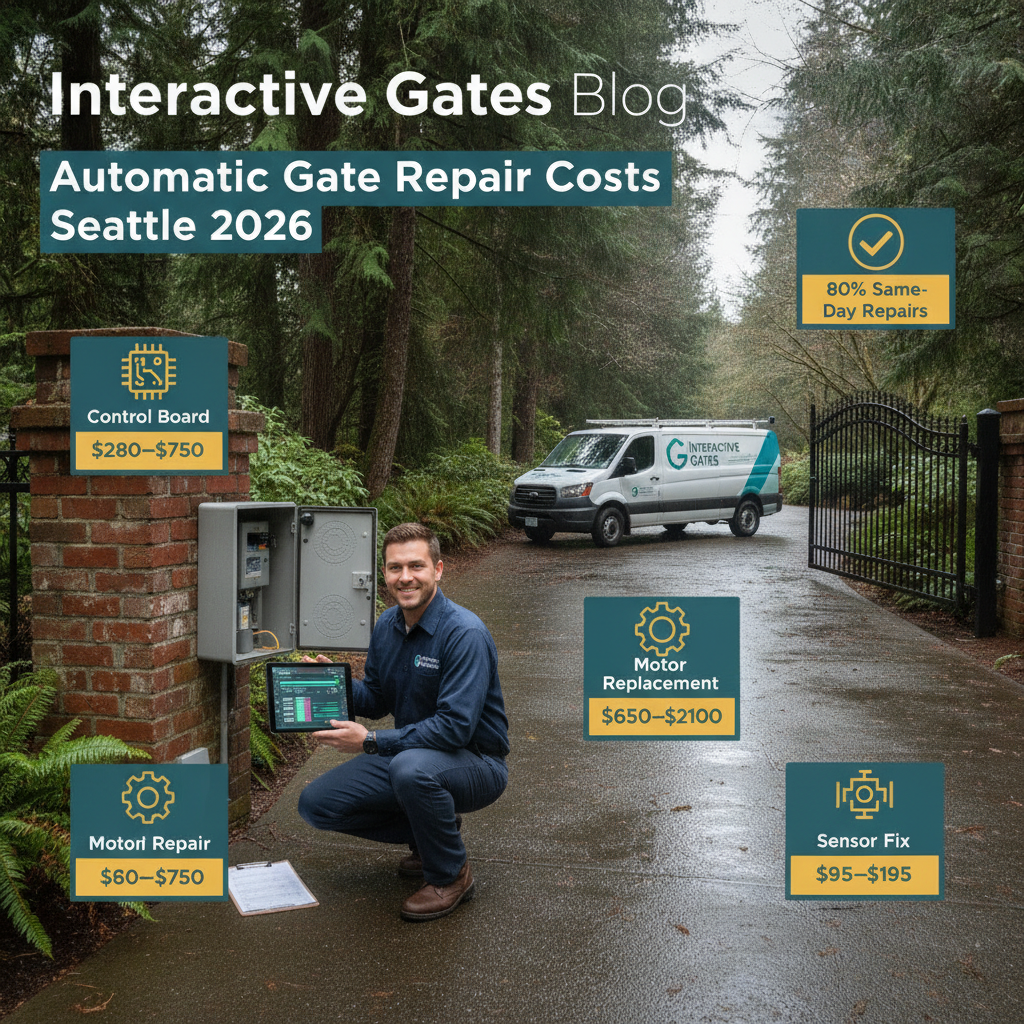
- Basic Seattle gate repairs (sensor cleaning, remote reprogramming) run $95–$220 in 2026.
- Motor/operator replacement is the most common mid-range job: $650–$2,100 depending on brand and gate size.
- Control board replacements cost $280–$750 parts and labor combined — moisture damage is the top cause in Seattle.
- Hinge, rack, and arm repairs range from $150–$600; slide-gate rack replacement on a 20-ft panel runs $400–$700 installed.
- Emergency/after-hours call-outs in King and Snohomish counties add $85–$175 to any repair invoice.
- Annual service agreements ($180–$380/year) catch rust and corrosion early, cutting average repair spend by 30–40%.
- Most Seattle gate repairs are completed same-day or next-day when parts are in stock — roughly 80% of jobs.
- Gates over 12–15 years old often cost more to repair than replace; get a comparison quote if the bill tops $1,200.
Why Is My Automatic Gate Not Working — and How Much Will It Cost to Fix in Seattle?
You pull into your driveway in Bellevue, Gig Harbor, or Snohomish and the gate just sits there. No hum, no movement, maybe a blinking light on the operator box. Or the opposite: the gate creaks open and refuses to close, leaving your property exposed all night. Whatever broke, the first thing you want to know is: what is this going to cost me?
Seattle's famously wet, grey winters — 150+ rain days a year, plus coastal salt air in areas like Tacoma and Gig Harbor — put electric gate systems under stress that homeowners in drier climates never face. Moisture creeps into control boards, rust attacks hinges, and algae films over photo-eye lenses. This guide breaks down every common Seattle gate repair by problem type, part, and neighborhood context, with real 2026 price ranges so you know what to expect before the tech even shows up.
What Are the Most Common Automatic Gate Repairs in the Seattle Area?
After years of service calls across King, Pierce, and Snohomish counties, a clear pattern emerges. Here are the failures technicians see most often, ranked by frequency:
- Photo-eye (safety sensor) misalignment or fouling — Rain, spider webs, and mud are constant culprits in the Pacific Northwest. Cost: $95–$195 (diagnostic + cleaning/realignment). If a sensor needs full replacement, add $60–$120 for the sensor pair.
- Dead or degraded battery backup — Most residential operators use a 12V sealed lead-acid battery. Seattle power flickers during winter storms knock gates offline. Battery swap: $85–$160 labor-included.
- Remote/keypad reprogramming or transmitter replacement — Vehicle signal interference from newer cars is increasingly common. Reprogramming: $95–$150. New LiftMaster or Viking remote: $35–$90 per unit plus programming.
- Control board failure — The #1 moisture-related failure in Seattle. A corroded or shorted board on a LiftMaster LA400, FAAC 400, or Apollo 1500 costs $280–$750 to replace including labor. Italian-made FAAC boards can run toward the top of that range due to parts sourcing.
- Motor/operator replacement — When the motor itself burns out (common after 10–14 years or heavy cycle abuse), you're looking at $650–$2,100 fully installed. A single-arm residential swing operator like the LiftMaster LA500 lands around $850–$1,100 installed; a commercial-grade FAAC 740 for a heavy slide gate can reach $1,600–$2,100.
- Hinge repair or replacement (swing gates) — Hillside lots in areas like Snohomish, Auburn, and parts of Tacoma put enormous lateral stress on hinges. Weld repair: $175–$350. Full hinge set replacement: $300–$550 installed.
- Rack-and-pinion or drive chain issues (slide gates) — Debris and rust eat rack gear teeth. Rack replacement on a standard 16–20 ft slide gate: $400–$700 installed. Chain tensioning or replacement on a Viking or Linear operator: $150–$320.
- Loop detector or vehicle sensor failure — Underground loop detectors in Seattle driveways can degrade faster due to frost heave and ground saturation. Replacement including concrete core drilling: $350–$650.
Pro Tip: If your gate was installed before 2015 and uses an older Elite or Linear control board, ask your technician whether updated firmware or a board upgrade is available — a $180 board update can add two to three years of reliable operation and is far cheaper than a full operator swap.
How Does Seattle's Climate Make Gate Repairs More Expensive?
Seattle averages 38 inches of rain annually — but what matters more is the duration of wetness. Months of continuous drizzle, high humidity (often 80–90% RH in winter), and morning fog create conditions where standard residential gate hardware corrodes noticeably faster than the manufacturer's rated lifespan suggests.
Specific cost implications by climate factor:
- Corrosion on steel gates and hinges: Unpainted or poorly primed steel shows surface rust within two to three Seattle winters. Wire brushing and repainting at a service visit adds $75–$150. If corrosion has reached structural welds, a fabricator repair runs $200–$500.
- Moisture in operator enclosures: Even IP55-rated enclosures let vapor in over time. Technicians in King County frequently find condensation inside LiftMaster and Viking boxes on systems older than six years. A gasket re-seal and desiccant pack install costs $60–$110 added to any service call.
- Salt air near Puget Sound: Properties in Gig Harbor, Tacoma's waterfront neighborhoods, and north Seattle closer to the Sound see accelerated corrosion. Stainless hardware upgrades at installation save money long-term; retrofitting costs $120–$280 for a hinge set.
- Freeze events: Seattle averages only a handful of hard freezes, but when temps drop below 28°F, hydraulic operators (common in FAAC systems) can experience sluggish operation. A cold-weather hydraulic fluid upgrade at a service visit costs $80–$130.
What Does a Gate Repair Service Call Cost in Seattle by Neighborhood?
Labor rates vary modestly across the metro based on drive time, permit complexity, and local demand. Here is a realistic 2026 breakdown:
- Seattle proper / Bellevue / Kirkland: Diagnostic call-out fee $95–$130; hourly labor $125–$165/hr. High-end neighborhoods like Medina or Laurelhurst sometimes have longer access roads that add 15–20 minutes of billable time.
- Tacoma / Lakewood / Puyallup: Call-out $85–$115; labor $110–$145/hr. Slightly lower than Seattle core but comparable parts costs.
- Everett / Lynnwood / Snohomish: Call-out $90–$120; labor $115–$150/hr. Rural parcels in Snohomish County with long gravel driveways occasionally carry a distance surcharge of $25–$50.
- Gig Harbor / Bremerton / Kitsap Peninsula: Ferry or longer-route travel can add $40–$80 to invoices. Factor this in when budgeting for a same-day call.
- Auburn / Kent / Renton: Rates align with Tacoma: call-out $85–$115; labor $110–$145/hr. Industrial zoning means commercial gate work is common here, with higher-volume operators and correspondingly higher parts costs.
Most repair companies offer a free or low-cost diagnostic when the repair is booked through them (the $95–$130 call-out fee is typically credited toward the repair invoice).
Pro Tip: Scheduling a repair for Tuesday–Thursday before noon gets the fastest response in most Seattle-area markets. Monday mornings and Friday afternoons are peak booking times; mid-week slots often mean same-day or next-morning availability.
How Much Does It Cost to Replace vs. Repair an Automatic Gate Operator in Seattle?
This is the question every homeowner faces when the repair estimate climbs past $800. Here is a direct comparison for 2026:
- Repair an aging LiftMaster LA400 single swing operator: Control board $280, labor $150 = $430 total. Makes sense if the operator is under 10 years old.
- Replace that same operator with a new LiftMaster LA500: Operator + installation $950–$1,150. Makes sense if the unit is 12+ years old, has had multiple repairs, or the gate itself is being upgraded.
- Repair a Viking slide gate operator (V2000): Motor brushes + capacitor $220, labor $175 = $395. Reasonable for a well-maintained 8-year-old unit.
- Replace with a new Viking V2000 or equivalent FAAC 844: $1,200–$1,600 installed. The right move once repair costs in a rolling 24-month window exceed $700–$800.
The general rule of thumb: if a single repair exceeds 50–60% of the replacement cost for that operator, get a full replacement quote and compare. A reputable technician will give you both numbers honestly. You can browse real project examples from across the Seattle area at the Interactive Gates project portfolio to calibrate what a full system looks like versus a repaired one.
What Parts Break Most Often — and What Do They Cost in 2026?
- LiftMaster LA400/LA500 control board: $155–$220 (part only)
- FAAC 400/740 solenoid valve: $95–$165 (part only)
- Apollo 1500/3500 limit switch kit: $45–$85 (part only)
- Viking V2000 motor capacitor: $25–$55 (part only)
- Photo-eye sensor pair (any brand): $55–$120 (part only)
- 12V 7Ah battery backup: $35–$65 (part only)
- Wired keypad (DoorKing, HySecurity, LiftMaster): $120–$280 (part only)
- Underground loop detector card: $85–$175 (part only)
- Rack gear section (1 meter, galvanized): $40–$90 (part only)
Labor to install any of the above typically adds $95–$200 depending on access complexity and whether the gate needs to be manually released and held during the swap.
Does Homeowners Insurance Cover Automatic Gate Repairs in Seattle?
Generally, no — standard homeowners policies treat an automatic gate as a fence structure, and normal mechanical wear is excluded. However, you may have a valid claim if:
- A vehicle hit the gate (file under auto liability of the at-fault driver's policy)
- A falling tree or windstorm caused structural damage (covered under most HO-3 policies; typical deductible $1,000–$2,500)
- Lightning struck the control system (covered under most policies as a sudden electrical event)
Document everything with photos before any repair begins. If you suspect a weather event triggered the failure, call your insurer before booking the technician so they can authorize an adjuster visit.
In One Minute: Seattle Gate Repair Cost Recap
- Sensor cleaning/realignment: $95–$195
- Battery backup replacement: $85–$160
- Remote or keypad reprogramming: $95–$150
- Control board replacement: $280–$750
- Hinge repair or replacement: $175–$550
- Slide gate rack replacement: $400–$700
- Full motor/operator replacement: $650–$2,100
- Emergency after-hours surcharge: +$85–$175
- Annual maintenance plan: $180–$380/year (offsets most small repairs)
If you want a real-world sense of what residential and commercial gate systems look like once repaired or replaced, the Interactive Gates portfolio shows completed projects across the region. To understand what a new system would cost versus continuing repairs, start with the residential gate installation overview or use the Interactive Gates gate designer tool to spec out a replacement system and get a ballpark figure instantly.
Frequently Asked Questions About Automatic Gate Repair in Seattle
How long does a typical gate repair take in Seattle?
Most residential gate repairs are completed in one to three hours on-site. Simple fixes like sensor cleaning, battery swaps, or remote reprogramming take 30–60 minutes. Control board replacements or loop detector installs typically run two to three hours. If a part must be special-ordered (common with older FAAC or Apollo components), the job may be split across two visits, usually within three to seven business days. Roughly 80% of jobs are completed same-day when the technician carries a stocked parts van.
Can I do my own automatic gate repair in Seattle to save money?
Minor tasks — replacing a battery backup, cleaning photo-eyes, or reprogramming a remote — are reasonable DIY jobs if you are comfortable following the operator manual. Any repair involving 120V AC wiring, underground loop detectors, or structural welding should be left to licensed professionals. In Washington State, electrical work on gate operators that involves hardwired connections technically falls under electrical code and may require a permit depending on the scope. Unpermitted electrical work can create liability issues when you sell the property.
Why does my gate work fine in summer but fail every winter in Seattle?
Cold, wet weather stresses three things simultaneously: battery capacity drops (a marginal battery that tests fine in July may fail at 38°F), lubricants thicken in hinges and rack gears causing the motor to work harder, and photo-eye lenses fog with condensation triggering false obstruction signals. Scheduling a fall tune-up in September or October — before the rainy season — catches all three issues and prevents most winter failures. A tune-up runs $120–$200 and is often included in an annual maintenance agreement.
What brands are easiest and cheapest to repair in the Seattle area?
LiftMaster (LA series for swing, CSL24U/CSW200 for slide) has the broadest parts availability locally, making repairs faster and often cheaper. Viking Access and Linear also have good regional parts distribution. FAAC and BFT systems offer excellent quality but some boards and solenoids must be shipped from California or internationally, adding two to five business days and sometimes 20–30% higher parts cost. Apollo and Elite mid-range units fall in between — common enough that parts are usually in stock within one business day.
How do I know if my gate needs repair or full replacement?
A useful benchmark: if repair costs in any rolling 24-month window exceed 60% of what a new operator would cost installed, replacement is almost always smarter. Also consider age — most residential operators are designed for 50,000–100,000 cycles over a 10–15 year lifespan. If your gate opens and closes five times daily, that is roughly 3,650 cycles per year, meaning a 100,000-cycle unit should last about 27 years under normal use. Heavy households (8–10 cycles/day) hit the mechanical limit in 14–17 years. Visible corrosion on the motor housing, repeated board failures, or grinding noises that return after lubrication are all signs replacement is the better investment.
Do HOAs in Seattle need different gate repair protocols than homeowners?
Yes, in two ways. First, HOA and commercial gate systems typically run higher-duty operators (FAAC 844, HySecurity SlideSmart, LiftMaster CSW200) that have different maintenance intervals and parts costs than residential units. Second, many HOAs in King and Snohomish counties have CC&Rs requiring board approval before any structural modification, even a like-for-like operator swap. Pure repairs (replacing a failed component with the same model) generally do not need approval, but check your governing documents. For HOA-scale projects, the commercial and HOA gate page outlines what communities across the Seattle metro typically budget and plan for.
Ready to Get a Straight Answer on Your Gate Repair?
Whether your gate is making a grinding noise in Bellevue, refusing to close in Snohomish, or simply blinking error codes at your Tacoma rental property, getting a clear, honest estimate is the first step. The team at Interactive Gates serves homeowners and property managers across King, Pierce, and Snohomish counties with transparent pricing and same-day availability on most common repairs. You can explore what a repair or replacement might look like for your specific gate style using the gate designer tool, read what other local customers experienced on the reviews page, or reach out directly via the contact page to schedule a diagnostic visit. No pressure, no surprises — just a straight answer about what it will take to get your gate working again.