- A camera-plus-gate bundle in Seattle runs $350–$1,200 installed depending on resolution, night vision, and wiring type.
- Most Seattle driveways need at least two camera angles: one wide-entry shot and one close-up for license plates.
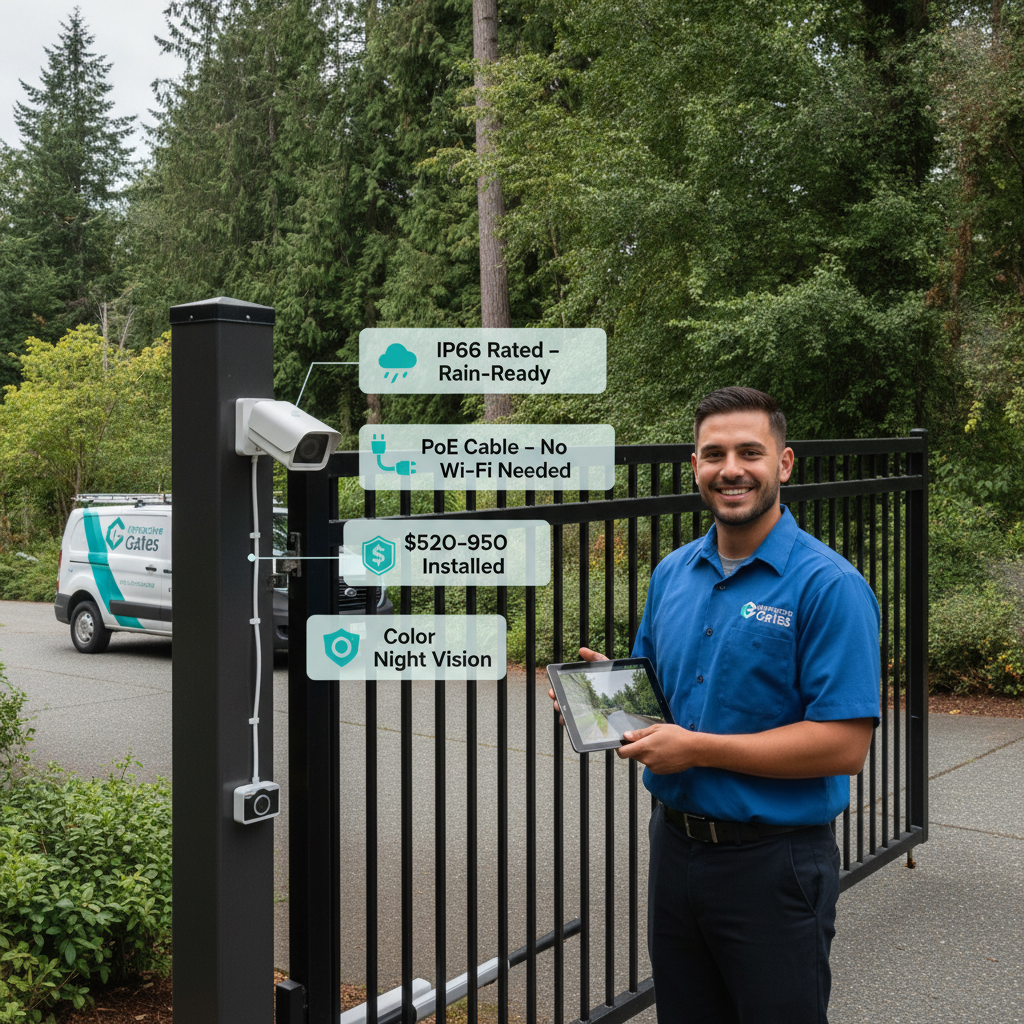
- IP66-rated or higher housings are non-negotiable in Seattle's rain — lower-rated units fog and fail within one wet season.
- PoE (Power over Ethernet) cameras outperform Wi-Fi cameras in tree-heavy neighborhoods like Magnolia, Laurelhurst, and Bellevue's Somerset Hill where signal drop is common.
- Cloud storage plans average $5–$15/month per camera; NVR local storage adds $150–$400 upfront but eliminates monthly fees.
- Permit requirements for gate camera wiring are minimal in most Seattle-area jurisdictions — no separate electrical permit needed if the camera runs on low-voltage PoE.
- Top brands used by Seattle installers in 2026: Hikvision ColorVu, Axis P3268, LiftMaster Smart Video Intercom, and Reolink RLC-823A.
- Read time: 8 minutes. Real numbers, real neighborhoods, no fluff.
What Security Cameras Should I Add to My Electric Gate in Seattle?
You just had an electric gate installed — or you're planning one — and now you're wondering: do I need cameras, where do I point them, and what's this actually going to cost me? Those are exactly the right questions to ask before anyone starts drilling into your post or running conduit underground. Seattle properties present a specific set of challenges: persistent rain from October through April, dense tree canopy that blocks wireless signal, and driveway grades in neighborhoods like Capitol Hill, Queen Anne, and the Issaquah Highlands that change how a camera sees the road. This guide walks you through every decision you'll face in 2026, with real prices and real local context.
Why Does a Gate Camera Setup in Seattle Need to Be Different From Anywhere Else?
The Pacific Northwest doesn't just get wet — it stays wet, gray, and humid for months at a stretch. A camera that performs flawlessly in Phoenix or even San Jose will struggle in Seattle if it isn't specced for sustained moisture. Here's what local climate forces you to think about:
- Condensation inside housings: Budget cameras rated IP54 or IP55 let moisture vapor migrate through seals. After one or two seasons, the lens fogs permanently. You need IP66 minimum; IP67 or IP68 for exposed post-top mounts.
- Color night vision matters more here: Seattle gets roughly 226 cloudy days per year. Infrared (IR) night vision produces washed-out black-and-white footage in drizzle — the IR beam reflects off water droplets and creates a white-out effect. Cameras with built-in white-light or color night vision (like Hikvision ColorVu or Reolink's color series) produce usable footage in overcast, light-rain conditions that IR cameras simply can't handle.
- Tree canopy blocks Wi-Fi: Neighborhoods like Medina, Mercer Island, and North Bend have heavy conifer cover. Even a gate that's 60 feet from your router may show constant dropouts on a 2.4 GHz Wi-Fi camera. PoE (Power over Ethernet) eliminates that problem entirely — one Cat6 cable carries both power and 1 Gbps data with zero interference.
- Frost events: Snohomish County, Auburn, and Tacoma's higher elevations see overnight frost more frequently than Seattle proper. Cameras should be rated to operate at 14°F (-10°C) or colder — most quality units are, but confirm before buying.
Pro Tip: If your gate post is hollow steel, ask your installer to run the PoE cable inside the post before the gate is set. Retrofitting conduit after the fact on a welded steel post adds $80–$180 in labor versus $0 if it's done during the original install.
Where Should I Mount Cameras on a Driveway Gate in Seattle?
Mounting location determines whether your footage is actually usable in a police report or HOA dispute. Here are the four positions local installers use on Seattle-area properties:
- Position 1 — Intercom/keypad post, eye level (5–6 ft): This is your visitor-face camera. It captures who's pressing your keypad. Pair it with your intercom (LiftMaster's CAPXLV or Doorbird D2101V work well here). Cost to add: $180–$320 installed if bundled with the intercom.
- Position 2 — High post or fence column, wide angle (8–10 ft): This camera covers the full gate opening and street approach. A 2.8mm or 4mm lens at this height captures vehicles, pedestrians, and license plates approaching from the street. This is the camera that actually deters tailgating. Cost: $250–$450 installed for a weatherproof PoE unit.
- Position 3 — Garage-facing / driveway interior: Shows who came through the gate and where they went. Critical for delivery driver disputes. For longer driveways in Gig Harbor or Snohomish estates, you may want two interior cameras. Cost: $200–$380 each installed.
- Position 4 — License-plate capture (LPC) camera: A dedicated LPC camera has a narrow field of view, high zoom, and exposure tuned for fast-moving, reflective plates. It's overkill for most single-family homes but worth it for HOA communities and commercial properties in Bellevue or Tacoma. Cost: $350–$700 installed.
What Does a Gate Camera System Cost in Seattle in 2026?
Here's what real Seattle-area homeowners and property managers are paying this year:
- Single camera added to new gate install (bundled): $280–$450 installed, including conduit stub-out and integration with LiftMaster myQ or similar app.
- Two-camera entry package (visitor face + wide angle), new install: $520–$950 installed with PoE switch, 100 ft Cat6 cable run, and basic NVR setup.
- Retrofit onto existing gate (no prior camera wiring): $400–$800 for two cameras — the premium is trenching or surface-mounting conduit to reach existing power.
- Full four-camera gate perimeter system with NVR: $1,100–$2,200 installed. Common on larger properties in Gig Harbor, Bellevue, and Mercer Island.
- Cloud storage add-on: $5–$15/month per camera on platforms like Hikvision Hik-Connect or Reolink cloud. Axis cameras use their own ACAP platform at $8–$20/month.
- Local NVR storage: A 4-channel NVR with a 2TB drive runs $150–$300 and stores 30+ days of continuous 4MP footage with no monthly fee.
Labor rates in King County and Snohomish County for low-voltage camera wiring run $75–$110/hour in 2026. A two-camera job typically takes 2–3 hours for a pre-wired new gate and 4–6 hours for a retrofit.
Which Camera Brands Are Seattle Gate Installers Using in 2026?
Not every security camera is designed with gate integration in mind. These are the brands and models Seattle-area gate technicians are actually spec'ing this year:
- Hikvision ColorVu DS-2CD2347G2-LU: 4MP, full-color night vision even in 0.0005 lux, IP67, operates down to 4°F. The go-to for Seattle drizzle. Street price: $95–$130 per camera; installed $220–$320.
- Reolink RLC-823A: 8MP (4K), color night vision, PoE, IP66, two-way audio. Strong value play for homeowners who want to self-monitor via the Reolink app. Street price: $65–$90; installed $180–$280.
- Axis P3268-LV: Commercial-grade 8MP, NEMA 4X, ONVIF-compliant. Preferred by HOA boards who need footage admissible in legal proceedings. Street price: $280–$360; installed $420–$560.
- LiftMaster CAPXLV Smart Video Intercom: Integrates directly with myQ gate operators. 1080p, two-way video, app-based visitor access, IP54 (acceptable for covered posts, not exposed). Best when you want one device that handles intercom AND camera. Street price: $280–$340; installed $380–$500.
- Doorbird D2101V: European-made video intercom with PoE, IP65, and native integration with FAAC and BFT openers. Popular in Lake Washington waterfront properties. Street price: $320–$400; installed $450–$620.
Do I Need a Permit to Add Cameras to My Gate in Seattle?
In most Seattle-area jurisdictions — including the City of Seattle, Bellevue, Tacoma, Everett, and unincorporated King County — running low-voltage PoE camera cable does not require a separate electrical permit. PoE is Class 2 low-voltage wiring, same classification as doorbell and thermostat wire. No permit, no inspection, no delay.
Exceptions: If your installer is tapping into 120V power to run a powered switch or NVR at the gate pedestal, that may require an electrical permit under Seattle's amended NEC 2023 adoption. Confirm with your installer before work starts. The permit itself is typically $65–$120 and adds 1–2 weeks if required. Seattle properties in historic overlays (like Pioneer Square or Harvard-Belmont) may also have design-review requirements for visible hardware on street-facing posts.
Pro Tip: Run one extra Cat6 stub in conduit to a future camera location when you're doing the original install. The incremental cost is about $40–$80 in materials and zero additional labor. Adding a second camera later without that stub costs $200–$400 in retrofit conduit work.
How Do I Integrate Gate Cameras With My Existing Smart Home or App?
This is the question most homeowners forget to ask until after the cameras are installed. Here are the integration paths that actually work in 2026:
- LiftMaster myQ ecosystem: If your gate opener is a LiftMaster LA400, CSL24UL, or SW402 (all common on Seattle residential installs), the myQ app already supports video intercoms and select cameras. You get gate open/close events, visitor video clips, and remote access from one app.
- ONVIF-compatible NVR: Hikvision, Reolink, Axis, and Dahua cameras all support ONVIF, meaning any ONVIF NVR can record them regardless of brand. This is the flexible choice for mixed-brand setups.
- Home Assistant / local automation: Tech-forward homeowners in Bellevue and Lynnwood are increasingly running Home Assistant on a local server to unify gate triggers, camera motion events, and smart locks. This requires some technical setup but eliminates all cloud subscriptions.
- Standalone cloud apps: Reolink and Hikvision both offer free tiers with limited clip storage. If you want 24/7 continuous recording, budget for a paid plan or local NVR.
In One Minute: Gate Cameras in Seattle 2026
Here's the full picture compressed: A single camera added to a new Seattle gate install runs $280–$450; a two-camera PoE package is $520–$950; a full four-camera perimeter system hits $1,100–$2,200. You need IP66 or higher housings for Seattle rain — no exceptions. Choose color night vision (Hikvision ColorVu, Reolink 823A) over IR-only cameras because infrared washes out in drizzle. Run PoE cable, not Wi-Fi, in tree-heavy neighborhoods. Local NVR storage costs $150–$300 upfront with no monthly fees; cloud plans run $5–$15/month per camera. No electrical permit is required for low-voltage PoE runs in most Seattle-area jurisdictions. If you're building a new gate, stub out conduit for a second camera now — it's $40–$80 extra and saves $200–$400 in retrofit costs later. Want to see how a camera package fits into your overall gate setup? Browse residential gate options here or design your gate setup with the interactive visualizer.
Frequently Asked Questions: Gate Cameras in Seattle
Do I need Wi-Fi at my gate for a security camera to work?
No — and in most Seattle properties, Wi-Fi at the gate is unreliable anyway. PoE (Power over Ethernet) cameras run on a single Cat6 cable that carries both data and power. No Wi-Fi needed, no signal dropouts, and no lag. The cable runs from your gate to an NVR or PoE switch inside your home or garage. Wi-Fi cameras are acceptable only if your gate is within 30–40 feet of a strong router signal with no thick walls, concrete columns, or dense tree canopy in between.
What IP rating do I need for a camera at a Seattle driveway gate?
IP66 is the minimum for any camera mounted in an exposed position at a Seattle gate. IP66 means dust-tight and protected against powerful water jets from any direction — sufficient for Seattle's rain and spray. If the camera is mounted on top of an open post with no overhang, IP67 (temporary immersion protection) is a better spec. IP54 cameras, common in budget smart-home devices, are not adequate for a Seattle outdoor gate application.
Can I add cameras to an existing gate that wasn't wired for them?
Yes, but expect a retrofit premium. Adding two PoE cameras to an existing, non-wired gate in Seattle costs $400–$800 installed. The labor difference versus a bundled new-gate install comes from trenching or surface-mounting conduit to reach your existing power source, and potentially pulling a low-voltage electrical permit if 120V is involved. Ask your installer to quote both a surface-conduit route and a trenched route — the price difference is usually $100–$200 and trenching is cleaner long-term.
How long does gate camera footage get stored?
It depends on your storage method. Cloud plans typically offer 7–30 days of motion-triggered clips, depending on tier. A local NVR with a 2TB drive stores roughly 20–45 days of continuous 4MP footage from two cameras before it loops and overwrites. For most Seattle residential properties, 14–30 days of storage is sufficient. HOA and commercial properties in Washington State may need 30–90 days under their insurance carrier's requirements — confirm with your carrier.
Will a gate camera work during Seattle's power outages?
Standard PoE cameras go offline when power fails unless you have a UPS (uninterruptible power supply) on the PoE switch and NVR. A basic UPS for a two-camera system costs $60–$120 and provides 2–6 hours of runtime — enough to cover most short outages in the Seattle area. If your gate also has a battery backup system, the camera circuit can often be tied to that same backup. Discuss this integration at the time of install; retrofitting it later adds $80–$160 in wiring labor.
What's the best camera for capturing license plates at a gate in Seattle?
For residential use, a Hikvision ColorVu or Reolink RLC-823A mounted at 8–10 feet with a 4mm lens pointed at the driveway approach will capture usable plate images on most passenger vehicles in daylight and low-light. For guaranteed plate reads at speed (delivery trucks, multiple visitors per day), a dedicated LPC camera with a 12mm–25mm lens and wide dynamic range tuned for reflective surfaces is worth the upgrade at $350–$700 installed. See examples of installed gate camera systems in our portfolio.
Ready to Add Cameras to Your Gate?
The right camera setup doesn't have to be complicated or expensive — it just has to be specced for Seattle's actual climate and your property's actual layout. Whether you're bundling cameras into a brand-new gate project or retrofitting onto an existing opener, the decisions you make at install time (PoE vs. Wi-Fi, IP rating, mounting position, storage type) determine whether your footage is useful five years from now or sitting in a fogged, offline camera that stopped working in its second wet season. Reach out to the Interactive Gates team to get a site-specific recommendation — no pressure, just a straight answer on what your driveway actually needs.
FAQs