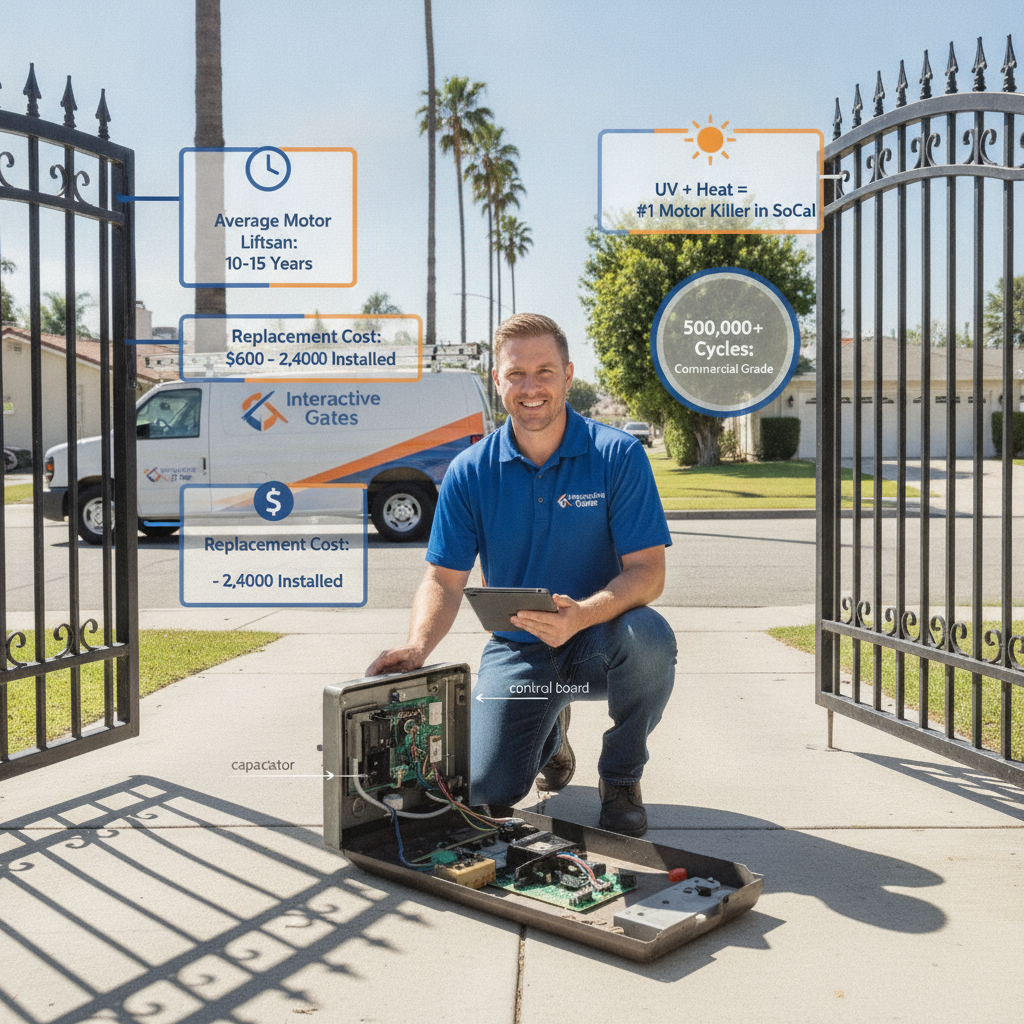
- Most residential gate motors in Los Angeles last 10–15 years with routine maintenance; neglected motors often fail in 6–8 years.
- Cycle count matters more than age: budget motors are rated 50,000–100,000 cycles; commercial-grade motors handle 500,000+ cycles.
- Southern California heat and UV exposure degrade motor capacitors, circuit boards, and wiring insulation faster than cooler climates.
- Motor replacement in LA runs $600–$2,400 installed depending on brand, gate weight, and access difficulty.
- LiftMaster, FAAC, and Viking consistently top longevity rankings for SoCal residential and HOA properties in 2026.
- Coastal salt air in Malibu, San Clemente, and Laguna Beach can cut motor lifespan by 20–30% without annual corrosion treatments.
- Signs your motor is failing include slow movement, grinding noise, and mid-cycle reversals — catching these early saves the full replacement cost.
- A new motor with a 3-year parts-and-labor warranty is almost always a better value than a third repair on a motor over 10 years old.
How Long Do Automatic Gate Motors Actually Last in Los Angeles?
How long does an automatic gate motor last? When does a gate motor need to be replaced? Is it worth repairing a gate motor that keeps failing? If you're a homeowner in Encino, a property manager in Culver City, or an HOA board member in Rolling Hills, these are exactly the questions you're asking — usually right after your gate has already stopped working. This guide gives you real numbers, real brand comparisons, and a clear framework for deciding whether to repair or replace your motor in 2026.
What Determines How Long a Gate Motor Lasts in Los Angeles?
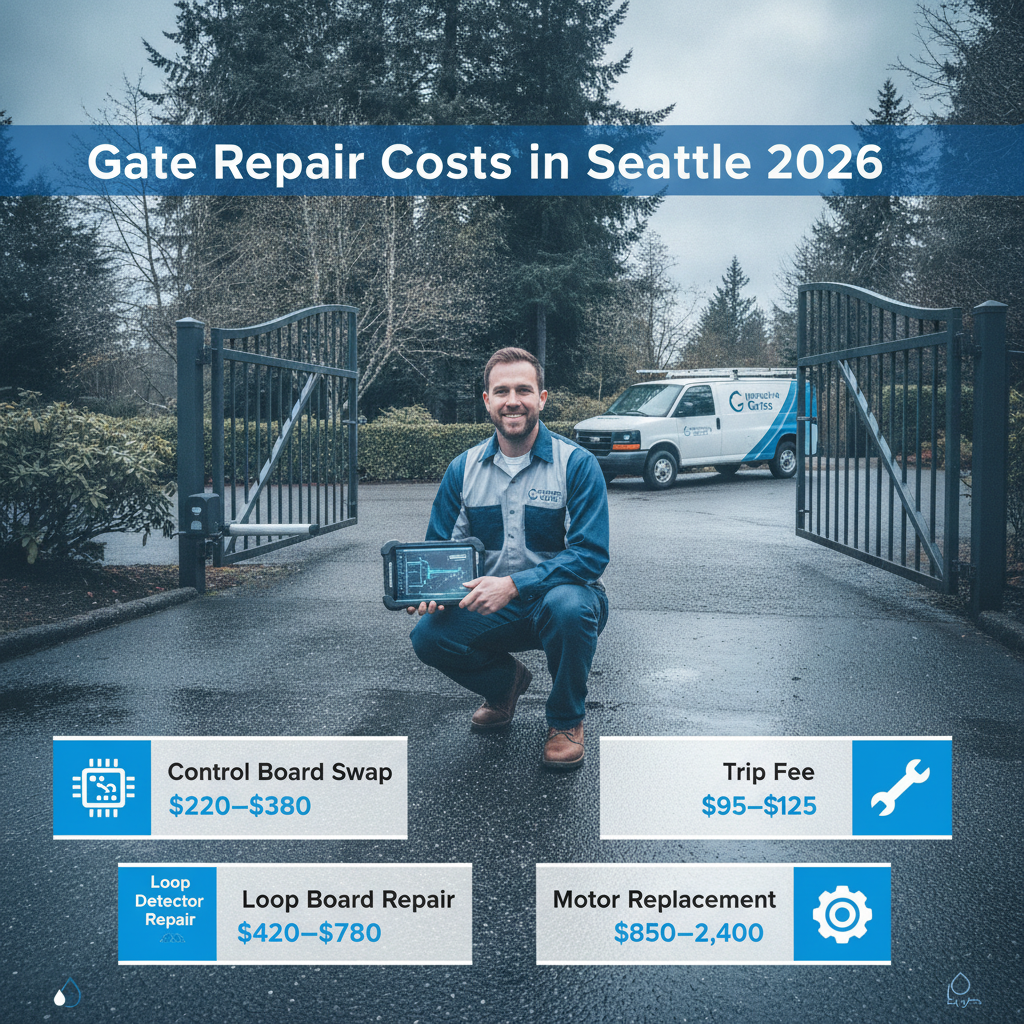
Unlike Seattle or Portland where rain and cold are the primary enemies of gate hardware, Los Angeles motors face a different set of stressors. Extreme UV radiation breaks down plastic components, rubber seals, and wiring insulation. Inland areas like the San Fernando Valley regularly see summer temps above 105°F, which causes thermal stress in motor windings and accelerates capacitor failure. Coastal areas like San Clemente and Laguna Beach add salt-air corrosion on top of heat. Canyon communities like Topanga and Laurel Canyon deal with dust, debris, and steep grades that force motors to work harder on every cycle.
The single most accurate predictor of motor lifespan is cycle count — how many times the gate opens and closes. A cycle is one open plus one close. Here's how that breaks down by motor class:
- Entry-level residential motors (Apollo 1500, Ghost Controls) — rated 50,000–80,000 cycles, roughly 7–10 years for a typical household making 20–25 cycles per day.
- Mid-range residential motors (LiftMaster LA400, FAAC 400 series) — rated 100,000–150,000 cycles, roughly 10–15 years at the same usage rate.
- Commercial and HOA-grade motors (LiftMaster LA500, FAAC 844, Viking D-Gate) — rated 300,000–500,000+ cycles, designed to last 15–25 years in high-traffic applications.
A busy HOA in West Hollywood with 80 units might log 300–500 cycles per day, burning through an entry-level motor in under a year. That's why motor sizing to actual usage is non-negotiable in LA's multi-family and gated community market.
How Does Southern California's Climate Specifically Shorten Gate Motor Life?
The LA basin's climate is tough on electronics in ways that most people don't anticipate. Capacitors — the small components that give the motor its starting torque — are highly sensitive to heat. At sustained temperatures above 100°F, a capacitor rated for 10 years of service may fail in 4–6 years. Replacing a capacitor costs $80–$180 in parts and labor and is often the first repair a motor needs around year 5.
Circuit boards are equally vulnerable. UV light penetrates even vented enclosures, and cheap motor housings in direct sun can reach internal temperatures of 130–140°F. This is why brands like FAAC and LiftMaster use UV-stabilized polycarbonate enclosures and conformal-coated circuit boards on their higher-end models — a detail worth verifying before purchase.
Coastal salt air creates a third threat. Properties within 1–2 miles of the Pacific — including San Clemente, Laguna Beach, and Marina del Rey — see accelerated oxidation of motor terminals, wiring connectors, and exposed hardware. Without annual dielectric grease treatment and terminal inspection, corrosion can cause intermittent failures and board shorts that mimic much more expensive problems.
Pro Tip: If your gate is within two miles of the coast, ask your installer specifically about marine-grade wiring connectors and sealed motor enclosures. FAAC's 844 series and LiftMaster's RSW12V both offer sealed designs that perform measurably better in salt-air environments than standard residential units.
What Are the Warning Signs a Gate Motor Is About to Fail?
Gate motors rarely fail without warning. The problem is that most property owners don't recognize the early signs, so they wait until the gate is completely stuck before calling for service. Here's the progression to watch for:
- Slow or sluggish movement: If your gate used to open in 8 seconds and now takes 14–16 seconds, the motor is working harder than it should. This often means worn gears, low lubrication, or a weakening capacitor.
- Mid-cycle reversal: The gate starts to open or close, then reverses for no apparent reason. This can indicate a failing limit switch, a problem with the safety sensor loop, or an overheating motor cutting out on its thermal protection circuit.
- Grinding or clicking sounds: Grinding usually means gear wear inside the gearbox. Clicking can be a relay cycling rapidly due to low voltage or a failing control board.
- Inconsistent response to remotes or keypads: If the gate sometimes responds and sometimes doesn't, and you've already replaced the remote batteries, the problem is usually the receiver board or power supply — not the access control device itself.
- Error codes on the control panel: LiftMaster units display error codes that correspond to specific faults. Code 1-5 on an LA400, for example, indicates an obstruction or sensor loop problem; Code 4-1 indicates a gate travel fault. Referencing your brand's diagnostic chart can tell you whether the issue is repairable or terminal.
How Much Does Gate Motor Replacement Cost in Los Angeles in 2026?
Motor replacement costs in LA are influenced by four factors: the brand and model you choose, the weight and type of your gate (slide vs. swing, single vs. dual), labor rates in your specific neighborhood, and whether any secondary components — wiring, control boards, limit switches — need replacement at the same time.
- Entry-level motor replacement (Apollo, GTO Pro): $600–$950 installed. These are appropriate for lightweight aluminum gates under 400 lbs with low to moderate traffic.
- Mid-range residential motor replacement (LiftMaster LA400, FAAC 400 series): $1,100–$1,600 installed. Best value for most single-family homes in LA making 20–50 cycles per day.
- Premium residential / light commercial (LiftMaster LA500, FAAC 844, Viking 1000): $1,600–$2,400 installed. Appropriate for heavier gates (400–1,000 lbs), HOA entry points, or high-cycle applications.
- Dual swing gate motor replacement: Add 60–80% to single-motor costs since both operators typically need replacement simultaneously for synchronized movement.
- Labor alone (motor swap only, no secondary repairs): $250–$450 in most LA neighborhoods; $350–$550 in higher-cost areas like Bel Air, Pacific Palisades, or Rolling Hills.
If your installer discovers that the wiring harness, control board, or solar panel (if applicable) also needs replacement, budget an additional $150–$600 depending on what's affected. It's very common on motors over 10 years old for a secondary component failure to have caused or accelerated the primary motor failure.
Pro Tip: Always ask for a written quote that separates parts from labor. This lets you compare actual motor cost against what you'd pay buying the same unit online — and it protects you if secondary issues appear during the swap. Reputable installers won't charge full labor again if they discover a board problem during a scheduled motor replacement.
Repair vs. Replace: How Do You Decide?
The 50% rule is a useful starting point: if a repair costs more than 50% of a full motor replacement, replacement is almost always the better investment. But there are nuances specific to LA properties:
- If the motor is under 7 years old and the failure is a capacitor, limit switch, or wiring connector — repair. These are common wear items and the motor itself still has years of life left.
- If the motor is 8–12 years old and you're facing a second or third repair — replace. The control board, gearbox, and wiring are all approaching end of life simultaneously.
- If the motor is over 12 years old — replace regardless. Even a successful repair will likely be followed by another failure within 12–18 months, and you'll pay labor costs twice.
- If you're upgrading to smart access control (app-based entry, video intercom, or license plate recognition) — replace even if the motor still functions. Older motors often lack the communication protocols needed for modern integrations, and trying to retrofit them adds cost with unreliable results.
You can browse current gate system options and configurations at the Interactive Gates design tool to get a sense of what a full system upgrade would look like for your property type and budget.
Which Gate Motor Brands Last Longest in Los Angeles?
Based on 2026 field performance across SoCal's residential and commercial gate market, here's how the major brands rank for longevity in the LA climate:
- LiftMaster LA400 / LA500: The most widely installed residential motor in Southern California. Sealed motor housing, thermal protection, and broad dealer support make these the default recommendation for most LA homes. Expected lifespan: 12–15 years at normal residential use. Replacement cycle parts are available locally within 24–48 hours at most LA distributors.
- FAAC 400 / 844: Italian-engineered motors with excellent heat tolerance and sealed gearboxes. The 844 is a favorite for heavy dual-swing gates and HOA applications in areas like Orange County and Rolling Hills. Expected lifespan: 12–18 years.
- Viking Access D-Gate / Q-55: Popular for commercial and high-cycle HOA use. Viking's direct-drive mechanism eliminates the chain or belt that wears out in cheaper units. Expected lifespan at HOA cycle rates: 10–14 years.
- Apollo 1500 / 1600: Budget-friendly and widely available, but showing shorter field lifespans in coastal and high-heat LA environments — typically 7–10 years before capacitor or board failures become frequent. Better suited for low-traffic secondary gates than primary driveway entries.
- Ghost Controls TTC1: Well-reviewed for rural and low-traffic residential use, but not recommended for properties with more than 20–25 cycles per day or for steel/iron gates over 500 lbs.
HOA and Multi-Family Properties: What's Different?
For HOA communities in areas like Rolling Hills, gated neighborhoods in Orange, or coastal communities near Laguna Beach, the calculus on motor lifespan changes significantly. Entry points that serve 50–200 households may log 400–800 cycles per day, meaning even a commercial-grade FAAC 844 rated for 500,000 cycles will reach its design limit in 2–4 years if the gate is not properly sized for the volume.
HOA boards should request annual motor cycle-count audits from their gate service provider. Many modern commercial gate operators (LiftMaster LA500, Viking Q-55, FAAC 844) include a built-in cycle counter accessible from the control panel. Tracking this number allows boards to plan motor replacement proactively — before a failure leaves 80 households unable to enter or exit their community.
For more on managing gate systems at the community level, the Interactive Gates HOA and commercial gate page outlines service contracts, cycle-count monitoring, and planned replacement programs.
In One Minute: Automatic Gate Motor Lifespan in Los Angeles
Most residential gate motors in LA last 10–15 years with proper maintenance. Southern California's heat, UV, and coastal salt air are the primary enemies — they degrade capacitors, circuit boards, and wiring faster than cooler climates. The best predictor of lifespan isn't age, it's cycle count: budget motors top out at 50,000–100,000 cycles while commercial-grade units handle 500,000+. Replacement costs range from $600 to $2,400 installed depending on brand and gate type. Brands like LiftMaster, FAAC, and Viking lead for longevity in the SoCal market. Watch for slow movement, grinding sounds, and mid-cycle reversals — these are your early warning signs. Apply the 50% rule when deciding to repair vs. replace, and always replace a motor over 12 years old rather than repairing it again.
Frequently Asked Questions: Gate Motor Lifespan in Los Angeles
How many years should a gate motor last in Southern California?
Most mid-range residential gate motors — LiftMaster, FAAC, Viking — last 10–15 years in the Los Angeles area with annual maintenance. Budget motors like Apollo or Ghost Controls typically last 7–10 years, especially in coastal or high-heat inland locations. HOA and commercial motors are designed for 15–20+ years but may reach their cycle limit faster due to heavy daily use.
What causes gate motors to fail faster in Los Angeles than other cities?
Three main factors: extreme heat (100°F+ temps in the Valley and inland areas), UV radiation that degrades plastic housings and circuit board coatings, and coastal salt air that corrodes terminals and connectors. These factors work together to shorten capacitor life, accelerate wiring insulation breakdown, and cause intermittent board failures that often precede a complete motor burnout.
How much does it cost to replace a gate motor in Los Angeles in 2026?
Installed costs range from $600–$950 for entry-level motors up to $1,600–$2,400 for premium residential or commercial-grade units. Dual swing gate replacements cost 60–80% more than single-motor jobs. Labor alone runs $250–$550 depending on neighborhood and gate access complexity. Secondary repairs (wiring, boards, limit switches) add $150–$600 on older systems.
Is it worth repairing an old gate motor or should I just replace it?
Use the 50% rule: if a repair costs more than half of full replacement, replace. Any motor over 12 years old should be replaced rather than repaired again — subsequent failures on aging components typically follow within 12–18 months. Motors under 7 years old with minor component failures (capacitor, limit switch) are good candidates for repair.
Which gate motor brand lasts the longest in Los Angeles?
FAAC's 844 series and LiftMaster's LA500 consistently show the longest field lifespans in SoCal — 12–18 years for residential use and 10–14 years at HOA cycle rates. Viking Access is preferred for high-cycle commercial applications. Apollo and Ghost Controls are reliable for low-traffic secondary gates but are not recommended as primary driveway operators for busy LA households.
How can an HOA know when its gate motor needs replacement?
Most commercial-grade motors include a built-in cycle counter on the control panel. HOA boards should request annual cycle-count audits from their service provider and compare the recorded count against the motor's rated cycle limit. Proactive replacement — scheduled 6–12 months before the rated cycle limit — avoids emergency failures that can lock out or trap residents during peak hours.
Ready to Find Out Where Your Motor Stands?
Whether your gate is grinding through its last months or you're planning an upgrade before a failure happens, getting a professional assessment is the fastest way to know what you're actually working with. The team at Interactive Gates serves properties across Los Angeles, Orange County, and Southern California — from single-family driveways in Encino to HOA entry systems in San Clemente. You can review past projects at the Interactive Gates portfolio, read what other LA-area property owners experienced at the reviews page, or explore options for your specific property type at the residential gate page. When you're ready to have someone take a real look, the contact page is the easiest place to start.
FAQs