- Most Portland gate repairs fall between $185 and $1,400 depending on what broke and how long the technician is on-site.
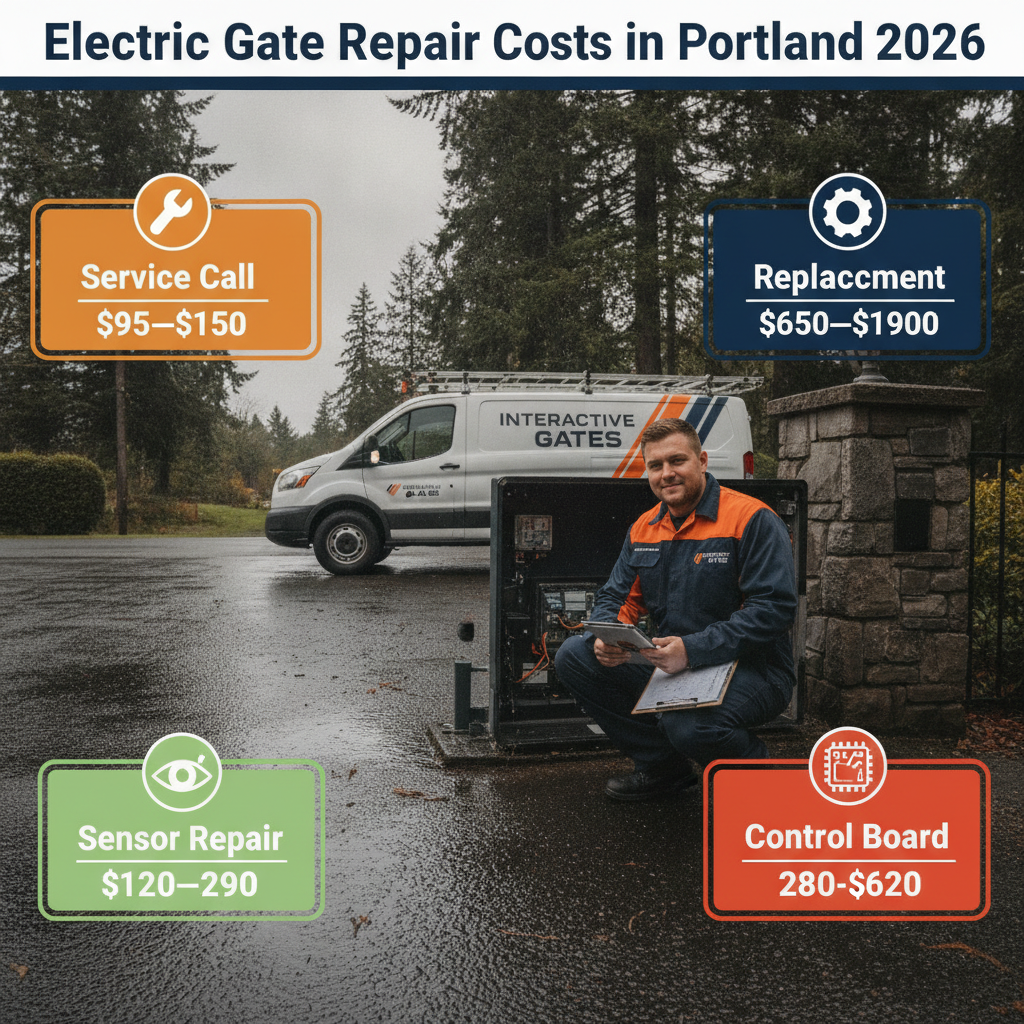
- A service call alone runs $95–$150 in the Portland metro before any parts or labor are added.
- Motor/operator replacement is the priciest single repair, averaging $650–$1,900 installed for residential swing or slide gate operators.
- Control board failures average $280–$620 and are more common on gates exposed to Portland's damp, freeze-thaw winters.
- Safety sensor realignment or replacement costs $120–$290 and is one of the most common calls Portland technicians receive.
- Welding and structural repairs on wrought-iron or steel gates run $200–$800+ depending on crack length and rust penetration.
- HOA and commercial gate repairs can run 20–35% higher than equivalent residential work due to heavier-duty components and traffic-cycle demands.
- Deferring a $200 sensor fix can turn into a $1,500 motor replacement within 12–18 months — the math strongly favors early service.
What Does Gate Repair Actually Cost in Portland in 2026?
You searched something like 'why is my gate stuck open Portland' or 'electric gate repair cost near me' — and you ended up here. Good. Portland homeowners, property managers, and HOA boards deal with a specific cocktail of gate-killing conditions: 150+ days of annual rainfall, the occasional hard freeze in the West Hills or Gresham, moss and debris accumulation in tracks, and underground wiring that gets waterlogged in poorly drained lots. All of that shapes what breaks, how fast it breaks, and what it costs to fix.
This post gives you real 2026 price ranges organized by repair type, explains why Portland's climate drives certain failures faster than in drier markets, and helps you figure out whether the quote you just received is in the right ballpark.
How Much Is a Gate Repair Service Call in Portland?
Before any wrench turns, most Portland-area gate companies charge a diagnostic or service-call fee. In 2026, expect $95–$150 for a residential visit within the core Portland metro (Portland proper, Beaverton, Gresham, Hillsboro). Properties in Lake Oswego, Oregon City, or Salem may see a travel surcharge of $25–$55 on top of that base fee, especially for same-day or next-morning slots.
That service-call fee is typically credited toward the repair total if you proceed with the work — so it's not a sunk cost, it's essentially a diagnosis deposit. Emergency after-hours calls (nights, weekends, holidays) carry an additional premium of $75–$130, bringing the out-of-pocket entry cost to around $170–$280 before parts.
What Are the Most Common Gate Repairs in Portland and What Do They Cost?
Safety Sensor Repair or Replacement: $120–$290
Photoelectric safety sensors — the beam-and-receiver pair that stops the gate if something is in the path — are the single most-called repair in Portland. Why? Moisture. The low-profile sensor housings that sit near ground level in a driveway collect condensation, road grime, and in fall months, leaf debris that knocks the beam off-axis. A realignment visit with no parts needed runs $120–$175. If one or both sensors need replacement (Mighty Mule, LiftMaster, FAAC, or Viking OEM sensors), add $60–$115 per sensor. Full replacement with labor lands at $190–$290.
If you live in Portland's hillside neighborhoods — Southwest Hills, Healy Heights, Sylvan-Highlands — your sensors also deal with seasonal debris loads that flat-lot properties never see. Twice-yearly cleaning is worth every penny.
Control Board / Logic Board Failure: $280–$620
The control board is the brain of an automated gate. It interprets sensor inputs, timing commands, and access-control signals. Portland's freeze-thaw cycles — temperatures that dip into the mid-20s°F on winter nights and climb to 55°F by afternoon — cause micro-condensation inside operator housings that corrodes board traces over time. FAAC, LiftMaster, and Apollo control boards run $140–$360 for the part alone; labor to remove and program the new board adds $110–$180. Expect $280–$620 total installed.
Pro Tip: If your gate starts running erratic cycles — opening partway, reversing for no reason, or failing to respond to the first keypad press — that's a classic board degradation pattern. Address it before the board fails completely and takes your stored access codes with it.
Gate Motor / Operator Replacement: $650–$1,900
When a motor seizes or burns out, there's no patch. You're replacing the operator. For residential swing gates, a mid-range LiftMaster LA400PKG or FAAC 390 swing operator runs $850–$1,250 installed for a single-leaf gate. Dual-leaf swing gate operators double the parts cost and add an hour of labor, landing at $1,350–$1,900. Slide gate operators (Viking SL3000, LiftMaster LSW24U) fall in the $950–$1,600 range installed, depending on gate weight and track condition.
Portland's damp environment is hard on motors because water ingress through improperly sealed conduit or a cracked housing corrodes brushes and bearings. Operators that weren't sealed for a wet climate — or were installed with open conduit entries — routinely fail in 6–9 years instead of the 12–15 year expected lifespan. See our portfolio for examples of proper sealed installations done in the Portland metro.
Track Repair or Track Replacement (Slide Gates): $200–$750
Slide gate tracks accumulate a nasty mix of leaf matter, mud, and gravel from Portland driveways — especially in Beaverton, where many homes sit on slightly pitched suburban lots with gravel shoulders. A clogged or bent track creates resistance that overloads the motor and shortens its life. Track cleaning and re-alignment runs $150–$220. If the track itself is bent, corroded, or sections need welding, budget $300–$750 depending on track length and steel gauge.
Hinge, Arm & Hardware Repair (Swing Gates): $175–$550
Swing gate hinges fail in two ways in Portland: rust from moisture exposure, and stress fractures from gates that swing into prevailing wind. The corridor from the Columbia River Gorge into Gresham and Troutdale sees consistent east wind events that can exceed 50 mph — a swing gate that isn't properly counterbalanced or latched will hammer its hinges hard. Hinge replacement on a single leaf is $175–$280. If the gate arm (the mechanical linkage between the motor and the gate leaf) is bent or stripped, add $120–$260 for the arm assembly plus labor.
Wiring, Loop Detector & Underground Electrical: $190–$950
Vehicle detection loops embedded in driveway asphalt wear out or crack when asphalt heaves slightly during frost — common in the outer Portland metro. Loop replacement requires cutting the asphalt, re-routing the loop wire, patching the cut, and reprogramming the detector. That job runs $350–$950 depending on asphalt depth and loop geometry. Surface-mounted edge sensors (a dry-climate alternative rarely appropriate in Portland) cost less but don't hold up against standing water.
Low-voltage wiring repairs — corroded connections, damaged conduit, or failed splice points — typically run $190–$390. If your gate is on a property with a French drain or catch basin nearby, ask the technician to check conduit entries for moisture intrusion while they're on-site. It's a 15-minute check that can prevent a $600 repair six months later.
Welding & Structural Repairs: $200–$800+
Cracked welds and rusted sections on wrought-iron or steel gates are more common in Portland than in drier metros because moisture works into micro-gaps in paint and primer. A single cracked weld repair runs $200–$350. Rust removal, re-welding, and touch-up priming on a gate with moderate rust penetration runs $400–$650. If structural integrity is compromised across multiple panels, you may be looking at $700–$800+ — at which point replacement starts to make economic sense for older gates.
Pro Tip: An annual touch-up with a rust-inhibiting primer on bare metal spots costs about $40 in materials and 30 minutes of your time. Skipping this for three consecutive wet Portland winters can turn a surface-rust situation into a structural one.
Does the Neighborhood or Property Type Affect Repair Costs?
Yes — and significantly. A few Portland-area factors that drive repair costs above the baseline:
- West Hills and Hillsboro hillside lots: Steep driveways mean swing gates often bind on the return arc as frost heaves shift the post footing even slightly. Post re-setting and arm re-calibration adds $150–$280 to any motor or hinge repair.
- Gresham and Troutdale (Gorge corridor): Wind-load stress on swing gates is higher here. Expect hinge and arm wear to arrive 20–30% sooner than metro-average.
- HOA and commercial sites: Gates that run 100+ cycles per day — common at apartment complexes, storage facilities, and gated communities — wear hardware 3–4x faster than residential gates averaging 10–20 cycles. Commercial and HOA gate repair typically runs 20–35% above equivalent residential pricing due to heavier-duty parts and the cost of coordinating access during the repair window.
- Older Portland bungalow neighborhoods (Sellwood, St. Johns, Concordia): Many of these properties have aging electrical panels that make adding a proper dedicated circuit for a gate operator difficult without an electrician sub-contracted in — adding $200–$450 to any operator swap.
Repair vs. Replace: When Does the Math Change?
As a rough rule: if the repair quote exceeds 50% of a new installation cost, and the gate is more than 10 years old, replacement deserves a serious look. A $1,100 motor repair on a 14-year-old swing gate with rusting welds, corroded wiring, and a control board on its second replacement is not a good investment. A new residential gate system installed correctly with proper weatherproofing will outlast another round of repairs by a decade.
Use the 50/10 rule as a starting point: 50% of replacement cost, and 10+ years of age — if both boxes are checked, get a replacement quote before committing to the repair.
In One Minute: Portland Gate Repair Cost Recap
- Service call: $95–$150 (credited toward repair if you proceed)
- Safety sensor repair/replacement: $120–$290
- Control board replacement: $280–$620
- Motor/operator replacement: $650–$1,900
- Track repair or replacement: $200–$750
- Hinge and arm repair: $175–$550
- Wiring and loop detector: $190–$950
- Welding and structural: $200–$800+
- HOA/commercial premium: +20–35% above residential baseline
- Emergency after-hours surcharge: +$75–$130
Frequently Asked Questions About Gate Repair Costs in Portland
Why is my Portland gate repair quote higher than quotes I see online from other states?
Portland's wet climate requires waterproofed components, sealed conduit entries, and rust-resistant hardware that costs more than the standard parts used in drier climates. Labor rates in the Portland metro also reflect Oregon's higher cost of living. Quotes from Arizona or Texas comparison guides are simply not applicable here.
Does homeowner's insurance cover electric gate repair in Portland?
It depends on the cause. If your gate was damaged by a vehicle collision, storm debris, or a named peril covered under your policy, your homeowner's insurance may cover repairs minus your deductible. Wear-and-tear failure — the most common type — is almost never covered. Contact your insurer and document the damage with photos before the technician arrives.
How long does a typical Portland gate repair take?
Most single-system repairs (sensor, control board, hinge) are completed in 1–3 hours on the same visit once parts are confirmed available. Motor replacements typically take 2–4 hours. Welding jobs or underground electrical work may require a return visit if the technician needs to source materials or involve a sub-contractor.
Can I repair my electric gate myself to save money?
Minor tasks like cleaning sensors, clearing track debris, and lubricating hinges with a silicone-based lubricant are DIY-safe. Electrical work, control board programming, and anything involving the 120V line to the operator should be left to licensed technicians. Oregon requires licensed electrical contractors for line-voltage work, and unpermitted wiring changes can create liability issues when you sell the property.
How do I get an accurate repair quote for my Portland gate?
The most reliable method is a paid diagnostic visit ($95–$150) where a technician identifies the root failure — not just the symptom. Phone quotes based on 'my gate won't open' are rarely accurate because a gate that won't open can have six different causes at six different price points. A written itemized quote after the diagnostic is the only way to compare apples to apples across contractors. Contact us to schedule a diagnostic visit anywhere in the Portland metro.
Are repair costs higher in Lake Oswego or Oregon City compared to central Portland?
Marginally, yes. Properties in Lake Oswego and Oregon City are farther from most service hubs, so travel time can add $25–$55 to the base service call. The repair work itself is priced identically — parts and labor rates don't change by zip code, only travel does.
Ready to Get Your Portland Gate Back on Track?
If your gate is making new noises, moving slowly, stopping mid-travel, or just sitting open because nothing else seems to work, the diagnostic is the right first step. Most problems in the Portland metro have straightforward fixes — if they're caught before secondary damage sets in. Browse our customer reviews from Portland-area homeowners and property managers, or use our gate designer tool if you're weighing a full replacement alongside the repair quote. When you're ready to book a visit, we're here.
FAQs