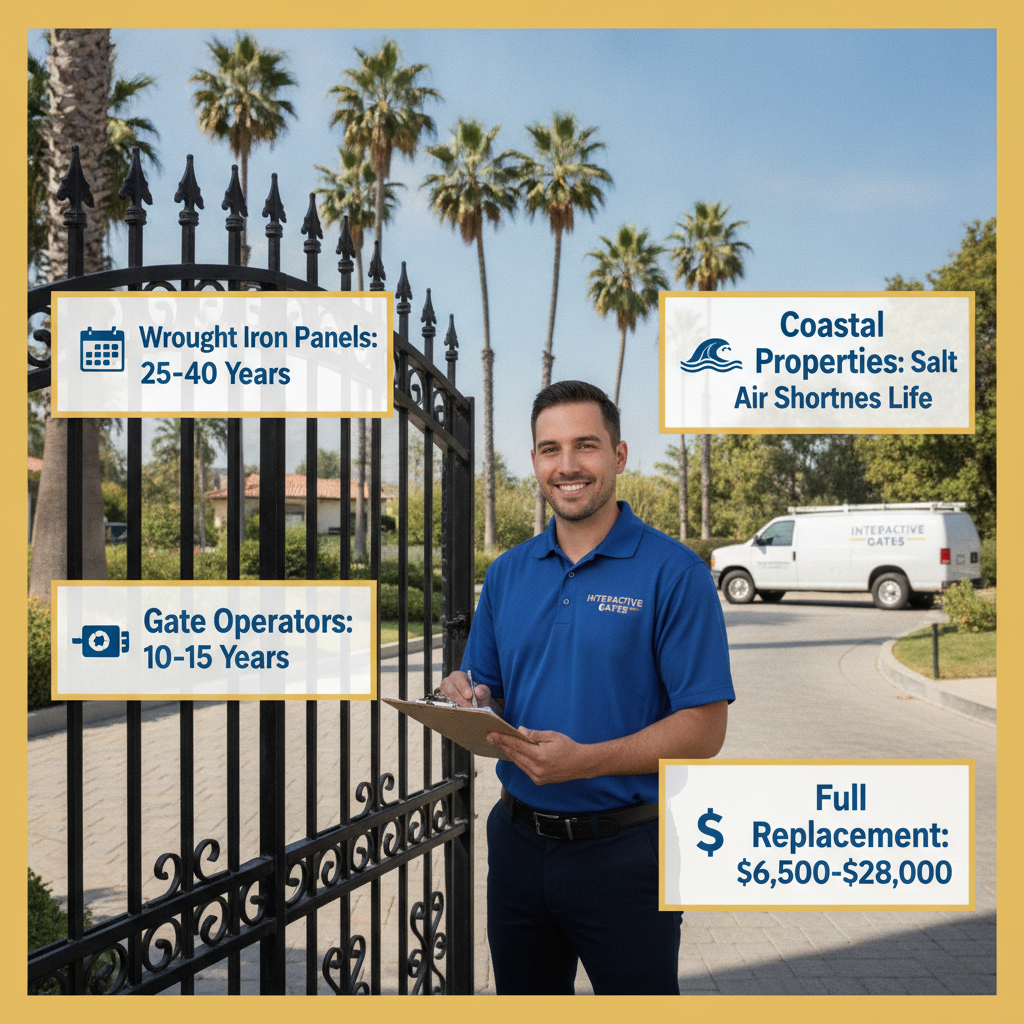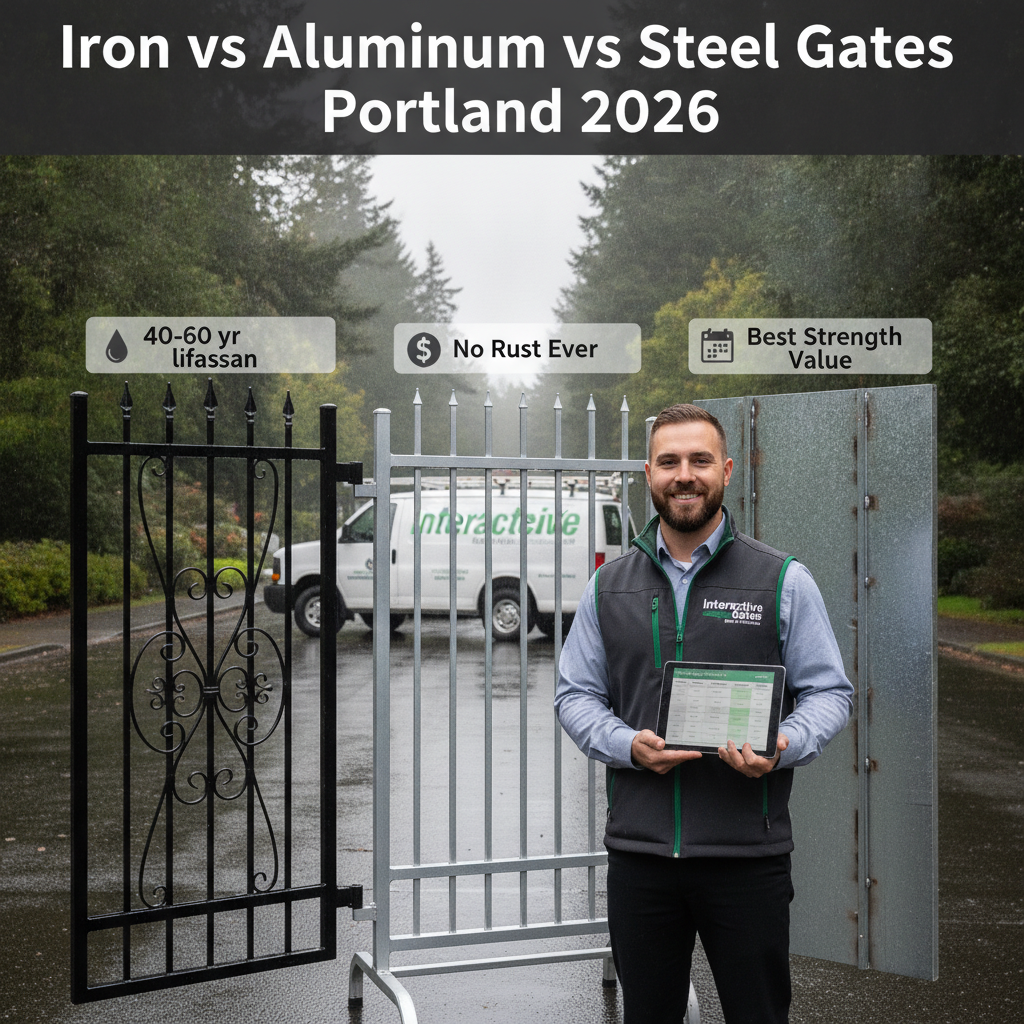
- Wrought iron gates cost $4,500–$14,000 installed in Portland and last 40–60 years with proper rust management in wet climates.
- Aluminum gates run $3,200–$9,500 installed and never rust — making them the lowest-maintenance pick for Portland's 144+ rain days per year.
- Steel (mild and galvanized) lands at $3,800–$11,500 installed and offers the best strength-to-cost ratio for high-traffic driveways and commercial entries.
- Portland's average annual rainfall of 36–43 inches is the single biggest material factor — surface coatings, weep holes, and powder-coat quality matter more here than in drier metros.
- Galvanized steel adds $400–$900 to base steel pricing but can double corrosion resistance in neighborhoods like St. Johns, Sellwood, and along the Columbia Slough corridor.
- Aluminum gates cycle 150,000–250,000 times before needing structural attention; iron and steel gates reach similar numbers only with annual maintenance.
- Portland Title 28 and Multnomah County permitting apply to most automated gate installations — material choice affects permit timelines when structural calcs are required.
- Powder-coat warranties range from 5 to 25 years depending on brand and coating process — always ask for mil thickness specs before signing a contract.
Wrought Iron, Aluminum, or Steel Gate — Which One Holds Up in Portland's Rain?
What kind of gate lasts the longest in Portland? Will wrought iron rust out in the wet season? Is aluminum strong enough for a heavy driveway gate? How does galvanized steel compare to powder-coated steel in the Pacific Northwest? These are the real questions Portland homeowners, property managers, and HOA boards are searching — and the answers depend almost entirely on one thing: how your material of choice handles 36–43 inches of annual rainfall, morning fog, and freeze-thaw cycles in the Gorge corridor.
This guide breaks down all three major gate materials with real 2026 installed price ranges, cycle counts, maintenance schedules, and neighborhood-specific context so you can make the right call before anyone digs a post hole.
How Does Portland's Climate Actually Damage Electric Gates?
Portland sits in a unique micro-climate band. The west side — Hillsboro, Beaverton, Lake Oswego — receives slightly less precipitation than the east side, but both zones share prolonged wet seasons that run October through May. Average humidity between November and March hovers around 80–88 percent. That sustained moisture is the primary enemy of ferrous metals (iron and steel) and the primary reason aluminum has gained significant market share in the Pacific Northwest over the past decade.
Beyond rain, Portland homeowners in the Columbia Gorge corridor — Troutdale, Gresham, and points east — face additional wind load events that can exceed 60 mph during Gorge wind events. Heavy wrought iron and thick steel panels actually perform better structurally in those high-wind zones, while lightweight aluminum may require heavier-gauge framing (1.5-inch to 2-inch wall tubing) to resist racking.
Freeze-thaw is a secondary but real concern. Portland proper rarely stays frozen for extended periods, but elevations above 700 feet — Southwest Hills, Forest Park adjacents, and parts of Lake Oswego's upper ridgeline — can see 15–30 freeze-thaw cycles per winter. Those cycles force moisture into any micro-crack in a coating, accelerating rust in iron and steel systems faster than raw rainfall alone.
What Is Wrought Iron and What Does It Actually Cost in Portland in 2026?
True wrought iron is a low-carbon, slag-infused metal that was the dominant gate material for centuries. In practice, most gates sold as 'wrought iron' today are actually mild steel with decorative forged elements — true hand-wrought iron is rare and custom-ordered. For this guide, we use the term as the market uses it: heavy ornamental steel construction with scrollwork, pickets, and architectural detail.
Installed costs for ornamental iron-style gates in the Portland metro in 2026 range from $4,500 for a basic single-swing pedestrian gate with LiftMaster LA412 operator up to $14,000+ for a wide dual-swing estate gate with Viking V-2000 or FAAC 402 operators, intercom, and custom scroll detail. Mid-range 14-foot dual swing configurations with standard decorative scrollwork and a LiftMaster CSW200 operator land around $7,500–$9,800 installed.
Lifespan in Portland's climate: 40–60 years structurally, but surface coatings need attention every 5–10 years. Without repainting or powder-coat touch-up, rust can develop at welds, cut edges, and hinge contact points within 3–5 years in the wettest microclimates (St. Johns, Lents, areas near the Willamette floodplain). With proper maintenance — annual inspection, touch-up paint on chips, and a full sandblast-and-recoat every 10–12 years — ornamental iron gates in Portland regularly outlast the homes they protect.
Pro Tip: If you're ordering an ornamental iron gate for a Portland property, specify hot-dip galvanized priming beneath the powder coat rather than standard epoxy primer. The upcharge is typically $300–$600 on a residential gate but can add 8–12 years to your coating life in a wet climate.
Is Aluminum a Good Gate Material for Portland Homes?
Aluminum has become the go-to material recommendation for Portland residential gates in the $3,200–$9,500 installed range, and for good reason: it is chemically incapable of rusting. Aluminum oxidizes, but aluminum oxide forms a tight, self-healing layer that actually protects the metal beneath — unlike iron oxide (rust), which flakes off and exposes fresh metal to further corrosion.
For Portland's wet season, aluminum's rust immunity is a significant operational advantage. There are no annual touch-up paint requirements, no rust-prevention sprays, and no sandblasting cycles. A properly powder-coated aluminum gate in Portland requires only periodic washing and a visual inspection of mechanical hardware (hinges, wheels, latches) once or twice a year.
Standard aluminum gate profiles used in the Pacific Northwest run 1-inch to 1.5-inch square tubing for residential applications and 2-inch wall tubing for commercial or HOA entries. Heavier 2-inch profiles are recommended for gates wider than 16 feet or in Gorge wind zones. Decorative options have expanded substantially — aluminum can now be fabricated to mimic ornamental iron scrollwork at a fraction of the weight, though the detail level rarely matches true custom iron work.
Installed cost breakdown in Portland 2026: single-swing pedestrian gate with Apollo 1550ETL operator, $3,200–$4,800; standard 12-foot dual-swing driveway gate with LiftMaster LA412 operators, $5,500–$7,200; wide 16-foot sliding aluminum gate with LiftMaster SL3000 operator and keypad, $7,800–$9,500. Commercial aluminum slide gates for apartment complexes or HOAs in Beaverton or Lake Oswego run $9,000–$16,000 depending on width and access control integration.
Cycle life for aluminum gates with quality hardware: 150,000–250,000 cycles before structural inspection is warranted. That equates to roughly 20–35 years at 20 openings per day.
How Does Steel Compare — and When Does It Make More Sense Than Iron or Aluminum?
Steel gates occupy the middle ground between aluminum's rust immunity and iron's decorative density. There are two main categories Portland installers work with in 2026: mild (carbon) steel and galvanized steel.
Mild steel is the most common fabrication material for custom-built gates. It's strong, weldable, and moderately priced. Without protective coating, it begins surface-rusting in Portland conditions within 6–18 months. With high-quality powder coat (typically 3–4 mil dry film thickness), it performs well for 8–15 years before needing a recoat cycle. Installed costs for mild steel driveway gates in the Portland metro: $3,800–$8,500 for residential swing configurations, $5,500–$11,500 for wider sliding or bi-parting commercial setups.
Galvanized steel is mild steel that has been dip-coated in molten zinc, creating a sacrificial corrosion barrier. For Portland properties in high-humidity microclimates — near Gresham's low-lying areas, along the Columbia Slough, or in Oregon City's riverside zones — galvanized steel is worth the premium. The upcharge is typically $400–$900 on a residential gate. Galvanized coatings extend the time before rust breakthrough to 20–30 years even if the powder coat is chipped or scratched, because the zinc corrodes preferentially before the steel beneath.
For Hillsboro commercial parks, warehouse entries, and agricultural properties in the Tualatin Valley, galvanized steel slide gates are the dominant choice among experienced local installers. They handle heavy truck traffic, wide openings (up to 40 feet), and the wet winter season without the maintenance demands of uncoated mild steel.
Pro Tip: When comparing steel gate quotes in Portland, always ask the fabricator for the powder-coat mil thickness spec. Budget fabricators often apply 1.5–2 mil coatings that chip within 2–3 years in Pacific Northwest conditions. Specify 3–4 mil DFT (dry film thickness) minimum, and get it in writing.
Which Material Is Best for Portland HOAs and Multi-Family Properties?
HOA boards and property managers operating in communities across Lake Oswego, Beaverton, and Oregon City face a different calculus than residential homeowners. High-cycle environments — 50–200+ openings per day — accelerate wear on every component, and material choice affects long-term operating budgets meaningfully.
For HOA entry gates cycling 80–150 times daily, aluminum is increasingly the preferred structural choice because it places zero corrosion maintenance burden on volunteer boards. A well-fabricated aluminum gate at a 60-unit community in Beaverton can run 8–12 years without any material-related service calls — only mechanical hardware (operator, hinge bearings, loop detectors) requires periodic attention. Installed cost for a complete dual-gate HOA entry system in the Portland metro in 2026 with aluminum panels, dual LiftMaster CSW200 operators, RFID keypad, and telephone entry: $18,000–$32,000 depending on gate width and access control complexity.
For communities that prioritize aesthetics — high-end neighborhoods in Lake Oswego's upper west side or gated estates near Sauvie Island — ornamental iron-style gates remain popular because they project a visual weight and permanence that aluminum cannot fully replicate. These communities typically budget $1,200–$2,500 per year for maintenance (touch-up paint, lubrication, hardware inspection) versus $400–$800 per year for comparable aluminum systems. Visit our HOA and commercial gate page for a full breakdown of what community gate systems include.
What About Mixing Materials — Iron Frame with Aluminum Infill, or Steel Posts with Aluminum Gates?
Hybrid construction is increasingly common in Portland and makes practical sense. A popular configuration: heavy steel or galvanized steel posts and frame (for structural rigidity and wind resistance) with aluminum infill pickets or panels (for corrosion-free surface area). This approach gives you the structural mass of steel at the hinge and post connection points — where loads concentrate — while eliminating rust risk across the large surface area of the gate face.
Cost premium for hybrid construction: typically $600–$1,500 more than all-aluminum of equivalent size, but less than all-iron/steel for equivalent corrosion resistance over a 20-year horizon. For Gorge-adjacent properties in Gresham where wind loads are real structural considerations, hybrid construction is increasingly the recommendation from experienced Pacific Northwest gate installers.
Galvanic corrosion between steel posts and aluminum panels is a legitimate concern — dissimilar metals in direct contact with moisture can accelerate oxidation. Experienced fabricators isolate the contact points with neoprene bushings or use aluminum-compatible zinc-rich primers at the interface. Ask your installer specifically how they handle the steel-to-aluminum transition before work begins.
How Do Portland's Permitting Rules Affect Material Choice?
Most automated gate installations in the Portland metro require a permit under Multnomah County or City of Portland Title 28 (residential) or Title 24 (commercial). Material selection directly affects whether structural calculations are required. Gates exceeding certain weight thresholds — typically 500 lbs for residential swing gates — may trigger engineering review of post footings and hinge hardware. Heavy ornamental iron gates frequently fall into this category; aluminum gates rarely do.
Timeline impact: standard residential aluminum gate permits in Portland process in 3–6 weeks. Heavy iron or custom steel gates requiring structural engineering letters can add 2–6 weeks to that timeline. If you're on a tight installation schedule — before a home sale, before a tenant move-in, or ahead of a rainy season window — aluminum's lighter weight can meaningfully accelerate your project. See our Portland service page for local permitting context specific to this market.
Material Comparison at a Glance: Portland 2026
- Wrought Iron / Ornamental Steel: $4,500–$14,000 installed | 40–60 yr lifespan | Annual maintenance required | Best for: high-end aesthetics, Gorge wind zones, lower-cycle residential driveways
- Aluminum: $3,200–$9,500 installed | 25–40 yr lifespan | Minimal maintenance | Best for: HOAs, wet microclimates, moderate-to-high cycle driveways, budget-conscious residential
- Mild Steel: $3,800–$8,500 installed | 20–35 yr lifespan (with maintenance) | Moderate maintenance | Best for: custom fabrication, commercial entries, mid-budget residential
- Galvanized Steel: $4,200–$11,500 installed | 30–45 yr lifespan | Low-to-moderate maintenance | Best for: riverside and slough-adjacent properties, Tualatin Valley agricultural/commercial, high-humidity microclimates
In One Minute: Portland Gate Material Summary
Portland's wet climate makes corrosion resistance the top selection criterion for electric gate materials. Aluminum wins on maintenance simplicity and long-term cost for most residential and HOA applications. Galvanized steel wins for commercial, high-cycle, and structurally demanding sites. Ornamental iron wins on aesthetics and wind-zone performance but demands the most ongoing maintenance to survive Portland's 144+ rain days per year. Hybrid steel-frame/aluminum-infill systems are a growing middle ground. Installed prices in 2026 range from $3,200 (basic aluminum single-swing) to $14,000+ (custom ornamental estate gate), with HOA systems running $18,000–$32,000 for complete dual-gate entries with access control. Whatever material you choose, powder-coat quality — minimum 3–4 mil DFT — and galvanic isolation details matter as much as the base metal in the Pacific Northwest. You can browse completed local projects at our project portfolio or use the gate designer tool to preview styles before requesting a quote.
Frequently Asked Questions: Gate Materials in Portland
Does wrought iron rust quickly in Portland's rainy climate?
True ornamental iron and mild steel gates will develop surface rust in Portland conditions within 3–7 years without maintenance, particularly at welds and cut edges. However, with hot-dip galvanized priming beneath quality powder coat (3–4 mil DFT), a well-fabricated iron gate can go 10–15 years before needing significant corrosion attention. Annual inspections and chip touch-up are essential in Portland's sustained wet season.
Is aluminum strong enough for a Portland driveway gate?
Yes, for the vast majority of residential driveways. Aluminum gates using 1.5-inch to 2-inch square tubing with adequate frame bracing handle normal vehicle traffic loads, standard wind loads, and daily cycling with ease. For Gorge-adjacent properties with documented high-wind exposure or very wide gates (18 feet+), specify heavier 2-inch wall tubing or a hybrid steel-frame design to ensure structural rigidity.
What is the cheapest electric gate option that will still last in Portland?
A powder-coated aluminum single-swing gate with an Apollo 1550ETL or LiftMaster LA412 operator is typically the lowest-cost entry point at $3,200–$4,800 installed, and it offers the lowest ongoing maintenance cost in Portland's climate. Mild steel at similar price points is structurally comparable but requires more maintenance investment over time to prevent rust breakthrough.
Do Portland HOAs need special gate materials under local codes?
Portland Title 28 and Multnomah County permitting do not specify a required material for gate panels, but they do govern structural requirements based on gate weight, opening type, and proximity to right-of-way. Heavier iron gates may trigger engineering review of post footings. HOA boards should consult with a licensed gate contractor familiar with local code before specifying materials to avoid permit delays.
How often does a steel gate need repainting in the Portland area?
A mild steel gate with standard powder coat (1.5–2 mil) in Portland typically shows chip-related rust within 4–7 years and needs a full recoat cycle every 8–12 years. Upgrading to 3–4 mil powder coat extends the first recoat interval to 12–18 years. Galvanized steel with quality powder coat can go 20+ years before full strip-and-recoat is needed, making it the lower-maintenance steel option for wet Pacific Northwest climates.
Can I see examples of different gate materials installed on Portland-area properties?
Yes — our project portfolio includes completed installations across the Portland metro in aluminum, steel, and ornamental iron styles. You can also use the Interactive Gates design visualizer to preview gate styles and materials on a property photo before committing to a design direction.
Ready to Choose the Right Gate Material for Your Portland Property?
The best gate is the one that fits your climate reality, your maintenance tolerance, and your budget — not the one with the most decorative scrollwork or the lowest upfront sticker price. If you'd like a site-specific recommendation from a team that installs gates across Portland, Beaverton, Lake Oswego, and the broader metro, reach out through our contact page for a no-pressure consultation. We're happy to walk through material options, current lead times, and what the permit process looks like for your specific address before any commitment is made.