
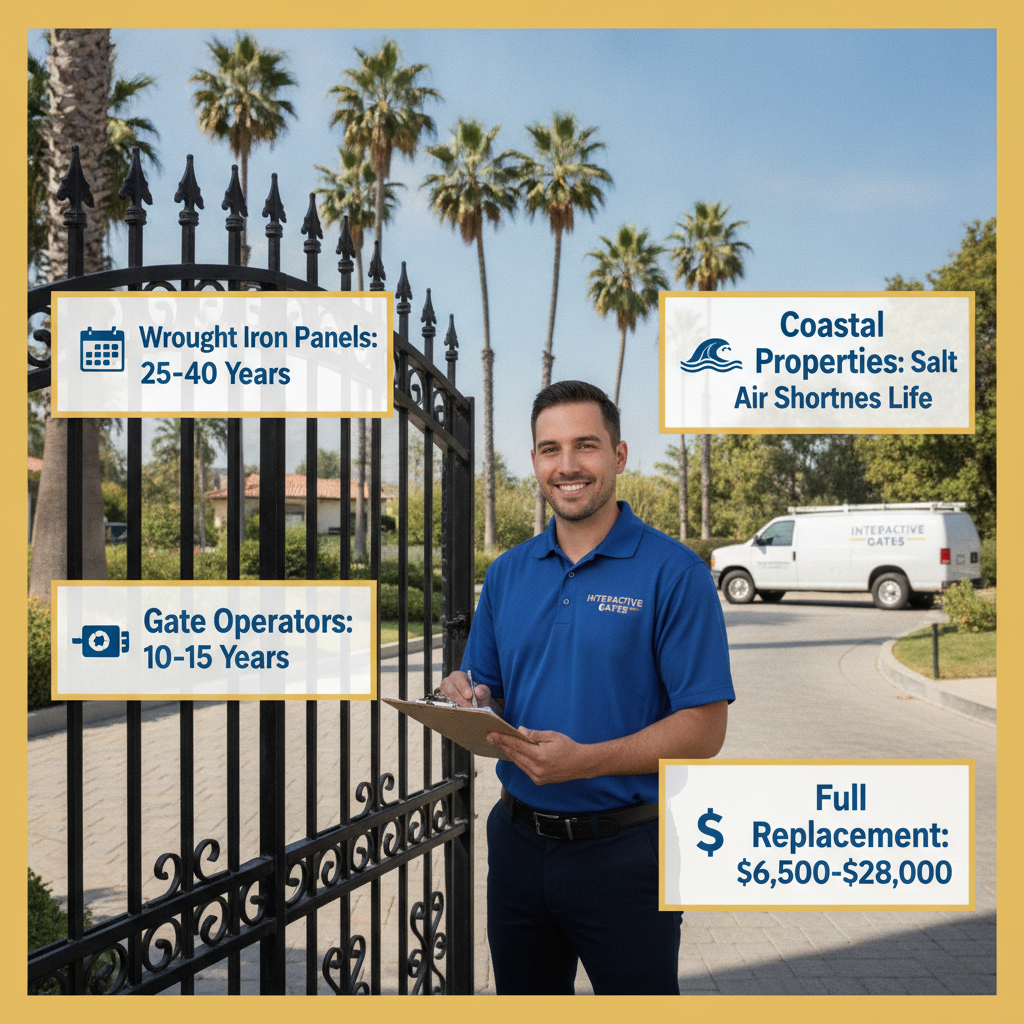
- Wrought iron swing gates last 25–40 years in Southern California when properly maintained — aluminum lasts 20–30 years, steel 15–25 years.
- Slide gate v-groove track hardware typically needs replacement every 8–12 years in LA's gritty, sun-baked conditions.
- Gate operators average 10–15 years of service life; coastal properties in Laguna Beach and San Clemente should expect the lower end due to salt air.
- Annual maintenance contracts run $180–$380 in the LA metro and can add 5–8 years to the life of your gate system.
- UL 325 safety sensors should be tested every 6 months and replaced every 5–7 years regardless of apparent condition.
- Most residential gate systems in Rolling Hills and Orange reach a replacement decision point at the 18–22 year mark, not because the gate fails but because operators and wiring do.
- Powder-coat finishes in LA's UV-intense climate need re-coating every 7–10 years to prevent oxidation from accelerating structural decay.
- A full gate system replacement in the Los Angeles market in 2026 runs $6,500–$28,000 depending on material, size, and access control complexity.
How Long Does an Electric Gate Actually Last in Los Angeles?
You're driving through your neighborhood in Orange, Rolling Hills, or Laguna Beach and you notice your gate is hesitating — grinding a little longer before it opens, dragging slightly on the return. Or maybe it's ten years old and you're wondering whether to keep pouring money into repairs or just replace the whole system. These are exactly the questions LA homeowners ask every day: How long should my electric gate last? Is it worth repairing? When does replacement actually make financial sense?
The honest answer is that gate lifespan in Los Angeles is shaped by three forces unique to Southern California: relentless UV radiation that degrades coatings and rubber components faster than in almost any other US metro, coastal salt air that corrodes hardware along the 30-mile coastal corridor from San Clemente to Los Angeles, and the sheer volume of daily cycles that come with busy family properties and gated HOA communities. This guide breaks down real numbers by gate type, material, and neighborhood so you can make a smart decision in 2026.
How Long Do Different Electric Gate Types Last in Southern California?
Not all gates age at the same rate. The mechanism — swing vs. slide vs. vertical lift — affects which components wear fastest and how expensive those replacements are.
Swing Gates
A well-built single or dual swing gate is the workhorse of the LA residential market. In neighborhoods like Rolling Hills and Orange, wrought iron swing gates routinely reach 30–40 years with periodic maintenance. The gate panel itself is extremely durable. What limits the system is the actuator arm or underground operator: expect 12–18 years from a quality underground unit like a FAAC 760 or an Apollo 1600, and 10–14 years from a surface-mounted arm operator like a LiftMaster LA400 or Viking VK-300. Hinges on heavy ornamental iron gates should be inspected annually; commercial-grade stainless hinges last indefinitely, but standard galvanized hinges in coastal ZIP codes can fail in as few as 7 years.
Sliding Gates
Sliding gates are common on narrow lots and commercial driveways throughout Los Angeles and Laguna Beach. The gate panel itself has a similar lifespan to swing gates — 20–35 years for steel or iron — but the track, rollers, and rack gear take a beating from LA's gritty particulate matter and summer heat. Expect to replace v-groove rollers every 5–8 years ($180–$340 per set installed) and the full track system every 10–14 years ($600–$1,400 installed). Slide gate operators — LiftMaster SL3000, FAAC 844, Viking SW-200 — average 10–14 years in the LA climate before motor or board failure makes replacement more economical than repair.
Vertical Lift & Bi-Folding Gates
Vertical pivot and bi-fold gates are less common residentially but appear in luxury hillside properties and commercial sites. Their mechanical complexity means more potential failure points, and lifespans of 12–18 years for operator systems are typical. The structural panels themselves can last 25+ years if powder-coated properly and touched up every 7–10 years.
How Does Los Angeles Climate Shorten Gate Life?
Southern California is not gentle on outdoor metal. Here's what's actually attacking your gate system year-round:
- UV radiation: LA receives roughly 284 sunny days per year. Powder-coat and paint finishes that would last 15+ years in Seattle or Portland need recoating every 7–10 years in LA. Degraded coating exposes base metal, accelerating rust on steel and pitting on aluminum.
- Salt air (coastal corridor): Properties within 1–2 miles of the Pacific — San Clemente, Laguna Beach, coastal LA — see accelerated corrosion on springs, cables, hinges, and circuit boards. Marine-grade stainless fasteners and conformal-coated control boards add $200–$500 upfront but can double hardware lifespan.
- Heat cycles: Summer temperatures regularly hit 95–105°F in inland valleys like the San Gabriel or Santa Clarita areas. Repeated thermal expansion and contraction stresses welds, warps cheaper aluminum panels, and degrades rubber seals on pneumatic operators.
- Seismic movement: California's earthquake activity — even minor tremors — can gradually shift gate posts out of plumb, stressing hinges and operators asymmetrically. Gates that are slightly out of alignment work their motors harder, reducing lifespan by 15–25%.
Pro Tip: If your gate is within two miles of the ocean, ask your installer for stainless steel hardware upgrades, a conformal-coated control board, and a marine-grade operator like the FAAC 402 CBC — the upfront premium of $300–$700 typically pays back within 4–6 years in avoided corrosion repairs.
What's the Lifespan of Electric Gate Operators Specifically?
The gate panel and the gate operator are two completely separate aging curves. Homeowners often confuse panel life with system life.
Here's what to expect from the most common residential operator brands in the LA market in 2026:
- LiftMaster LA400 / LA500: 10–14 years, rated 1,500–3,000 cycles/month. Strong warranty support; parts widely available at local dealers. Excellent for inland properties in Orange or suburban LA.
- FAAC 760 / 844: 12–18 years in residential use. Italian-engineered hydraulic units handle heat exceptionally well. Parts availability improved significantly in Southern California after 2023. Premium pricing ($1,800–$3,200 for the operator alone) but widely considered the best ROI for coastal and luxury properties.
- Viking VK-300 / SW-200: 10–15 years. Texas-built, popular for mid-market LA residential. Good heat tolerance; board failures are the most common end-of-life issue.
- Apollo 1600 / 3500: 8–13 years. Budget-to-mid market positioning. Adequate for properties with fewer than 20 cycles per day.
- Elite series operators: 10–14 years. Popular with LA HOA communities for their UL certification and app-connectivity options.
Cycle count matters as much as calendar age. A Laguna Beach vacation rental with 60+ gate cycles per day will burn through an operator in 6–8 years. A single-family home in Rolling Hills with 10–15 cycles per day will see that same operator run 14–16 years.
When Does Repairing Stop Making Sense? The 50% Rule in LA's Market
In 2026, the industry threshold remains the 50% Rule: if a single repair exceeds 50% of the cost to replace the entire operator, replace the operator. Here's how that math works in Los Angeles pricing:
- New operator installation (residential swing): $1,400–$3,800
- New operator installation (residential slide): $1,600–$4,200
- Control board replacement: $380–$720 — worth doing if the motor and hardware are under 8 years old
- Motor winding failure: $600–$1,100 — almost always triggers a full replacement recommendation on operators over 10 years old
- Hydraulic cylinder rebuild (FAAC): $450–$900 — cost-effective if the operator is under 10 years old, borderline after that
The full gate panel only makes sense to replace when: the structural integrity is compromised (heavy rust through the tube, bent frame from vehicle impact), the style is incompatible with a new operator mounting system, or the HOA has updated its design standards. A gate panel replacement in the LA market runs $2,800–$18,000 for residential ornamental iron or steel, with custom powder-coat colors adding $400–$1,200.
Pro Tip: Before deciding, ask for a written assessment that separates panel condition from operator condition. Many homeowners replace a perfectly sound iron gate simply because the operator died — an expensive mistake. A good technician will give you both replacement costs and repair costs in writing so you can compare apples to apples.
How Do Gate Lifespans Differ by LA Neighborhood?
Geography within Los Angeles County and Orange County creates meaningful differences in how long gate components last:
- Rolling Hills / Palos Verdes Peninsula: Coastal exposure accelerates hardware corrosion. Operators average 10–13 years. Gate panels in wrought iron often reach 30+ years because the neighborhood's lower traffic density means fewer daily cycles.
- Orange / Anaheim Hills: Inland heat and Santa Ana wind conditions drive UV degradation of coatings and dry out rubber components faster. Expect powder-coat recoating every 7–8 years. Operators average 11–15 years.
- Laguna Beach / San Clemente: Salt air is the dominant factor. Budget for stainless hardware upgrades and plan on operator lifespans of 9–13 years. See our San Clemente service page and Laguna Beach service page for specific local recommendations.
- Central Los Angeles (hillside properties): Seismic micro-movement and steep driveway grades stress operators harder. Swing gate actuators on steep inclines work at higher torque loads; plan for 10–13 years vs. the 14+ year lifespan on flat lots.
What Does a Full Gate System Replacement Cost in Los Angeles in 2026?
When replacement is the right call, here's what you'll actually spend in the current market:
- Basic single swing gate + operator (aluminum, no access control): $6,500–$9,500
- Dual swing ornamental iron + FAAC underground operators: $14,000–$22,000
- Slide gate (steel, residential, up to 16 ft): $8,500–$14,000
- Full system replacement with video intercom + keypad + app control: Add $1,800–$4,500 to any base gate cost
- Luxury estate ornamental iron with custom powder-coat, dual operators, full access control: $22,000–$28,000+
Permit costs in LA County run $150–$550 depending on jurisdiction, and lead times for custom ornamental iron fabrication are currently 4–8 weeks in 2026. Want to preview styles before committing? Use our free gate designer tool to see gate styles on your actual property.
In One Minute: Electric Gate Lifespan in Los Angeles 2026
- Wrought iron gate panels: 25–40 years with maintenance
- Aluminum gate panels: 20–30 years
- Gate operators: 10–18 years depending on brand, cycle load, and coastal exposure
- Track/roller hardware on slide gates: replace every 5–8 years
- Powder-coat recoating: every 7–10 years in LA's UV climate
- Annual maintenance contracts: $180–$380/year, adds 5–8 years to system life
- Full system replacement cost: $6,500–$28,000+ depending on scope
- Apply the 50% Rule: if one repair exceeds 50% of replacement operator cost, replace it
Frequently Asked Questions: Electric Gate Lifespan in Los Angeles
How long do electric gate motors last in Southern California?
Most residential gate operators in the LA area last 10–15 years under normal single-family use. Coastal properties in Laguna Beach and San Clemente should plan for the lower end of that range — 9–13 years — due to salt-air corrosion on internal components. High-cycle properties like vacation rentals or busy HOA entrances may see operators wear out in 6–9 years regardless of brand.
Does the hot LA climate really shorten gate life?
Yes, in two specific ways. Inland heat (95–105°F in summer valleys) accelerates degradation of rubber seals, lubricants, and powder-coat finishes. UV radiation — which LA receives at much higher annual intensity than Pacific Northwest cities — breaks down coatings that protect base metal. Together, these factors can reduce coating lifespan by 30–40% compared to a gate in Seattle or Portland, making regular maintenance and recoating essential.
Is it worth repairing an electric gate that's 15 years old in Los Angeles?
It depends on what failed. If the gate panel itself is structurally sound and the failure is a control board ($380–$720 repair), it's almost always worth repairing. If the motor has failed and the operator is over 12 years old, replacement is usually more economical because other components are near end-of-life anyway. Get a written itemized assessment before committing either way.
What's the most durable gate material for coastal Los Angeles properties?
Wrought iron with a high-quality epoxy primer and powder-coat finish is the most durable panel option if properly maintained. For hardware, specify marine-grade stainless fasteners and a conformal-coated control board. FAAC hydraulic operators are widely regarded as the top choice for coastal environments because their sealed hydraulic system is less vulnerable to salt-air corrosion than exposed gear-rack systems.
How much does it cost to replace just the gate operator in Los Angeles in 2026?
Operator-only replacement (labor and unit) runs $1,400–$4,200 in the LA metro depending on brand, gate type (swing vs. slide), and any electrical work needed. LiftMaster units are at the lower end; FAAC underground hydraulic operators are at the higher end. If new conduit or a pedestal needs to be installed, add $300–$800 to those figures.
How do I know when my gate needs to be replaced versus just serviced?
Key replacement signals: operator motor fails after age 12, structural rust penetrates gate tube walls, gate has been struck by a vehicle and the frame is bent, or repair costs for one service visit exceed 50% of a new operator's installed cost. Key service signals: gate is slow or hesitating but under 10 years old, safety sensors fail a reversal test, or the gate drifts out of alignment seasonally. Annual inspections help catch issues before they become replacement decisions. Contact our Los Angeles team to schedule a system assessment.
Ready to Know Exactly Where Your Gate Stands?
Whether your gate is five years old and just needs its first tune-up or twenty years old and showing real signs of fatigue, an honest assessment from an experienced local tech is the most valuable thing you can get before spending a dollar. Explore our residential gate services, browse real LA installation examples in our portfolio, or read what local customers say on our reviews page. When you're ready to talk specifics, reach out to our Los Angeles team — no pressure, just straight answers about what your gate actually needs in 2026.


