- Cedar and redwood gates cost $4,500–$9,000 installed but require resealing every 1–2 years in Seattle's wet climate.
- Powder-coated steel gates run $6,000–$14,000 installed and last 20–30 years with minimal upkeep in Puget Sound conditions.
- Aluminum gates cost $5,500–$11,000 installed and never rust — making them a strong choice for waterfront lots in Gig Harbor or Lakewood.
- Wood gates average 8–15 years in Seattle versus 20–30 years for steel and 25–35 years for aluminum before major structural work is needed.
- LiftMaster, FAAC, and Viking all make operators rated for 300–500 lb gates — weight matters because wood swells and gets heavier when wet.
- Annual maintenance on a wood gate runs $350–$700 (sealing, hardware checks, hinge adjustments) versus $150–$300 for steel.
- Seattle's 37–40 inches of annual rainfall is the single biggest material-selection factor — wood joints absorb moisture and can warp within 3–5 rainy seasons without treatment.
- Most Mercer Island and Bellevue HOAs require powder-coated metal or composite — verify CC&Rs before ordering wood.
Wood Gate or Metal Gate in Seattle — Which One Should You Actually Buy?
You've been searching things like 'best gate material for Seattle rain,' 'does wood rot on electric gates in the Pacific Northwest,' or 'aluminum vs steel driveway gate Seattle 2026.' Those are exactly the right questions, and the answers depend on your neighborhood, lot type, HOA rules, and how much hands-on maintenance you're willing to do every year. This guide walks through every major material option with real 2026 price ranges, lifespan data, and the climate-specific details that generic reviews always skip.
How Does Seattle's Climate Actually Affect Gate Material?
Seattle averages 37–40 inches of rain per year, with sustained damp periods from October through April. That's not torrential — it's chronic low-grade moisture, which is actually harder on gate materials than occasional heavy storms. Wood absorbs this moisture through end grain and joinery, causing swelling that throws off auto-operator alignment. Steel that loses its coating oxidizes fast in standing water. Even aluminum, which doesn't rust, can develop corrosion at fastener points if dissimilar metals are used in the hinge hardware.
Beyond rain, neighborhoods like Gig Harbor, Tacoma waterfront, and Lakewood deal with salt-laden air that accelerates corrosion on any ferrous metal. Properties in Snohomish and Auburn often sit on clay-heavy soil that shifts seasonally, stressing gate posts regardless of what the gate leaf is made of. And in elevated areas of Bellevue or parts of Everett, wind gusts during fall and winter storms routinely hit 35–55 mph — a factor that affects how heavy and rigid your gate needs to be.
What Are the Real Costs of Wood Electric Gates in Seattle in 2026?
Wood gates are the most visually warm option and often chosen for craftsman-style homes in neighborhoods like Fremont, Wallingford, and West Seattle. But they come with the highest long-term maintenance cost of any gate material in this climate.
2026 installed price range for wood electric gates in Seattle:
- Cedar or redwood single swing gate (10–12 ft): $4,500–$7,000
- Cedar or redwood dual swing gate (14–18 ft): $7,000–$9,500
- Horizontal-slat hardwood slide gate (up to 16 ft): $8,000–$13,000
Those prices include a LiftMaster LA400 or equivalent swing operator, standard keypad, and basic concrete post work. They do not include permit fees (typically $150–$400 in King County) or upgraded access control like video intercoms, which add $800–$2,500.
The catch: cedar gates need a penetrating oil or sealant applied every 12–18 months in Seattle's climate. Skipping even one cycle causes the wood to gray, check-crack along the grain, and eventually delaminate at the frame joints. That maintenance visit costs $250–$450 each time you hire it out. Over 10 years, you're adding $2,500–$4,500 in maintenance alone — before you account for any hinge replacements or motor recalibrations caused by gate weight changes as the wood absorbs and releases moisture seasonally.
Pro Tip: If you love the look of wood but live near the water in Gig Harbor or Lakewood, specify a marine-grade teak or IPE hardwood frame with hidden aluminum substructure. It costs 20–30% more upfront but cuts moisture-related warping by roughly half and keeps the motor aligned longer.
What Do Steel Electric Gates Cost in Seattle in 2026?
Powder-coated steel is the workhorse of Seattle gate installs. It's heavy enough to feel substantial, takes paint well (including custom colors to match fencing), and holds up for 20–30 years with basic annual maintenance. The coating does the heavy lifting — as long as it's intact, the steel underneath stays protected even in sustained rain.
2026 installed price range for steel electric gates in Seattle:
- Ornamental steel single swing gate (10–12 ft): $6,000–$9,500
- Ornamental steel dual swing gate (14–18 ft): $9,500–$14,000
- Flat-bar or tubular steel slide gate (up to 20 ft): $10,000–$16,500
- Cantilever slide gate in steel (commercial or large residential): $14,000–$22,000
Steel gates pair well with Bellevue and Everett properties where HOAs often mandate a specific finished appearance. Many HOA boards in those areas specify powder-coated black or dark bronze — steel is the most cost-effective way to hit that look at scale.
Maintenance on a powder-coated steel gate in Seattle runs $150–$300 per year for a professional tune-up: checking the operator, lubricating hinges and rollers, inspecting the coating for chips, and touching up any bare spots with cold galvanizing compound before rust can start. If the coating is damaged and left untreated through a full Seattle rainy season, surface rust appears within 4–8 weeks and can require sandblasting and re-coating at $800–$1,800 per gate leaf.
How Does Aluminum Compare to Steel for Seattle Gates in 2026?
Aluminum has become significantly more popular in Seattle installs over the past two years, specifically because it is genuinely corrosion-proof — there's no iron in the alloy, so rain and salt air simply can't rust it. It's also about 40% lighter than steel at equivalent panel sizes, which means less stress on operators and posts over time.
2026 installed price range for aluminum electric gates in Seattle:
- Aluminum single swing gate (10–12 ft): $5,500–$8,500
- Aluminum dual swing gate (14–18 ft): $8,500–$12,500
- Aluminum slide gate (up to 20 ft): $10,000–$15,000
The tradeoff: aluminum dents and bends more easily than steel if a vehicle impacts it. For properties on busy streets or with multiple drivers using the gate daily — think a Tacoma rental property or a Lynnwood multi-family — steel's impact resistance often wins out. But for waterfront properties in Gig Harbor, aluminum is almost always the smarter call because the salt-air corrosion risk is eliminated entirely.
Aluminum also works especially well in coastal and semi-coastal areas because you can use stainless steel hardware throughout with no galvanic corrosion issues, as long as your installer specifies the correct isolating bushings at dissimilar-metal contact points. Annual maintenance on aluminum runs $120–$250 — mostly operator service and hinge lubrication, since the panel itself requires almost no treatment.
What About Wrought Iron Gates in Seattle?
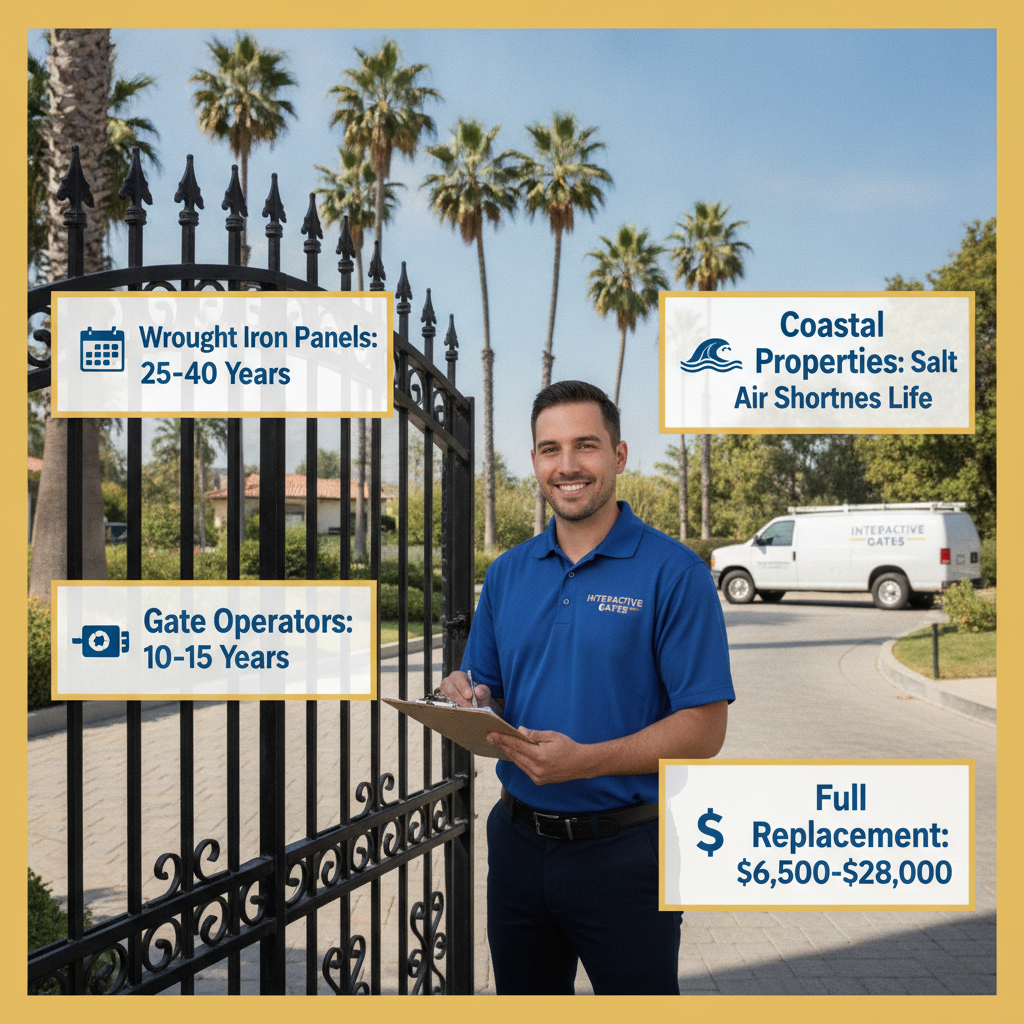
True wrought iron is rare in new installs — most gates sold as 'wrought iron' are actually mild steel with decorative forge-style details. Authentic wrought iron is hand-worked and typically custom-fabricated, starting at $12,000–$25,000 installed for a driveway gate in 2026. In Seattle's climate, it requires the same coating care as steel. The benefit is aesthetic and longevity — a properly maintained wrought iron gate can outlast the house it's attached to. It's most common on higher-end properties in Seattle neighborhoods like Madrona, Madison Park, and Broadmoor.
Which Gate Operators Work Best With Each Material?
Material choice directly affects your operator selection because weight and duty cycle requirements vary significantly:
- Wood gates: Because wet cedar can gain 15–25% in weight during heavy rain seasons, operators need headroom. The LiftMaster LA500 (rated to 500 lb per leaf) or FAAC 391 are commonly specified for wood swing gates over 12 ft wide.
- Steel gates: Standard ornamental steel runs 150–350 lb per leaf. LiftMaster LA400, Viking XL, or FAAC 400 cover most residential steel swing gates comfortably. Heavy cantilever slides need industrial-class operators starting at the LiftMaster CSL24V or FAAC 615.
- Aluminum gates: Lighter weight means you can often use a smaller operator — LiftMaster LA400 handles most aluminum swing gates up to 16 ft — but don't downsize too aggressively if the gate faces prevailing southwest winds off Puget Sound. Wind load on a solid-panel aluminum gate can exceed 800 lb of force in a 50 mph gust.
Cycle count matters too: residential operators are typically rated 15–30 cycles per day; HOA or multi-family gate operators need commercial-rated equipment at 100–300 cycles per day. See real examples of what's been installed locally in the project portfolio.
Pro Tip: Always ask your installer what the operator's rated duty cycle is at the gate's actual weight — not the maximum weight rating. A motor rated for 500 lb gates may only be rated for 15 cycles/day at that load. If you're running 40+ cycles daily, you need either a lighter gate material or a higher-duty operator.
Do Seattle HOAs or Local Codes Restrict Gate Materials?
In King, Pierce, and Snohomish counties, there's no single county-wide rule about gate materials — but there are several layers to check:
- HOA CC&Rs: Many planned communities in Bellevue, Mercer Island, and parts of Auburn specify metal gates only — no wood — because of maintenance and appearance uniformity standards. Always request CC&R review before ordering materials.
- Historic overlay zones: Parts of Capitol Hill and First Hill in Seattle have design review requirements. Wood or decorative wrought iron may be required to match existing character.
- Wildland-Urban Interface (WUI) zones: Hillside properties in parts of Snohomish County adjacent to forested areas may face fire-resistance requirements that effectively eliminate untreated wood gate panels.
For HOA-managed communities, see our HOA gate services page for a breakdown of what multi-unit communities typically need and what the per-unit cost structure looks like in 2026.
In One Minute: Wood vs. Metal Electric Gates in Seattle 2026
Cedar/redwood gates cost $4,500–$9,500 installed, look beautiful, but need resealing every 12–18 months and average only 8–15 years before major structural work in Seattle's 37–40 inch annual rainfall environment. Powder-coated steel runs $6,000–$16,500 installed, lasts 20–30 years with basic upkeep, and is the most HOA-friendly option. Aluminum costs $5,500–$15,000 installed, never rusts, and is the best choice for waterfront and salt-air properties in Gig Harbor and Lakewood. Wrought iron is premium ($12,000–$25,000+) and lasts generations with proper coating care. Operator selection must account for gate weight — wood gates get heavier when wet, so size up. Annual maintenance costs range from $120–$250 for aluminum to $350–$700 for wood. Check HOA CC&Rs and any WUI fire codes before finalizing your material choice.
Frequently Asked Questions: Wood vs. Metal Electric Gates in Seattle
Does cedar really warp on electric gates in Seattle's rain?
Yes — untreated or under-maintained cedar will begin to check-crack and warp within 2–4 wet seasons in Seattle. The issue is end-grain moisture absorption at the frame joints, which causes the gate to grow slightly wider, throwing off the operator's limit settings and eventually straining hinges. Marine-grade sealant applied every 12–18 months significantly reduces but does not eliminate this risk. If you want the wood aesthetic with lower maintenance, an aluminum-framed gate with cedar infill panels is a reliable compromise that many Fremont and West Seattle homeowners have switched to.
How long does a powder-coated steel gate last in Seattle without rusting?
A properly applied powder coat (60–80 microns thick, applied over sandblasted clean metal) will protect a steel gate for 15–25 years before needing full recoating in Seattle conditions. The weak points are chip damage — any bare spot exposed to Seattle's sustained dampness will rust within 4–8 weeks. Annual inspections with touch-up cold galvanizing spray on any chips or scratches keeps the clock running. Stainless steel fasteners throughout the assembly prevent secondary rust streaks from hardware.
Is aluminum strong enough for a security gate in Seattle?
For residential and most HOA applications, yes. 6061-T6 aluminum alloy — what quality gate fabricators use — has a yield strength of around 40,000 psi, which is more than adequate for a driveway gate. The limitation is impact resistance: aluminum dents and bends more readily than steel when struck by a vehicle. For properties where vehicle strike is a realistic risk (tight driveways, guest drivers, delivery vehicles), steel's additional rigidity is worth the extra corrosion maintenance. For waterfront homes or aesthetics-first installs, aluminum is an excellent choice.
What gate material do most Seattle HOAs require?
Based on CC&Rs we regularly review in King and Snohomish counties, the majority of HOAs with gate standards require powder-coated metal — most commonly black or dark bronze tubular steel or aluminum. Wood is rarely permitted as the primary gate material in HOA communities because of the maintenance variability — one homeowner's neglected cedar gate can look dramatically different from a neighbor's well-maintained one within three years. If you're unsure about your CC&Rs, bring the governing documents to your consultation and we'll flag any restrictions before design begins.
Can I mix wood and metal on the same electric gate?
Absolutely — and it's increasingly common in Seattle. A tubular steel or aluminum frame with cedar, teak, or composite wood infill panels gives you structural rigidity from the metal while delivering the warm, residential appearance of wood. The frame handles hinge and operator loads, while the wood panels are protected on three sides by the frame and only need sealing on the exposed face. This hybrid approach costs roughly 15–25% more than a wood-only gate but significantly outlasts it in Pacific Northwest conditions. It also tends to satisfy HOA requirements for metal-framed gates.
Does gate material affect my home insurance or security rating?
Not directly in most standard homeowner policies — insurers don't typically specify gate material. However, some umbrella or high-value home policies from carriers active in Seattle do credit properties with specific perimeter security features, and a steel or aluminum gate with a certified access control system is more likely to qualify for those credits than an unmotorized wood gate. Check with your agent about any perimeter security discounts when you're adding an automatic gate regardless of material.
Ready to Choose the Right Gate Material for Your Seattle Property?
If you're still weighing wood versus steel versus aluminum, the best next step is to see real examples side by side. Browse the completed project gallery for Seattle-area installs, or use the gate design visualizer to see different materials and styles on a driveway that matches your property type. When you're ready to talk specifics — lot dimensions, HOA rules, operator options — the residential gate services page walks through what a consultation covers, or you can reach out directly for a no-pressure site evaluation. There's no single right answer on material — the right answer is the one that fits your climate exposure, your maintenance tolerance, and your neighborhood's specific requirements.