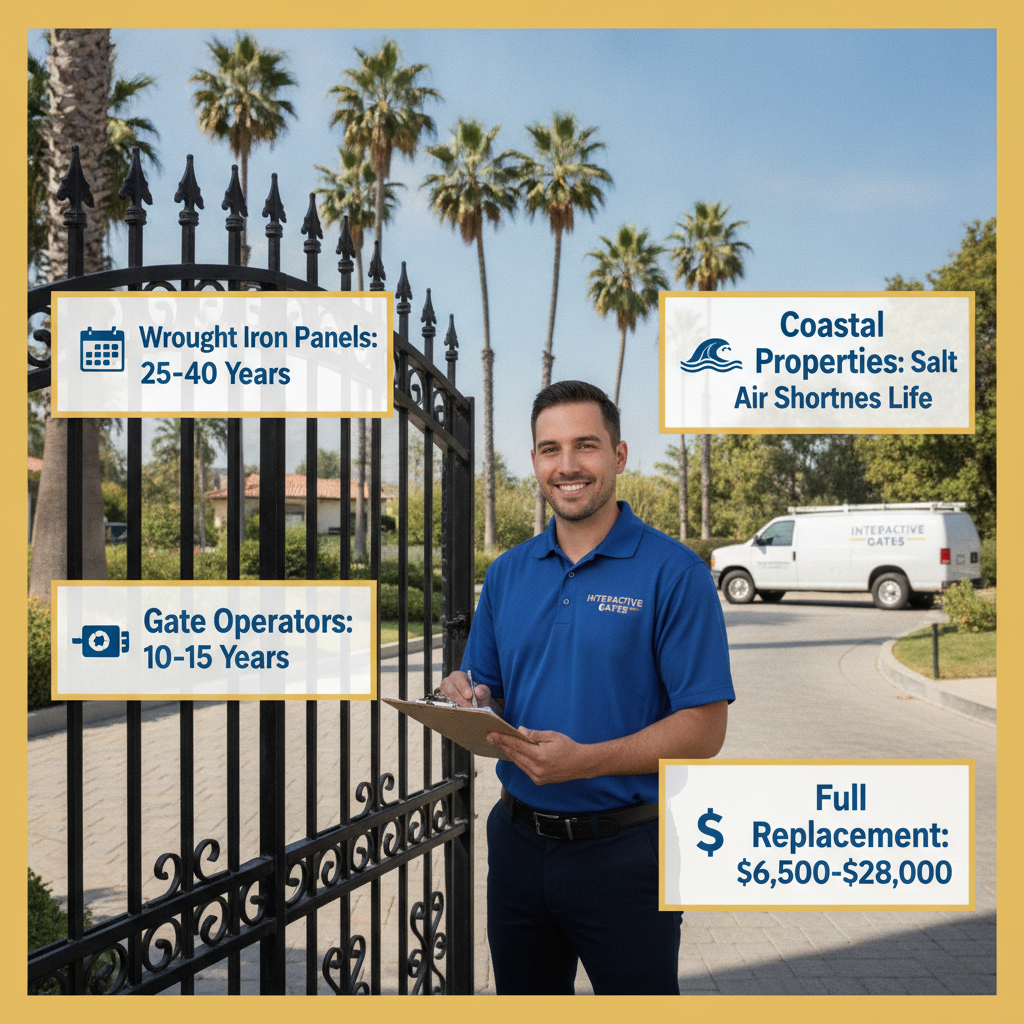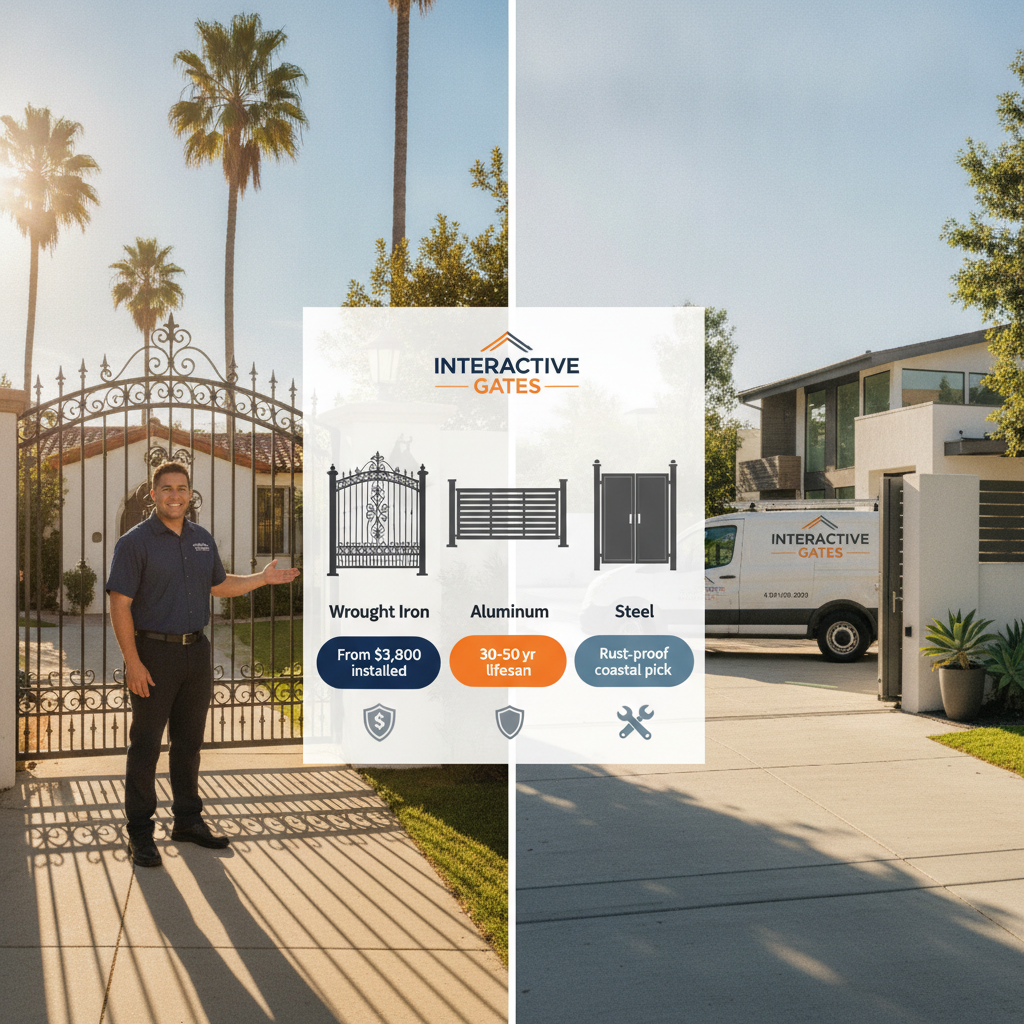
- Wrought iron gates last 40–60+ years in Los Angeles but require rust-touch-ups every 3–5 years due to coastal salt air, especially near Laguna Beach and San Clemente.
- Aluminum gates cost $3,800–$9,500 installed in 2026, never rust, and are the top choice for oceanfront properties within a mile of the Pacific.
- Steel swing gates run $5,500–$14,000 installed depending on width, infill design, and whether you're in a hillside neighborhood like Rolling Hills or a flat lot in Orange.
- Powder-coat finish adds 10–15 years to any metal gate's lifespan and costs $400–$900 extra at installation — worth every dollar in the LA marine layer zone.
- LiftMaster, FAAC, and Viking operators are the three most-installed brands by local gate companies across the LA basin in 2026; brand choice matters as much as gate material.
- HOA approval timelines in gated communities like Rolling Hills Estates average 4–8 weeks; always confirm material and finish specs before ordering.
- Aluminum gates weigh 40–60% less than steel, putting far less stress on operators and posts — a real advantage on sloped driveways common in the Santa Monica Mountains and Palos Verdes.
- Most residential gates in LA are replaced at 20–30 years, not because the metal fails, but because the operator, hinges, or weld joints give out first.
Wrought Iron, Aluminum, or Steel — Which Gate Material Is Right for My LA Home?
You've decided you want an automatic driveway gate. Now comes the question that stumps almost every homeowner: what should it be made of? A neighbor in Laguna Beach swears by aluminum. A property manager in Orange says nothing beats a heavy steel slide gate. A Rolling Hills estate owner insists wrought iron is the only material that looks the part. Who's right? All of them — and none of them — because the best material depends on your specific property, your ZIP code's climate microclimate, your HOA rules, and your long-term budget. This guide breaks it all down with real 2026 numbers and local Southern California context so you can make the call with confidence.
What Is the Actual Difference Between Wrought Iron, Steel, and Aluminum Gates?
These three terms get used interchangeably at hardware stores and in contractor quotes, which causes real confusion. Here's the straight story for 2026.
Wrought iron is a low-carbon iron alloy that was traditionally hand-forged by blacksmiths. True wrought iron is rare today — most gates marketed as 'wrought iron' are actually mild steel with an ornamental design that mimics classical ironwork. When your gate company says 'wrought iron,' they usually mean heavy-gauge tubular steel with decorative pickets, scrollwork, or spear tips that give that classic estate look. Genuine hand-forged wrought iron gates are still available from specialty fabricators for $12,000–$30,000+ for a single-leaf driveway gate, but they are uncommon.
Steel gates use structural steel tubing, typically 1.5-inch to 2-inch square or rectangular profiles, welded into frames with infill pickets or panels. They are heavy — a 16-foot dual-swing steel gate can weigh 600–900 lbs — and extremely strong. They rust if the finish fails and they are not maintained.
Aluminum gates use extruded aluminum tubing or cast aluminum components. They are lightweight (a comparable 16-foot aluminum gate weighs 200–350 lbs), genuinely rust-proof (aluminum oxidizes but does not flake or pit the way iron and steel do), and require almost no maintenance beyond occasional washing. The trade-off: aluminum is softer and can dent more easily if struck by a vehicle.
How Much Do Each Gate Materials Cost in Los Angeles in 2026?
Prices below are fully installed — gate fabrication, operator, loop detectors, safety edges, keypad or intercom entry system, concrete post footings, and electrical connection. They reflect the LA basin market as of mid-2026.
Aluminum swing gates (residential, single driveway): $3,800–$7,200. Double-leaf (dual swing) aluminum: $5,500–$9,500. Aluminum slide gates up to 20 feet: $6,000–$11,000.
Steel swing gates (residential): $5,500–$10,000 single leaf. Dual swing: $8,000–$14,000. Steel slide/rolling gate up to 20 feet: $9,000–$16,500.
Ornamental 'wrought iron' style (heavy steel, ornate): $7,500–$18,000 for residential dual swing depending on custom scrollwork and finish. Estate-scale or commercial: $15,000–$35,000.
Commercial and HOA applications — think a gated community entry in San Clemente or a multi-tenant property in Orange — add $3,000–$12,000 for vehicle loop systems, card readers, telephone entry, and CCTV integration. See our HOA and commercial gate page for a deeper breakdown.
Pro Tip: Always get quotes that separate the gate fabrication cost from the operator cost. A cheap gate with a quality LiftMaster SL595 or FAAC 760 operator will outperform an expensive gate on a budget motor every single time.
Which Gate Material Holds Up Best Against the LA Climate?
Southern California sounds like paradise for metal — no freeze-thaw cycles, no road salt, no brutal ice storms. That's partly true. But the LA basin has three distinct corrosion microclimates that matter enormously for gate material selection.
Coastal zone (within 1 mile of the Pacific — Laguna Beach, San Clemente, parts of LA's West Side): Salt-laden marine air is relentless. Steel and iron gates in this zone without exceptional surface prep will show rust blisters within 3–5 years of a finish failure. Aluminum is the overwhelming favorite here. If you insist on steel for the aesthetic, budget for repainting every 4–6 years and touch-up inspections annually. Galvanized steel (hot-dip galvanizing adds $800–$2,000 to fabrication) plus powder coat is the minimum protection for coastal steel gates.
Inland valleys and hillside neighborhoods (Rolling Hills, Palos Verdes, parts of Orange, most of the SGV): Less salt, more UV. Southern California's UV index is among the highest in the continental US, degrading paint and powder coat faster than manufacturers' spec sheets (written for cloudy climates) suggest. Expect 12–18 years from a quality powder coat in inland LA vs. 20+ years in, say, Portland. Both steel and aluminum perform well here; the choice becomes aesthetic and budget-driven.
Fire-risk and WUI zones (hillside properties in the Santa Monica Mountains, Malibu, parts of Glendale and Pasadena): Cal Fire and local fire departments increasingly scrutinize gate design for emergency vehicle access. Non-combustible metal gates (steel, iron, aluminum) are all acceptable, but gate width, opening speed, and Knox Box provisions for fire department override are code requirements that affect your design. Your gate contractor must know local fire access ordinances — this is not a detail to overlook.
How Long Does Each Gate Material Last in Los Angeles?
Lifespan figures assume professional installation, correct surface finish, and routine annual maintenance (lubrication of hinges and operator, visual inspection, touch-up painting as needed).
Aluminum: 30–50 years for the gate structure itself. Aluminum does not rust. Expect to replace the operator every 12–20 years depending on cycle count and brand. HOAs with high-volume entry gates may cycle an operator through 200,000+ cycles in 8–10 years.
Steel (powder-coated): 25–40 years structurally if maintained. Surface rust is the enemy — a chip in the finish that goes untreated for two rainy seasons can undercut the coating and spread. Annual inspection and spot touch-up with cold galvanizing compound plus matching powder-coat spray extends life dramatically.
Ornamental 'wrought iron' style steel: Same metallurgy as steel, but the ornate profiles (scrollwork, spear tips, rings) create more surface area and more crevices where moisture hides. Ornate gates need slightly more diligent maintenance. Lifespan: 25–45 years with care.
The honest truth: in our experience across the LA basin, most residential gates are replaced not because the metal frame failed but because the welds cracked, the hinges wore out, or the homeowner simply wanted an updated style. Choosing a material that's 'good enough' and investing more in a quality operator and finish is usually smarter than spending the maximum on the heaviest steel frame possible.
What About Aesthetics — Which Material Looks Best for LA Homes?
Design matters in Los Angeles in a way that is genuinely distinct from other markets. Curb appeal, architectural consistency, and neighborhood character all play into what gate style is appropriate — and in many neighborhoods, HOA design standards dictate material, color, and style anyway.
Spanish Colonial, Mediterranean Revival, and Hacienda homes (common in San Clemente, parts of Orange, and older LA neighborhoods) look best with ornamental steel or wrought-iron-style gates in flat black, oil-rubbed bronze, or dark charcoal. Aluminum can mimic this look but tends toward lighter profiles that can look less substantial on a wide motor-court entry.
Modern and Contemporary homes (abundant in Los Angeles, the Hills, and coastal communities) suit horizontal-slat aluminum or steel gates in matte black, dark bronze, or custom RAL colors. The lighter weight of aluminum allows for larger panels without operator overload.
Ranch and Craftsman homes (Rolling Hills, parts of Glendale) often pair well with either material in a classic estate swing-gate configuration. The ornamental steel look reads 'established' and 'secure' — values that rank highly in these neighborhoods.
Want to visualize how different gate styles look on your actual property before committing? Use our gate designer tool to preview styles, colors, and configurations in real time.
Pro Tip: If your property is in a Rolling Hills HOA or any Palos Verdes community, get architectural committee approval in writing before your gate contractor orders materials. HOA approval in these communities takes 4–8 weeks and rejection of a non-compliant material can mean a costly re-order.
Steel vs. Aluminum: Which Is Better for Sloped Driveways in Los Angeles?
This is a question that comes up constantly for hillside properties — and the answer matters more than most homeowners realize. The hills of Rolling Hills, Palos Verdes, the Hollywood Hills, Bel Air, and Malibu all present driveways with grades ranging from 5% to over 20%.
On a sloped driveway, a swing gate must either be installed level (with a gap underneath on the downhill side) or raked to follow the grade. Both approaches work, but a heavy steel gate on a steep slope places enormous stress on hinge posts and operators during the opening arc. Aluminum's weight advantage — 40–60% lighter than equivalent steel — translates directly to a smaller, less expensive operator, fewer hinge post failures, and longer operator motor life.
Slide gates on sloped driveways require a track that follows the grade and a counterbalanced or rack-and-pinion operator rated for slope. Both steel and aluminum slide gates can work, but again, lighter aluminum reduces wear on the operator. For very steep sites (over 12% grade), consult with your installer about a vertical-lift or swing-arm solution — our Rolling Hills gate installation page covers hillside-specific configurations in detail.
What Operator Brand Should I Pair With My LA Gate Material?
The gate material and the operator are a system — they need to be matched correctly. Here's how local installers typically pair them in 2026.
LiftMaster SL595 / SL3000: Industry workhorse for residential and light commercial. Works with aluminum and steel gates. The SL595 handles gates up to 2,000 lbs and 40 feet; the SL3000 is for heavier commercial steel. LiftMaster's myQ app integration is best-in-class for homeowner convenience.
FAAC 760 / FAAC 844: Italian-engineered hydraulic and electromechanical operators favored for heavy ornamental steel and iron gates. The 760 is the go-to for dual swing iron/steel gates in upscale residential applications. FAAC operators are quieter and handle high-cycle-count installations exceptionally well.
Viking Access VG-25 / VG-50: Viking's slide gate operators are widely used across commercial and multi-family properties in the LA basin. The VG-50 handles 2,500-lb panels and integrates cleanly with ButterflyMX and DoorKing intercom systems common in LA apartment complexes and gated communities.
Apollo 1600 / 1650: A solid mid-range choice for lighter aluminum swing gates on residential properties. Good value, reliable, and integrates with standard keypads and loop systems. Popular for single-family homes in Orange, Laguna Beach, and San Clemente where the gate sees lower daily cycle counts.
Browse our project portfolio to see real installations across the LA area by gate type, material, and operator brand.
Is There a 'Best' Choice for Most Los Angeles Homeowners in 2026?
If you're within a mile of the coast: aluminum, full stop. The corrosion resistance advantage is too significant to ignore, and the cost savings on long-term maintenance are real. Pair it with a quality FAAC or LiftMaster operator and a good powder-coat finish.
If you're inland, on a flat lot, and want the classic ornamental estate look: ornamental steel with hot-dip galvanizing plus powder coat. Budget for touch-up maintenance every 4–6 years and you'll have a gate that looks impressive for 30+ years.
If you're on a steep hillside driveway: aluminum for the weight advantage, regardless of coastal proximity. Your operator will thank you.
If you manage an HOA or commercial property with a high-cycle entry gate: heavy-gauge steel for the structural durability, paired with a commercial-rated Viking or FAAC operator. See more on commercial and HOA gate options on our HOA and commercial gate page.
For residential gate options and to start a quote, visit our residential gate page or contact our Los Angeles team directly.
In One Minute: Material Guide for LA Gates
Aluminum: Rust-proof, lightweight, $3,800–$9,500 installed, best for coastal and hillside. Lasts 30–50 years structurally. Low maintenance. Steel: Strong, heavy, $5,500–$14,000 installed, best for inland and flat lots wanting the ornamental estate look. Needs regular finish maintenance. Lasts 25–40 years. Wrought iron style (heavy steel ornamental): Most dramatic look, $7,500–$18,000+ installed, highest maintenance, most appropriate for large estates and Mediterranean/Spanish architecture. All three work in LA — the right choice is property-specific. Finish quality (hot-dip galvanizing + powder coat) matters as much as material choice. Operator brand matters as much as gate material. Get the system right as a whole.
Frequently Asked Questions: Electric Gate Materials in Los Angeles
Does aluminum look as good as steel or wrought iron for a high-end LA home?
Modern extruded aluminum gates have improved dramatically in profile thickness and design options. For contemporary and modern homes, aluminum can look virtually identical to steel and often superior because the larger panel sizes and clean lines are easier to achieve in lighter material. For traditional Spanish Colonial or Mediterranean Revival homes, heavy ornamental steel still has an aesthetic edge, especially on wide estate entries where the visual weight of the gate reads as intentional luxury.
How often do I need to repaint or refinish an electric gate in Los Angeles?
A quality powder-coat finish on steel in an inland LA location (Orange, parts of Glendale, the San Gabriel Valley) typically holds well for 12–18 years before full refinishing is needed. Coastal properties (Laguna Beach, San Clemente, the West Side) should plan on inspection every 3–4 years and full refinishing every 8–12 years. Aluminum gates with a powder-coat finish rarely need refinishing structurally — the coat may fade or chalk from UV exposure over 15–20 years, but there is no rust to worry about underneath.
Can I add an automatic gate opener to an existing wrought iron or steel gate?
Yes, in most cases. An existing gate in good structural condition — solid welds, plumb posts, functional hinges — can be retrofitted with a new operator. The installer will assess gate weight, leaf width, post condition, and available electrical service. Heavy ornamental steel gates that are out of plumb or have deteriorated posts often need reinforcement before adding automation. Budget $1,200–$3,500 for a retrofit operator installation on an existing residential swing gate, depending on the brand and any structural prep needed.
What gate material is best for fire-prone hillside areas in Los Angeles?
All three metals (steel, iron, aluminum) are non-combustible and acceptable from a fire-resistance standpoint. The bigger code concern in LA's Wildland-Urban Interface zones is gate width for fire truck access (typically a minimum 20-foot clear opening is required for new construction in many WUI areas), opening speed, and Knox Box provisions. Work with a gate installer who knows your local fire district's requirements — requirements vary between LA City, LA County, and the various incorporated cities like Malibu.
How do I know if my neighborhood HOA allows any gate material, or are they restricted?
HOA CC&Rs vary enormously. Most HOAs in gated communities like Rolling Hills Estates specify allowable materials (often 'wrought iron or tubular steel, black only'), prohibited materials (vinyl, wood in many communities), and design approval processes. Obtain your HOA's Architectural Guidelines before getting any quotes — a gate contractor cannot be held responsible for ordering a gate that the HOA then rejects. Our team can review your HOA guidelines as part of the consultation process.
Is there a price difference between getting an aluminum gate vs. a steel gate in 2026 for a standard 12-foot single driveway in LA?
Yes. For a standard 12-foot single-leaf swing gate on a flat lot, aluminum typically comes in $800–$2,000 less than equivalent-style steel, primarily because aluminum fabrication requires less labor and the lighter weight means a less expensive operator tier. However, if the steel design is simpler (flat pickets, no scrollwork) and the aluminum design is more complex, the pricing can equalize. Always compare quotes on the same design spec, not just the material label.