- Wood gates in LA cost $3,800–$9,500 installed but require refinishing every 2–4 years due to UV exposure and coastal humidity.
- Powder-coated aluminum gates run $5,500–$14,000 installed and resist rust, salt air, and heat far better than any wood species.
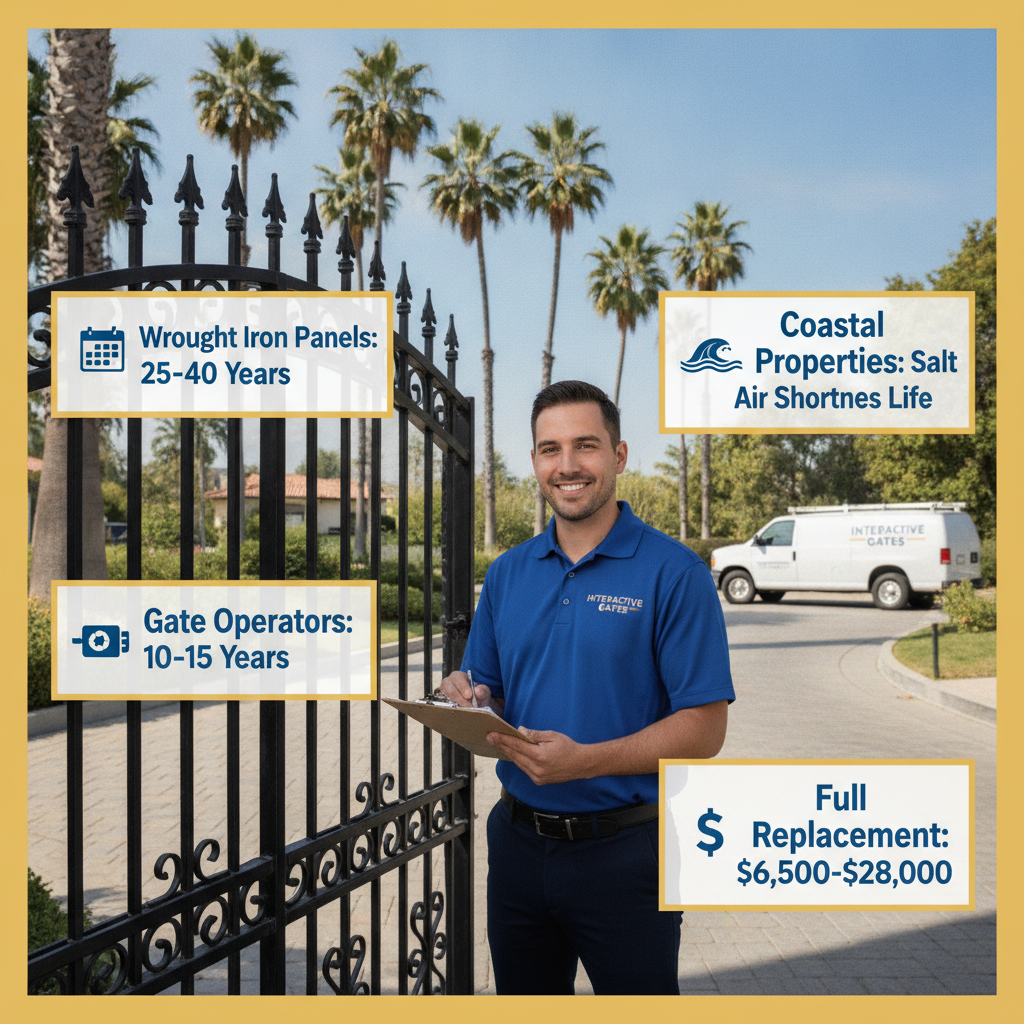
- Wrought iron gates last 30–50 years but need professional repainting every 5–8 years in coastal zip codes like Laguna Beach and San Clemente.
- Untreated cedar or redwood can warp in as little as 18 months in high-UV hillside neighborhoods like Rolling Hills or Palos Verdes.
- Aluminum is the most popular material for residential electric gates in LA because it is lightweight (reducing motor wear), rust-proof, and HOA-friendly.
- Steel gates cost $6,000–$16,000 installed and are favored for commercial and high-security applications but are overkill for most single-family driveways.
- Santa Ana wind events and marine layer salt air are the two biggest material killers in Southern California — your choice of finish matters as much as the base metal.
- Most automatic gate motors last 50,000–100,000 cycles regardless of material, but a heavier gate will burn through motor life 20–35% faster.
Wood or Metal Electric Gate — Which Should You Install on Your LA Property in 2026?
Homeowners across Los Angeles type questions like how long does a wood driveway gate last in LA, does metal rust near the beach in Southern California, and what is the best gate material for a hillside home in Rolling Hills every single day. The answer is not one-size-fits-all. Southern California throws a unique mix of punishing UV radiation, marine layer salt air along the coast, bone-dry Santa Ana wind events in the inland valleys, and wildfire-season heat at gates that have to look great in front of million-dollar properties. This guide breaks down every material option with real 2026 price ranges, maintenance timelines, and honest pros and cons so you can make the right call before you spend a dollar.
What Makes the LA Climate So Hard on Gate Materials?
Los Angeles is not one climate — it is five. Coastal communities like Laguna Beach, San Clemente, and Orange deal with constant marine layer moisture and salt-laden air that accelerates oxidation on any bare metal and causes wood grain to swell and shrink daily. Move inland toward Los Angeles proper or east toward the foothills and the challenge flips: relentless UV index readings of 8–11 all summer long, humidity that drops below 10% during Santa Ana events, and surface temperatures on dark-painted gates that routinely hit 160°F. In elevated neighborhoods like Rolling Hills, you add high-wind exposure on top of the UV load. Any material you choose has to survive all of these stressors, not just one.
How Long Does a Wood Electric Gate Last in Los Angeles?
In the Pacific Northwest, a properly sealed cedar gate can last 15–20 years. In LA, cut that estimate roughly in half. Here is what you realistically get by species:
- Cedar: 7–12 years with annual sealing. Without sealing, expect warping and cracking within 18–24 months on south-facing or hillside installations.
- Redwood: 10–15 years with consistent maintenance. Redwood's natural tannins offer better UV resistance than cedar, making it the better wood choice for LA.
- Teak: 15–20 years, but lumber costs have pushed teak gate panels to $800–$1,400 per linear foot — reserved for ultra-luxury estates in Bel Air and Malibu-adjacent areas.
- Pressure-treated pine: Not recommended for visible driveway gates. It twists aggressively in high-UV environments and is nearly impossible to stain evenly.
The bigger problem with wood and electric gates is weight. A standard 14-foot double-swing wood gate built from 2-inch-thick redwood boards weighs 350–500 lbs per leaf. That load forces you into a heavier, more expensive operator — typically a FAAC 391 or Viking SL-1000 equivalent — rather than the lighter LiftMaster LA500 that aluminum gates typically pair with. Heavy gates also cycle through motor life faster: expect 30,000–45,000 cycles versus the 80,000–100,000 cycles a properly matched aluminum gate will deliver.
Pro Tip: If you love the look of wood but want durability, ask about aluminum gates with a wood-grain powder-coat finish or composite infill panels. Several LA fabricators now offer this hybrid — you get the visual warmth of cedar without any of the warping, sealing, or rot risk.
How Much Does a Wood Electric Gate Cost in Los Angeles in 2026?
Wood gate pricing in LA has risen roughly 12% since 2024 due to lumber costs and finishing labor. Here are realistic 2026 installed ranges:
- Single swing wood gate (10–12 ft), cedar: $3,800–$5,500 installed with a basic operator
- Double swing wood gate (14–16 ft), redwood: $6,500–$9,500 installed with a mid-tier operator
- Sliding wood gate (up to 20 ft), redwood or teak: $8,000–$14,000 installed — the slide mechanism adds complexity and the heavy panel requires a commercial-grade operator
- Annual refinishing/sealing service: $350–$750 per gate, every 2–4 years depending on sun exposure
Factor in refinishing costs over a 10-year window and a $6,500 wood gate can easily cost $9,000–$10,500 in total ownership cost before any repairs — nearly matching the entry price of a quality aluminum gate that needs almost no maintenance.
How Long Does an Aluminum Electric Gate Last in Los Angeles?
Powder-coated aluminum is the dominant residential gate material in Los Angeles in 2026, and for good reason. A quality aluminum gate fabricated from 6061 or 6063 alloy and finished with a TGIC polyester powder coat will last 25–35 years in Southern California with essentially zero structural maintenance. The powder coat itself typically holds for 15–20 years before fading, at which point a professional respray costs $600–$1,200 — a fraction of wood's ongoing refinishing costs.
Aluminum's real advantage in LA is weight. A comparable 14-foot double-swing aluminum gate weighs 120–200 lbs per leaf, allowing pairing with a LiftMaster LA500UL or FAAC 390 operator that runs quietly and cycles 80,000–120,000 times before needing service. Salt air does not corrode aluminum the way it attacks steel — the metal forms a natural oxide layer that protects the substrate, which is why you see aluminum used so heavily in Laguna Beach and San Clemente coastal neighborhoods.
How Much Does an Aluminum Electric Gate Cost in Los Angeles in 2026?
- Single swing aluminum gate (10–12 ft): $5,500–$8,000 installed
- Double swing aluminum gate (14–16 ft): $8,500–$14,000 installed
- Aluminum cantilever sliding gate (up to 24 ft): $10,000–$18,000 installed
- Custom laser-cut decorative aluminum (estate-level): $18,000–$35,000+ installed
Aluminum gates carry a higher upfront cost than basic wood, but the 25-year total ownership cost is significantly lower when you eliminate refinishing, rot repair, and frequent operator replacements driven by overweight panels.
Where Does Wrought Iron and Steel Fit In?
Wrought iron (technically mild steel forged by hand) and structural steel are the traditional premium materials for ornate estate gates in neighborhoods like Rolling Hills and Bel Air. Steel delivers unmatched visual weight and can be fabricated into incredibly intricate scroll and picket designs that aluminum cannot always match at the same price point.
The tradeoff: steel corrodes. In coastal LA zip codes, a steel gate without proper epoxy primer plus topcoat will show surface rust within 18–24 months. A high-quality installation uses hot-dip galvanization or an epoxy zinc primer followed by a polyurethane topcoat and needs full repainting every 5–8 years in coastal locations, every 8–12 years inland. Professional repaint of a 16-foot double-swing iron gate runs $900–$2,000 in LA in 2026.
- Wrought iron / steel single swing gate (10–12 ft): $5,000–$9,500 installed
- Wrought iron / steel double swing gate (14–18 ft): $9,000–$16,000 installed
- Ornate custom estate steel gate (20+ ft): $18,000–$45,000+ installed
Steel gates weigh 400–800 lbs per leaf for heavy ornamental designs. That demands heavy-duty operators — FAAC 844 ER, BFT Phobos AC A25, or Viking SL-2000 class — adding $1,500–$3,500 to the operator budget versus aluminum-compatible units.
Pro Tip: If you want the estate look of wrought iron without the corrosion risk, specify aluminum ornamental fabrication. Modern CNC and TIG welding techniques allow aluminum to replicate iron scroll work at 40–50% of the weight, enabling smaller operators and dramatically lower long-term maintenance costs.
What About Vinyl or Composite Gate Materials in LA?
Vinyl (PVC) gates are popular for rear-yard privacy fencing but are rarely recommended for automatic driveway gates in LA. Vinyl becomes brittle under sustained UV exposure above 90°F — surface temperatures that gate panels in San Fernando Valley or east Orange County exceed regularly. Most vinyl manufacturers void structural warranties above 100°F ambient, and the material cannot handle the mechanical stress of an automated operator on a primary entry gate. Composite (wood-plastic blend) infill panels inside an aluminum or steel frame are a different story and can work well, but the frame should still be metal.
Which Material Is Best for HOA Communities and Gated Complexes?
If you manage an HOA or multi-family property, aluminum is almost universally the correct answer. It is HOA-board-friendly (low lifetime maintenance cost means lower reserve fund draws), cycle-rated for high-traffic entrances (a busy community gate cycles 200–400 times per day, meaning 70,000–145,000 cycles per year), and aesthetically versatile enough to match any architectural standard. Visit our commercial and HOA gate page for community-specific sizing and access-control guidance, and browse real local projects in our project portfolio.
Does Gate Material Affect Which Opener Brand You Should Use?
Yes — significantly. Gate weight is the primary sizing factor for any automatic operator. Here is a quick 2026 pairing guide:
- Aluminum swing gate (under 300 lbs per leaf): LiftMaster LA500UL, FAAC 390, Apollo 1550 Pro — operators in the $800–$1,400 range
- Heavy redwood or steel swing gate (300–600 lbs per leaf): FAAC 391, BFT Phobos A25, Viking SL-1000 — operators in the $1,200–$2,200 range
- Ornamental iron estate gate (600–1,200 lbs per leaf): FAAC 844 ER, BFT Kustos, Viking SL-2000 — operators in the $2,000–$4,000 range
- Sliding gates of any material over 18 ft: FAAC 741, LiftMaster RSW12U, Apollo 635 — operators in the $1,500–$3,500 range
Choosing an undersized operator for a heavy gate is the single most common cause of premature motor failure. If you inherited a property with an existing gate and are not sure whether the operator is correctly matched, a service technician can load-test it in under an hour.
In One Minute: Wood vs. Metal Gates in LA 2026
Wood gates cost $3,800–$9,500 installed but need refinishing every 2–4 years and typically last only 8–15 years under LA's UV and salt-air load. Aluminum gates cost $5,500–$18,000 installed, last 25–35 years with minimal upkeep, weigh far less (protecting your motor), and resist coastal corrosion with no ongoing structural maintenance. Steel and wrought iron deliver the best visual impact for estate properties and last 30–50 years but require repainting every 5–8 years in coastal zones and demand heavy-duty operators. For most LA homeowners — especially anyone within 5 miles of the coast — powder-coated aluminum is the best combination of longevity, aesthetics, maintenance cost, and motor compatibility. Ready to see what different materials look like on your property before committing? Try the Interactive Gates gate designer tool to preview styles and finishes in real time, or request a free on-site estimate.
Frequently Asked Questions: Wood vs. Metal Gates in Los Angeles
Does a wood gate void an automatic gate operator warranty in Los Angeles?
Not automatically, but most operators specify a maximum gate weight. If your wood gate exceeds the operator's rated capacity — common with heavy redwood or teak panels — the manufacturer can deny warranty claims on burned motors or damaged gearboxes. Always have your installer verify that gate weight is within the operator's rated load, with at least a 20% safety margin.
Which gate material is best for a coastal property in Laguna Beach or San Clemente?
Powder-coated aluminum is the clear winner for coastal Southern California. Aluminum does not rust, its natural oxide layer actually increases in salt air, and a quality TGIC powder coat handles marine humidity without peeling. Wrought iron or steel is workable with proper galvanization and an annual inspection, but aluminum dramatically reduces your long-term maintenance burden and cost.
How often does an aluminum gate need to be repainted or refinished in LA?
A quality TGIC polyester powder-coat finish applied to aluminum should hold its color and adhesion for 15–20 years in Southern California conditions. When it does eventually need refreshing, a professional respray runs $600–$1,200 for a standard residential gate — far less frequent and less expensive than wood's 2–4 year refinishing cycle.
Are there HOA rules in LA communities that restrict gate materials or colors?
Yes, many Southern California HOAs — particularly in planned communities in Orange County, Rolling Hills Estates, and gated LA neighborhoods — specify approved materials, colors, and maximum gate heights. Always request a copy of your CC&Rs and Architectural Guidelines before ordering any gate. Your installer should also be able to pull local municipal codes. See our Rolling Hills service page for hillside-specific considerations.
How much more does an ornamental aluminum gate cost compared to a plain aluminum tube gate in Los Angeles?
A basic flat-panel or tubular aluminum gate runs $5,500–$9,000 installed for a standard residential swing gate. An ornamental aluminum gate with laser-cut decorative panels, scroll work, or custom picket spacing runs $12,000–$25,000 installed. The extra cost comes from CNC fabrication time, heavier-gauge material, and more complex welding — but you still benefit from aluminum's weight and corrosion advantages over iron at any price point.
Can I see examples of different gate materials installed on real LA properties?
Yes — our project portfolio includes completed residential and commercial gate installations across Southern California in aluminum, steel, and ornamental iron. You can also use the Interactive Gates visualizer tool to preview gate styles and finishes before your consultation.
Ready to Choose the Right Gate Material for Your Los Angeles Property?
The best gate is the one that looks great on day one and still looks great on year twenty — without costing you a fortune in maintenance along the way. Whether you manage a hillside estate in Rolling Hills, a coastal home in Laguna Beach, or a residential community in Orange, our local team can walk your property, assess your driveway grade and HOA requirements, and recommend the right material, style, and operator combination for your specific situation. Explore our residential gate options or get in touch for a no-pressure site visit — we are happy to answer questions and give you an honest assessment before you commit to anything.