
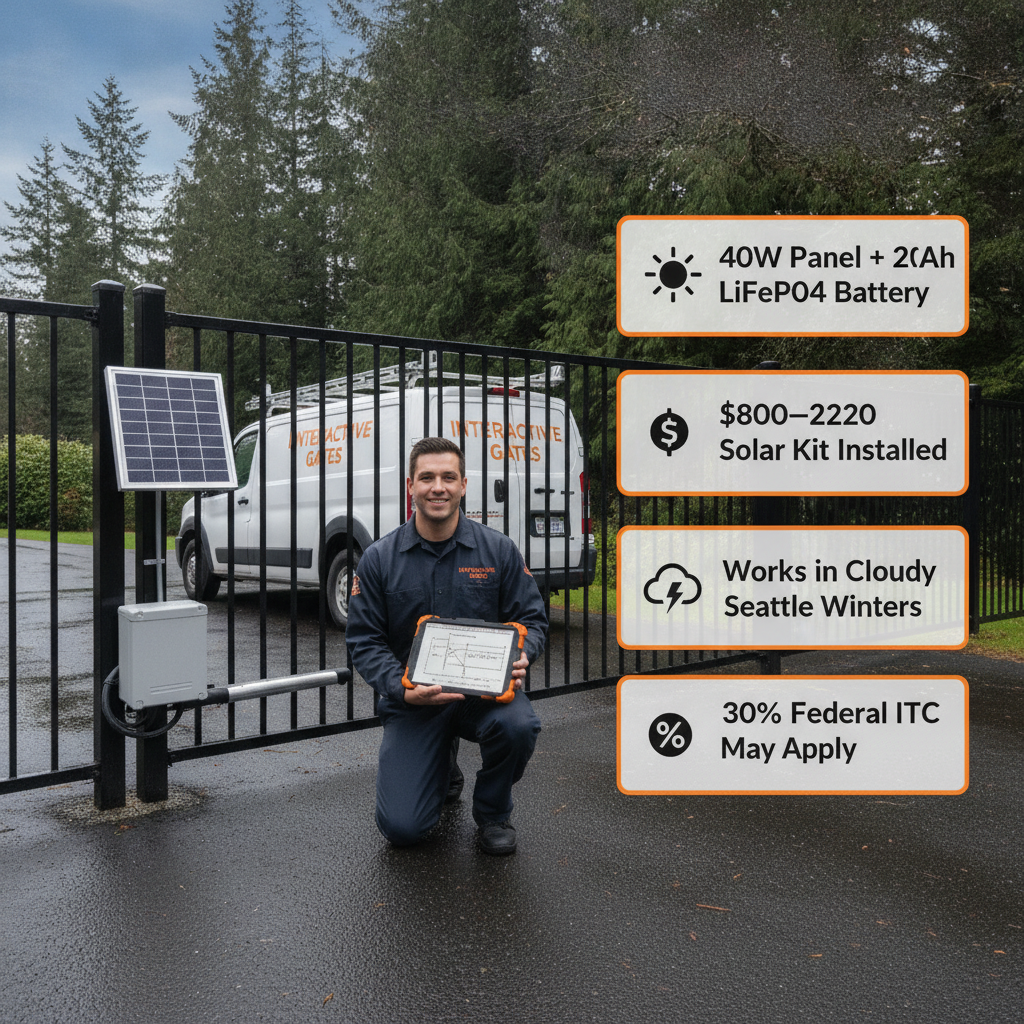
- Solar gate kits in Seattle run $800–$2,200 for the panel and battery components, on top of your gate and opener costs.
- Seattle averages only 152 sunny days per year, but modern monocrystalline panels generate usable power even on overcast days — enough for most residential gates.
- A typical residential swing gate uses 15–40 watts per cycle; a properly sized 30W–80W panel with a 20Ah–40Ah AGM or lithium battery handles 30–80 cycles per day.
- Trenching conduit to a distant panel costs $12–$28 per linear foot in Seattle — solar often pays back in 3–6 years when the trench run exceeds 60 feet.
- LiftMaster, FAAC, and Viking all offer solar-ready operators with low-power standby modes that are ideal for Seattle's diffuse-light winters.
- South- and southwest-facing installations in Bellevue, Sammamish, and Issaquah hillside lots see the best solar yield; heavily tree-shaded lots in Shoreline or Woodinville may need a hybrid grid-backup system.
- Washington State offers a sales-tax exemption on solar equipment (RCW 82.08.962) that can save $80–$220 on a typical solar gate kit.
- Most solar gate installs in the Seattle metro qualify for a 30% federal ITC when paired with a home solar system, potentially cutting net kit cost to $560–$1,540.
Is Solar Power for an Automatic Gate Actually Viable in Seattle?
You've probably typed something like 'solar electric gate Seattle,' 'does solar gate work in Pacific Northwest,' or 'automatic gate no electricity hookup Seattle' into Google. It's a fair question — Seattle's gray winters make homeowners skeptical, and that skepticism is partly warranted. But the full answer is more nuanced than a simple yes or no. By the end of this guide you'll know exactly which properties in the greater Seattle area are good solar candidates, what the real 2026 price tags look like, and how to avoid the most common sizing mistakes that leave gates stuck in January.
How Much Sun Does Seattle Actually Get — and Does It Matter for Gate Solar?
Seattle receives roughly 152 sunny days and 2,021 peak sun hours annually, compared to Los Angeles's 3,000+. That sounds discouraging until you understand how modern gate solar systems work. Unlike rooftop solar systems optimizing for kilowatt-hour production, a gate opener is a micro-load — it draws power in short, intense bursts (2–8 seconds per cycle) and then sits idle. The solar panel's job is really just to keep the battery topped up between uses.
Monocrystalline panels — the same technology used in commercial installations — produce roughly 60–80% of their rated output under overcast skies. A 40W panel rated for full sun still generates 24–32 watts on a typical Seattle winter day. Paired with a properly sized AGM or lithium iron phosphate (LiFePO4) battery, that's enough to handle a residential driveway gate cycling 20–60 times per day even through December and January gray stretches.
Where solar struggles in Seattle: deep tree shade (canopy-heavy neighborhoods like Shoreline's Richmond Beach or Woodinville acreage lots), north-facing slopes, and gates with unusually high cycle counts (apartment complexes, busy commercial properties). For those situations, a hybrid system with a grid-backup trickle charger is the smarter answer.
What Does a Solar Gate System Cost in Seattle in 2026?
Think of solar gate pricing in three layers: the gate and opener themselves (which you'd pay regardless of power source), the solar kit, and installation labor. Here's how those numbers break down locally:
- Solar panel (20W–80W monocrystalline): $90–$280 depending on wattage and brand (Renogy, Ameresco, Goal Zero OEM equivalents)
- Battery pack (20Ah–40Ah AGM): $75–$180; lithium iron phosphate (LiFePO4) upgrades run $220–$450 and last 2–3× longer
- Charge controller (PWM or MPPT): $35–$120; MPPT controllers recover 10–30% more energy in low-light conditions — worth the premium in Seattle
- Mounting hardware, cables, weatherproof enclosure: $80–$200
- Complete solar kit (all-in, no opener): $800–$2,200 installed, depending on battery chemistry and panel size
- Gate + opener + solar (full project): $4,500–$14,000+ depending on gate style, material, and site complexity
Compare that to the alternative: trenching electrical conduit from the panel box to a remote gate location. In the Seattle area, licensed electrical trenching runs $12–$28 per linear foot all-in (trench, conduit, wire, backfill, patching). A 100-foot run costs $1,200–$2,800 before the electrician even hooks anything up. Add a dedicated 20A circuit: another $350–$700. At that math, solar becomes cost-competitive the moment your trench run passes about 50–70 feet — which covers a large percentage of rural lots in Snohomish County, acreage in Gig Harbor, and hillside driveways in Auburn.
Pro Tip: Request an MPPT (Maximum Power Point Tracking) charge controller instead of the cheaper PWM type any time you're installing in the Seattle metro. MPPT units harvest 15–30% more energy from diffuse light — that extra recovery margin is exactly what keeps your battery full through a week-long November rain.
Which Gate Openers Are Solar-Compatible in Seattle 2026?
Not every operator handles solar gracefully. You want a unit with a low-power standby mode — ideally under 1 watt at rest — so the battery isn't constantly drained between cycles. The following brands are commonly installed by local crews and have proven solar track records in the Pacific Northwest climate:
- LiftMaster LA400PKGU / LA500PKGU: Purpose-built solar swing gate kits with an integrated MPPT controller, 10W panel, and 7Ah battery for light-duty use; upgrade to a 40W panel for Seattle conditions. Retail kit: $620–$890.
- FAAC 402 CBS / 422 CBS: Italian-engineered, 24V DC operators with sub-0.5W standby draw; excellent performance in wet climates. Popular in Bellevue and Tacoma upscale residential installs. Operator alone: $780–$1,100.
- Viking Access VG-10 / VG-25: American-made, rugged 24V DC operators with a dedicated solar input terminal. Standby draw: ~0.8W. A strong choice for heavy aluminum or steel gates on Eastside lots.
- Apollo 1550ETL / 1650ETL: Budget-friendly but reliable 12V DC operators; work well with solar on single-gate residential installs where cycle counts stay under 40/day. Operator: $380–$520.
- FAAC 844 ER (sliding gates): For long driveway sliding gates — which are common on Sammamish and Issaquah ridge lots — this 24V operator offers an optional solar package and a 3W standby max.
Avoid repurposing a standard 120V AC operator with a solar inverter. The inverter itself consumes power continuously, wiping out the efficiency gains of going solar in the first place.
Which Seattle-Area Properties Are the Best Candidates for Solar Gates?
After years of local installs, the properties that benefit most share a few common traits:
- Long driveway setbacks: Rural parcels in Snohomish, acreage in Duvall or Carnation, and hillside lots above Gig Harbor where the gate is 80–200 feet from the nearest electrical panel.
- South- or southwest-facing gate posts: The Sammamish Plateau, Cougar Mountain area in Issaquah, and the south-slope neighborhoods of Bellevue see 10–20% better solar yield than north-facing properties.
- New construction without run conduit yet: If the electrician hasn't pulled wire to the gate location, going solar from the start saves the trenching cost entirely.
- Off-grid or backup-power priority: Homeowners in Snohomish County who've experienced multi-day outages in wind events increasingly prefer solar+battery as their gate's primary power — the gate keeps working when the grid goes down.
- Low-to-moderate cycle count (under 60 cycles/day): Residential homes, small HOAs (under 20 units), and single-family properties in Lynnwood or Everett fit squarely in this window.
Properties that should stick with grid power or add a hybrid backup: busy commercial properties, high-density HOAs with 80+ daily cycles, and any lot where significant tree canopy shades the panel location more than 4 hours per day.
What Incentives Apply to Solar Gate Systems in Washington State?
Washington is unusually solar-friendly on the tax side:
- Sales tax exemption (RCW 82.08.962): Solar equipment — including panels, batteries, and charge controllers for gate systems — is exempt from Washington's 10.25% combined state/local sales tax when the system is attached to a residential property. On a $1,500 solar kit, that's roughly $150 back in your pocket.
- Federal Investment Tax Credit (ITC), 30%: If your gate solar system is installed as part of a broader home solar installation (or if you can document it as part of a residential solar array), you may claim 30% of equipment costs against federal income tax. Consult your tax advisor — this is site-specific.
- No Washington state income tax: Unlike Oregon, there's no additional state solar income tax credit to layer in, but the sales-tax exemption is straightforward and applies at the point of purchase.
Pro Tip: Keep your itemized receipts for the solar panel, battery, controller, and wiring separate from your gate and opener invoice. A clean paper trail makes the RCW 82.08.962 exemption and any ITC documentation much easier to substantiate.
How Does Seattle's Weather Affect Solar Gate Battery Life?
AGM (Absorbent Glass Mat) batteries — the standard choice in most solar gate kits — perform adequately in Seattle but have two weaknesses: they lose 20–30% capacity at freezing temperatures, and they don't recover well from deep discharges. If a gate sits unused for a week in January and the panel can't keep up, an AGM battery can sulfate and fail prematurely. Expected AGM lifespan in Seattle's climate: 3–5 years.
LiFePO4 (lithium iron phosphate) batteries cost 2–3× more upfront ($220–$450 for a gate-appropriate 20Ah pack) but retain 95%+ capacity down to 32°F, handle partial-charge cycling gracefully, and last 8–12 years in Seattle conditions. For any property that sees sustained cloudy stretches or periods of low usage, LiFePO4 is the upgrade that pays for itself — often within 4–6 years of avoided battery replacements.
In One Minute: Solar Gates in Seattle
Seattle gets less sun than Southern California but more than enough diffuse light for residential gate solar to work reliably. The break-even point versus grid power usually hits when your trench run exceeds 50–70 feet — extremely common on Snohomish County acreage, Gig Harbor hillside lots, and Eastside ridge properties. Budget $800–$2,200 for the solar kit on top of your gate and opener. Choose a 24V DC operator (FAAC, Viking, or LiftMaster solar series) with sub-1W standby draw, pair it with an MPPT controller, and upgrade to LiFePO4 battery chemistry for Seattle's wet winters. Washington's sales-tax exemption offsets $80–$220 of kit cost, and the federal ITC may cover another 30% if conditions are met. Heavily shaded lots or high-cycle-count commercial properties should add a grid-backup trickle charger rather than go fully off-grid. See real completed installs in our project portfolio and read what local customers say on our reviews page.
Frequently Asked Questions: Solar Electric Gates in Seattle
Will a solar gate work through Seattle's rainy winter months?
Yes, with proper sizing. Modern monocrystalline panels produce 60–80% of rated output under overcast skies. A 40W–60W panel paired with a 20Ah–40Ah LiFePO4 battery provides enough stored energy to run a residential swing or slide gate through 5–7 consecutive cloudy days without any sun at all — enough buffer for even Seattle's grayest stretches. An MPPT charge controller recovers maximum energy from diffuse light and is strongly recommended over PWM for Pacific Northwest installs.
How much does it cost to add solar to an existing automatic gate in Seattle?
Retrofitting solar to an existing compatible 24V DC gate operator typically costs $900–$2,000 installed, including the panel, battery, MPPT controller, enclosure, and labor. If your existing operator runs on 120V AC, you may need to replace it with a DC-compatible unit — add $600–$1,400 for the operator swap. Get a site assessment first to confirm panel placement and shading conditions.
Does a solar gate keep working during a power outage?
Yes — that's one of the most compelling reasons Seattle homeowners choose solar. Because the system is battery-backed and independent of the grid, your gate continues to operate normally during outages. Snohomish County and King County both experience multi-day wind-event outages in fall and winter; a solar gate with adequate battery capacity is fully functional throughout. Standard grid-tied gates with battery backup only last 50–200 cycles before the backup battery depletes.
What panel size do I need for a solar gate in Seattle?
For a typical residential single swing gate cycling 20–50 times per day, a 40W panel with a 20Ah LiFePO4 battery is the recommended minimum for Seattle. Double-gate or heavy slide-gate applications should step up to a 60W–80W panel with a 30Ah–40Ah battery. Heavily shaded installations may need two panels in parallel or a supplemental grid-backup charger. Avoid undersizing — a 10W panel (common in cheap kits) is borderline adequate in Los Angeles but insufficient for Seattle winters.
Are there local Seattle permits required for a solar gate system?
The gate structure itself typically requires a permit in King, Snohomish, and Pierce counties (fence/gate permit, $75–$200). The solar components — panel, battery, controller — are generally classified as low-voltage accessory equipment and do not require a separate electrical permit when operating at 24V DC or below. However, if you're adding a 120V AC grid-backup charger, a licensed electrician and electrical permit are required. Always verify with your specific city or county building department, as rules vary between jurisdictions like Seattle and Lakewood.
Can my HOA use solar for the community gate in Seattle?
Absolutely — and it's increasingly popular for smaller HOAs (under 30 units) on rural or semi-rural properties where grid connection is expensive. For high-traffic HOA gates cycling 100+ times daily, a hybrid system combining a 80W–120W solar array with a grid-backup trickle charger is the standard recommendation. This keeps operating costs low while ensuring reliability during heavy use periods. Our team handles HOA and commercial gate projects across the Seattle metro and can provide a site-specific solar feasibility assessment.
Ready to Find Out If Solar Makes Sense for Your Property?
Solar gate power isn't the right answer for every Seattle driveway — but for the right property, it eliminates a costly trench run, keeps your gate running during outages, and pays for itself within a few years. If you're not sure whether your lot qualifies, the best first step is a quick site conversation. You can also explore gate styles and configurations with our free gate designer tool, or reach out to our team directly. We're happy to walk through panel placement, battery sizing, and whether a hybrid grid-backup approach makes more sense for your specific neighborhood and cycle count — no pressure, just honest answers.


