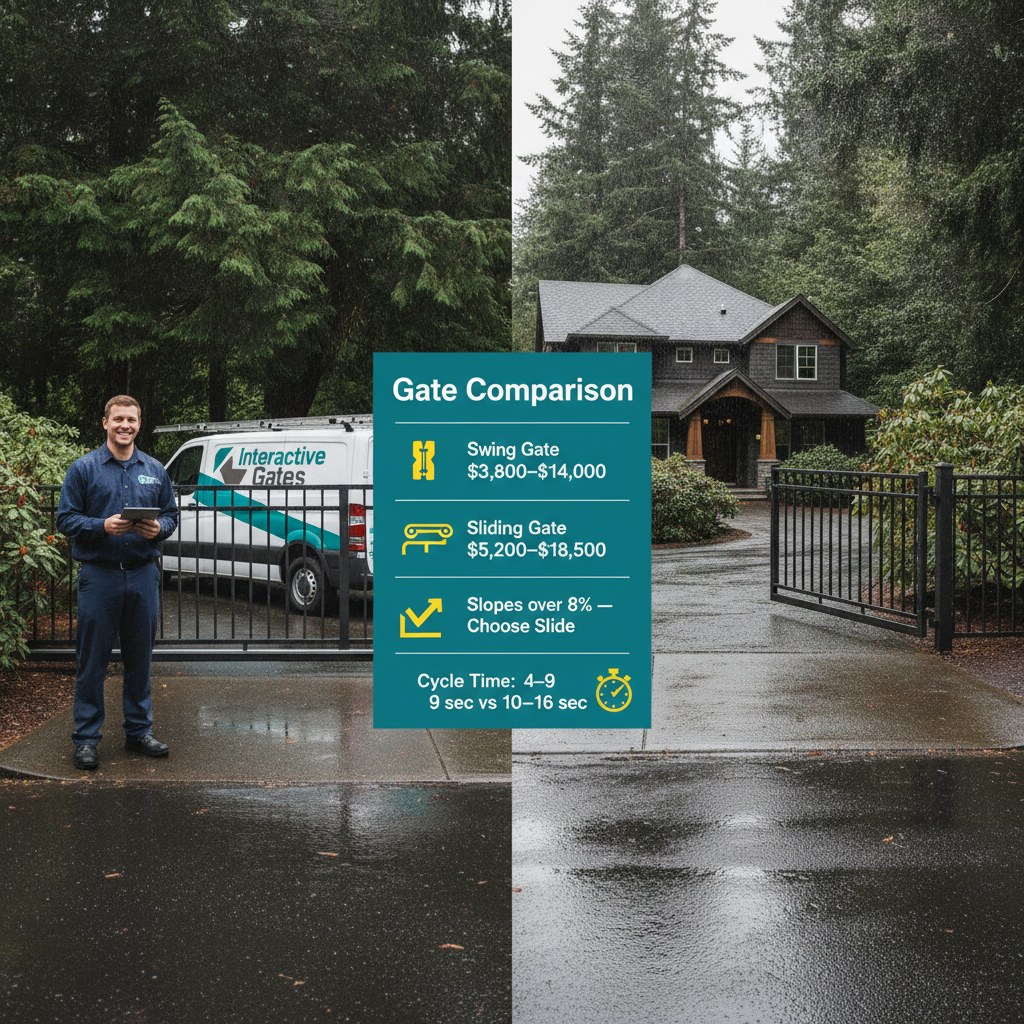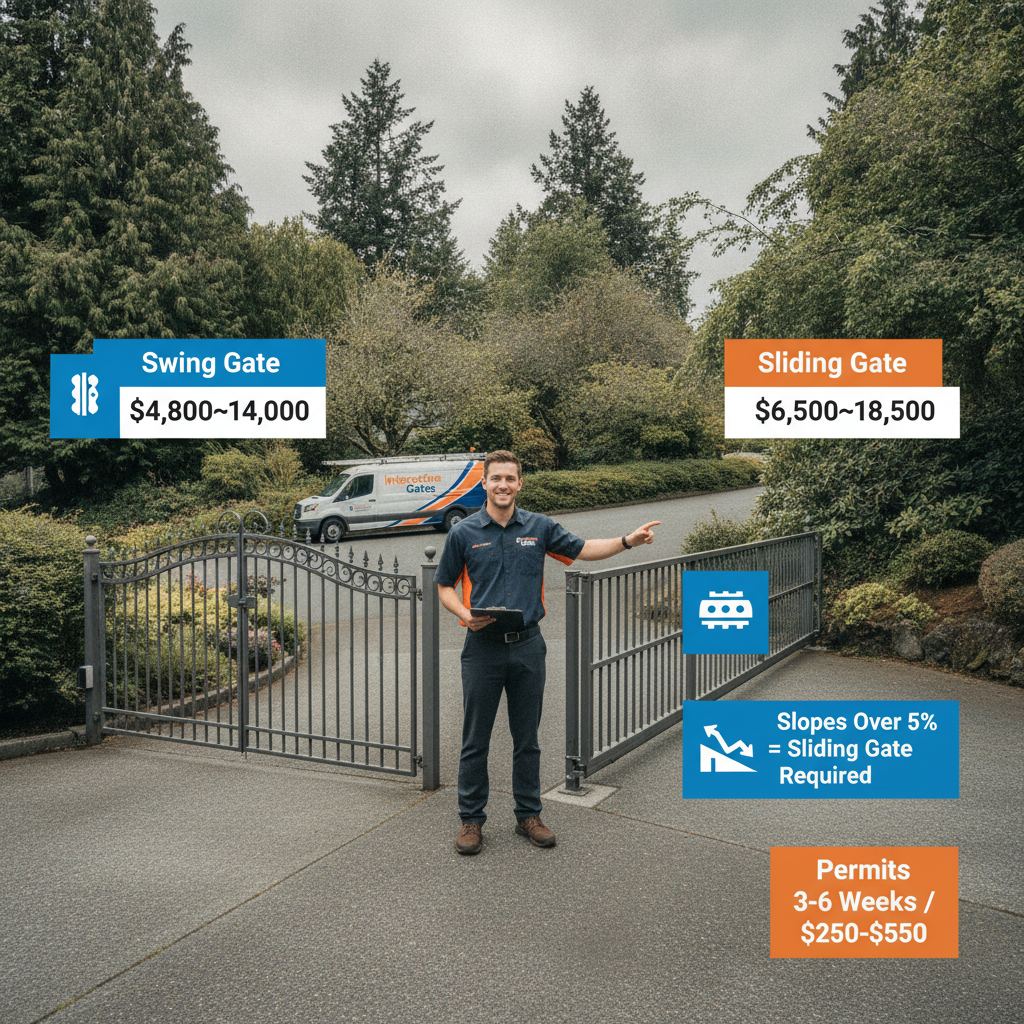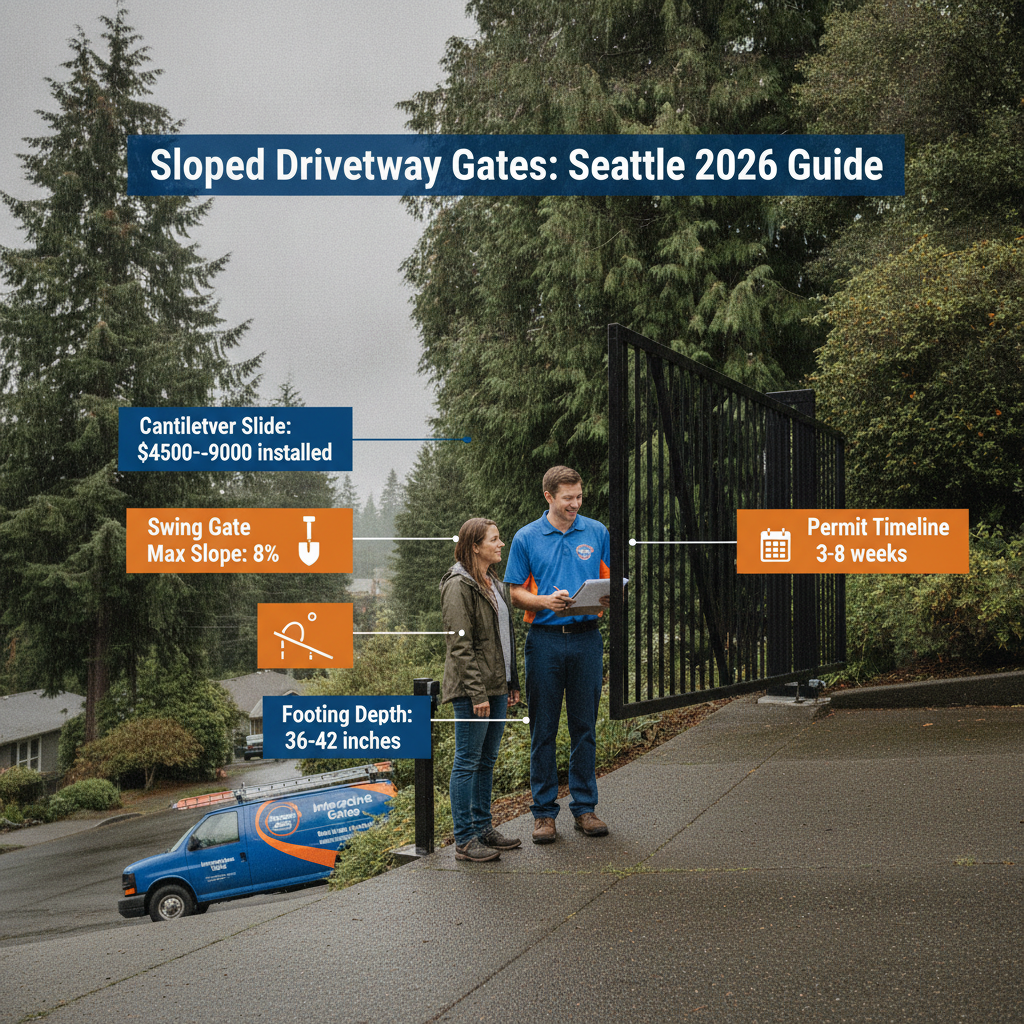
- Swing gates need a relatively flat arc — slopes steeper than 8% in the swing path cause dragging, binding, and motor burnout within 2–3 years.
- Sliding gates handle grades up to 15% along their travel path but require a level track pad; on steep lots this means grading costs of $800–$2,500.
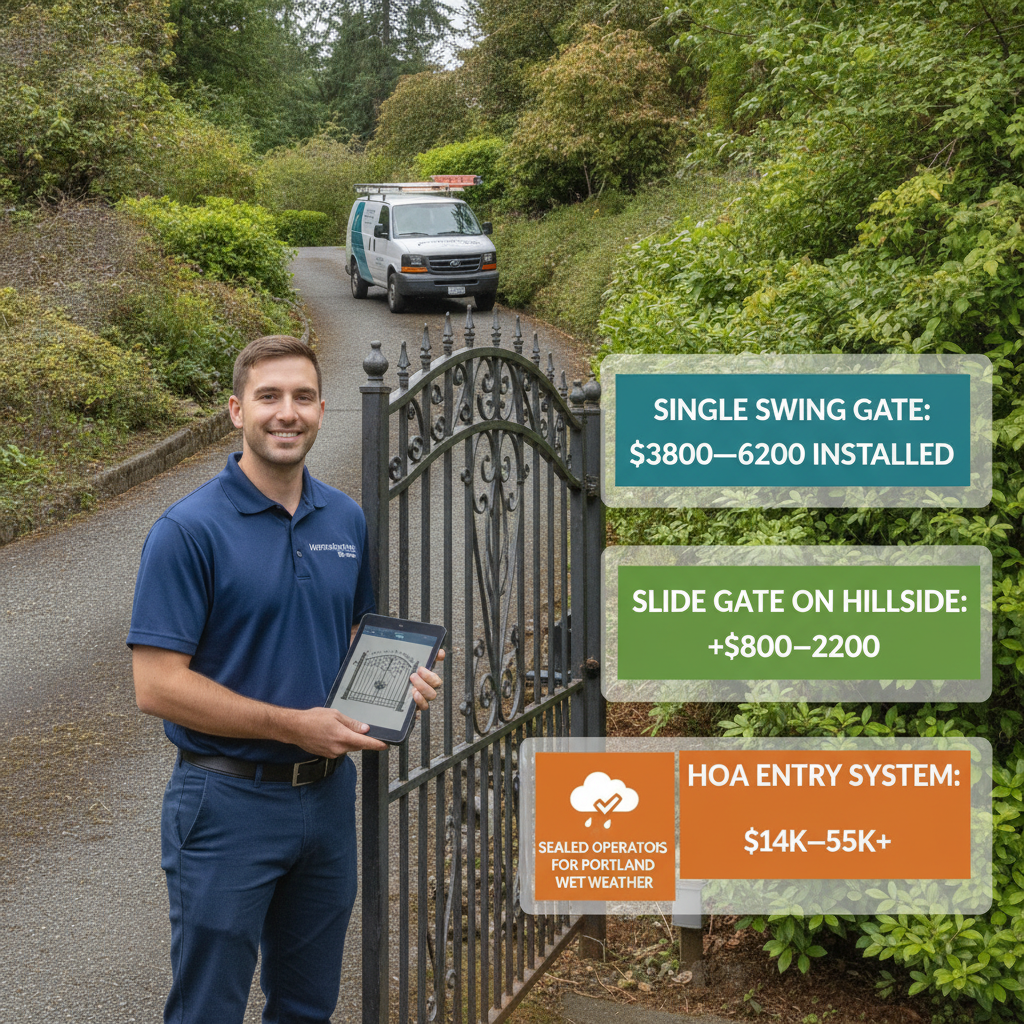
- A single swing gate operator in Seattle runs $1,200–$2,800 installed; a dual swing pair jumps to $2,800–$5,500 depending on gate weight and hill geometry.
- A cantilever slide gate (no ground track) costs $4,500–$9,000 installed and is the most slope-tolerant option for steep Seattle hillside lots.
- Seattle's clay-heavy soil shifts seasonally, which moves posts and misaligns gates — budget $300–$600 for deep concrete footings (36–42 inches) regardless of gate style.
- Slope-related service calls average $185–$320 per visit in the Seattle metro; choosing the right gate type upfront eliminates most of these callbacks.
- LiftMaster, FAAC, and Viking all make slope-rated operators — but each brand has specific incline limits; matching operator to grade is non-negotiable.
- Permit timelines in Seattle, Bellevue, and Tacoma run 3–8 weeks in 2026; factor that into your project schedule before grading work begins.
Sloped Driveway in Seattle — Swing Gate or Slide Gate?
If you've searched 'can I put a swing gate on a sloped driveway in Seattle,' or 'sliding gate on a hill — will it work?' you're not alone. Seattle's topography — from the steep hillside lots of Capitol Hill and Queen Anne to the rolling grades of Bellevue's Eastside neighborhoods and the waterfront approaches in Gig Harbor — creates a genuine engineering challenge that flat-lot gate guides completely ignore. The wrong gate type on a sloped driveway doesn't just look awkward; it destroys operators, strips gears, and creates safety hazards within a couple of seasons. This guide gives you the honest, slope-specific breakdown so you choose once and choose right.
Why Does Driveway Slope Matter So Much for Gate Selection?
Every automatic gate follows a fixed geometric path when it moves. A swing gate traces an arc in the plane of the ground. A slide gate travels laterally along a track (or hangs from a cantilever rail). When the ground isn't level, those paths get complicated fast.
For swing gates, the critical measurement is the slope inside the swing arc — the grade the gate panel actually sweeps across when opening. If that surface drops or rises more than roughly 8%, the leading edge of the gate will either drag on the uphill side or lift away from the ground on the downhill side. Neither is acceptable for security, and the torsional stress transfers directly to the operator, cutting motor life from a typical 10–15 years down to 2–4 years.
For sliding gates, what matters is the slope along the travel path (parallel to the fence line) and whether a level track foundation can be constructed. A gate sliding downhill will accelerate under gravity and slam the end stop; a gate sliding uphill requires the motor to work against grade on every opening cycle. Cantilever designs eliminate the ground-track problem but still need a plumb, level post column — which on steep lots requires substantial concrete work.
Seattle's specific terrain adds two more variables: expansive clay soils that heave during the wet season (October through March), shifting gate posts by fractions of an inch that compound into major alignment problems, and moss-slick surfaces that make bottom-rolling slide gates a maintenance headache without sealed, stainless-steel track hardware.
What Slope Is Too Steep for a Swing Gate in Seattle?
The short answer: if your driveway grade inside the swing arc exceeds 8%, a standard swing gate will cause problems. Here's how that maps to real Seattle neighborhoods:
- 0–5% grade (Bellevue flats, South Seattle, Auburn valley floors): Both swing and slide work well. Swing is usually the more cost-effective choice for single-family residential.
- 5–8% grade (most Eastside neighborhoods, Lynnwood rolling terrain, parts of Tacoma): Swing gates are viable with a tapered bottom rail cut to follow the grade, and an operator with torque compensation. Add $400–$700 for the custom fabrication.
- 8–15% grade (Queen Anne, Capitol Hill, Madrona, steep Gig Harbor lots, hillside Snohomish acreage): Swing gates are not recommended without significant grading of the arc area ($1,500–$4,000). A cantilever slide gate is almost always the smarter long-term choice.
- Over 15% grade: Vertical-lift gates or bi-folding gates become worth evaluating. These cost $8,000–$18,000 installed but eliminate all slope-in-path issues entirely.
Pro Tip: Measure the slope inside the swing arc specifically — not the driveway grade at the gate post. Many Seattle driveways have a transition zone (a flatter apron) right at the street where the gate sits, even though the driveway climbs steeply behind. Have your installer measure both zones before quoting.
Swing Gate Options for Moderate Slopes: What Actually Works
For lots in that 5–8% zone, a few engineering solutions let you keep a swing gate without torturing the operator:
- Tapered bottom rail: The gate panel is fabricated with a raked bottom edge that parallels the slope. Adds $350–$650 to fabrication cost for a single panel, $600–$1,100 for a dual-panel driveway gate. Common in wrought-iron and tubular steel gates from Seattle-area fabricators.
- Grade-adjusted hinge height: One hinge column is set slightly higher to tilt the gate panel and compensate for grade. Works on slopes up to about 6%.
- Slope-compensating operators: The LiftMaster LA500 and FAAC 402 CBS both have adjustable torque and end-of-travel settings that help on moderate grades. The FAAC 402 in particular handles up to 500 kg panels and has built-in obstacle detection that's important when gate swing geometry changes seasonally as soil shifts. These operators run $900–$1,600 for the unit alone; installed, figure $2,000–$3,200 per leaf.
Sliding Gate Options for Seattle's Steeper Hillside Lots
When the slope rules out a swing gate, you have two sliding gate families to consider:
Bottom-Rolling Slide Gates
The gate hangs from top rollers and is guided by a bottom track set in concrete. They're the more affordable option — $3,200–$6,500 installed for a typical 12–16 foot residential opening — but they have real drawbacks on steep Seattle lots. The track collects debris, moss, and standing water during Seattle's 38+ inches of annual rainfall. Stainless-steel v-groove track with a sealed roller wheel mitigates this but adds $400–$700 to the build. Also, the concrete track pad must be perfectly level even if the surrounding grade isn't, which often means a small retaining curb on the low side — budget an extra $600–$1,200 for that concrete work.
Cantilever Slide Gates
No ground track at all. The gate panel cantilevers off a top rail mounted on two robust post columns and glides on sealed roller carriages. This is the gold standard for sloped, wet, or debris-prone sites. Installation cost runs $4,500–$9,000 for a residential gate in the Seattle area, depending on gate weight, panel width, and post-footing depth. The panel itself must extend roughly 50–60% longer than the opening width (so a 14-foot opening needs a 20–22 foot panel), which requires a clear counterbalance space behind the gate post — a layout constraint that rules out some lots.
On steep Eastside lots in Bellevue or hillside properties in Gig Harbor, cantilever gates paired with a Viking VG-F12 or FAAC 740 operator are a common specification. The Viking VG-F12 is rated for panels up to 1,200 lbs and 40 feet wide, handles up to 50 cycles per hour, and has a built-in thermal cutout that protects the motor during Seattle's heavy-use rainy-season periods. MSRP on the VG-F12 operator alone is approximately $1,100–$1,400; installed with hardware, wiring, and access control integration, plan for $1,800–$3,000 just for the operator portion of the project.
Pro Tip: On lots where the clear space behind the post is limited (common on corner lots in Snohomish or on narrow Eastside parcels), a bi-parting cantilever — two shorter panels sliding in opposite directions — can work with half the counterbalance clearance. It costs roughly 20–30% more but solves the space constraint cleanly.
Footing Depth on Seattle's Hillside Lots: Why It's Non-Negotiable
Seattle's expansive clay soils (common in the Rainier Valley, Beacon Hill, and many Eastside neighborhoods) absorb moisture and swell during the wet season, then contract in summer. On a flat lot this causes minor post movement. On a sloped lot, that movement is directional — posts shift downhill incrementally — and it directly misaligns whatever gate is hanging on them.
Standard footing depth for a flat Seattle lot is 24–30 inches. On sloped lots, reputable installers pour 36–42 inch deep footings, often with a bell-bottom or tie-back design. The concrete cost difference is $300–$600 per post, but it's one of the highest-ROI line items in the entire project. A gate that stays aligned doesn't generate service calls; a gate that drifts half an inch per season generates $185–$320 service calls every 6–12 months.
Real Cost Comparison: Swing Gate vs. Slide Gate on a Sloped Seattle Driveway in 2026
- Standard swing gate (0–5% grade, single leaf, steel, LiftMaster LA500 operator): $2,800–$4,500 installed
- Tapered-rail swing gate (5–8% grade, dual leaf, wrought iron, FAAC 402 operator): $5,500–$9,000 installed
- Bottom-rolling slide gate (8–12% grade, steel or aluminum, 14-foot opening, Viking operator): $3,200–$6,500 installed plus $600–$1,200 for level pad work
- Cantilever slide gate (8–15% grade, tubular steel, 14-foot opening, FAAC 740 or Viking VG-F12): $4,500–$9,000 installed
- Vertical-lift or bi-fold gate (over 15% grade or extreme space constraints): $8,000–$18,000 installed
- Deep footing upgrade (per post, clay-soil hillside lots): $300–$600 additional
- City of Seattle / Bellevue / Tacoma permit fees: $150–$500 depending on gate valuation and municipality
Which Seattle Neighborhoods Have the Most Slope-Related Gate Challenges?
Not all Seattle-area lots are equal. Here's where slope complications show up most frequently:
- Queen Anne, Capitol Hill, Madrona: Grades of 10–20% are common. Cantilever slide gates dominate new installations here. Swing gates almost always require grading work to succeed.
- Bellevue Eastside (Clyde Hill, Medina, Hunts Point): Mix of flat and rolling terrain. Many high-value estates choose dual swing gates on their flatter aprons, but property managers on steeper lots consistently shift to cantilever slide configurations. See what's been installed in the area at our Bellevue service page.
- Gig Harbor hillside properties: Steep waterfront approaches combined with rocky substrate make footing work expensive but essential. Cantilever slide gates are common. Check local install examples at our Gig Harbor service page.
- Snohomish acreage: Rural lots with long, sloped gravel driveways often use cantilever or bottom-rolling slide gates for agricultural-feel driveway entrances. Snohomish County permit timelines can run 4–8 weeks in 2026. See our Snohomish service page for local context.
- Lynnwood and Everett mid-grades: Mostly 3–8% slopes. Tapered swing gates work well here with proper fabrication. Browse completed projects at our Lynnwood page and Everett page.
In One Minute: Sloped Driveway Gate Decision for Seattle in 2026
Here's the rapid-fire version: Under 8% slope in the swing arc? A swing gate with a tapered bottom rail works and costs less. 8–15% slope? Go cantilever slide gate — it handles the grade, sheds Seattle's rainfall, and outlasts any ground-track system on a hillside. Over 15%? Talk to an installer about vertical-lift or bi-fold options. Always spec deep footings (36–42 inches) in Seattle's clay-heavy soils regardless of gate style, and budget $150–$500 for permits in the Seattle metro. Operator brands LiftMaster, FAAC, and Viking all have slope-appropriate models — what matters is matching the specific operator torque rating to your gate weight and grade. If you want to visualize styles before committing, use the Interactive Gates gate designer tool. And if you're ready to have a pro measure your actual grade and give you a real quote, the contact page is the fastest path forward.
Frequently Asked Questions
Can a swing gate work on a steep Seattle driveway?
It depends on the slope inside the actual swing arc, not just the driveway pitch. If the ground the gate sweeps across is steeper than about 8%, a standard swing gate will drag, bind, or fail prematurely. A tapered bottom rail and torque-compensating operator (like the FAAC 402 CBS) extend the viable range to about 8%, but beyond that a cantilever slide gate is the safer, longer-lasting choice for Seattle hillside lots.
How much does a cantilever slide gate cost in Seattle in 2026?
Expect $4,500–$9,000 installed for a residential cantilever slide gate in the Seattle metro, covering a typical 12–16 foot opening with a steel or aluminum panel, a FAAC 740 or Viking VG-F12 operator, and deep footings. High-security or ornamental iron versions run toward the upper end or beyond. Commercial properties with wider openings or heavier traffic requirements will see higher costs.
Do I need a permit for a gate on a sloped driveway in Seattle or Bellevue?
Yes, in most cases. The City of Seattle and the City of Bellevue both require permits for automatic gate installations, with fees typically ranging $150–$500 depending on the project valuation. If grading work is also required to create a level track pad or apron, a grading permit may be needed separately. In 2026, plan for 3–8 weeks of permit review time before installation can begin.
What gate operator is best for a steep Seattle hillside lot?
For sliding gates on steep lots, the Viking VG-F12 (rated to 1,200 lbs, 50 cycles/hour) and the FAAC 740 are both proven performers in Seattle's climate and slope conditions. For moderate-slope swing gate applications, the LiftMaster LA500 and FAAC 402 CBS handle grade compensation well. The right choice depends on gate weight, panel width, and actual grade — have an installer measure before specifying an operator.
How do Seattle's clay soils affect gate post stability on slopes?
Seattle's expansive clay soils absorb moisture and swell in the wet season, then contract in summer. On sloped lots this creates directional post movement — posts shift incrementally downhill — which misaligns gates over time. Deep footings (36–42 inches, sometimes with a bell-bottom) are essential on hillside lots and add $300–$600 per post compared to standard flat-lot footings. This upfront cost prevents chronic misalignment and eliminates recurring service calls.
Is a bottom-rolling slide gate okay on a sloped Seattle driveway?
A bottom-rolling slide gate can work if the travel path along the fence line is relatively level (or can be made level with a concrete track pad), but the ground track collects Seattle's heavy rainfall, moss, and debris. Without a stainless-steel v-groove track and sealed rollers, maintenance burden is high on hillside lots. Cantilever slide gates eliminate the ground-track problem entirely and are generally the better long-term investment for slopes above 8% in the Seattle area.
Ready to Figure Out What Your Slope Actually Needs?
Every Seattle hillside lot is different — the grade, the soil type, the clear space behind the post, and local permit requirements all interact. The best next step is a site visit from an installer who can actually measure your driveway grade inside the swing or slide path, check soil conditions, and give you a quote based on what your specific lot requires rather than a generic price list. Browse real completed projects in our project portfolio for inspiration, and when you're ready, reach out through our contact page — no pressure, just straight answers from people who install gates on Seattle-area hillside lots every week.