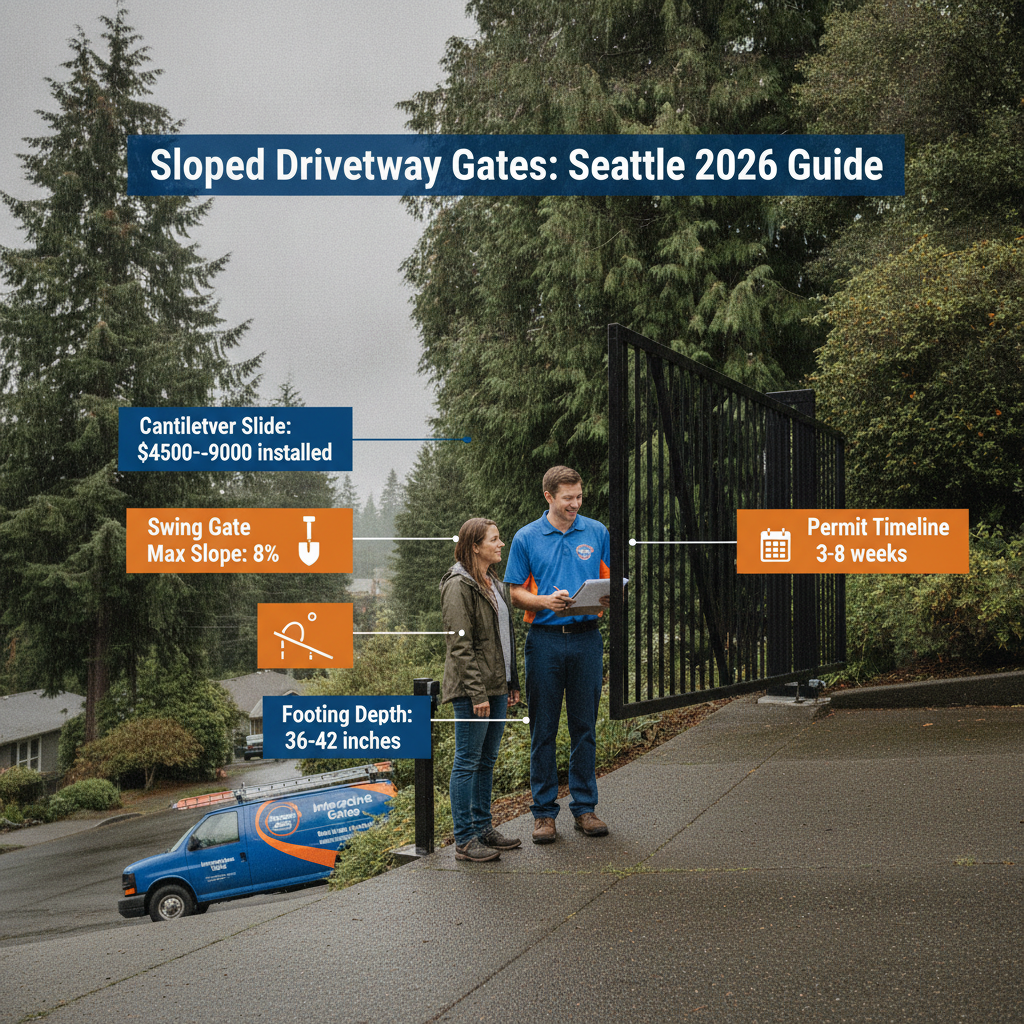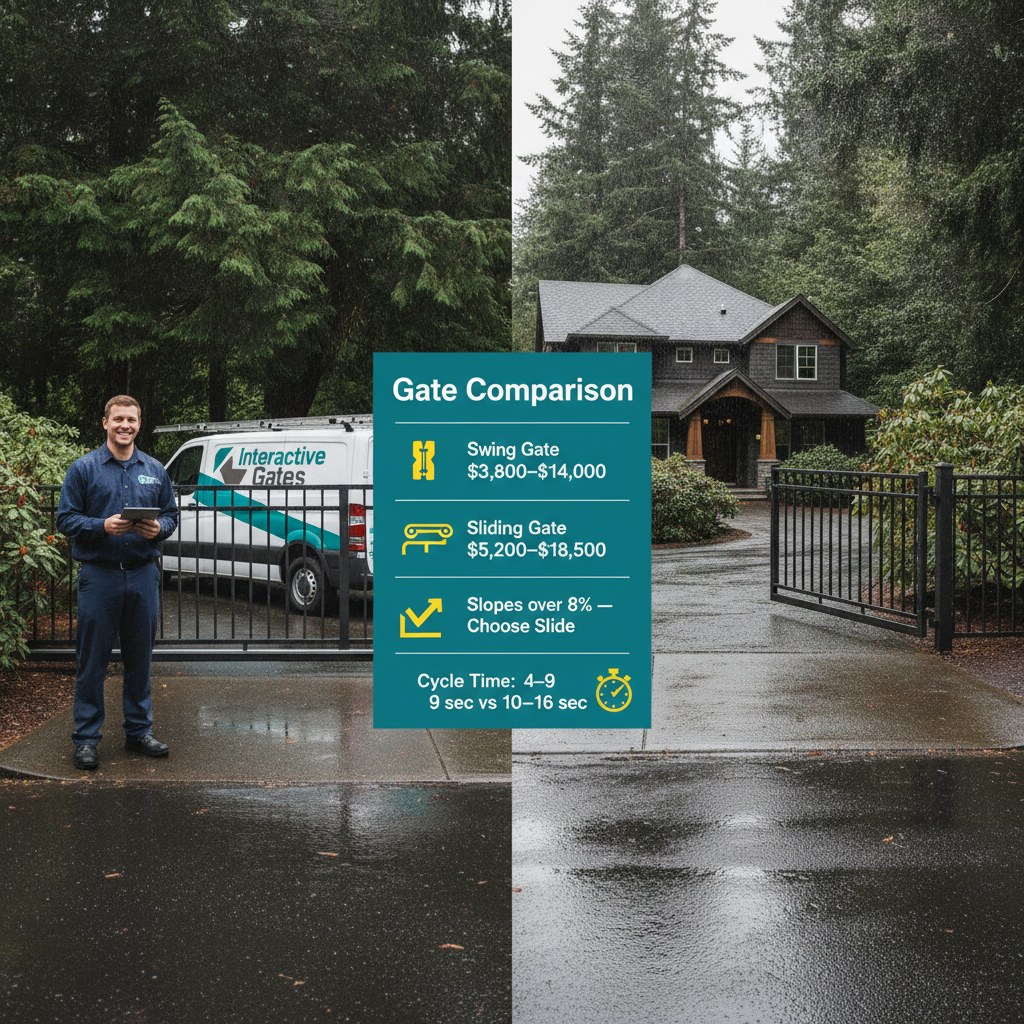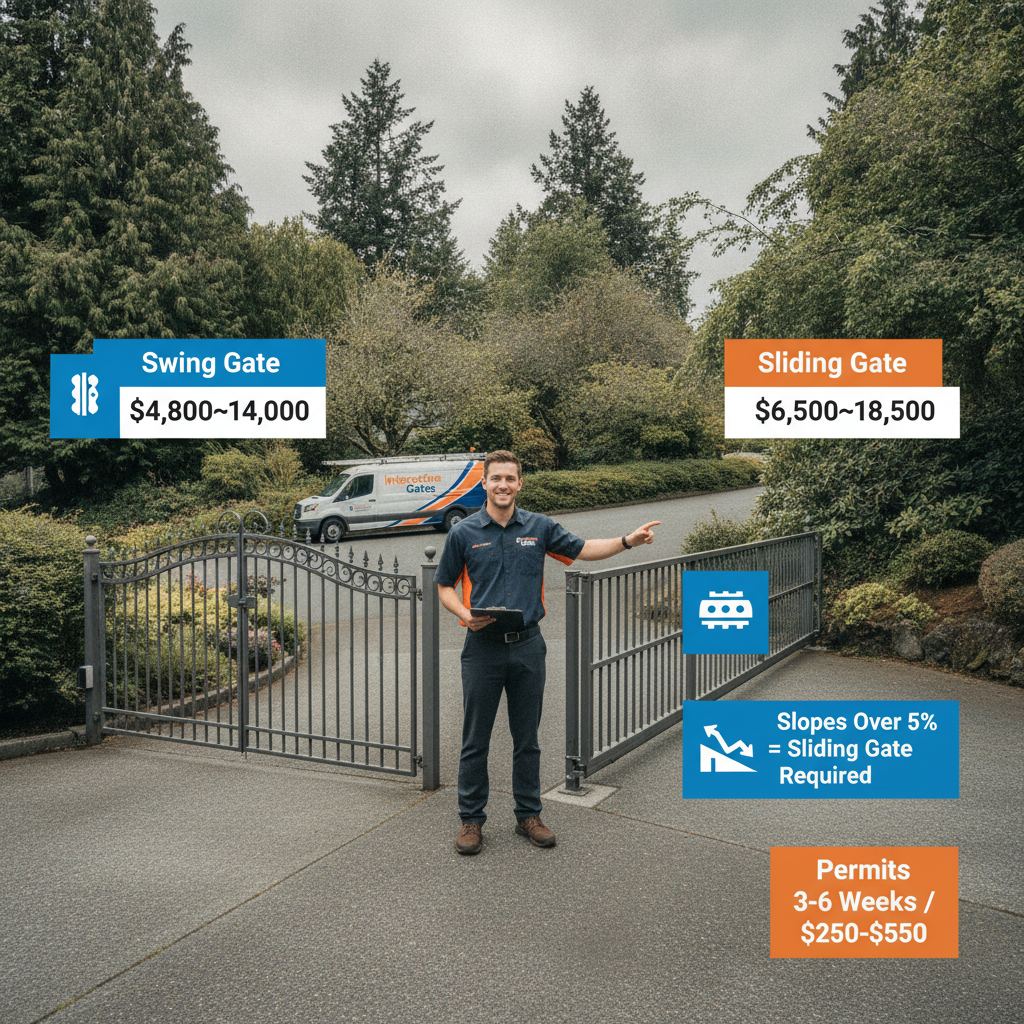
- Swing gates need at least 8–12 inches of level ground at the hinge post — slopes steeper than 8% almost always cause arc-clearance failures.
- Sliding gates handle grades up to 15% without special engineering, making them the default choice on steep LA hillside lots.
- A single swing gate operator (LiftMaster CSW200) runs $1,800–$2,800 installed in 2026; a Viking SL-3000 slide operator costs $2,200–$3,400 installed.
- Grading or retaining-wall work to flatten a swing-gate arc adds $1,500–$6,000 depending on soil type and footage in neighborhoods like Bel Air or Palos Verdes.
- Curved-track slide systems solve extreme grades (15–25%) but add $900–$2,000 to hardware costs.
- Los Angeles County and most city building departments require a permit for motorized gates on driveways — plan for $250–$600 and 3–8 weeks.
- Cantilever slide gates eliminate ground-track problems caused by Southern California's expansive clay soils and are preferred in Rolling Hills and Laguna Beach.
- Most LA hillside installations are fully complete in 1–3 days once materials arrive and permits clear.
Does a Sloped Driveway Rule Out a Swing Gate in Los Angeles?
Homeowners in the Hollywood Hills, Bel Air, Rancho Palos Verdes, Laguna Beach, and San Clemente are all asking the same question in 2026: can I put an electric gate on my sloped driveway, and which type actually works? The short answer is yes — but the gate type, operator, and sometimes your driveway itself must be chosen around your grade. Get it wrong and you end up with a $12,000 gate that scrapes the asphalt every time it opens. This guide breaks down exactly what works, what fails, and what it costs on Los Angeles-area sloped lots in 2026.
How Does Driveway Slope Affect Gate Selection?
Every swing gate travels in a fixed arc. If your driveway slopes upward toward the house, the bottom edge of the gate will dig into the pavement at some point in that arc. If it slopes downward from the street, the gate droops away from the latch post. Either scenario causes binding, motor strain, and premature failure of hinges and operators — often within 2–4 years on unaddressed grades.
Sliding gates travel horizontally on a track (or float on a cantilever rail) parallel to the fence line, so the gate's movement is entirely independent of what the driveway is doing underneath. That is why slide gates are the go-to solution on most Southern California hillside properties.
Here is the practical grade breakdown most installers use in 2026:
- 0–4% grade: Swing or slide — both work fine with standard hardware.
- 4–8% grade: Swing gate possible with a custom arc-cut bottom rail and hinge-side grading; slide gate works without modification.
- 8–15% grade: Swing gate requires significant grading or a retaining wall ($1,500–$6,000 extra); slide gate preferred.
- 15–25% grade: Swing gate is almost never practical; curved-track or cantilever slide gate required.
- Over 25% grade: Vertical pivot lift or a hydraulic swing with custom fabrication — contact an engineer before ordering anything.
What Are the Specific Problems Swing Gates Face on LA Slopes?
Southern California adds a few layers of complexity that homeowners elsewhere do not deal with. First, LA's expansive clay soils shift seasonally — a hinge post that is perfectly plumb in October can tilt 0.5–1.5 inches by February after El Niño rains. That movement alone can knock a precisely fitted swing gate out of arc alignment. Second, fire-hardening requirements in Very High Fire Hazard Severity Zones (VHFHSZ) — which cover large portions of the Santa Monica Mountains, Topanga, and the Foothill communities — require gates to be openable by emergency vehicles, which adds a KNOX box or crash-bar requirement that changes your clearance geometry. Third, many hillside lots in neighborhoods like Rolling Hills and Laguna Beach have entry columns or stone pilasters that were built before automation was planned, leaving almost no setback room for a swing gate to open without hitting a landscaping wall or parked car.
Pro Tip: Before ordering any gate, have your installer shoot a laser level across the full arc of the proposed swing path — not just at the posts. On a curved LA hillside driveway, the low point is often 18–24 inches off the posts, right where nobody checks.
How Much Does a Sliding Gate Cost on a Sloped LA Driveway in 2026?
Sliding gate prices in Los Angeles vary by material, width, operator brand, and whether you need a cantilever or ground-track system. Here are real 2026 installed price ranges:
- Ground-track slide gate, aluminum, 12 ft, LiftMaster SL595: $4,800–$7,200 installed
- Ground-track slide gate, steel, 16 ft, Viking SL-3000: $6,500–$9,800 installed
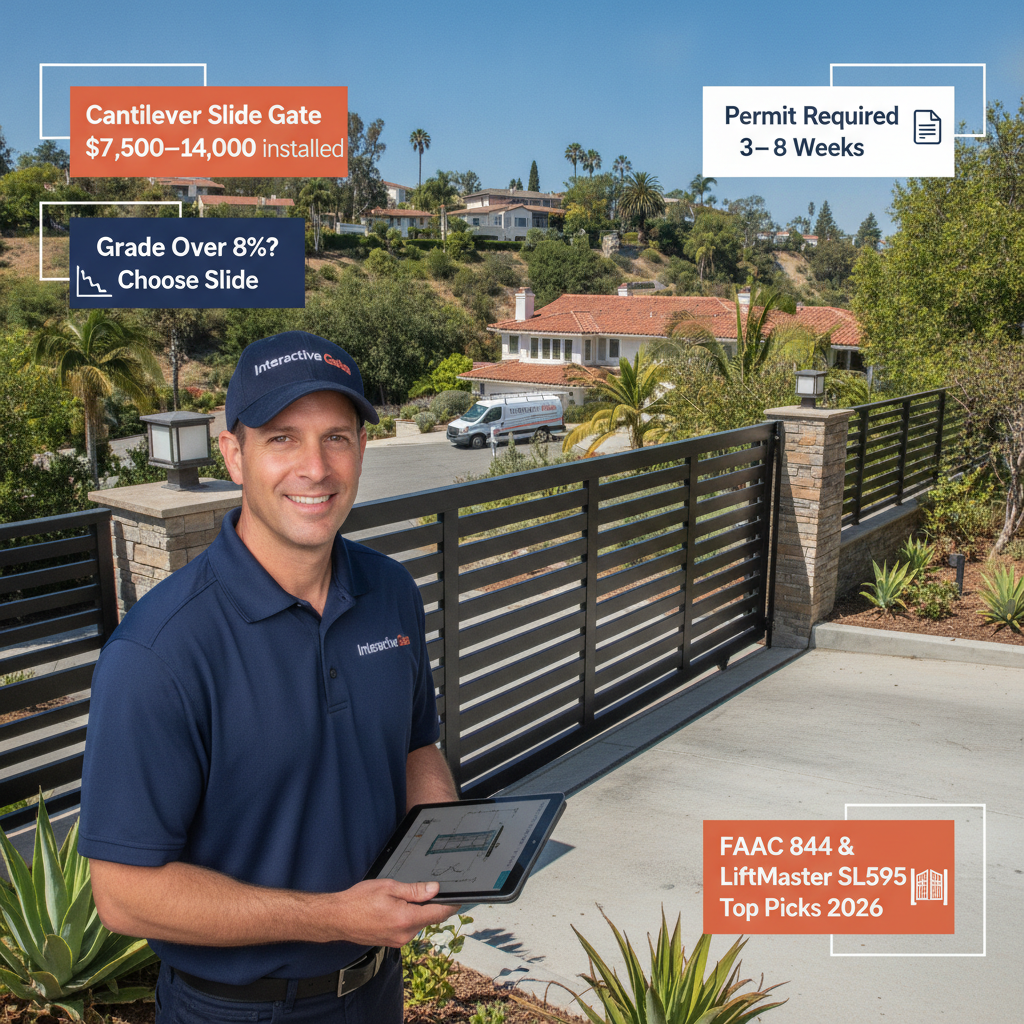
- Cantilever slide gate, aluminum, 14 ft, FAAC 844 operator: $7,500–$11,500 installed
- Cantilever slide gate, ornamental iron, 18 ft, Viking SL-3000: $10,000–$16,000 installed
- Curved-track slide gate for grades 15–25%, custom fabrication: add $900–$2,000 to hardware cost above
These prices include operator, one keypad, one vehicle loop detector, photo-eye safety sensors, and standard wiring runs up to 50 feet. Access control upgrades (video intercoms, app-based LiftMaster myQ, license-plate readers) add $600–$3,500 depending on system. View completed projects in our project portfolio to see how slope challenges were solved on real LA properties.
How Much Does a Swing Gate Cost on a Sloped LA Driveway in 2026?
If your grade is under 8% and you want swing gates — perhaps for aesthetic reasons common in San Clemente Spanish-colonial estates or Orange tract homes with wide front yards — here is what to budget in 2026:
- Single swing gate, aluminum, 10 ft, LiftMaster CSW200: $3,200–$5,500 installed
- Dual swing gate, aluminum, 14 ft total, LiftMaster CSW200 pair: $5,800–$9,000 installed
- Dual swing gate, ornamental iron, 16 ft total, FAAC 391 operator: $8,500–$14,000 installed
- Arc-cut bottom rail (custom bevel to clear slope): add $300–$700 per leaf
- Hinge-side grading or small retaining wall to create level pad: add $1,500–$6,000 depending on soil and footage
The grading cost is where most homeowners are blindsided. On a standard Palos Verdes lot with 10% grade and a 12-foot entry, a concrete level pad for swing-gate operation runs $2,200–$4,500 with a landscape contractor, or $3,500–$6,000 if a small retaining wall is needed. On steeper terrain this can easily exceed the gate itself.
Pro Tip: If your heart is set on swing gates for curb appeal but your grade is 6–10%, ask about raking hinge sets — these allow the gate leaf to hang at a slight angle so the bottom rail follows the slope rather than swinging into it. They cost $180–$350 extra per post and can eliminate grading on moderate grades entirely.
Cantilever vs. Ground-Track Slide Gates: Which Is Better for LA Soil?
Ground-track systems use a steel V-groove rail embedded in or surface-mounted on the driveway. They are less expensive and handle most residential widths up to 20 feet easily. The problem in Los Angeles is that clay-heavy soils in Bel Air, Topanga, and the San Gabriel foothills expand and contract significantly with seasonal moisture — heaving the track, cracking the concrete channel, or leaving a ridge that catches tires. Debris accumulation (leaves, acorns, eucalyptus pods) is also constant and blocks the trolley mechanism, requiring more frequent maintenance.
Cantilever systems hang the gate from an overhead rail with no ground contact at all. They cost $1,500–$3,000 more than equivalent ground-track systems but eliminate the soil-movement and debris problems entirely. For most LA hillside properties above $800,000 in value, the long-term savings in maintenance and the cleaner look make cantilever the smarter investment. Ask about cantilever options when you contact Interactive Gates for a site assessment.
What Permits Do You Need for a Gate on a Sloped LA Driveway?
As of 2026, Los Angeles City, LA County unincorporated areas, and most incorporated cities (Laguna Beach, San Clemente, Rolling Hills, Orange) all require a building permit for motorized driveway gates. Sloped-lot installations frequently also trigger a grading permit if more than 50 cubic yards of soil is moved — which easily happens when you are creating a level swing-gate pad. Expect:
- Building permit fee: $250–$600 for most residential gate projects
- Grading permit (if needed): $350–$900 additional
- VHFHSZ fire-gate compliance review: $0–$200 additional plan-check fee
- Timeline: 3–8 weeks for standard residential; 6–14 weeks in coastal commission overlay zones (Laguna Beach shoreline parcels)
A professional installer will pull the permit on your behalf and include it in the project scope. Unpermitted gates in LA can result in stop-work orders, fines of $500–$5,000, and mandatory removal — especially in fire-zone and hillside ordinance areas. See our full LA gate guide for Los Angeles city-specific pages.
Which Operator Brands Handle Sloped-Lot Conditions Best in 2026?
Not all operators are equal when a gate must work harder because of slope-related stress. Here are the brands and models LA installers most recommend in 2026 for sloped-lot applications:
- LiftMaster SL595 (slide): 1 HP DC motor, 150 cycles/day rated, handles gates up to 1,500 lbs and 50 feet. Strong thermal management for Southern California heat. myQ app integration standard.
- Viking SL-3000 (slide): 1/2 HP, 300 cycles/day, handles up to 1,200 lbs. Extremely popular on LA multi-family and HOA properties because of reliability and a nationwide parts network.
- FAAC 844 (slide/cantilever): Italian engineering, DC brushless motor, 60 cycles/hour, whisper-quiet — preferred on luxury residential in Bel Air and Rolling Hills where noise matters.
- LiftMaster CSW200 (swing): Handles single leafs up to 18 ft and 900 lbs. Reliable in moderate-slope applications with proper arc preparation.
- FAAC 391 (swing): Hydraulic operator — slower but nearly zero maintenance and handles slopes and heavy iron gates better than chain or screw-drive alternatives. Typical lifespan 15–20 years.
- Apollo 1500 (swing): Budget-friendly at $900–$1,400 installed, suitable for lighter aluminum gates on 0–5% grades. Not recommended for steep hillside applications.
In One Minute: Sloped Driveway Gate Decision in Los Angeles
If your driveway slopes more than 8%, choose a slide gate — almost always a cantilever system on LA clay soils. Budget $7,500–$14,000 installed for a typical residential cantilever slide. If your grade is under 8% and you want the look of swing gates, budget $5,800–$14,000 for dual swing, add $300–$6,000 for any needed grading or raking hinges, and pick a heavy-duty operator like the FAAC 391 or LiftMaster CSW200. Permit fees run $250–$600 and take 3–8 weeks — budget for them. Use our gate design visualizer to preview styles on your property before committing to a style or material. Check recent installations at our project portfolio and read what LA homeowners say on our reviews page.
Frequently Asked Questions: Sloped Driveway Gates in Los Angeles
Can a swing gate work on a steep Los Angeles hillside driveway?
It can, but grades above 8% make swing gates expensive and risky. You will need grading work ($1,500–$6,000), custom arc-cut gate rails, or raking hinge sets — and even then, soil movement common on LA hillsides can throw the gate out of alignment within a few seasons. Slide gates are strongly recommended for grades over 8% on Southern California properties.
What is a cantilever slide gate and why is it popular in LA?
A cantilever slide gate hangs from an overhead rail with no ground contact, so it is immune to track-heaving caused by LA's expansive clay soils and requires no ground channel that can fill with debris. It costs $1,500–$3,000 more than a ground-track slide gate but lasts longer with less maintenance — making it the preferred choice on most hillside and high-value LA residential properties in 2026.
How long does it take to install a gate on a sloped LA driveway?
The physical installation takes 1–3 days once materials are on site and permits are cleared. Permit processing adds 3–8 weeks for most LA jurisdictions, or up to 14 weeks in coastal-commission overlay zones. If grading work is needed, that typically runs 1–2 days before the gate crew arrives.
Do I need a special permit for a gate on a sloped lot in Los Angeles?
Yes. LA City, LA County, and all major incorporated cities require building permits for motorized gates. Sloped lots may additionally trigger a grading permit if soil is moved. Fire-zone properties (VHFHSZ) get an extra compliance review. Total permit costs range from $250 to over $1,000 when grading permits are included. Your installer should pull the permits on your behalf.
Which gate operator brand is best for a hillside driveway in Los Angeles?
For slide gates on hillside properties, the LiftMaster SL595 and FAAC 844 lead in 2026 — both handle heavy gates and high-temperature Southern California conditions well. For swing gates on moderate slopes, the FAAC 391 hydraulic operator outlasts chain-drive alternatives and needs minimal maintenance. Viking SL-3000 is the top pick for HOAs and multi-family slide-gate applications due to its 300-cycle-per-day rating and parts availability.
How much extra does a sloped driveway add to gate installation costs in Los Angeles?
For slide gates, the slope itself usually adds little — a curved track on very steep grades adds $900–$2,000 to hardware. For swing gates, slope-related costs are the bigger line item: arc-cut bottom rails add $300–$700 per leaf, raking hinges add $180–$350 per post, and grading or retaining walls add $1,500–$6,000 depending on scope. Total slope premium on a swing-gate project can reach $3,000–$8,000 on a challenging hillside lot.
Ready to Figure Out the Right Gate for Your Slope?
Every Los Angeles hillside lot is different — grade, soil type, column placement, HOA rules, and fire-zone status all shape the right answer. If you are ready to get clarity on which gate type fits your specific driveway, explore residential gate options or reach out for a no-pressure site assessment. A quick look at the actual grade and setbacks is worth more than any online calculator — and it keeps you from spending $6,000 on grading you did not need.