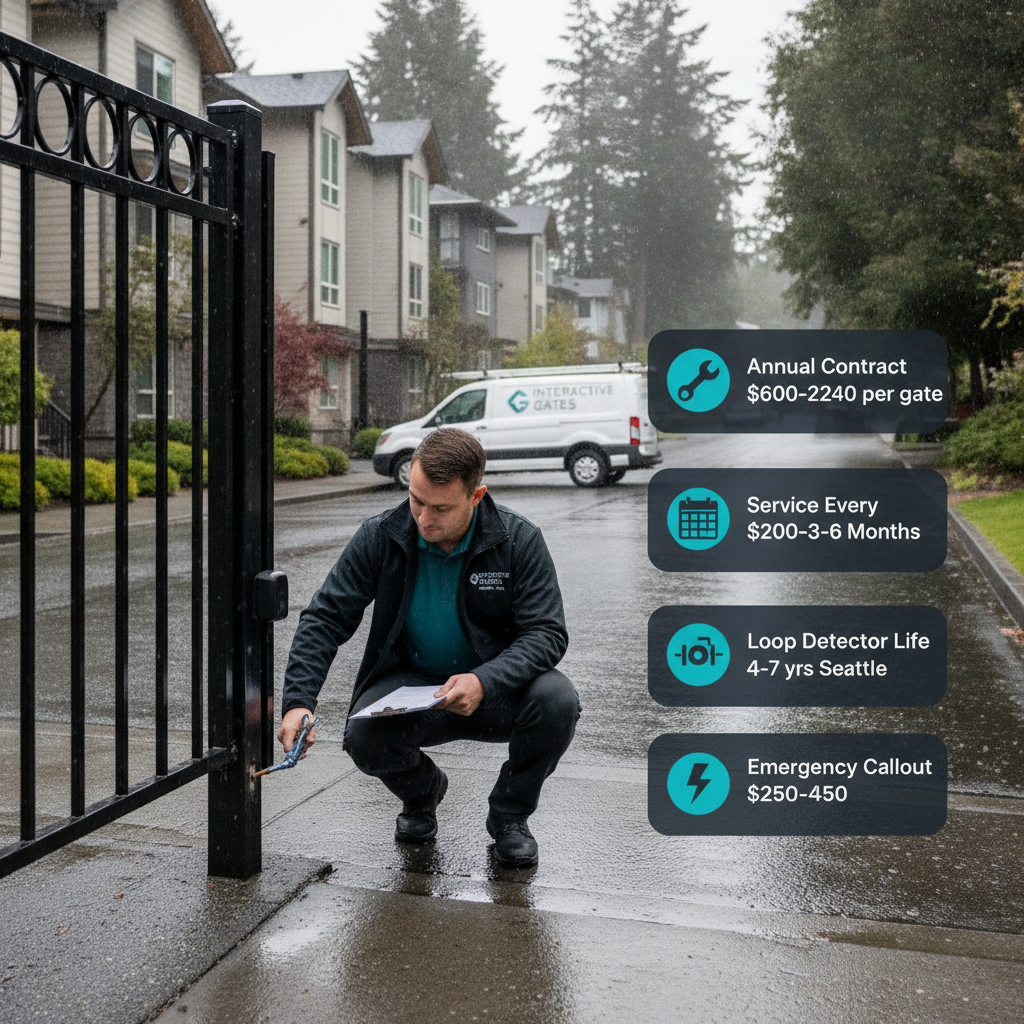
- Annual HOA gate maintenance contracts in Seattle run $600–$2,400 per gate depending on gate type, operator brand, and visit frequency.
- Seattle's wet climate demands lubrication every 3–4 months — not the standard 6-month interval recommended in drier regions.
- Most commercial-grade operators (FAAC, LiftMaster CSW200, Viking Q) are rated 500,000–1,000,000 cycles — but corrosion and moisture cut that down without proper maintenance.
- Loop detector replacements — one of the most common Seattle HOA repairs — run $350–$750 per loop installed, and wet soil accelerates failure.
- Access control boards (keypads, intercoms, RFID readers) should be inspected twice yearly; salt-air communities in West Seattle and Shoreline see accelerated terminal corrosion.
- A deferred-maintenance gate failure at an HOA entrance can cost $3,000–$8,000 in emergency repair versus $800–$1,200 in scheduled annual service.
- Most Seattle-area HOA boards underestimate reserve fund line items for gates — budgeting $500/year when realistic 10-year costs average $1,800–$2,500/year per gate system.
- Preventive replacement of rubber seals, drive belts, and limit switches every 3–5 years can add 4–6 years to an operator's effective lifespan.
You're the treasurer of a Bellevue townhome HOA. The front gate stops responding on a Tuesday morning. Half the residents are locked out, the property manager is getting texts, and the repair bill — after an emergency weekend call — lands at $4,200. Sound familiar? Search queries like 'HOA gate service plan Seattle,' 'how often should a community gate be serviced,' 'who pays for gate maintenance in an HOA,' and 'commercial gate maintenance cost Seattle 2026' are all pointing at the same problem: most HOA boards don't know what they don't know about gate upkeep until something breaks expensively. This guide covers exactly what Seattle-area communities need to service, how often, what it costs, and how to build a maintenance budget that actually holds up.
Why Seattle's Climate Makes HOA Gate Maintenance Non-Negotiable
Seattle averages 37–38 inches of rain annually, but the real issue isn't the volume — it's the duration. Persistent low-level drizzle from October through April keeps metal surfaces damp for weeks at a time. For a community gate system, that translates to three specific failure patterns you won't find in Phoenix or even Portland:
- Accelerated hinge and pivot corrosion: Uncoated or poorly painted steel hinges on swing gates oxidize within 2–3 wet seasons without annual wire-brushing and zinc-based re-coating. This is especially pronounced in communities near Puget Sound — West Seattle, Shoreline, Gig Harbor — where salt particulates compound the problem.
- Loop detector wire degradation: The inductive loops embedded in asphalt near gate entry and exit points absorb ground moisture. Seattle's freeze-thaw cycles (even mild ones) work micro-cracks into the sealant, letting water wick into the detector wire. Most loops last 4–7 years in Seattle versus 8–12 years in Southern California.
- Operator board moisture ingress: Even IP-rated control boards suffer when conduit entry points aren't resealed annually. The FAAC 844 and LiftMaster CSW200 are both excellent operators, but neither is immune to a hairline conduit gap that lets humid air cycle in and out for three winters.
The practical upshot: service intervals that are fine for a Denver or San Diego HOA need to be compressed by roughly 30–40% in the Puget Sound region. That's not a sales pitch — it's reflected in the failure rates Seattle gate technicians actually see.
What Does an HOA Gate Maintenance Visit Actually Include?
Not all 'tune-up' visits are equal. When you're comparing quotes from gate service companies, ask for an itemized scope. A proper Seattle-market HOA gate maintenance visit should include all of the following:
- Operator mechanical inspection: Drive belt or drive chain tension check and adjustment; gear lubrication with NLGI Grade 2 lithium-complex grease (not WD-40); limit switch position verification for open and close stops; clutch or torque limiter adjustment to rated force specification.
- Hinge, pivot, and roller inspection: Visual and tactile check for rust pitting, worn bearing races, and loose fasteners. Lubrication with marine-grade grease on all pivot points. Flag any hinge showing more than 2mm of play for replacement planning.
- Safety device testing: Full-cycle test of all safety edges (obstruction reversal), photo-eye alignment and cleaning, loop detector sensitivity check with a test vehicle or hand-held loop tester, and vehicle presence sensor calibration. Washington State does not currently require UL 325 re-certification at resale the way some California jurisdictions do, but HOA liability exposure is real — document every test result.
- Access control hardware check: Keypad button travel and corrosion inspection; intercom audio and camera (if equipped) function test; RFID or proximity reader antenna alignment; telephone entry system line test (if applicable). Brands like Linear, 2N, DoorBird, and Aiphone all have specific firmware update schedules — ask your tech to check current firmware versions.
- Electrical connections and wiring: Torque-check all terminal block connections; inspect conduit runs for moisture intrusion or physical damage; test battery backup (if installed) under load — most sealed lead-acid batteries in gate operators degrade measurably after 2–3 Seattle winters and should be replaced every 3–4 years.
- Gate structure and hardware: Check weld integrity at gate corners and hinge plates; measure gate sag or alignment drift (a swing gate sagging more than 0.5 inches at the latch side is impending a motor overload condition); inspect latch and lock mechanism for proper engagement.
Pro Tip: Ask your service provider to give you a written report with pass/fail ratings for each item — not just a verbal 'everything looks good.' For HOA boards, this documentation is your protection if a liability claim ever arises from a gate malfunction.
How Often Should an HOA Gate Be Serviced in Seattle?
The honest answer depends on gate usage volume and gate type, but here are realistic minimums for the Seattle market in 2026:
- High-traffic community gates (100+ cycles/day, e.g., apartment complexes, larger HOAs in Bellevue or Kirkland): Full preventive maintenance every 3 months. That's four visits per year. At this cycle volume with Seattle humidity, waiting 6 months between visits is a false economy.
- Medium-traffic HOA gates (30–100 cycles/day, typical townhome or single-family community of 40–120 homes): Full service every 4–6 months, minimum twice yearly. Add a visual inspection walk-through in October before the rainy season and in April after it.
- Low-traffic community gates (under 30 cycles/day, small HOAs of under 30 homes): Annual full service is the minimum, but bi-annual is strongly recommended given Seattle climate factors.
Cycle counts matter because most commercial operators have cycle-based warranties and lifespan ratings. A FAAC 844 or 740 is rated for approximately 800,000–1,000,000 cycles. A LiftMaster CSW200 is rated for 500,000 cycles. A high-traffic gate doing 200 cycles per day hits 73,000 cycles per year — meaning the operator is mid-life in 7–10 years regardless of maintenance. For reserve fund planning, that lifespan clock starts on installation day, not when you first notice a problem.
What Does HOA Gate Maintenance Cost in Seattle in 2026?
Here are realistic ranges for the Seattle metro, including the Eastside (Bellevue, Kirkland, Redmond), South King County (Auburn, Federal Way, Renton), and North King/Snohomish (Lynnwood, Everett, Shoreline):
- Single visit, one gate (swing or slide, standard residential operator): $175–$350. Most communities shouldn't be paying per-visit rates — contract pricing is substantially better.
- Annual contract, one gate, two visits/year: $600–$950. Includes parts up to a defined per-item cap (typically $75–$150/part), labor, and written report.
- Annual contract, one gate, four visits/year (high-traffic): $1,400–$2,400. Some providers offer unlimited service calls within this tier for an additional $200–$400/year premium.
- Multi-gate HOA contracts (2–4 gates, e.g., entry + exit + pedestrian): Per-gate cost drops 15–25% at volume. A three-gate complex on a 4-visit/year schedule might run $2,800–$4,500/year total.
- Emergency call-out (nights, weekends, holidays): $250–$450 trip charge plus parts and labor billed at $125–$195/hour. This is the number that motivates HOA boards to get a service contract.
Common repair line items you'll see on HOA maintenance invoices in 2026:
- Loop detector replacement (cut-in or saw-cut): $350–$750 installed
- Commercial hinge replacement (heavy-duty, weld-on): $180–$400 per hinge including labor
- Drive belt or chain replacement: $220–$480 depending on operator model
- Battery backup replacement: $95–$185 parts and labor
- Gate realignment/adjustment: $150–$320 labor
- Access control board replacement: $400–$1,200 depending on brand and complexity
- Intercom system replacement (e.g., Aiphone GT series): $1,200–$3,500 installed
Pro Tip: If your HOA has been with the same gate company for 3 or more years without a contract rate review, request a re-quote. Labor rates in the Seattle market have increased 12–18% since 2024, and some per-visit rates haven't been adjusted to reflect newer, better-value annual contract structures.
Who Is Responsible for HOA Gate Maintenance — the HOA or Individual Owners?
This is one of the most common sources of HOA board confusion. The short answer: almost universally, the gate system is a common element under Washington State's Homeowners Association Act (RCW 64.38) and the community's CC&Rs, meaning maintenance is the HOA's financial and operational responsibility — not individual unit owners. However, there are nuances:
- If a resident's vehicle damages the gate, most CC&Rs allow the HOA to charge back repair costs to that owner after due process.
- Pedestrian gates serving individual units (e.g., a private courtyard gate) may be classified as limited common elements and the owner's responsibility — check your CC&Rs specifically.
- Access control credentials (key fobs, app access, remote controls) are typically owner-purchased but HOA-programmed — the board controls credentialing, the owner pays for lost or additional remotes.
For communities in Bellevue, Everett, or Lynnwood, local city codes may also impose obligations on HOAs operating gates over public or quasi-public paths — worth a 30-minute conversation with a Washington HOA attorney if your community is near a public sidewalk or easement.
How Should an HOA Budget for Gate Maintenance and Replacement?
Reserve fund studies are required for many Washington HOAs, and the gate system should be a named line item. Here's how to build a realistic 10-year cost projection for a single community gate in the Seattle market (2026 dollars):
- Years 1–5 (new or recently serviced system): $800–$1,200/year in scheduled maintenance. Budget $500 annually in a sinking reserve for parts and unscheduled repairs. 5-year total: $6,500–$8,500.
- Years 6–10 (mid-life system): Maintenance stays at $900–$1,400/year, but parts costs increase. Budget $1,000–$1,500/year for loop detector replacement, hinge work, and access control upgrades. Operator replacement ($2,500–$5,500 installed for a commercial unit) is a realistic possibility in year 8–12. 5-year total: $9,500–$15,000 including one operator replacement.
- Full system replacement (gate, operator, access control, loops): Budget $15,000–$45,000 depending on gate size, material, operator grade, and access control complexity. This is a capital expense, not a maintenance expense, and should appear in your reserve study as a separate line item with a realistic lifespan of 15–25 years for the gate structure and 10–15 years for the operator and electronics.
For an HOA currently evaluating or planning a new gate system, the HOA gate systems page has useful reference information on system types and access control options. The gate design visualizer can help boards show homeowners what a proposed gate would look like before committing to a design — useful for member meetings.
Choosing a Gate Maintenance Provider for Your Seattle HOA
Not every residential gate company is equipped to handle HOA and commercial-scale maintenance. When vetting providers, look for:
- Experience with your specific operator brand (FAAC, LiftMaster, Viking, BFT, DITEC — they each have different maintenance protocols and proprietary diagnostic tools)
- Ability to provide written service reports and digital maintenance logs — essential for HOA record-keeping
- Bonded and insured for commercial work (general liability minimums of $1M–$2M for HOA contracts)
- Contract terms that include response time guarantees — 4-hour emergency response is reasonable to ask for in a metro market like Seattle
- References from other HOAs or property managers in the area, not just homeowners
You can see examples of HOA and multi-family gate projects in the project portfolio, and read verified customer feedback on the reviews page to get a sense of how communities in the area have been served.
In One Minute: HOA Gate Maintenance in Seattle 2026
Seattle's wet climate means standard 6-month service intervals aren't enough for most HOA gates — high-traffic systems need service every 3 months, mid-traffic every 4–6 months. A proper visit covers the operator, hinges, safety devices, access control hardware, wiring, and gate structure. Annual maintenance contracts run $600–$950 for a single gate at two visits per year, rising to $1,400–$2,400 for four annual visits on a busy community gate. Emergency call-outs cost $250–$450 just to show up, making contracts a clear financial win. The gate system is almost always an HOA common element under Washington law. Reserve fund studies should budget $800–$1,200/year in maintenance plus a capital reserve for operator replacement ($2,500–$5,500) every 10–15 years. Loop detectors fail faster in Seattle's wet soil — budget $350–$750 per replacement every 4–7 years. The cost gap between deferred maintenance ($3,000–$8,000 emergency repairs) and proactive service ($800–$1,200/year) is the single best argument for a service contract.
Frequently Asked Questions: HOA Gate Maintenance in Seattle
How much does an HOA gate maintenance contract cost in Seattle?
Most HOA gate maintenance contracts in the Seattle area run $600–$950 per gate per year for two scheduled visits, or $1,400–$2,400 per gate per year for four visits on high-cycle-count community gates. Multi-gate contracts (two or more gates at the same property) typically carry a 15–25% per-gate discount. Emergency call-out fees ($250–$450 trip charge plus labor) are usually separate from contract pricing, though some providers offer an unlimited-call tier for an additional $200–$400 annually.
How often should a community gate be serviced in the Seattle area?
High-traffic HOA gates (100+ cycles per day) should be serviced every 3 months in the Seattle climate. Mid-traffic gates (30–100 cycles/day) need service every 4–6 months, at minimum twice per year. Low-traffic gates in small communities (under 30 cycles/day) need annual service at a minimum, with bi-annual service strongly recommended given Seattle's persistent moisture. These intervals are shorter than national standard recommendations specifically because of the Puget Sound region's humidity and mild freeze-thaw cycle patterns.
Who is responsible for gate maintenance in a Washington State HOA?
Under Washington's Homeowners Association Act (RCW 64.38) and most community CC&Rs, the gate system is a common element — the HOA's financial and operational responsibility, not individual owners. Exceptions can apply to limited common elements like private courtyard gates. If a resident's vehicle damages the gate, most CC&Rs allow the board to charge back repair costs to that owner. Credentials such as key fobs or remotes are typically owner-purchased but HOA-programmed and controlled.
What parts of an HOA gate system fail most often in Seattle?
The most common failure points in Seattle's climate are: inductive loop detectors (4–7 year lifespan in wet soils, replacement cost $350–$750 each); battery backups in gate operators (degrade noticeably after 2–3 wet winters, $95–$185 to replace); hinge and pivot corrosion on swing gates (especially near Puget Sound); and access control terminal block corrosion from humidity cycling in poorly sealed conduit runs. Drive belts and chains are also wear items, typically needing replacement every 5–8 years depending on cycle count.
How should an HOA budget for gate maintenance and eventual replacement?
A realistic Seattle-market budget for a single community gate system is $800–$1,200 per year in scheduled maintenance, plus a reserve contribution of $500–$1,500 per year toward operator replacement and major repairs. Full operator replacement (commercial grade, installed) runs $2,500–$5,500 and is realistic every 10–15 years for mid-traffic systems. A full gate system replacement (structure, operator, access control, loops) ranges from $15,000–$45,000 and should appear as a capital expense in your HOA reserve fund study with an anticipated 15–25 year lifespan for the gate structure.
Can an HOA gate system work with a property management company's access control platform?
Yes — many modern access control systems used on Seattle HOA gates integrate with property management platforms. Brands like 2N, Verkada, Liftmaster's myQ Community, and Aiphone's IX series all offer API-level or app-level integrations with management software. RFID and mobile credential systems (Bluetooth, NFC) allow property managers to add, suspend, or revoke access credentials remotely without a site visit. If your community is considering an upgrade or new installation, the HOA gate systems overview covers access control options in detail.
Ready to Get Your Community Gate on a Service Plan?
If your HOA board is overdue for a gate inspection, navigating a failed system, or putting together a reserve fund line item for the first time, starting with a professional assessment is the right move. An experienced technician can give you an honest condition report, estimated remaining lifespan on your operator and hardware, and a service contract proposal sized to your actual cycle volume and gate type. For communities across the Seattle metro — from Tacoma and Auburn to Snohomish — Interactive Gates works with HOA boards and property managers to build maintenance programs that prevent the expensive surprises. Reach out through the contact page to schedule an on-site evaluation — no obligation, no pressure, just a clear picture of where your gate system stands.