- UL 325 compliance is mandatory for every new automatic gate installation in Portland — no exceptions, no grandfathering for recent installs.
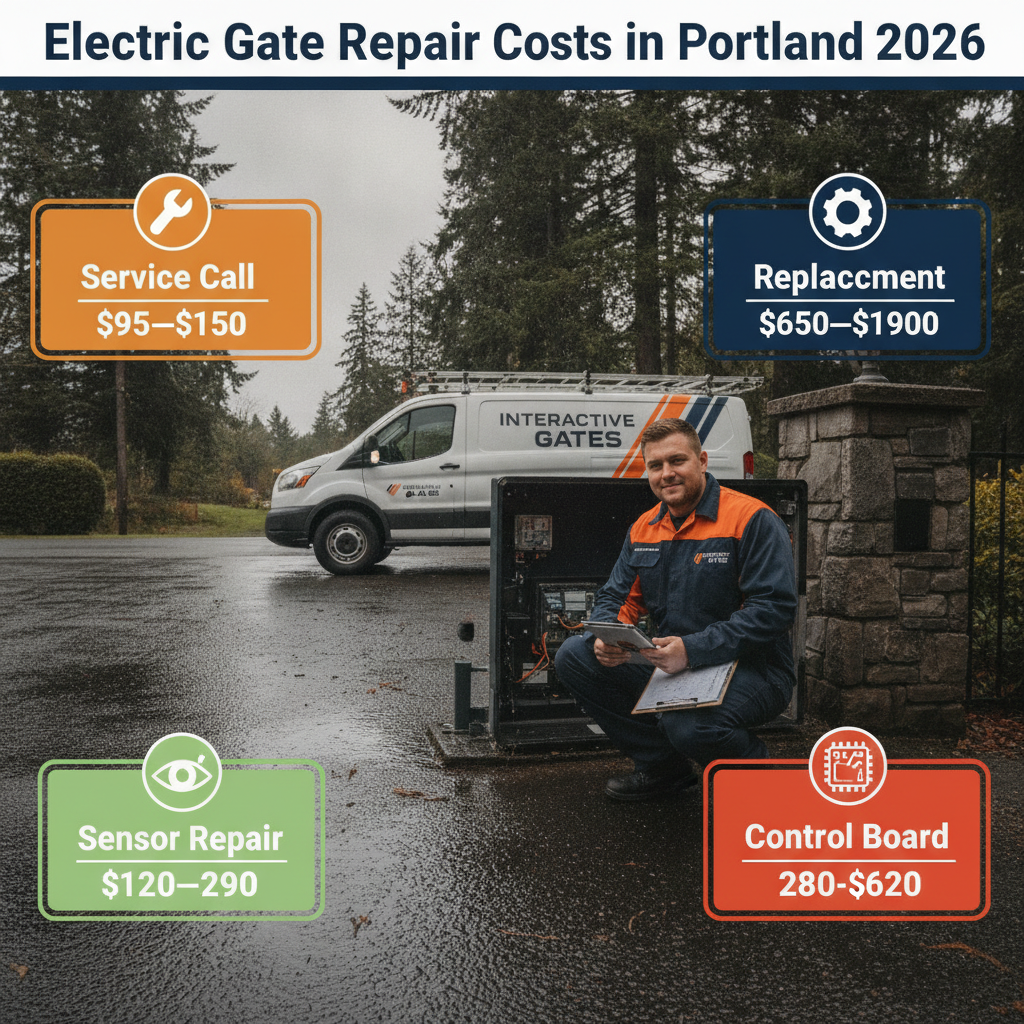
- Photo-eye sensors cost $120–$280 installed and are the single most code-critical safety component on any swing or slide gate.
- Entrapment protection requires at least two independent devices under UL 325 — one primary, one secondary (e.g., photo eyes + edge sensor).
- Portland's wet winters accelerate sensor drift — misaligned photo eyes account for roughly 60 % of gate safety failures inspected locally each year.
- Edge sensors (contact strips) run $180–$380 installed and are the most reliable secondary device for sliding gates on sloped lots in SW Portland and Lake Oswego.
- A monitored gate entrapment system with vehicle loop detection adds $400–$900 to a residential install but is effectively required on HOA and commercial entries.
- Oregon OSHA and Portland Bureau of Development Services can require a full safety audit on commercial and multi-family gates before a certificate of occupancy is issued.
- Wireless safety kits from LiftMaster (RSW12U) or FAAC (XBAT) retrofit to existing openers in 2–4 hours for $250–$500 labor-inclusive.
What Does Portland Code Actually Say About Automatic Gate Safety?
If you've searched 'do I need safety sensors on my automatic gate in Portland' or 'what does Oregon code require for electric gate safety,' you're asking the right questions — and the answers matter more than most homeowners realize. A gate that closes on a child, a pet, or a bicycle is a liability that insurance companies take very seriously, and the City of Portland's Bureau of Development Services (BDS) aligns with the national UL 325 standard for automated vehicular gate systems. Here's what that means in plain language for a 2026 install or upgrade.
What Is UL 325 and Why Does It Apply to Your Portland Gate?
UL 325 is the Underwriters Laboratories safety standard that governs all automated vehicular gates sold or installed in the United States. Portland contractors must install UL 325–listed gate operators and equip every system with UL-listed entrapment protection devices. The standard was most recently revised in 2024 and took effect for new installs by January 2026. If your gate operator carries a UL 325 label (look for the circular UL mark on the motor housing), it was manufactured to meet the standard. If not, your insurer may deny a liability claim and your installer may face code violations.
Practically speaking, UL 325 requires that every automatic gate have a minimum of two independent entrapment-protection zones — a primary device and a secondary device. Neither can be a timer-to-stall (the old-school method of letting the motor strain until it times out) except as a tertiary backstop. The common combinations approved for Portland residential gates in 2026 are: photo eyes + edge sensor, photo eyes + loop detector, or monitored entrapment system + photo eyes.
Pro Tip: If your gate was installed before 2016 and hasn't been safety-updated since, there is a reasonable chance it doesn't meet current UL 325 requirements. Ask your installer to do a complimentary safety audit — Interactive Gates technicians check this during every service call in the Portland metro.
What Safety Devices Are Required vs. Optional on a Portland Residential Gate?
Required: Photo-Eye Sensors (Retroreflective or Through-Beam)
Photo eyes project an infrared beam across the gate opening. When anything breaks the beam — a car, a person, a dog — the gate stops and reverses. For residential swing gates in Portland, one set of through-beam photo eyes mounted 6–12 inches above the ground is the minimum primary entrapment device. Installed cost in 2026 runs $120–$280 for a standard residential pair (LiftMaster MSW or FAAC XP20 are the two most common brands our crews use in Beaverton and Lake Oswego). Through-beam sensors (separate transmitter and receiver) are more reliable in Portland's rainy climate than retroreflective units, which can false-trigger when raindrops hit the reflector.
Required (as Secondary): Edge Sensors or Loop Detectors
An edge sensor is a rubber contact strip mounted along the leading edge of a sliding gate or the face of a swing gate arm. It acts like a giant 'touch bumper' — when the gate contacts any object, the strip compresses and signals the operator to reverse immediately. Edge sensors cost $180–$380 installed for a standard residential gate up to 16 feet. They're especially valuable on Lake Oswego and Oregon City properties where sloped driveways mean a sliding gate can accelerate faster than a photo eye can react.
Vehicle loop detectors — inductive loops cut into the pavement — are the other popular secondary device. They detect the mass of a vehicle and prevent the gate from closing on a car that's still in the opening. A single residential loop runs $350–$650 installed; dual-loop setups (one inside, one outside) cost $600–$1,100. Loop detectors are essentially mandatory on any HOA gate in Portland's Metro region — the commercial and HOA gate standard in Oregon calls for them in any application where vehicle throughput exceeds roughly 20 cycles per day.
Optional but Strongly Recommended: Monitored Entrapment Systems
A monitored entrapment system (sometimes called a 'Type D' device under UL 325) uses a combination of sensors and logic built into the gate controller to continuously verify that the entrapment-protection devices are functioning. If a sensor goes offline or is blocked, the system puts the gate in a fail-safe hold-open mode and alerts the property owner by app or email. LiftMaster's myQ platform and FAAC's iSMA module both offer this functionality. Add-on cost for retrofitting to an existing operator: $400–$900 installed, depending on the controller's age and compatibility.
Optional: Pedestrian Gates and Secondary Egress
Oregon building code doesn't mandate a separate pedestrian gate, but Portland BDS strongly recommends them for any property where people on foot regularly use the same opening as vehicles. A pedestrian gate with its own access hardware (keypad, card reader, or app-controlled latch) adds $800–$2,400 to a project depending on material and width. This is a common add-on for Hillsboro and Beaverton homes where kids walk to and from school through driveways.
How Does Portland's Rainy Climate Affect Gate Safety Sensors?
Portland averages 36–43 inches of rain per year, most of it falling as extended drizzle between October and April. That moisture profile is different from Seattle's heavier winter dumps and much wetter than Los Angeles — it means sensors don't get a dramatic soaking, they get a slow, persistent wetting that causes gradual alignment drift and lens clouding on photo eyes. Our service team in Portland finds that roughly 60 % of safety-related gate failures during winter calls trace back to misaligned or dirty photo eyes rather than any mechanical fault.
Best practice for Portland properties in 2026: use IP65-rated or better enclosures on all sensor hardware. LiftMaster's MSW series and Viking Access's model EC2000 both ship with IP65 enclosures standard. If your photo eyes are in open-face brackets, budget $60–$120 to upgrade to weather-sealed housings at your next service visit. Portland homeowners on the West Hills, where fog is denser and temperatures drop below freezing a few times each winter, should also ask about heated sensor brackets — a niche but worthwhile $80–$150 upgrade that eliminates frost-induced false triggers.
Pro Tip: Clean photo-eye lenses with a dry microfiber cloth every 30–60 days during the rainy season. It takes two minutes and prevents 80 % of nuisance reversals. Add it to your monthly calendar alongside the gate lubrication schedule.
What Are the Safety Requirements for HOA and Commercial Gates in Portland?
HOA and commercial gate installations in the Portland metro are subject to both UL 325 and Oregon OSHA's General Safety guidelines for powered equipment. For properties in the City of Portland proper, BDS may require a permit and inspection that includes a functional test of all entrapment-protection devices before issuing final approval. The key differences from residential requirements are:
- Dual vehicle loop detectors (inside and outside loops) are effectively required, not optional.
- Warning signs must be posted on both sides of the gate stating 'AUTOMATIC GATE — STAND CLEAR' in lettering at least 1 inch tall.
- An emergency release mechanism accessible to first responders is required, typically a Knox Box or padlocked emergency pull cord.
- Cycle-rated operators — commercial gates must use operators rated for at least 100 cycles per day (residential units are typically rated 15–50 cycles/day).
- Annual safety inspections are strongly recommended and sometimes written into HOA CC&Rs as a maintenance obligation.
If your HOA is in Hillsboro, Beaverton, or Gresham, check whether your city has adopted stricter local amendments — some municipalities in Washington County require a building permit for any gate over 6 feet in height or 12 feet in width, which triggers a formal safety inspection at close-out.
How Much Does a Full Safety Upgrade Cost for an Existing Portland Gate?
Many Portland homeowners have gates installed in the 2010s or early 2020s that were compliant at the time but fall short of 2026 UL 325 standards. Here's a realistic cost breakdown for bringing a typical residential swing or slide gate up to current code:
- Photo-eye replacement (1 pair, IP65, through-beam): $120–$280 installed
- Edge sensor strip (up to 16 ft gate leaf): $180–$380 installed
- Vehicle loop detector (single loop, saw-cut pavement): $350–$650 installed
- Monitored entrapment controller module (myQ or iSMA): $400–$900 installed
- Warning signage (2 signs, hardware included): $40–$80
- Full safety audit + compliance report: $95–$175 (often waived with same-day repair work)
A typical residential safety upgrade bringing a mid-2010s gate to 2026 standards runs $650–$1,400 all-in, depending on how much of the hardware needs replacing. See our project portfolio for before-and-after examples of safety retrofits in the Portland area, and check out customer reviews to see what Portland homeowners say about the process.
Can I Design a New Gate That's Already Safety-Compliant From Day One?
Yes — and it's far easier and less expensive to build safety in from the start than to retrofit later. When you use our gate design tool, you can configure your gate type (swing vs. slide), operator brand, and access-control system. Our Portland team then verifies that the sensor package bundled with your selected operator meets 2026 UL 325 requirements before the quote is finalized. For a new residential install, the safety devices are typically included in the base operator price — you're not paying a separate line item. The cost only separates out if you're adding loop detectors (which require pavement cutting) or a monitored entrapment controller.
In One Minute: Portland Automatic Gate Safety 2026
Every automatic gate in Portland must comply with UL 325, which requires at minimum two independent entrapment-protection devices. For most residential gates, that means photo-eye sensors ($120–$280 installed) as the primary device, plus either an edge sensor ($180–$380) or a vehicle loop detector ($350–$650) as the secondary. Portland's wet climate causes sensor drift — use IP65-rated enclosures and clean lenses monthly. HOA and commercial gates need dual loops, warning signs, emergency release access, and cycle-rated operators. A full safety upgrade on an older gate costs $650–$1,400. Build safety in from day one on a new install and it's largely included in the operator package. Contact your installer for a complimentary safety audit if your gate is more than five years old.
Frequently Asked Questions About Automatic Gate Safety in Portland
Is UL 325 compliance legally required in Portland, or just a recommendation?
UL 325 compliance is effectively required for any new automatic gate installation in Portland. Oregon's electrical and building codes reference UL-listed equipment as the accepted standard, and Portland BDS inspectors expect it on permitted projects. While BDS doesn't issue a specific 'gate safety permit' in every case, any gate that causes an injury and is found to be non-compliant with UL 325 creates significant liability exposure for both the property owner and the installer. Treat it as mandatory.
What happens if my photo-eye sensors fail in Portland's rainy weather?
If the primary entrapment device (photo eyes) fails and the gate detects the fault, a UL 325-compliant operator will default to a fail-safe hold-open mode — the gate stays open and won't auto-close until the fault is cleared. This is by design: a gate stuck open is a nuisance, but a gate that closes on a person is a catastrophe. If your gate is instead closing on a blocked beam (which means it's not UL 325 compliant or the sensor wiring has degraded), call for service immediately. During Portland's rainy season, expect sensor faults to increase — budget for at least one sensor cleaning and alignment check per year.
Do I need a permit to add safety sensors to an existing gate in Portland?
In most cases, adding or replacing sensors on an existing gate does not require a standalone permit from Portland BDS, as it's considered maintenance of existing equipment. However, if the sensor upgrade is part of a larger scope — replacing the operator, extending the gate, or modifying the electrical supply — a permit may be required. Always confirm with your installer before work begins. Permitted work in Portland typically adds 1–3 weeks to a project timeline for plan review.
How often should safety sensors be tested on a Portland residential gate?
UL 325 recommends testing all entrapment-protection devices monthly. In practice, Portland homeowners should do a manual obstruction test — place a 2x4 flat on the ground in the gate's path and try to close the gate. It should stop and reverse before the leading edge contacts the board. Do this test at the start of the rainy season (October) and again in spring (April). Also inspect photo-eye alignment and clean lenses at those same intervals. Log the tests in a simple maintenance notebook, especially if you're an HOA board member — documentation matters if a claim is ever filed.
What is the difference between a photo eye and an edge sensor, and do I need both?
A photo eye projects a beam across the gate opening and detects anything in the path before the gate arrives. An edge sensor is mounted on the gate itself and detects contact when the gate physically touches an object. Photo eyes catch obstructions early — before the gate reaches them — while edge sensors are the last line of defense if something enters the opening after the beam has cleared. Under UL 325, you need both (or an equivalent combination) because no single device covers every failure scenario. For sliding gates on sloped Portland lots, the combination of a through-beam photo eye plus a contact-strip edge sensor is the most reliable and most commonly installed pairing in 2026.
Can I install gate safety sensors myself to save money?
Homeowners sometimes attempt DIY sensor installation, but it's not recommended for UL 325 compliance. The sensor wiring must integrate correctly with the gate operator's control board, and the mounting height, beam angle, and alignment must meet UL 325 specifications. An incorrectly wired photo eye can fail to stop the gate even when it appears to be working. In Portland, if a gate with a DIY sensor modification injures someone, your homeowner's insurance may deny the claim on the basis that the system was altered outside of a licensed installation. The professional install cost ($120–$380 depending on sensor type) is minimal compared to the liability exposure of a non-compliant setup.
Ready to Make Your Portland Gate Safer?
Whether you have a 10-year-old gate that's never had a safety audit or you're planning a brand-new install in Beaverton, Lake Oswego, or Gresham, the team at Interactive Gates can walk you through what your specific property needs to meet 2026 UL 325 standards. Start by using our gate design tool to explore configurations, or reach out directly for a site assessment. No pressure — just straight answers from people who install and service gates in Portland every day.
FAQs