- Seattle gates should handle sustained winds of 85–110 mph depending on exposure category and local topography — waterfront lots near Puget Sound demand the higher end.
- Steel and wrought-iron gates withstand wind loads better than hollow aluminum, but properly engineered aluminum with internal bracing can meet code at a fraction of the weight.
- UL 325 and ASCE 7-22 are the two standards installers reference in 2026 — ask any bidder which edition their engineer of record used.
- A wind-rated gate panel adds $400–$900 to material cost compared with a standard residential panel of the same size.
- Gate operators fail in storms more often than panels do — a battery-backup unit ($350–$600 installed) keeps access control live after outages that affect Snohomish County and the Eastside.
- Hinge and post sizing matter as much as the panel — undersized 4-inch posts on a 10-foot swing gate are the single most common storm failure point technicians see in Bellevue and Kirkland.
- Annual post-storm inspections cost $125–$200 and catch loose hardware before a $2,000+ structural repair becomes necessary after the next Puget Sound windstorm.
- Lead time for custom wind-rated panels runs 4–8 weeks in 2026 due to ongoing steel supply constraints — order before storm season, not during it.
Does My Electric Gate Actually Need a Wind Rating in Seattle?
If you have ever watched a neighbor's wooden fence panel sail across the street during a November windstorm, you already know that the Pacific Northwest is not a benign climate for outdoor structures. Homeowners in Seattle, Bellevue, and Everett routinely search questions like what wind load does my gate need in Seattle, will my automatic gate survive a windstorm, and what happens to my gate operator when the power goes out in a storm. This guide answers all of those questions with current 2026 engineering standards, real price ranges, and the specific local conditions that make Puget Sound installations different from anywhere else in the country.
What Wind Speeds Do Seattle-Area Gates Actually Face?
The International Building Code and ASCE 7-22 divide the country into wind speed zones. Most of King County falls into a zone requiring design for 85 mph three-second-gust wind speeds under Exposure Category B (suburban areas with trees and neighboring structures). However, that number rises fast the moment a property moves toward open water or elevated terrain. Waterfront lots in Gig Harbor, exposed hillside properties in Tacoma's north end, and large-lot rural parcels in Snohomish County can fall into Exposure Category C or D, pushing the design wind speed to 100–110 mph. That is not a small difference — wind load on a structure scales with the square of velocity, so a 110 mph design load is roughly 67 percent greater force than an 85 mph load on the same panel area.
The practical takeaway: never assume your gate contractor designed for your actual site conditions without asking. Request the wind load calculation or at minimum ask which exposure category was assumed. A reputable installer working in Lynnwood on a mid-block suburban lot has very different obligations than one installing a dual 12-foot swing gate on a bluff property overlooking the sound.
How Are Automatic Gate Panels Rated for Wind in 2026?
Gate panels are not tested the same way windows or garage doors are. There is no single mandatory gate-specific wind-rating label the way there is for impact-rated windows in Florida. Instead, engineers apply ASCE 7-22 Chapter 29 (components and cladding) to calculate the pressure a panel must resist, then specify the panel's structural members — picket diameter, horizontal rail depth, weld specification, and post embedment depth — accordingly.
In 2026, the two frameworks Seattle installers cite most often are:
- ASCE 7-22 — the structural engineering standard that sets the wind pressure calculation methodology. Updated from ASCE 7-16, it tightened exposure category boundaries in several Puget Sound ZIP codes.
- UL 325 (2026 edition) — the primary safety standard for gate operators and entrapment protection. While UL 325 itself is primarily a safety standard rather than a structural wind standard, operators must function correctly after panel deflection caused by wind events, so gate system designers use both together.
What does wind rating actually look like in a real gate? A standard residential ornamental aluminum swing gate uses 1.5-inch square pickets and a 2-inch by 4-inch horizontal rail. A wind-engineered version of the same gate might use 1.75-inch pickets, a 3-inch by 5-inch rail with internal gussets, and 6-inch by 6-inch steel posts set 42 inches into concrete rather than the typical 30 inches. The visual difference is subtle; the structural difference is enormous.
Which Gate Materials Handle Pacific Northwest Storms Best?
Material choice interacts heavily with wind performance. Here is how the three main materials compare in a Seattle-climate, high-wind-load context:
- Steel (tube and ornamental): The strongest option pound for pound. A 2-inch by 4-inch 11-gauge steel rail has roughly 40 percent more section modulus than an equivalent aluminum extrusion. Steel does require powder coating or galvanizing to resist the marine-air corrosion that accelerates in waterfront neighborhoods — expect a 15–25 year finish lifespan with proper coating versus 8–12 years on an uncoated or cheaply coated panel.
- Wrought iron: Extremely stiff and heavy, which is a genuine advantage against wind deflection. The drawback is weight — a 12-foot wrought-iron panel can exceed 400 lbs, which places high cyclic stress on hinges and operators. In storm-prone areas, heavier operators (FAAC 844 series, LiftMaster LA500 series) are required, adding $600–$1,200 to operator cost versus lighter-duty models.
- Aluminum: Lighter, corrosion-immune without coating, and easier to engineer into long spans. Modern 6061-T6 aluminum extrusions with proper internal bracing meet wind load requirements at most suburban King County sites. The key phrase is proper internal bracing — a hollow-section economy aluminum panel from an offshore supplier almost certainly does not meet ASCE 7-22 at Exposure C. Insist on a domestic or reputable fabricator with actual engineering documentation.
Pro Tip: Ask your installer for the panel fabricator's name and request a specification sheet showing wall thickness and alloy grade. Any installer who cannot provide this in 2026 is guessing at structural adequacy, not engineering it.
What Do Wind-Rated Gates Cost in Seattle in 2026?
Below are real installed price ranges for wind-engineered gates across the Seattle metro. These figures assume a single residential driveway gate with operator, standard access control (keypad or remote), and standard 200-amp electrical service proximity. They do not include permit fees.
- Standard aluminum swing gate (not wind-rated), 10 ft: $4,800–$7,500 installed
- Wind-rated aluminum swing gate, 10 ft, Exposure B: $5,400–$8,600 installed
- Wind-rated steel swing gate, 10 ft, Exposure B: $6,200–$9,800 installed
- Wind-rated wrought-iron dual swing gate, 14 ft total, Exposure C: $11,000–$17,500 installed
- Wind-rated cantilever slide gate, 14 ft, steel, Exposure C (waterfront): $13,500–$21,000 installed
- Post reinforcement upgrade (larger posts, deeper embedment): $600–$1,800 per post depending on concrete work required
- Battery-backup operator upgrade: $350–$600 added to operator cost
The delta between a standard panel and a wind-rated equivalent of the same size is typically $400–$900 in materials and another $200–$500 in labor for heavier post work and longer installation time. On a $10,000 gate project, that is a 6–14 percent premium — a reasonable insurance policy given that a single storm failure can cause $3,000–$8,000 in damage and a weeks-long repair wait during peak storm-season demand.
Do Cantilever Slide Gates Outperform Swing Gates in High-Wind Conditions?
This is one of the most common questions property managers ask when speccing a gate for an exposed site. The short answer: it depends on failure mode. Cantilever slide gates have no ground track to fill with storm debris, and their horizontal travel means wind pressure acts on the panel perpendicular to the travel direction — which is actually the highest-load orientation. A swing gate, by contrast, can be positioned to arc away from prevailing wind during storms if the operator allows manual release.
In practice, cantilever slides on properly sized roller assemblies with a rear counterweight are extremely storm-resilient — the panel does not deflect into the frame the way a swing gate can. The operator, however, is more exposed to debris damage since it sits at the leading end of the track. For Auburn and Lakewood industrial properties where heavy vehicles share the driveway with storm-season debris, most installers recommend cantilever slides with a motor-cover shroud and a battery-backup board rated for at least 500 cycles on a single charge.
What Happens to My Gate Operator During a Puget Sound Power Outage?
Snohomish County PUD and Puget Sound Energy both report that their worst annual outage events — typically November through February — can leave neighborhoods without power for 12–72 hours. A gate operator without battery backup defaults to one of two states depending on how it is configured: locked closed (safer for security, nightmare for emergency vehicle access) or unlocked open (convenient, zero security). Neither is ideal.
In 2026, the recommended solution is an operator with an integrated sealed lead-acid or lithium battery backup. LiftMaster's LA500PKGU includes a battery board that delivers approximately 500 open-close cycles on a full charge — enough to last through most multi-day outages at a normal residential driveway. FAAC's 844 ER and Viking's E-series operators have similar integrated backup options. Standalone battery-backup add-on boards for existing operators cost $280–$450 in parts plus one to two hours of labor.
Pro Tip: If your gate serves a property with a backup generator, wire the gate circuit to the generator panel rather than relying on battery backup alone. A licensed electrician can add this sub-panel connection for $300–$700, and it eliminates the battery capacity concern entirely during extended outages.
How Do I Know If My Existing Gate Can Handle Seattle Storm Winds?
If your gate was installed before 2018 and no one has reviewed it since, there are four things to check before storm season:
- Post diameter and embedment: A 10-foot swing gate needs at minimum 4-inch-square steel posts set 36 inches into concrete, and ideally 5-inch posts at 42 inches for Exposure B sites. Probe alongside the post with a thin rod to estimate depth if records are unavailable.
- Hinge bolt torque: Hinges should be lag-bolted or through-bolted with locking nuts. If you can rock the hinge plate by hand, the fasteners have loosened — a common failure point after years of cycle stress and thermal expansion.
- Panel weld inspection: Look at the junction between horizontal rails and the vertical end stile. Hairline cracks at weld seams indicate fatigue — storm wind loads can propagate these failures suddenly.
- Operator mounting rigidity: The operator mounting bracket should be welded or through-bolted to the post, not just surface-mounted with wood screws into a rotting timber. This is the single most common amateur-installation failure mode.
A professional storm-readiness inspection from a licensed gate contractor costs $125–$200 in the Seattle metro in 2026 and typically includes a written report you can share with your HOA or insurance carrier.
In One Minute: Electric Gate Wind Ratings in Seattle
Most King County properties require gates designed for 85 mph gusts (Exposure B); waterfront and hilltop sites need 100–110 mph (Exposure C/D) per ASCE 7-22. Wind-rated panels cost $400–$900 more in materials than standard panels but prevent $3,000–$8,000 storm-damage repairs. Steel and properly engineered aluminum both meet code; cheap hollow offshore aluminum panels do not. Gate operators fail more often than panels — add battery backup ($350–$600 installed) to stay operational through Puget Sound outages. Check post embedment, hinge torque, and weld integrity before storm season. An annual inspection costs $125–$200 and catches failures before they become emergencies. Order custom wind-rated panels 4–8 weeks in advance.
Frequently Asked Questions: Electric Gate Wind Ratings in Seattle
Do I legally need a wind-rated gate in Seattle?
For a residential ornamental gate, there is typically no standalone permit required that triggers a mandatory wind-rating inspection — but when a permit is pulled (which is required for new electrical connections and in many jurisdictions for new post footings), the inspector may reference ASCE 7-22 compliance. More importantly, if a non-compliant gate causes property damage or injury during a storm, the liability exposure is significant. Building to code is both the legally prudent and practically safer choice regardless of whether an inspector visits your driveway.
Is a cantilever slide gate or a swing gate better in a Seattle windstorm?
Both can be engineered to meet wind load requirements. Cantilever slides avoid ground-track debris clogging and have no panel-to-frame deflection risk, making them popular on high-exposure commercial sites. Swing gates can be manually released to minimize wind load in an emergency and are generally easier to inspect and maintain. For most residential properties in King and Pierce counties, a properly engineered swing gate with wind-rated posts is adequate and less expensive than a cantilever system.
What operator brands work best for storm conditions in the Pacific Northwest?
LiftMaster (LA400, LA500 series), FAAC (844 ER, 741 series), and Viking (E-series) are the brands most commonly specified for high-cycle, storm-exposed residential and light-commercial applications in the Seattle area in 2026. All three offer integrated battery backup options and have service networks locally. Apollo operators are a budget-friendly option for lower-cycle residential use but have more limited battery-backup integration compared with the top three.
How much does a storm-damage gate repair typically cost in Seattle?
Minor repairs — tightening hardware, re-welding a cracked rail, replacing a damaged hinge — run $300–$900. Moderate structural damage (bent post, panel replacement) runs $1,500–$4,500. Complete post-and-panel replacements after a major windstorm event — which can involve concrete work, new operator mounting, and re-running conduit — commonly reach $5,000–$12,000 for a dual swing gate installation. Demand for gate repair spikes sharply after major Puget Sound windstorm events, so lead times can stretch to three to six weeks during peak post-storm periods.
Will my homeowner's insurance cover storm damage to an electric gate?
Most standard homeowner's policies cover windstorm damage to permanent structures, and a properly installed, permitted automatic gate qualifies as a permanent structure. The key word is permanent — a gate installed without permits or with non-standard footings may be characterized as an accessory structure with lower coverage limits. Review your policy's other-structures coverage (typically 10 percent of dwelling coverage) and document your gate with photos and installation records. Deductibles commonly run $1,000–$2,500, so smaller storm repairs may not be worth claiming.
How long does it take to get a wind-rated gate installed in Seattle in 2026?
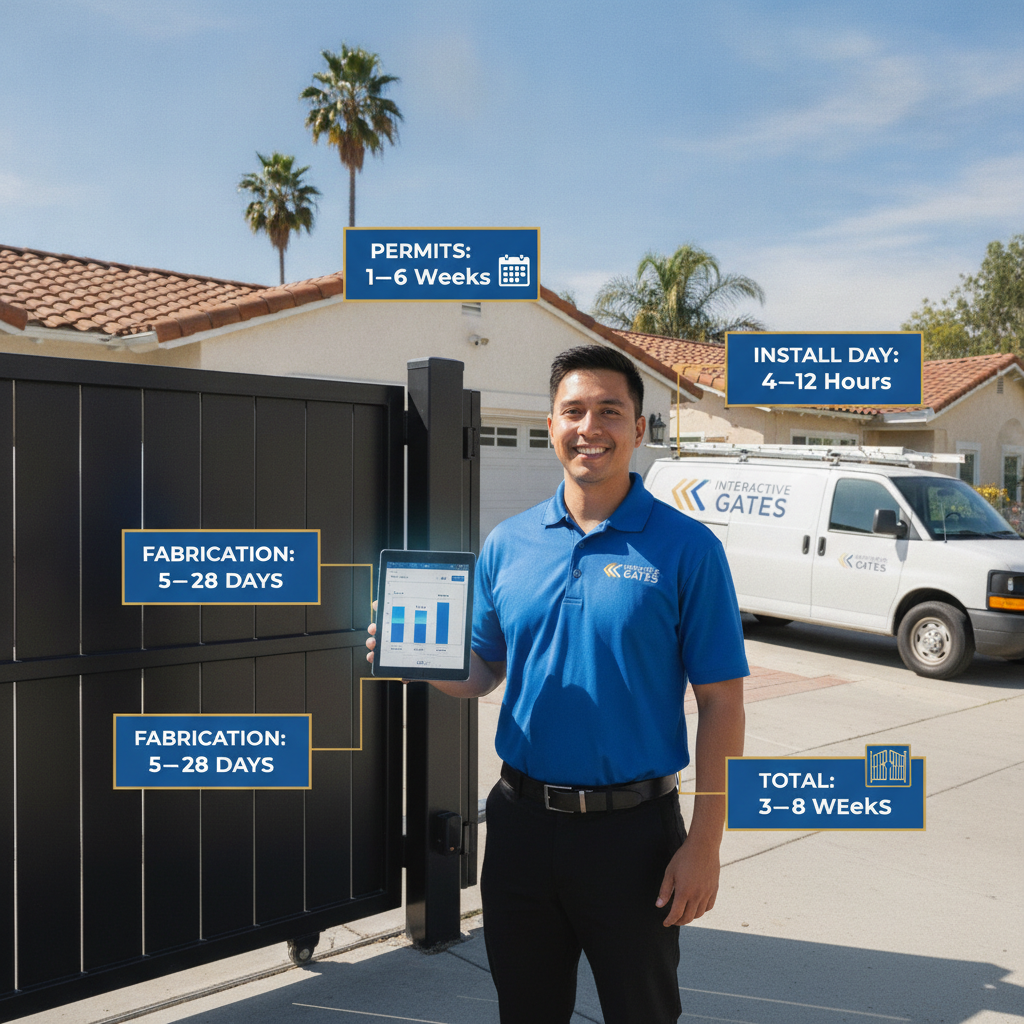
From signed contract to first open, plan on 6–10 weeks for a custom wind-rated gate. Engineering review and panel fabrication account for most of that lead time — 4–8 weeks for the panel itself. Operator installation and electrical connection typically take one to two days once materials arrive. If you need a permit, add two to four weeks depending on the jurisdiction (Seattle DCI has historically been slower than suburban permitting offices in Bellevue or Kirkland).
Ready to Storm-Proof Your Gate?
If you are heading into another Puget Sound storm season with a gate that has never been formally reviewed for wind load, now is the right time to get eyes on it. Reach out to the Interactive Gates team for a no-pressure site assessment, or browse residential gate options engineered for Pacific Northwest conditions. You can also explore styles and configurations with the gate designer tool before your first conversation, or read what homeowners across the region say about the installation and storm-performance experience. A gate that survives November without bending, binding, or losing power is not a luxury — it is exactly what a properly specified Pacific Northwest gate should do.