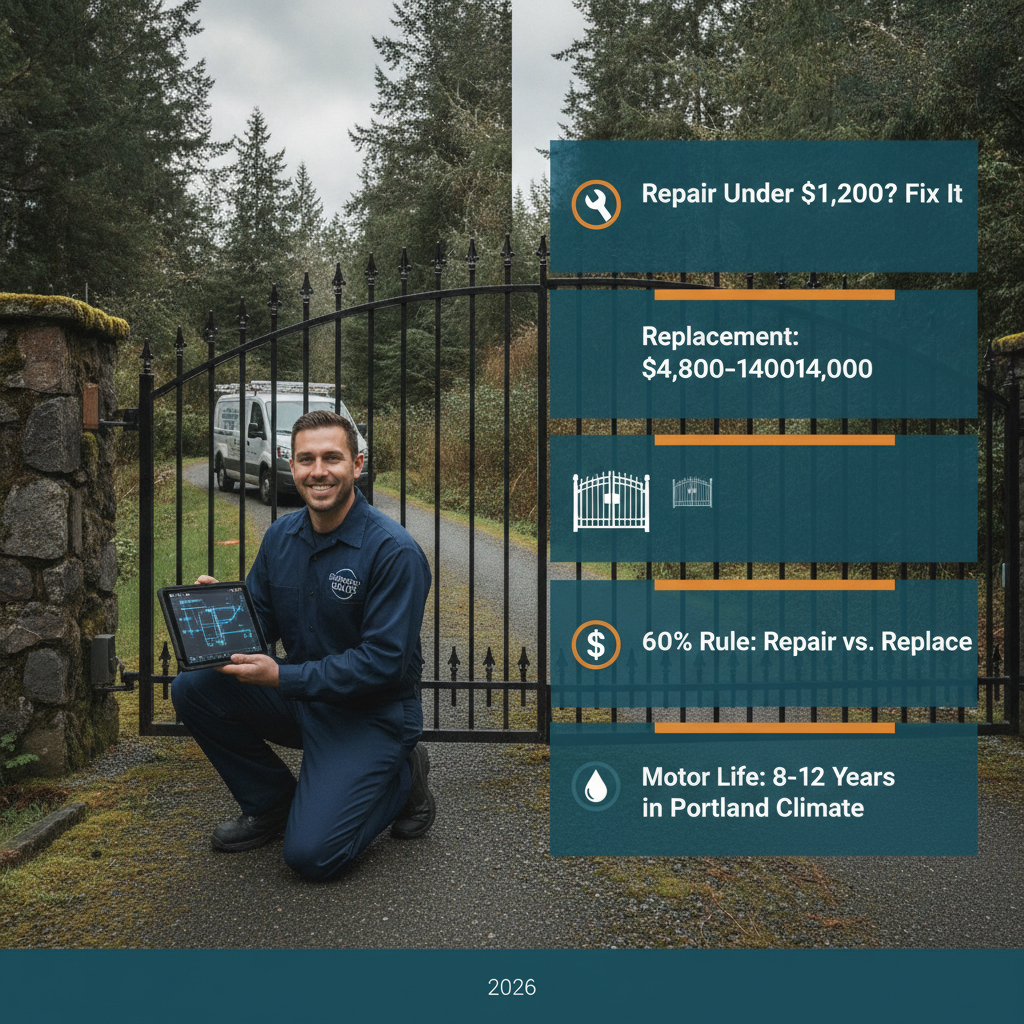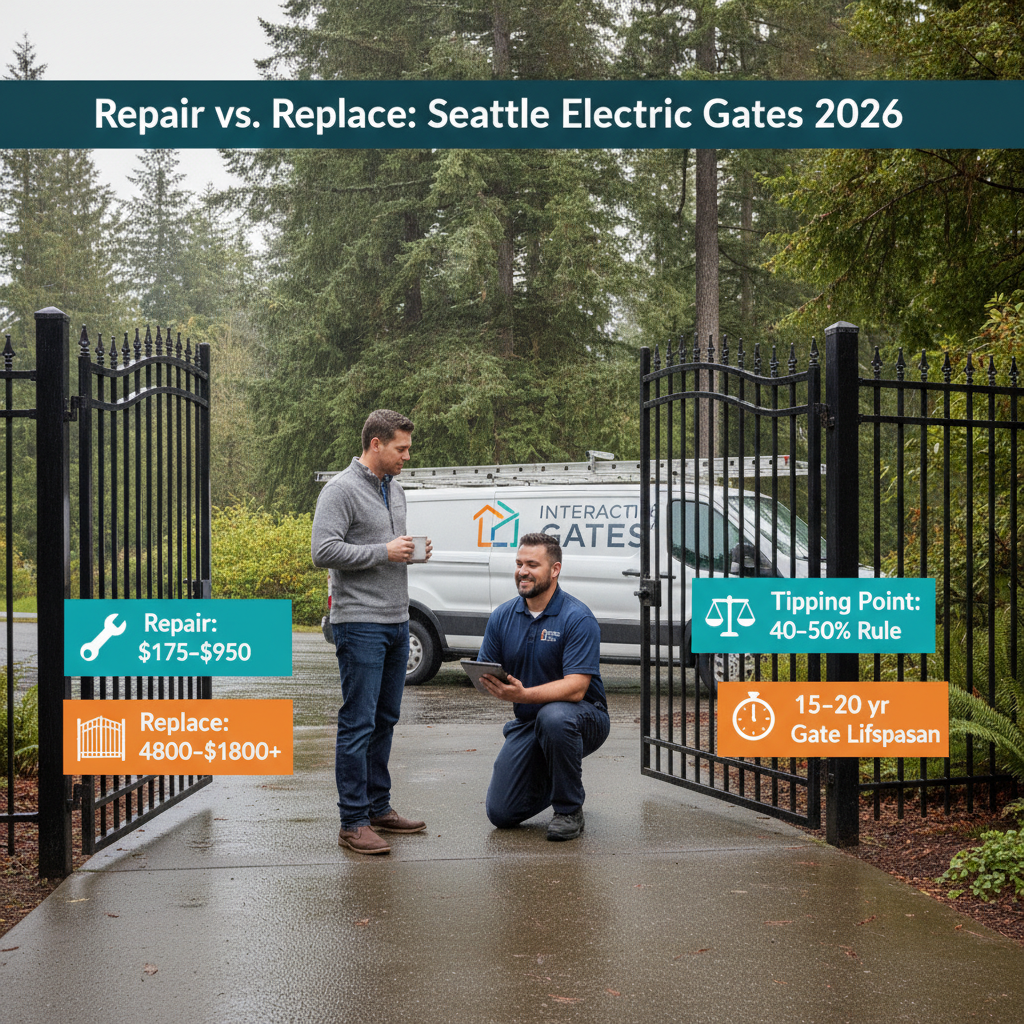
- Repair wins when total fix cost is under 40–50% of replacement value — anything beyond that, replacement usually makes more financial sense.
- Most Seattle gate repairs run $175–$950 depending on the part: boards, sensors, motors, or control boards.
- Full gate replacement in Seattle averages $4,800–$18,000+ installed, depending on material, width, and operator brand.
- Pacific Northwest moisture and freeze-thaw cycles accelerate hinge rust, operator corrosion, and wood rot faster than most homeowners expect.
- A quality swing gate operator (LiftMaster, FAAC, Viking) lasts 10–15 years with annual maintenance; neglected units often fail by year 6–8 in Seattle's climate.
- Warning signs that scream replacement: cracked welds on the gate frame, a motor that's been repaired 3+ times, or a gate older than 18–20 years.
- Permits may be required for full replacement in Seattle, Bellevue, and Tacoma — budget $150–$500 and 2–6 weeks for approval.
- The 'repair or replace' tipping point is usually hit at year 12–14 for most residential gates in King and Pierce Counties.
Should I Repair or Replace My Electric Gate in Seattle?
If your gate is grinding, stopping mid-cycle, or just sitting open and refusing to budge, you've probably already Googled 'electric gate repair near me' or 'how much does it cost to replace an automatic gate.' And then you hit the same wall everyone does: wildly different price estimates, vague advice, and no clear answer about whether you should spend $400 fixing what you have or bite the bullet and start fresh. This guide is built specifically for Seattle-area homeowners and property managers — Bellevue hillside driveways, Gig Harbor waterfront properties, Tacoma craftsman lots, and everything in between. We'll walk through real numbers, real failure patterns, and the exact framework installers use to make the call.
What Are the Most Common Electric Gate Problems in Seattle?
Seattle's climate is uniquely hard on gate hardware. Annual rainfall averages 38 inches, temperatures dip below freezing a dozen or more nights per year in neighborhoods like Snohomish County and south King County, and salt air affects waterfront properties from Gig Harbor up through Lynnwood. Here's what fails most often and what it costs to fix in 2026:
- Gate operator (motor) failure: The most common call. Operators burn out from overuse, water intrusion, or age. Repair (capacitor, gear swap) runs $200–$450. Full operator replacement: $850–$2,200 installed depending on brand and gate weight.
- Control board failure: Boards get fried by power surges — Seattle's windstorms are notorious for this. Board replacement: $275–$600 parts and labor.
- Hinge and post rust: Wrought iron and mild steel hinges corrode quickly in wet winters. Hinge replacement: $150–$400 per hinge. Severe post corrosion may require welding or full panel replacement ($600–$2,500+).
- Safety sensor misalignment or failure: Photo-eye sensors go out of alignment after ground settling or impact. Realignment: $95–$175. Sensor replacement: $175–$350.
- Wood gate rot: Cedar and Douglas fir gate panels — common in older Tacoma and Auburn neighborhoods — rot at the bottom rail within 8–12 years without treatment. Panel replacement: $400–$1,800 depending on size and species.
- Loop detector failure: Underground vehicle detection loops corrode or crack. Replacement requires cutting pavement: $450–$950 typical in King County.
- Wiring and conduit damage: Ground movement, tree roots, and frost heave cause conduit cracks. Rewire jobs: $300–$800 depending on run length.
Pro Tip: If your gate has failed in the same way twice within 24 months, that's rarely a coincidence — it's a symptom of a deeper issue (water intrusion, voltage problems, or structural misalignment) that a single repair won't solve long-term.
How Much Does Electric Gate Repair Cost in Seattle in 2026?
Labor rates for gate technicians in the Seattle metro have risen roughly 8–12% since 2024, driven by higher fuel costs and tight trade labor supply across King, Pierce, and Snohomish Counties. Here's what you should budget in 2026:
- Diagnostic service call: $95–$165 (often credited toward repair if you proceed)
- Operator repair (capacitor, relay, gear): $200–$450
- Operator replacement (LiftMaster LA500, FAAC 400 series, Viking E-Series): $850–$2,200 installed
- Control board replacement: $275–$600
- Sensor replacement (full pair): $175–$350
- Hinge weld or replacement: $150–$400 per hinge
- Loop detector replacement (includes cutting): $450–$950
- Access control system repair or upgrade (keypad, intercom, app-based): $300–$1,400
- Full rewire (gate to operator): $300–$800
Most single-issue repairs land in the $250–$700 range. If a tech is recommending repairs totaling more than $1,500–$2,000 on a gate that's already 12+ years old, you need to have a frank replacement conversation.
How Much Does Full Electric Gate Replacement Cost in Seattle in 2026?
Replacement is a bigger conversation, and costs vary enormously based on gate type, material, driveway width, and access control complexity. Here are real installed price ranges across the Seattle metro in 2026:
- Single swing gate, aluminum, basic operator (LiftMaster LA400): $4,800–$7,500
- Dual swing gate, ornamental aluminum, mid-tier operator: $7,500–$12,000
- Sliding gate, steel, up to 20 ft, FAAC or Viking operator: $8,500–$14,000
- High-end wrought iron or steel double swing gate with smart access control: $12,000–$22,000+
- Wood and steel hybrid privacy gate: $6,500–$11,000
Hillside lots in Bellevue and Gig Harbor often add $800–$2,500 for concrete work and custom post-setting. Properties in Snohomish with long driveway runs add $400–$900 for extended wiring. Permits in Seattle proper add $150–$500 and 2–6 weeks. Explore options for your property at our residential gate page, or if you manage an HOA or commercial property, see our commercial and HOA gate services page.
What Is the 'Repair or Replace' Rule Gate Installers Actually Use?
The industry standard is simple: if the total cost of a repair exceeds 40–50% of what a new equivalent gate system would cost, replacement is almost always the smarter move. Here's how that plays out in practice for Seattle homeowners:
- Your dual swing gate is 10 years old. A new comparable system costs $9,000. A repair quote comes in at $3,200. That's 35% — borderline, but repair is defensible if the gate structure itself is solid.
- Your sliding gate is 16 years old. Replacement would be $11,000. You've already spent $2,800 in repairs over the past 3 years, and the tech is now quoting $1,900 more. You're at 43% of replacement value in recent spending alone — time to replace.
- Your wood gate is 9 years old and needs a new operator plus panel replacement. Total quote: $3,800. New system: $7,200. At 53%, replacement wins — especially since wood panels in Seattle rarely make it past year 12 without rot issues anyway.
Age matters enormously. A gate under 8 years old is almost always worth repairing unless there's structural damage. A gate over 15 years old is almost always approaching replacement territory regardless of whether any single repair looks cheap in isolation.
Which Gate Problems Are Always Worth Repairing (and Which Are Red Flags)?
Almost always repair:
- Sensor misalignment or single sensor failure on a gate under 10 years old
- Remote control or keypad programming issues
- Single hinge replacement on a structurally sound gate
- Capacitor or relay failure on an operator under 8 years old
- Power supply or wiring issue isolated to a short run
Red flags that lean strongly toward replacement:
- Cracked or buckled gate frame welds — especially common on steel gates near Puget Sound waterfront properties
- Operator that has been repaired 3 or more times
- Gate that is visibly out of plumb or leaning (post failure)
- Multiple simultaneous failures (operator + board + sensors)
- Gate older than 18–20 years with original hardware
- Extensive wood rot across more than 40% of a wood-framed gate
Pro Tip: Request a written condition report from your technician before approving any repair over $500. A reputable installer will document what they found, what they fixed, and what else may need attention within the next 12–24 months — so you can make an informed decision rather than a reactive one.
Does Seattle's Climate Make Gates Wear Out Faster?
Yes — and it's not just rain. Seattle's specific combination of factors accelerates wear in ways that surprise homeowners who moved from drier climates:
- Freeze-thaw cycling: Neighborhoods in Snohomish, Auburn, and Lakewood see enough below-freezing nights that post concrete cracks, hinges seize, and loop detectors heave. Each freeze-thaw cycle is a micro-stress event on welded joints and mounting hardware.
- Marine air corrosion: Properties within a few miles of Puget Sound — Gig Harbor, West Seattle, Tacoma waterfront — experience accelerated rust on ferrous metals. Even powder-coated steel shows pin-rust within 5–7 years without touchup maintenance.
- Wet leaves and debris: Sliding gates on tree-heavy lots in neighborhoods like Lynnwood or north Seattle accumulate debris in tracks constantly, wearing V-groove wheels and flat track edges faster than in dry climates. Track replacement: $400–$900.
- Moss and algae growth: Wood gate panels and even aluminum frames accumulate moss that retains moisture and accelerates rot and corrosion under the surface.
The practical result: gate systems in Seattle typically reach the repair-or-replace decision point 2–4 years earlier than identical systems in Portland or Los Angeles. Plan your maintenance and replacement budget accordingly. You can see examples of durable gate builds in our local market at the project portfolio.
What Should I Ask Before Approving a Gate Repair in Seattle?
- 'How old is this operator model, and is it still supported?' Operators more than 10 years old may have discontinued parts — meaning the next failure could be irreparable anyway.
- 'What else is showing wear that I should know about?' A good tech will flag secondary issues; a transactional one won't.
- 'What warranty comes with this repair?' Quality installers back labor for 30–90 days minimum; parts warranties vary by manufacturer (typically 1 year).
- 'Will this repair interact with my existing access control?' Swapping operators sometimes requires reprogramming or replacing keypads and intercoms — that adds cost.
- 'Do I need a permit for this scope of work?' In Seattle and Bellevue, replacement (not repair) often triggers permit requirements. Your installer should know the threshold.
In One Minute: Repair vs. Replace Your Seattle Electric Gate
- Repair is the right call when the gate is under 10 years old, the structure is sound, and the repair cost is under 40% of replacement value.
- Replace when the gate is 15+ years old, has had repeated failures, shows structural damage, or when total repair costs approach half of what a new system would cost.
- Seattle's wet, freeze-thaw climate accelerates wear — budget for that reality.
- Typical repairs: $175–$950. Typical full replacement: $4,800–$18,000+ installed.
- Always get a written condition report before approving major repairs.
- Permits may be required for full replacement in Seattle, Bellevue, Tacoma — budget $150–$500 and up to 6 weeks.
Serving the Seattle area including Bellevue, Gig Harbor, Snohomish, Tacoma, and Lynnwood.
Frequently Asked Questions: Electric Gate Repair vs. Replacement in Seattle
How do I know if my electric gate motor needs repair or full replacement?
If the operator is under 8 years old and has one isolated failure (capacitor, relay, or gear), repair is almost always the right call. If it's over 10–12 years old, has been repaired more than twice, or shows signs of housing corrosion and water intrusion, a full operator replacement at $850–$2,200 installed is usually more cost-effective than another patch job that may fail within 12–18 months.
What's the average cost to repair an electric gate in Seattle in 2026?
Most single-issue repairs in the Seattle metro run $175–$950 in 2026, with the most common repairs (sensor replacement, control board swap, single hinge) landing in the $250–$600 range. Diagnostic service calls typically run $95–$165, which is often credited toward the repair if you proceed. Complex jobs like loop detector replacement or full rewiring can push past $950.
Do I need a permit to replace an electric gate in Seattle?
In most cases, yes — if you're doing a full gate and operator replacement (not a like-for-like repair), Seattle, Bellevue, and Tacoma typically require a building or electrical permit. Permit costs range from $150–$500 depending on scope and jurisdiction, and approval typically takes 2–6 weeks. Your installer should handle the permit application; confirm this before signing a contract.
How long should an electric gate last in the Seattle area?
With annual maintenance, a quality gate system — aluminum or steel frame with a LiftMaster, FAAC, or Viking operator — should last 15–20 years in Seattle's climate. Operators specifically tend to reach end of life at 10–15 years with good maintenance, or 6–8 years if neglected. Wood gates in Seattle's wet climate typically need panel replacement or full replacement within 10–14 years.
Is it worth repairing an old electric gate, or should I just replace it?
Use the 40–50% rule: if the repair cost exceeds 40–50% of what a new equivalent system would cost installed, replacement is almost always the better financial decision. For most Seattle residential gates, this tipping point arrives around year 12–14. Factor in Seattle's accelerated wear from marine air and freeze-thaw cycling — systems here typically age 2–4 years faster than in drier climates.
Which gate brands are easiest to repair in the Seattle area?
LiftMaster (LA400, LA500, CSW200), FAAC (400 and 700 series), and Viking (E-Series, F-Series) are the most widely supported brands in the Seattle market — parts are stocked locally and most qualified technicians are factory-trained on them. Apollo and Elite are also serviceable but may require longer lead times on specialty parts in 2026. Avoid obscure off-brand operators; parts availability can become a problem within 5 years.
Ready to Get a Real Answer for Your Gate?
The repair-or-replace decision is easier when you have a qualified technician actually look at your system — not just quote a single part over the phone. Whether you're in Bellevue, Gig Harbor, Tacoma, or anywhere across the Seattle metro, a proper on-site assessment gives you the real picture: what's failing, what's next, and what it truly costs to fix versus start fresh. You can start with our contact page to schedule a consultation, or explore gate options and styles with our interactive gate designer tool if you're already leaning toward replacement. No pressure either way — just honest answers so you can make the best call for your property and your budget.