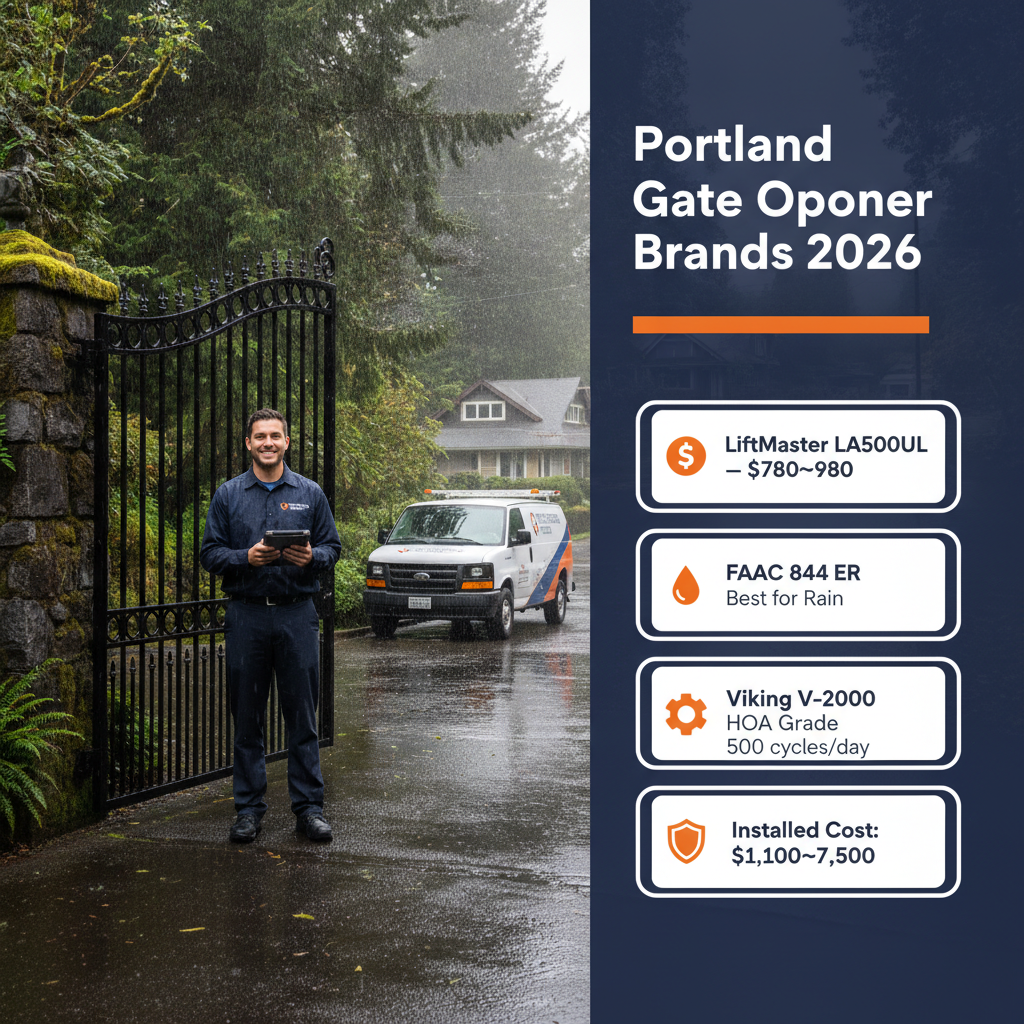
- LiftMaster LA500UL and FAAC 844 ER are the two most-requested residential swing gate openers in Portland in 2026, each rated for 500+ lb leaves.
- Slide/cantilever gate operators from Viking Access (V-2000) and FAAC 844 ER handle the wet, grit-heavy conditions common on Portland's east-side and hillside properties better than budget brands.
- Entry-level residential openers run $380–$650 (unit only); mid-range professional-grade units run $750–$1,400; heavy-duty commercial units start around $1,500 and climb to $3,200+.
- Corrosion-resistant aluminum housing and sealed circuit boards are non-negotiable in a city that sees 36+ inches of rain per year — cheap cast-zinc housings fail inside 3 seasons.
- Cycle ratings matter: a typical Portland household uses 8–14 gate cycles per day; spec a motor rated for at least 150 cycles/day for residential, 500+ for HOAs.
- Built-in battery backup (LiftMaster's P3 powerhead or FAAC's integrated backup module) is a practical must-have given Portland's winter ice storms and outages.
- Warranty windows range from 1 year (Apollo budget line) to 5 years parts + 3 years labor (FAAC commercial); always read the fine print on moisture and corrosion exclusions.
- Professional installation in Portland adds $600–$1,800 to opener cost depending on gate weight, run distance, and conduit work — DIY voids most manufacturer warranties.
What's the Best Automatic Gate Opener Brand for Portland in 2026?
If you've been Googling things like 'best electric gate opener for Pacific Northwest rain,' 'LiftMaster vs. FAAC for Portland driveway,' or 'which automatic gate motor survives Oregon winters' — you're in the right place. Portland's climate is unforgiving on electrical and mechanical components. At 36–38 inches of annual rainfall, months of near-freezing drizzle, occasional ice storms in the West Hills and Gresham corridor, and spring pollen that gums up worm gears, a gate opener that performs flawlessly in Phoenix or San Diego may fail inside two seasons here. This guide breaks down the actual brands, specific models, real 2026 price ranges, and the local nuances that determine which opener actually earns its keep on a Portland property.
How Do Portland's Climate Conditions Affect Gate Opener Performance?
Before diving into brands, it's worth understanding why Portland is harder on gate openers than most U.S. cities. The combination of persistent moisture, temperature cycling (nights can hit 25°F in January, afternoons can hit 55°F by February), and biological growth — moss, lichen, algae — creates a unique stress environment. Moisture infiltrates poorly sealed motors, corrodes terminal strips, and causes relay boards to short. Temperature cycling causes expansion and contraction in drive screws and pivot arms, accelerating wear on bushings and bearings. Gresham, Troutdale, and areas east of I-205 get heavier freeze cycles than inner Portland, which matters when you're speccing lubricants and arm materials. The West Hills — Raleigh Hills, Sylvan, and the Hillside neighborhoods — add slope and drainage complexity that overloads underpowered swing operators. Any brand recommendation that ignores these local realities is giving you generic advice, not Portland advice.
Pro Tip: Always ask your installer what IP (Ingress Protection) rating a motor's control board carries. For Portland, a minimum of IP54 (dust and splash resistant) is acceptable; IP65 or IP67 (fully weatherproof) is better, especially on exposed rural properties near Sauvie Island or in the Sandy River corridor.
LiftMaster for Portland Gates: Models, Costs & What Works in 2026
LiftMaster remains the most widely installed residential gate opener brand in the Portland metro in 2026, largely because of parts availability — every major electrical supply house from Beaverton to Gresham stocks components. Their residential swing gate line centers on two models worth knowing.
The LiftMaster LA400UL (single-arm, up to 300 lb leaf, up to 16 ft) retails around $520–$680 and suits lighter aluminum or narrow wood swing gates common in inner SE Portland and Sellwood bungalow lots. It includes MyQ connectivity for smartphone monitoring and a P3 motor (140 cycles/day rating). The LiftMaster LA500UL steps up to 500 lb leaves, 20 ft width, and 500 cycles/day — the right choice for heavier ornamental iron gates typical in Lake Oswego and the Dunthorpe area. Unit price runs $780–$980. Both include LiftMaster's sealed, temperature-compensated circuit board, which handles Portland winters reasonably well, though exposed installations benefit from an aftermarket weatherproof housing kit (~$85–$120 extra). For slide gates, the LiftMaster CSW200UL handles up to 2,000 lb panels and is a popular choice for HOA entry lanes in Beaverton's planned communities. Unit cost: $1,350–$1,700. Installation adds $700–$1,400 depending on conduit run length and existing power proximity. Total installed cost for a residential LiftMaster swing operator in Portland ranges from roughly $1,200–$2,600 depending on model and site conditions. Beaverton homeowners with long driveways in newer subdivisions often choose the LA500UL paired with a keypad and loop detector for a complete package.
FAAC for Portland Gates: Models, Costs & Why Pacific Northwest Pros Trust It
FAAC (Italian-engineered, U.S.-assembled) has gained significant market share in Portland's higher-end residential and HOA sector over the past three years. The reason is build quality: FAAC operators use oil-bath lubrication systems that perform excellently in cold, wet climates because the oil doesn't freeze the way grease-packed systems can. The FAAC 402 CBC is a compact underground swing operator (concealed beneath the driveway, so it's nearly invisible) favored on Lake Oswego and Oregon City estates where aesthetics matter as much as function. Underground mounting also protects the motor from Portland's surface weather entirely. Unit cost: $1,100–$1,450 per leaf; installation runs $900–$1,800 per leaf because excavation and waterproofing add labor. The FAAC 844 ER is the most popular above-ground swing operator in the FAAC lineup for Portland residential use — hydraulic, 180° swing range, rated to 1,100 lb per leaf, with an integrated battery backup module that keeps the gate operating through 72 hours of outage. At $1,050–$1,300 per unit plus $650–$1,100 installation, it costs more upfront than a LiftMaster LA500UL but typically outlasts it by 4–6 years in wet climates. Expect 15–20 year service life with annual maintenance. For slide gates, FAAC's FAAC 844 R rack-drive operator handles panels up to 2,200 lb with a sealed DC motor and integrated inverter. It's the go-to on steeper east Portland and Gresham properties where rack-and-pinion slide systems are preferred over V-track. Lake Oswego properties and Oregon City estates with long, exposed gate runs see FAAC specified most often.
Viking Access for Portland Gates: The Heavy-Duty Option for HOAs & Commercial Properties
Viking Access Systems (headquartered in California but widely distributed in the Pacific Northwest) occupies the heavy-commercial and HOA tier. Their Viking V-2000 slide gate operator is rated for 2,000 lb panels, 500 cycles/day, and includes a 24V DC motor with built-in battery backup and solar-ready wiring. It's the dominant choice in Portland's larger HOA-gated communities — communities in Hillsboro's Tanasbourne area, Bethany, and Cedar Hills neighborhoods rely on it. Unit cost: $1,600–$2,100; professional installation runs $1,000–$2,000 depending on existing infrastructure. The Viking SW-2200 swing operator handles dual-leaf gates up to 20 ft wide and 1,100 lb per leaf, with an IP65-rated control board — a meaningful spec advantage in Portland weather. Installed cost for a Viking HOA-grade swing system runs $4,500–$7,500 for a full dual-leaf entry with loop detectors, keypads, and intercom wiring. If you manage a Portland HOA entry, Viking's service network in the metro is robust — same-week parts delivery from Portland-area distributors is typical. See Interactive Gates' HOA and commercial gate services for more on what a full HOA entry system entails.
Apollo Gate Openers: Where They Fit (and Where They Don't) in Portland
Apollo (manufactured by Nice/Apollo) is the entry-level residential brand most often seen on budget installations — DIY-adjacent projects, light-use vacation properties, and rentals where minimizing upfront cost is the priority. The Apollo 1500ETL swing operator (single arm, up to 850 lb, 500 cycles/day rating) retails for $380–$500 and has decent specs on paper. The limitation in Portland is the control board: Apollo's standard board is not oil-bath lubricated and the housing IP rating is IP44, which is marginal for year-round Portland exposure. Units installed in exposed West Hills locations or on properties without overhang protection for the operator frequently show board corrosion failures within 36–48 months. Where Apollo performs acceptably: sheltered urban lots in NE Portland, Sellwood, or Multnomah Village where the gate posts have a small roof overhang or the operator is mounted in a low-rainfall shadow. Bottom line — Apollo makes sense for cost-conscious installs on protected sites with low cycle demand; it's not the right tool for Gresham hillsides or Sauvie Island properties.
Pro Tip: Regardless of brand, ask your Portland installer to apply a dielectric grease coat to all terminal connections at installation and re-apply annually. This single step prevents the majority of control board corrosion failures caused by Portland's salt-laden winter air that blows in off the Columbia River basin.
How Do Cycle Ratings Translate to Real Portland Household Use?
Cycle ratings are one of the most misunderstood specs in gate opener selection. A 'cycle' is one full open-and-close movement. A typical Portland household (two working adults, two cars) makes 8–14 gate cycles per day — that's 2,900–5,100 cycles per year. An operator rated for 150 cycles/day handles this easily. Problems arise when buyers select residential openers (often rated 50–80 cycles/day) for small multi-tenant properties or ADU lots in Portland's inner east side, where three to five households sharing one gate can generate 25–50 cycles per day, burning through motor brushes and gearboxes in 18–24 months. For any property with 3+ households sharing a gate, spec a commercial-rated operator (300–500+ cycles/day) even if the gate itself looks residential. This is a conversation worth having directly with your installer before you sign a quote. Browse completed Portland gate projects to see how the team specs operators for different property types.
What Does Professional Gate Opener Installation Cost in Portland in 2026?
Opener unit costs are only part of the picture. Here's a realistic breakdown of total installed costs in Portland in 2026:
- Budget residential swing gate (Apollo/LiftMaster LA400UL): $1,100–$1,700 installed, single leaf
- Mid-range residential swing gate (LiftMaster LA500UL): $1,500–$2,600 installed, single leaf
- Premium residential swing gate (FAAC 844 ER): $2,000–$3,500 installed, single leaf
- Underground operator (FAAC 402): $3,500–$6,000 installed per leaf (excavation included)
- HOA/commercial slide gate (Viking V-2000, FAAC 844 R): $3,500–$7,500 installed, single drive
- Add-ons: Battery backup module $150–$350; loop detector (vehicle sensor) $250–$450 installed; weatherproof housing kit $85–$180; solar panel integration $400–$900
Most Portland operators require a 120V dedicated circuit within 50 ft of the operator. If your panel is farther away, budget $8–$14 per linear foot for conduit and wire runs — a 100 ft run from panel to gate adds $800–$1,400 in electrical labor alone. Hillsboro and Gresham properties with long driveways frequently encounter this scenario. For a personalized look at gate configurations and styles before you get a quote, the Interactive Gates design visualizer lets you preview options in real time.
In One Minute: Portland Gate Opener Brand Summary 2026
LiftMaster — Best for: mid-range residential, strong parts network, good app integration. Best models: LA500UL (swing), CSW200UL (slide). Installed cost: $1,500–$2,600. Lifespan in Portland: 10–14 years with maintenance. FAAC — Best for: premium residential, oil-bath lubrication thrives in wet climate, integrated battery backup. Best models: 844 ER (swing), 844 R (slide), 402 CBC (underground). Installed cost: $2,000–$6,000. Lifespan: 15–20 years. Viking Access — Best for: HOAs, multi-family, commercial. Best models: V-2000 (slide), SW-2200 (swing). Installed cost: $3,500–$7,500. Lifespan: 15–20 years commercial use. Apollo — Best for: budget residential on sheltered, low-cycle sites. Best model: 1500ETL (swing). Installed cost: $1,100–$1,700. Lifespan in Portland: 5–8 years if well-protected. For any property, pair whichever brand you choose with a sealed control board, corrosion-resistant wiring connections, and an annual maintenance visit. That maintenance visit — typically $120–$220 in Portland in 2026 — will add years to any operator's lifespan.
Frequently Asked Questions: Portland Gate Openers 2026
Which gate opener brand is most reliable in Portland's rainy climate?
FAAC is widely regarded by Portland installers as the most rain-resilient residential brand, primarily because of its oil-bath motor lubrication and sealed hydraulic systems that resist moisture infiltration. LiftMaster is a close second for reliability and wins on parts availability and service speed. For HOA-scale use, Viking Access Systems matches FAAC on durability with broader regional service support.
How long should a gate opener last in Portland before needing replacement?
A properly spec'd and annually maintained gate opener should last 10–14 years for residential LiftMaster units and 15–20 years for FAAC or Viking heavy-duty units in Portland's climate. Budget Apollo operators in exposed locations often show failure at 5–8 years. The single biggest lifespan extender is an annual maintenance visit including lubrication, terminal inspection, and board cleaning — typically $120–$220 from a local Portland installer.
Do I need a permit to replace my gate opener in Portland?
Replacing a like-for-like gate opener (same type, same voltage) generally does not require a permit in the City of Portland or Multnomah County, but adding a new electrical circuit to power a gate opener does require an electrical permit. If you're upgrading from a battery-only solar operator to a hardwired 120V system, budget $150–$350 for the permit and inspection. Always confirm with the City of Portland Bureau of Development Services or your county building department before work begins.
What cycle rating do I need for a Portland HOA gate?
For HOA entry gates serving 20 or more households, specify a minimum 500 cycles/day rated operator — Viking V-2000 or FAAC 844 R are the standard choices. For smaller HOAs of 10–20 homes, a 300 cycles/day unit is adequate. Undersizing cycle rating is the number-one cause of premature HOA gate motor failure in Portland's metro communities.
Is battery backup worth adding to a Portland gate opener?
Yes — Portland averages 4–8 significant power outage events per winter due to ice storms and windstorms, particularly in the West Hills, Gresham, and Sandy River corridor areas. Battery backup (built-in on FAAC 844 ER and Viking V-2000, or add-on for LiftMaster LA-series at $150–$350) ensures you're never trapped inside or outside your property during an outage. It's a standard recommendation for any Portland installation, not an optional upgrade.
Can I install a gate opener myself in Portland to save money?
Mechanically, some homeowners successfully self-install lighter residential openers (Apollo, LiftMaster LA400UL) on simple, flat driveways. However, DIY installation voids manufacturer warranties on most brands, and any hardwired electrical connection requires a licensed electrician and permit in Oregon. Installation errors — incorrect arm geometry, missing safety loops, improperly torqued mounting hardware — also create liability under Oregon's UL 325 safety standard. Most Portland installers advise against DIY on anything beyond a temporary setup, and professional installation typically adds only $600–$1,100 to total project cost.
Ready to Choose the Right Opener for Your Portland Gate?
The 'best' gate opener brand is the one that matches your gate weight, your daily cycle demand, your site's weather exposure, and your budget — not simply the one with the most marketing. If you're still weighing options or want a site-specific recommendation, reach out to Interactive Gates for a no-pressure consultation. The team serves properties across Portland, Beaverton, Lake Oswego, Gresham, Hillsboro, Oregon City, and Salem — and can walk you through exactly which operator makes sense for your driveway before you spend a dollar. You can also explore residential gate options to see the full range of gate styles these operators pair with.