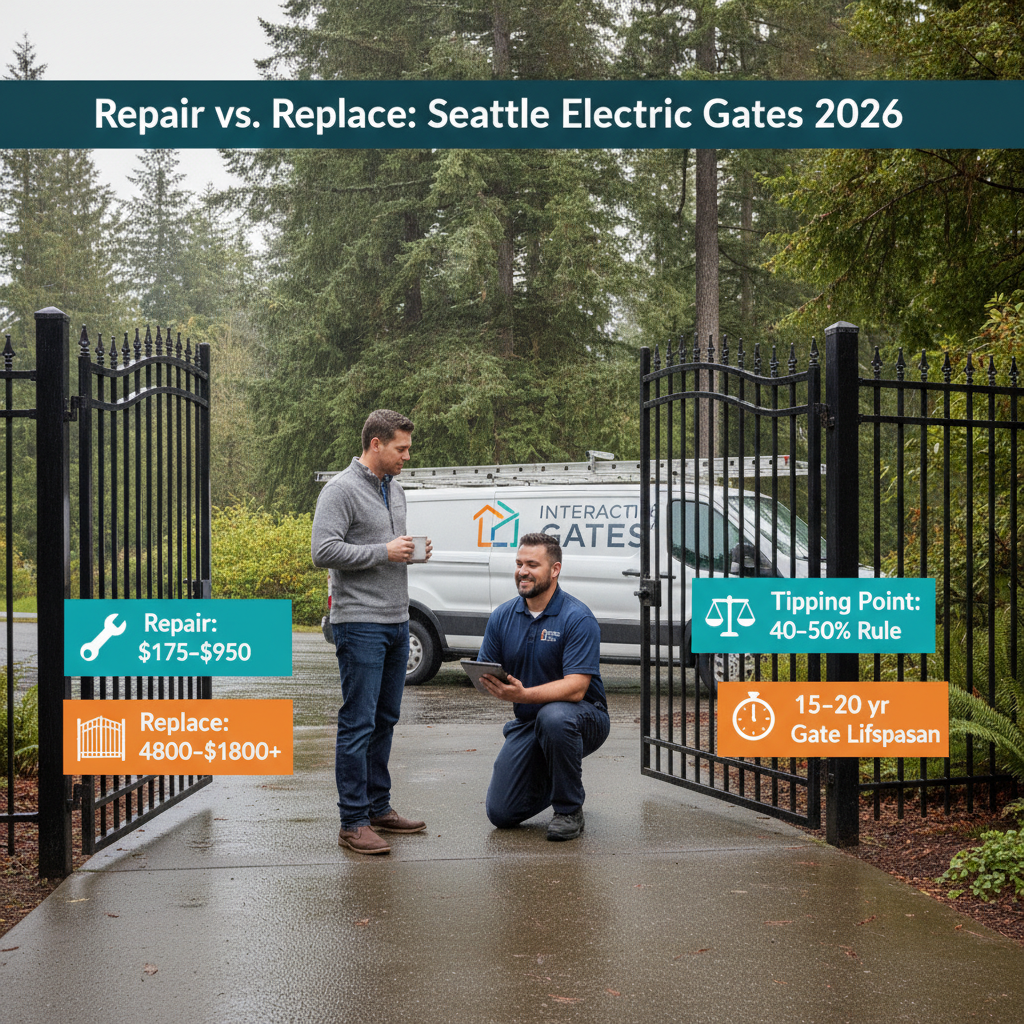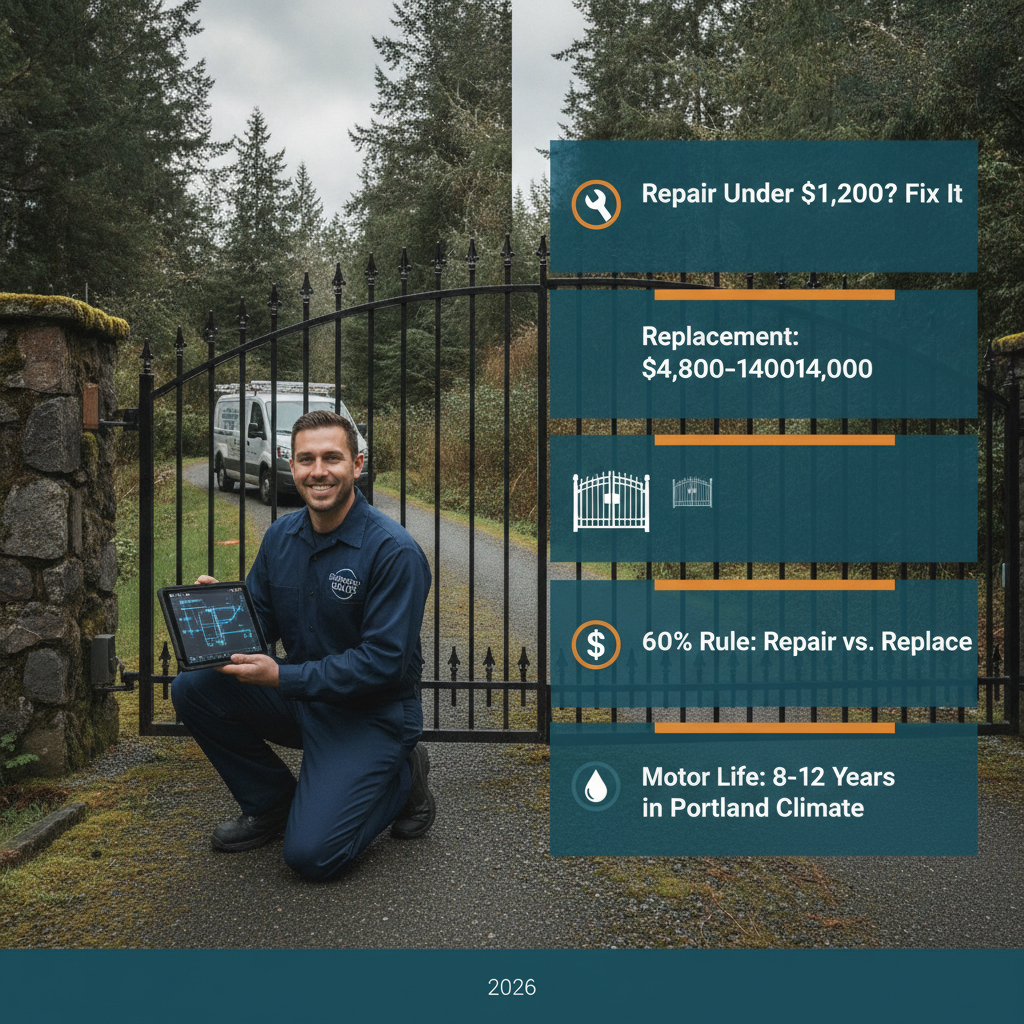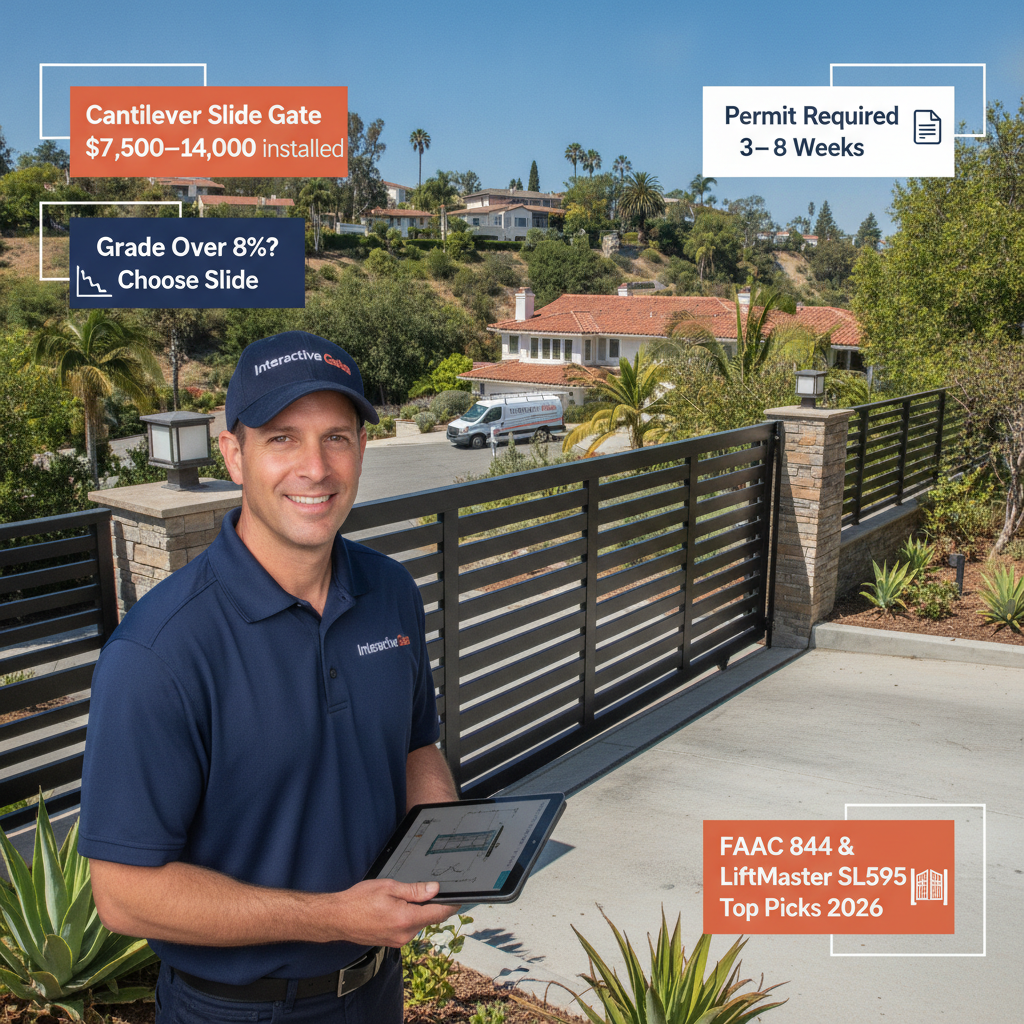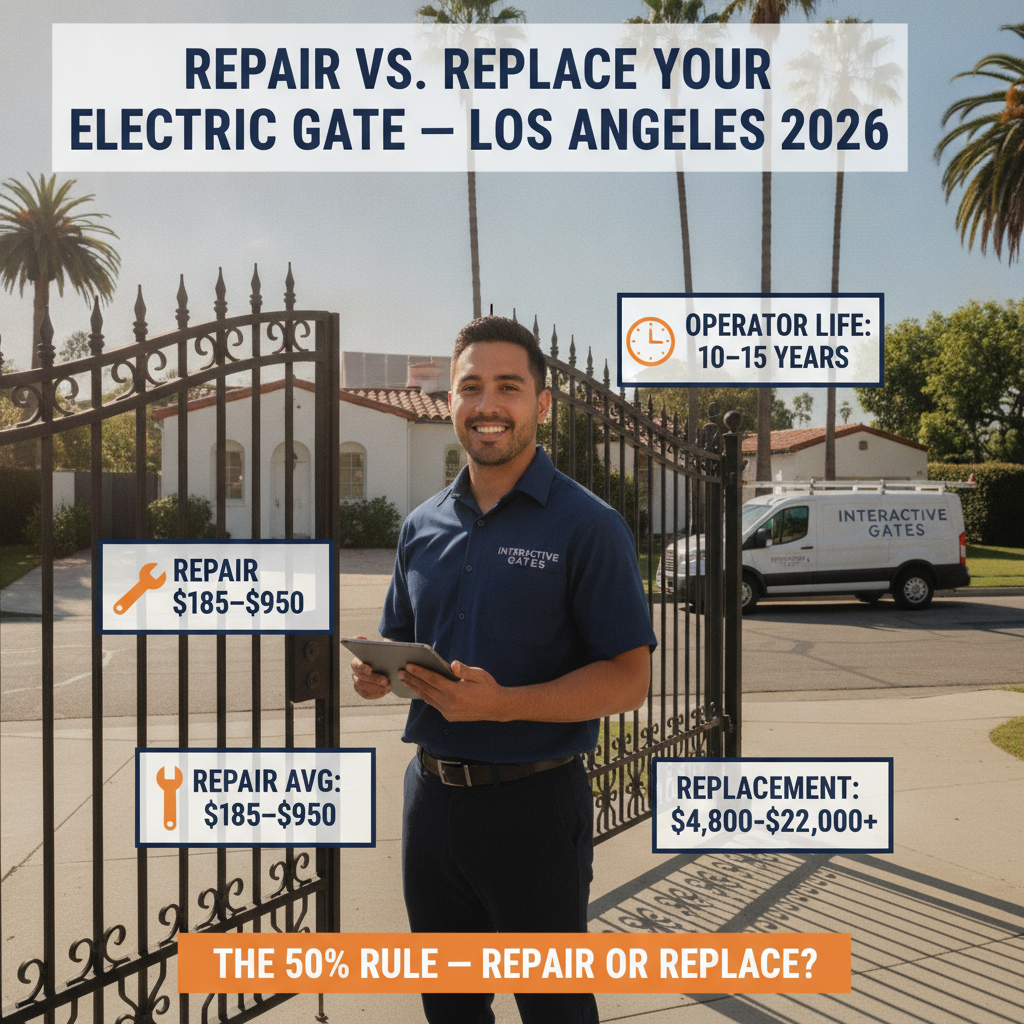
- Repair costs in Los Angeles average $185–$950 for most common issues; full replacement runs $4,800–$22,000+ installed.
- The 50% rule: if a single repair quote exceeds half the cost of a new gate system, replacement almost always pencils out better.
- Gate operators last 10–15 years in SoCal's heat and UV environment; structural steel or aluminum panels can last 20–30 years with proper coating.
- Salt-air corrosion in coastal zones (Laguna Beach, San Clemente, Rolling Hills Estates) accelerates metal fatigue 2–3× faster than inland properties.
- LiftMaster, FAAC, and Apollo are the three most common operator brands serviced across LA County and Orange County in 2026.
- Permit requirements vary by city: replacement triggers a new permit in most LA County jurisdictions ($150–$550 fee); a like-for-like repair generally does not.
- Most operators fail between 80,000–120,000 cycles; high-traffic HOA entrances in communities like Rolling Hills can hit that threshold in 6–8 years.
- Interactive Gates offers free on-site assessments — a tech visit beats any online estimate when deciding repair vs. replace.
Repair or Replace Your Electric Gate in Los Angeles — How Do You Actually Know?
You hit the remote, hear a grinding noise, and the gate stops halfway. Or maybe it just doesn't move at all. Now you're standing in your driveway in Laguna Beach or Los Feliz Googling: How much does it cost to fix an automatic gate in Los Angeles? Is it worth repairing or should I just replace it? What are the signs a gate is too far gone to save? These are exactly the right questions — and the answers depend on your gate's age, material, operator brand, and how hard that gate has been working. This guide gives you a clear, numbers-driven framework so you can make the call confidently in 2026.
What Are the Most Common Electric Gate Repairs in Los Angeles in 2026?
LA's climate sounds forgiving — no freeze-thaw cycles like Seattle — but Southern California has its own gate killers: intense UV, Santa Ana wind events, coastal salt air, and fine particulate dust from the inland valleys that grinds into gears and tracks. Here are the repairs LA homeowners and property managers call about most, with real 2026 price ranges:
- Gate operator / motor replacement: $650–$1,800 parts and labor depending on brand (LiftMaster LA500 swing operator runs ~$420 parts alone; FAAC 400 series closer to $580).
- Control board replacement: $280–$650 installed. UV heat cycles in the San Fernando Valley and Inland Empire kill capacitors and logic boards faster than coastal zones.
- Safety loop or sensor realignment: $125–$320. Required by UL 325 and California Title 19; a malfunctioning loop is a liability issue, not just an annoyance.
- Broken or bent gate arm / hinge: $175–$480 depending on gate weight. Swing gates on steep lots in Rolling Hills or Palos Verdes are especially prone to hinge stress.
- Track cleaning, realignment, and wheel replacement (sliding gates): $185–$550. Fine grit from Santa Ana events packs into V-groove or roller tracks and accelerates wear dramatically.
- Battery backup replacement: $95–$210. Sealed lead-acid batteries degrade in 2–4 years in SoCal heat; lithium units last 5–7 years and are worth the premium.
- Intercom or access control wiring: $220–$760 depending on system complexity. Older analog systems in 1990s–2000s-era HOA communities are frequently the weak link.
- Weld repair on steel gate frame: $250–$700. Coastal properties in San Clemente or Laguna Beach often show stress cracks at weld joints due to salt-accelerated corrosion.
Pro Tip: Before authorizing any repair, ask the technician to photograph and document the operator's cycle counter reading if it's accessible. LiftMaster commercial operators and FAAC units log total cycles. If you're sitting at 95,000+ cycles on a residential-grade operator, a $650 board repair may only buy you 12–18 months before the next failure.
When Does Repairing an Electric Gate in Los Angeles Make Sense?
Repair is almost always the right call when: the gate structure itself is sound (no significant rust-through, no bent posts, no cracked concrete anchor footings); the operator is under 8 years old; the repair addresses a single, isolated component; and the quote is less than 40–50% of a replacement system's cost. For context, a mid-range residential swing gate system in a neighborhood like Orange or Beaverton-comparable parts of the Inland Empire costs $5,500–$9,500 installed in 2026. So if your repair quote is under $2,500 and the gate is 6 years old, you repair. It's straightforward math.
Common repair-friendly scenarios in LA: a coyote or deer hit dented a panel but the operator is fine; a power surge fried the control board on a 4-year-old LiftMaster; the gate's rubber stop bumpers wore out and the arm is slamming the post. These are all one-component fixes on otherwise healthy systems.
When Should You Replace an Electric Gate in Los Angeles Instead of Repairing It?
Replacement becomes the smarter investment when multiple systems are failing simultaneously, when the gate structure has corrosion or physical damage that compromises integrity, or when the operator is an obsolete platform that can no longer be integrated with modern access control. Here are the clearest replace signals for LA properties in 2026:
- Operator is 12+ years old and has had two or more repair visits in the past 24 months. Stacking repair costs on aging hardware rarely ends well.
- Salt-air corrosion has compromised the gate frame. Coastal properties in San Clemente, Laguna Beach, or the Palos Verdes Peninsula often see steel gates reach end-of-life structurally in 15–18 years without marine-grade powder coat maintenance every 5–7 years.
- The gate post or column has shifted. In hillside neighborhoods — Rolling Hills, Silverlake, Eagle Rock — soil movement and erosion can shift gate columns out of plumb. Re-hanging a gate on a compromised post just delays the inevitable.
- You need UL 325 compliance upgrades. Pre-2008 gate systems frequently lack adequate entrapment protection. Retrofitting edge sensors, photo eyes, and loop detectors on an old gate can cost $900–$1,600 — often 60–80% of a new operator's cost — making replacement the smarter starting point.
- Your HOA or property requires vehicle loop detection that the current system can't support. Modern community access in developments like those in Orange or Gresham-comparable master-planned communities around LA often require dual-loop detection, LPR cameras, and cloud-managed access — none of which integrate cleanly with 2008-era swing operators.
- Cumulative repair spend in the past 3 years exceeds $2,200. That's real money that could have been applied toward a new system.
How Much Does Gate Replacement Cost in Los Angeles in 2026?
Los Angeles is a high-labor-cost market. Expect to pay 15–25% more than national averages for the same scope of work. Here's a realistic installed-cost breakdown by property type in 2026:
- Residential single-swing gate, aluminum, up to 12 ft: $4,800–$7,500 installed. LiftMaster LA400 or Apollo 1500 series operator, single-button keypad, 2 remotes.
- Residential bi-parting swing gate, steel or aluminum, 14–20 ft: $7,200–$13,500 installed. Common in Bel Air, Hidden Hills, Hancock Park.
- Residential sliding gate, steel or aluminum, up to 16 ft: $6,500–$11,000 installed. Popular in flatter lots in Orange County cities like Orange or San Clemente.
- Commercial single-entry sliding gate with access control: $9,500–$18,000 installed. FAAC or LiftMaster commercial operator, keypad, loop detectors, intercom.
- HOA dual-entry (in/out) with full access control package: $16,000–$32,000+ installed. Includes two operators, two loop sets, license plate reader camera, cloud-managed access system, and code-compliant safety equipment.
Permit fees add $150–$550 depending on city jurisdiction. Los Angeles City, Beverly Hills, and Santa Monica all require building permits for new gate installations that involve electrical work or structural footings. Orange, San Clemente, and Laguna Beach have their own municipal requirements — your installer should pull these on your behalf.
Pro Tip: If you're replacing a gate in a coastal zone (within 1,000 ft of the ocean), specify marine-grade powder coat or a hot-dip galvanized substrate for steel components. The upcharge is typically $400–$900 but will double the coating lifespan from 7–8 years to 15+ years before refinishing is needed.
How Do You Compare Repair vs. Replacement Costs Side by Side?
Use this simple framework. Get a written repair quote, then ask your gate company for a rough replacement range. Divide the repair cost by the replacement cost. If that ratio is under 0.35 (repair is less than 35% of replacement) and the gate is under 10 years old, repair. If the ratio is over 0.50 or the gate is over 12 years old, lean toward replacement. Between 0.35 and 0.50, factor in operator age, coastal exposure, and whether you need access-control upgrades — those soft factors often tip the decision toward replacement.
Example: Your sliding gate on a San Clemente property needs a new operator ($1,100), new control board ($420), and track realignment ($310). Total repair: $1,830. A replacement mid-range system is quoted at $8,200. Ratio: 0.22. Gate is 7 years old. Easy call — repair. Now flip it: the gate is 13 years old, has visible rust at the bottom rail, and this is the third repair in two years. Same quote, completely different answer.
Does the Type of Gate Material Change the Repair-vs-Replace Math?
Absolutely. Aluminum gates almost never justify early replacement on structural grounds alone — they don't rust, and panels can be repainted or powder-coated indefinitely. Wrought iron and mild steel gates are a different story: once corrosion penetrates the base metal in coastal LA environments, it spreads under the coating and the gate can look fine while quietly losing structural integrity. Inspect the bottom rail and any horizontal members closest to the ground. Rust blistering, flaking, or pitting deeper than 1/16 inch means the panel has likely reached end of structural life for a security gate application. Wooden driveway gates — still common in older Craftsman neighborhoods in Los Feliz or Highland Park — have a maximum operator-compatible lifespan of 12–18 years in LA's heat before frame joints loosen enough to stress the operator.
What About HOA Communities — Is the Calculus Different?
Yes, significantly. HOA boards in communities across the Los Angeles area face a different set of pressures: liability, resident complaints, code compliance, and budget cycles. A gate that fails repeatedly becomes a security and liability issue, not just a maintenance line item. For HOA properties, Interactive Gates recommends a formal gate audit every 3 years — a documented inspection of operator cycle count, safety device function, structural integrity, and access-control compatibility. This gives boards the data they need to plan replacements proactively rather than reactively, and to justify capital expenditure to residents. Learn more about HOA-specific gate systems and access control for communities at our HOA gate services page. You can also browse real installed projects at our project portfolio to see what other LA-area communities have done.
In One Minute: Repair vs. Replace Decision Guide for LA Gates in 2026
- Single component failure + gate under 10 years old + repair under 35% of replacement cost = repair.
- Multiple failures + gate over 12 years + coastal salt exposure + repair over 50% of replacement = replace.
- Operator cycle count over 100,000 on a residential unit = replace the operator at minimum.
- Structural rust-through on steel panel = replace the gate panel, evaluate operator separately.
- Need UL 325 compliance or modern access control = replacement often cheaper than retrofit.
- HOA with chronic failures = full system audit first, then decide.
If you're in the Los Angeles area and want a real eyes-on assessment, visit our Los Angeles gate services page or check out our Laguna Beach and San Clemente city pages for location-specific information. You can also use our gate designer tool to visualize replacement options before you commit, or head to our residential gate page to explore system types and features.
Frequently Asked Questions: Electric Gate Repair vs. Replacement in Los Angeles
How long does an electric gate operator last in the Los Angeles climate?
Most residential gate operators in the LA area last 10–15 years under normal use (30–50 cycles per day). High-UV environments like the San Fernando Valley and Inland Empire can stress electronics and shorten that window to 8–12 years without annual maintenance. Coastal zones add salt-air corrosion as an additional factor. LiftMaster, FAAC, and Apollo all offer operators rated for 100,000–150,000 cycles — at 40 cycles per day, that's roughly 7–10 years to rated life before reliability declines.
Do I need a permit to replace an electric gate in Los Angeles?
In most LA County jurisdictions, yes — replacing a gate system that involves new electrical connections or new concrete footings requires a building permit. Fees range from $150 to $550 depending on city. Cities like Beverly Hills, Santa Monica, and Malibu may have additional design-review requirements. A like-for-like repair (swapping a motor on an existing mount without structural changes) typically does not require a permit, but always confirm with your local building department or ask your gate installer to verify.
What is the average cost to repair an automatic gate in Los Angeles in 2026?
The most common single-issue repairs run $185–$950 in the LA market. Motor replacement is the most expensive common repair at $650–$1,800 installed. Control board swaps run $280–$650. Safety sensor and loop work runs $125–$550. Emergency after-hours service calls add a $95–$175 trip fee on top of parts and labor in most cases.
Can a rusted electric gate be repaired instead of replaced?
Surface rust (superficial oxidation with no pitting) can be treated, sanded, primed, and powder-coated for $300–$800 depending on gate size. Structural rust — where the metal has pitted, thinned, or cracked at welds — cannot be safely repaired to original strength in most cases and replacement of the affected panel or the full gate is the responsible recommendation. Coastal properties in Laguna Beach and San Clemente should budget for re-coating every 5–7 years to prevent structural rust from developing.
How do I know if my gate's operator is failing vs. a wiring or sensor problem?
Start with the basics: check the LED indicator on the control board — most LiftMaster and FAAC units flash an error code. Check photo-eye alignment (a misaligned sensor will prevent any movement as a safety lockout, not a mechanical failure). Listen for whether the operator hums without moving (motor or capacitor fault) vs. makes no sound at all (power, board, or wiring issue). A qualified gate technician can diagnose the root cause in 20–40 minutes in most cases. Don't let a sensor misalignment be misquoted as a full motor replacement.
Is it worth adding new access control features when replacing a gate in LA?
In 2026, yes — bundling access control with a gate replacement is almost always more cost-effective than adding it later. Trenching for conduit, programming, and integration work are already baked into the installation mobilization. Adding a cloud-managed keypad, Bluetooth/app access, and a video intercom at time of replacement typically adds $800–$2,500 to the project cost. Adding those same features 18 months later as a standalone project often runs $1,400–$3,800 due to separate mobilization and wiring costs.
Ready to Get a Real Answer for Your Gate?
The repair-vs-replace question has a right answer for every property — but it requires an honest, eyes-on look at your specific gate, operator, and use patterns. Interactive Gates serves homeowners, property managers, and HOA boards across the greater Los Angeles area, from Rolling Hills to Orange. If you'd like a straight assessment with no pressure, reach out to our team and we'll schedule a site visit. Sometimes a $185 adjustment is all you need. Sometimes it's time to start fresh. Either way, you deserve an honest answer.