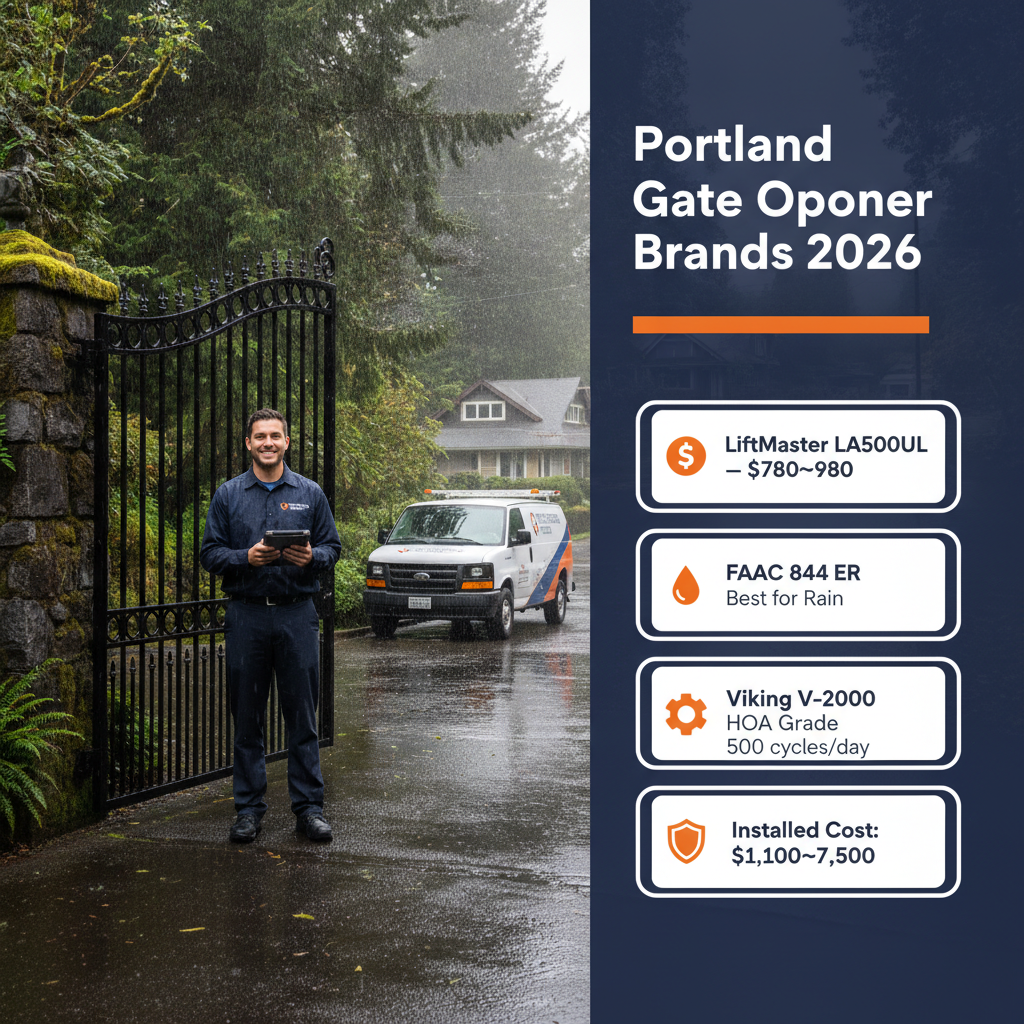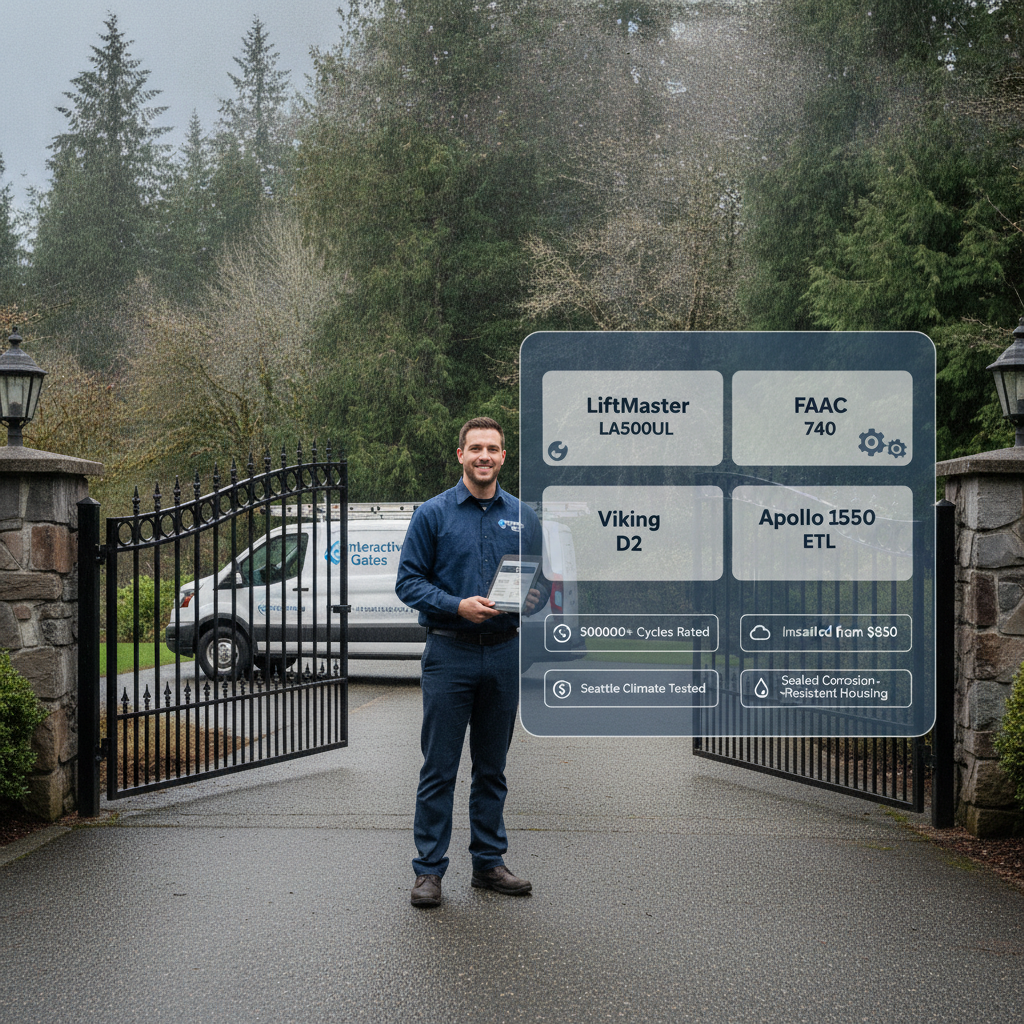
- LiftMaster LA500UL and FAAC 740 are the two most field-proven swing gate openers for Seattle's wet climate in 2026, each rated for 500,000+ cycles.
- Slide gate motors from Viking Access (D2 and G4 series) handle slopes common in Bellevue, Issaquah, and the Eastside without stalling in wet track conditions.
- Entry-level residential openers run $900–$1,400 installed; commercial-grade and dual-gate systems range $2,800–$6,500 installed depending on gate weight and driveway configuration.
- Corrosion-resistant aluminum housing and sealed circuit boards are non-negotiable in Seattle — open-frame motors fail within 2–4 years here.
- Apollo 1550 ETL is the best budget solar-compatible swing opener for single-panel gates under 400 lb in drier East Seattle and Sammamish microlimates.
- Permit timelines in Seattle and Tacoma run 3–6 weeks; choosing a pre-approved opener model from your installer's brand library can shave 1–2 weeks off that clock.
- Maintenance intervals for openers in the Seattle area should be every 10–12 months, not the 18–24 months manufacturers recommend for dry climates.
- FAAC and LiftMaster both offer remote diagnostics via app — a real advantage when a gate stalls on a rainy Tuesday and you need to know if it's the board or the limit switch before dispatching a tech.
Which Electric Gate Opener Brand Should You Buy for a Seattle Driveway in 2026?
You've searched 'best electric gate opener Seattle,' 'which gate motor survives Pacific Northwest rain,' or maybe 'why does my gate opener keep failing in winter' — and landed here. Good. This post answers all of it with real brand data, real price ranges, and real local context from properties across King County, Pierce County, and Snohomish County.
The honest answer up front: brand matters far less than selecting the right product line within a brand. LiftMaster makes openers that will last 15 years in Seattle and openers that will corrode in three. Same story with FAAC, Viking, and Apollo. What separates them is housing construction, board sealing, and duty-cycle rating — and we'll break all of that down below.
Why Does Seattle's Climate Destroy the Wrong Gate Opener?
Seattle averages 38–40 inches of rain annually — most of it as persistent drizzle rather than hard downpours. That low-intensity, high-frequency moisture is actually harder on electrical components than a heavy rainstorm, because water finds its way into every micro-gap in an unsealed enclosure over months, not hours. Add to that: temperatures that swing between 20°F on a rare Snoqualmie Pass cold snap and 90°F during an Eastside heat dome event, and you have a motor environment that punishes anything less than fully sealed, thermally compensated electronics.
Salt air is a secondary factor along the Puget Sound waterfront — West Seattle bluffs, Tacoma's Ruston Way corridor, Gig Harbor marinas — where aluminum oxidation and stainless fastener corrosion happen faster than even the manufacturers' Pacific Northwest warranty language accounts for.
The result: residential-grade openers with open-frame motors and uncoated circuit boards typically fail within 2–4 years here. The brands and model lines below are the ones that consistently survive 8–15 years in real Seattle-area installations.
LiftMaster for Seattle Gates in 2026: Which Models Are Worth It?
LiftMaster is the most widely installed brand in the greater Seattle market, partly because its dealer network is dense and parts availability is excellent even in Snohomish and Pierce counties. But not every LiftMaster product is built for the Pacific Northwest.
LA500UL (swing gate, residential to light commercial): This is the workhorse of Seattle residential installs in 2026. Rated for 500,000 cycles, it uses a fully enclosed die-cast aluminum housing with a UV-resistant polycarbonate cover that handles freeze-thaw cycles without cracking. The brushless DC motor means no brush wear from moisture intrusion. Installed cost for a single swing gate: $1,350–$1,900. Dual swing gate setup: $2,600–$3,500 depending on gate weight.
LA400UL: The step-down model — 300,000 cycles, same housing quality. Fine for a single-panel gate under 300 lb on a low-traffic residential driveway. Installed: $950–$1,350. Where it fails: properties with 20+ cycles per day (think short-term rentals or multi-unit driveways) will burn through the motor in 5–7 years instead of 10–12.
CSW200UL (commercial slide gate): Used heavily in Bellevue apartment complexes, Tacoma industrial, and Everett commercial. 1,000,000-cycle rating, 115V or 230V, remote diagnostics via myQ commercial portal. Installed: $3,800–$6,000 for most configurations. Overkill for a private residence, appropriate for any HOA or commercial property with 50+ daily cycles.
Pro Tip: Always verify that your LiftMaster installer is activating the motor's built-in heater option (available on LA500UL and CSW200UL) — this $80–$120 add-on during installation keeps the gearbox oil viscous during the 20–30°F nights that hit Snohomish County and the Eastside foothills every January and February.
FAAC for Seattle Gates in 2026: The European Option That Excels Here
FAAC is an Italian brand that dominates European gate markets — which means its engineering baseline is literally designed for cold, wet Northern European climates. It's become the preferred brand among premium Seattle residential installers for exactly that reason.
FAAC 740 (swing gate, medium to heavy duty): The 740 is a hydraulic operator — oil-driven rather than gear-driven — which makes it immune to the 'cold morning stall' that plagues gear motors when grease thickens below 25°F. Rated for 800,000 cycles. It handles gates up to 13 feet long and 880 lb. Installed cost: $1,800–$2,800 per leaf (dual swing: $3,500–$5,500). Premium over LiftMaster, but justified on heavy ornamental iron gates common in Medina, Mercer Island, and Broadmoor.
FAAC 402 (swing gate, lighter residential): Electromechanical, not hydraulic. Handles gates up to 7 feet and 330 lb. Best for aluminum driveway gates in Auburn, Lakewood, and Lynnwood where gate weight is lower. Installed: $1,100–$1,700 single leaf.
FAAC 844 (slide gate): Used in Seattle on flat to moderate driveways. 500,000-cycle rating, built-in obstacle detection, encoder motor feedback. Installed on a standard residential slide gate: $1,600–$2,400.
FAAC's main limitation in Seattle is parts lead time — if a hydraulic seal fails on a 740, your installer needs stock on hand. Confirm your installer carries FAAC spare parts locally before committing, especially if you're in a more remote location like Snohomish or Gig Harbor.
Viking Access for Seattle Slide Gates in 2026: The Slope Specialist
Viking Access Systems (a California brand now widely distributed in the Pacific Northwest) has become the go-to for Seattle's hilly terrain — particularly in neighborhoods like Capitol Hill, Beacon Hill, West Seattle, Bellevue's Somerset, and Issaquah Highlands where flat driveway approaches for slide gates are rare.
Viking D2 (residential slide gate): DC motor with soft-start/soft-stop, 100,000-cycle rating, loop detector ready. Handles gates up to 20 feet and 600 lb. The D2's slope compensation algorithm adjusts motor torque automatically as the gate moves, which matters when your driveway has a 2–5° cross-slope that makes a standard slide gate bind on its track. Installed: $1,200–$1,900.
Viking G4 (commercial slide gate): 500,000-cycle rating, 1,200 lb capacity, dual loop detector input, remote diagnostics. Standard at HOA entry points across Issaquah, Sammamish, and Kirkland communities. Installed: $2,800–$4,500. See real HOA installations in our project portfolio and read what property managers say on our reviews page.
Pro Tip: Viking's track systems include a V-groove rail option that sheds standing water better than flat-bottom rails — a critical spec for Seattle properties where organic debris (leaves, pine needles) collects in the track channel during October–March. Ask your installer to spec V-groove rail on any Viking slide gate installation.
Apollo Gates for Seattle in 2026: Best Budget Option for Lighter Gates
Apollo Gate Operators is the most affordable brand in this roundup and the right fit for a specific use case: single-panel aluminum swing gates under 400 lb on lower-traffic residential driveways in drier Seattle-area microclimates.
Apollo 1550 ETL: 150,000-cycle rating, solar-panel compatible out of the box, 12V DC motor. Installed cost: $850–$1,200 for a single gate. It's genuinely good value on properties in Sammamish, North Bend, or the Eastside where summer sun exposure makes solar a viable power source and rainfall, while real, doesn't pool against the opener housing the way it does in lowland Seattle neighborhoods.
Where Apollo underperforms: waterfront properties, shaded north-facing driveways, and any gate over 350 lb. The housing is durable but not in the same class as FAAC or LiftMaster LA-series. If you're comparing bids and one is significantly cheaper because the installer spec'd Apollo for a 450 lb iron gate on a Tacoma waterfront property — push back.
How Do Seattle-Area Permits Affect Opener Selection?
Seattle, Bellevue, Tacoma, and most King County jurisdictions require a building permit for new automatic gate installations, and the permit application must include the opener's UL 325 listing and ETL certification documentation. All four brands above — LiftMaster, FAAC, Viking, Apollo — are UL 325 listed. The practical issue is that some older FAAC models imported through non-authorized channels are not ETL certified for North American use. Confirm your installer is sourcing from authorized US distributors.
Permit timelines currently run 3–6 weeks in Seattle proper, 2–4 weeks in Bellevue and Tacoma, and 4–8 weeks in some Snohomish County jurisdictions. For more detail on what the permit process looks like locally, see our complete guide to automatic gate installation in Seattle, and if you're on the South Sound, our Tacoma gate installation page covers Pierce County's specific review process.
What Does a Full Opener Installation Cost in Seattle in 2026?
Here's a realistic price table for the Seattle metro in 2026, covering equipment plus installation labor (electrical rough-in, concrete post work, and basic access control wiring included):
- Apollo 1550 ETL, single swing gate under 400 lb: $850–$1,250 installed
- LiftMaster LA400UL, single swing gate: $950–$1,400 installed
- Viking D2, single slide gate: $1,200–$1,900 installed
- LiftMaster LA500UL, single swing gate: $1,350–$1,950 installed
- FAAC 402, single swing gate: $1,100–$1,750 installed
- FAAC 740, single swing gate (heavy duty): $1,800–$2,850 installed
- LiftMaster LA500UL, dual swing gate: $2,600–$3,600 installed
- FAAC 740, dual swing gate: $3,500–$5,500 installed
- Viking G4, commercial slide gate (HOA): $2,800–$4,500 installed
- LiftMaster CSW200UL, commercial slide: $3,800–$6,000 installed
These ranges assume standard driveway conditions. Add $400–$900 for significant concrete work, $300–$600 for trenching on long driveway runs, and $200–$500 for heavier-gauge electrical panel upgrades in older Craftsman homes in Capitol Hill or Wallingford where the existing electrical panel is at capacity. Want to spec your gate before calling anyone? Use the Interactive Gates design tool to preview styles and configurations.
Which Brand Should You Choose? A Quick Decision Framework
- Heavy ornamental iron gate, waterfront or premium neighborhood (Medina, Mercer Island, Broadmoor): FAAC 740 hydraulic
- Standard aluminum or steel swing gate, mid-range residential: LiftMaster LA500UL
- Sloped driveway slide gate, Eastside or West Seattle: Viking D2 or G4
- Budget residential, lighter gate, drier Eastside microlimate: Apollo 1550 ETL
- HOA or commercial, 50+ daily cycles: Viking G4 or LiftMaster CSW200UL
- Property with existing LiftMaster myQ ecosystem: Stay in LiftMaster family for unified app control
For residential gate options and to explore what's right for your specific property, see our residential gate page. If you manage an HOA or commercial property, our commercial and HOA gate page covers volume pricing and service agreements. And if you're in Bellevue or on the Eastside, our Bellevue gate installation page has local project examples and neighborhood-specific notes.
In One Minute: Electric Gate Opener Brands for Seattle 2026
- LiftMaster LA500UL: best all-around residential swing gate opener, 500K cycles, $1,350–$1,950 installed
- FAAC 740: best for heavy iron gates and waterfront properties, hydraulic, $1,800–$2,850 per leaf
- Viking D2/G4: best for sloped Seattle driveways and HOA slide gates, $1,200–$4,500 installed
- Apollo 1550 ETL: best budget option for lightweight aluminum swing gates, $850–$1,250 installed
- All brands should be UL 325 listed and sourced through authorized US distributors
- Seattle permit timelines: 3–6 weeks in city limits; plan accordingly
- Service every 10–12 months here, not the 18–24 months dry-climate spec sheets recommend
Frequently Asked Questions: Electric Gate Opener Brands in Seattle 2026
What is the most reliable electric gate opener for Seattle's rainy climate?
For most Seattle residential properties, the LiftMaster LA500UL and the FAAC 740 are the two most reliable choices in 2026. Both feature fully sealed, corrosion-resistant housings and are rated for 500,000–800,000 cycles. The FAAC 740's hydraulic mechanism gives it an edge in extreme cold, while the LiftMaster's myQ app integration and dense parts network make it more practical for most homeowners. Your gate's weight and traffic volume should drive the final decision.
How much does it cost to install a gate opener in Seattle in 2026?
Installed costs range from $850 for a budget Apollo single-gate system on a light aluminum gate up to $6,000 or more for a LiftMaster CSW200UL commercial slide gate system. The most common residential installation — a dual LiftMaster LA500UL swing gate setup — typically costs $2,600–$3,600 fully installed including electrical and basic access control wiring. Add $400–$900 for significant concrete or trenching work on longer driveway runs.
Does Seattle's cold weather affect electric gate openers?
Yes, particularly gear-driven openers that use grease lubrication. When temperatures drop below 25°F — common in Snohomish County, the Eastside foothills, and Tacoma inland areas in January and February — standard grease thickens and can stall a motor at startup. FAAC's hydraulic operators are inherently resistant to this problem. For LiftMaster LA500UL installations, activating the built-in gearbox heater option ($80–$120 at install time) prevents cold-stall in nearly all cases.
Do I need a permit to install a gate opener in Seattle?
Yes, in most Seattle-area jurisdictions a building permit is required for new automatic gate installations. The permit application must include UL 325 listing documentation for the opener. Timelines currently run 3–6 weeks in Seattle proper, 2–4 weeks in Bellevue and Tacoma, and up to 8 weeks in some Snohomish County areas. Working with an installer who has a pre-existing relationship with the local permit office and an approved project template can shorten this by 1–2 weeks.
How often should a gate opener be serviced in Seattle compared to other climates?
In Seattle's wet climate, opener service intervals should be every 10–12 months — significantly shorter than the 18–24 month intervals manufacturers recommend for dry-climate markets. Annual service includes lubricating the drive mechanism with marine-grade or silicone-based lubricant (not standard grease), inspecting the housing seals for moisture intrusion, testing safety sensors, and checking limit switch calibration. Skipping annual service in Seattle's climate is the single biggest factor in premature opener failure.
Which gate opener is best for a sloped Seattle driveway?
Viking Access Systems D2 (residential) and G4 (commercial/HOA) are the top choices for sloped Seattle driveways where slide gates need to operate smoothly on angled or uneven terrain. Viking's slope-compensation torque algorithm adjusts power delivery as the gate travels, preventing the binding and stalling that standard slide gate motors experience on cross-sloped tracks. LiftMaster LA500UL swing gate openers also work well on sloped lots since swing gates don't require a level track, making them a viable alternative where the driveway approach permits the swing arc.
Ready to Choose the Right Opener for Your Seattle Gate?
The right gate opener is one that matches your gate's weight, your driveway's geometry, your daily cycle count, and Seattle's specific climate demands — not just whatever happens to be in stock. If you'd like a straight conversation about which brand and model fits your property, the team at Interactive Gates has installed gates from Lynnwood to Gig Harbor to Auburn and everywhere in between. Reach out here and we'll give you an honest recommendation without the sales pressure.