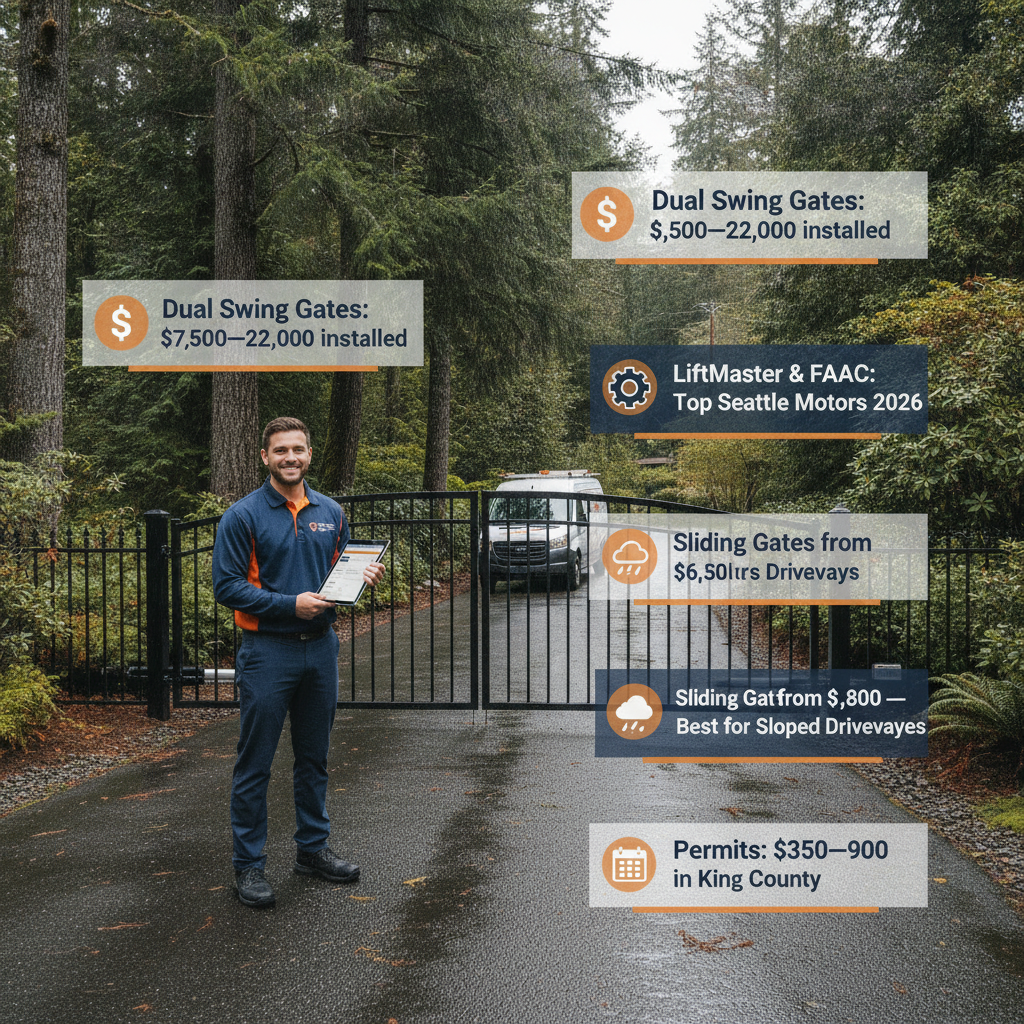
- Most Seattle electric gate installations require a building permit — skipping it risks fines of $500–$5,000 and forced removal.
- Permit fees in Seattle typically run $200–$650 for a residential gate project, depending on valuation and scope.
- Standard permit approval takes 3–6 weeks through Seattle's Department of Construction & Inspections (SDCI); over-the-counter same-day review is sometimes available for simple projects.
- An electrical permit is required separately any time a gate operator is hardwired to 120V or 240V service — add $150–$300 to your budget.
- Gates in shoreline setbacks, hillside zones, or landslide-prone areas (common in Magnolia, Queen Anne, and West Seattle) face extra review steps that can add 2–8 weeks.
- HOA communities must coordinate both city permits and CC&R approval — the HOA process can run parallel but must conclude before construction starts.
- Unpermitted gates discovered during a home sale commonly kill escrow or require a retroactive permit plus inspection, costing $1,000–$4,500 in Seattle's current market.
- A licensed gate contractor pulls permits on your behalf in most cases — verify this is included before signing any installation contract.
Do You Really Need a Permit to Install an Electric Gate in Seattle?
Homeowners across Seattle, Bellevue, and Tacoma are Googling the same thing right now: 'Do I need a permit for an automatic gate in Seattle?' and 'How long does gate permit approval take?' The short answer is almost certainly yes — and the long answer involves your specific lot, the gate's power source, your neighborhood's zoning overlay, and whether your property sits anywhere near a steep slope or shoreline. This guide breaks all of it down with real 2026 numbers so you can budget accurately and avoid the costly surprises that catch homeowners off guard every week.
What Triggers a Permit Requirement for an Automatic Gate in Seattle?
Seattle's Department of Construction & Inspections (SDCI) classifies an automatic gate installation as a combination project — it involves structural work (posts, footings, fence or gate panel) plus electrical work (the operator, control board, and access-control wiring). Either component alone can trigger a permit, and most projects trigger both.
You generally need a building permit when any of the following apply: the gate or attached fence exceeds 6 feet in height; the project involves concrete footings deeper than 12 inches; the installation is in a critical area (steep slope, landslide hazard, shoreline, or wetland buffer); or the gate serves a structure used for commercial or multi-family purposes. Even a 5-foot residential swing gate usually requires a permit if it is motorized and hardwired.
You need a separate electrical permit any time the gate operator is connected to the home's electrical panel — 120V plug-in operators in a weatherproof outlet may qualify as exempt in limited circumstances, but SDCI inspectors have been tightening that interpretation in 2026. When in doubt, pull the permit. The cost is small; the fine is not.
The narrow band of truly permit-exempt gates in Seattle includes manually operated gates under 6 feet that are not in critical areas and involve no electrical work. That describes very few automatic gate projects.
How Much Does a Gate Permit Cost in Seattle in 2026?
Seattle calculates building permit fees using a project valuation method. SDCI sets the valuation based on the fair-market replacement cost of labor and materials — not what you actually paid. For a typical residential automatic swing gate with concrete footings and a LiftMaster or Viking operator, SDCI will value the project at roughly $8,000–$18,000 depending on gate size and material.
Using SDCI's 2026 fee schedule, that valuation range produces a base permit fee of approximately $200–$480. Add the state surcharge (currently 10% of the permit fee), a technology fee of around $30, and a records fee of $15, and your all-in building permit cost lands between $250 and $560 for most single-family residential gates.
The electrical permit for the operator circuit runs separately: residential electrical permits in Seattle start at $150 and top out around $300 for a straightforward gate operator circuit. Expect to pay $150–$300 for this permit on top of the building permit.
If your property is in a critical area — which includes much of the hillside terrain in Queen Anne, Magnolia, Beacon Hill, and West Seattle — SDCI charges an additional critical-area review fee of $300–$800. Projects requiring a Shoreline Substantial Development Permit (for lots within 200 feet of Lake Washington, Lake Union, Puget Sound, or major creeks) add $1,000–$2,500 in permit fees alone and require a public comment period.
Total permit cost for a straightforward Seattle residential gate: $400–$860. For a critical-area property: $750–$3,400.
How Long Does Seattle Gate Permit Approval Take in 2026?
SDCI's published target for residential over-the-counter (OTC) review is same day to 3 business days for simple projects that qualify. In practice, 2026 wait times at the Applicant Services Center have been running 1–5 business days for OTC projects. To qualify for OTC review, the project must be straightforward: single-family residential, no critical areas, no shoreline overlay, standard zoning, and a complete application package submitted electronically through Seattle's Applicant Portal.
Projects that do not qualify for OTC review enter standard plan review. In 2026, SDCI's standard plan review queue for residential projects is running 3–6 weeks from the date a complete application is accepted. Incomplete applications restart the clock, which is the most common cause of project delays — missing site plans, incorrect legal descriptions, or omitted electrical load calculations are the top three failure points.
Add a critical-area review and the timeline extends to 8–14 weeks. A shoreline permit can take 4–6 months, including the mandatory 21-day public comment window under Washington's Shoreline Management Act.
Once permits are issued, your contractor schedules installation and then calls for inspections: a footing inspection before concrete is poured, a rough electrical inspection before wiring is covered, and a final inspection once the gate is operational. Scheduling inspections in Seattle currently takes 3–10 business days per inspection slot. Plan your total project timeline — from permit application to final sign-off — at 6–12 weeks for a standard residential project and 4–8 months for a critical-area or shoreline site.
Pro Tip: Submit your permit application electronically through SDCI's Seattle Services Portal before your contractor even orders materials. The permit review period overlaps with lead times for gate panels (2–5 weeks for custom steel or iron work), so a well-timed application costs you nothing in schedule.
What Documents Does Seattle SDCI Require for a Gate Permit?
A complete gate permit application for Seattle typically includes: a completed permit application form; a site plan drawn to scale showing property lines, existing structures, the proposed gate location, setbacks, and any easements; a construction detail sheet showing gate dimensions, footing depth and diameter, post sizes, and hardware specifications; the manufacturer's cut sheet for the gate operator (LiftMaster LA500, FAAC B680H, Viking DC2000, Apollo 1550 ETL, etc.); an electrical load calculation for the operator circuit; and photos of the existing driveway approach and any existing fence.
For critical-area properties, add: a critical-area report prepared by a licensed geotechnical engineer (cost: $1,500–$4,000); a drainage plan if grading is involved; and a tree survey if any significant trees are within the work area. Seattle's Urban Forestry Division has jurisdiction over trees with a trunk diameter over 6 inches measured at 4.5 feet above grade — gate post footings sometimes fall within the drip line of protected trees, triggering an additional review.
Does the City of Bellevue or Tacoma Handle Permits Differently?
If your property is in Bellevue, you work with the City of Bellevue Development Services department rather than SDCI. Bellevue's residential gate permit process is similar in structure but tends to run slightly faster — standard review currently averages 2–4 weeks in 2026. Bellevue's permit fees are comparable to Seattle's, in the $350–$700 range for a typical residential gate project including the electrical permit. Bellevue also has its own critical-area regulations under BMC Chapter 20.25H, and hillside properties in Bridle Trails, Somerset, or Cougar Mountain may face the same additional review burdens as Seattle's steep-slope zones.
In Tacoma, the Planning and Development Services department handles gate permits. Tacoma's fees are somewhat lower — typical residential gate permits run $180–$420 all in — and standard review times in 2026 are 2–5 weeks. Tacoma's North Slope Historic District adds a design-review layer that can extend timelines by 3–6 weeks for properties within its boundaries.
For properties in unincorporated King County (outside city limits but within the county), the King County Department of Local Services Permitting Division handles review. Their 2026 standard residential review times are running 4–8 weeks, and fees follow a similar valuation-based schedule to Seattle's.
If your project is in Gig Harbor or Snohomish, visit the Gig Harbor service page or the Snohomish service page for jurisdiction-specific notes — both cities have their own permitting departments with distinct timelines.
What Happens If You Install a Gate Without a Permit in Seattle?
SDCI actively investigates unpermitted work through neighbor complaints, aerial imagery review, and routine inspection sweeps. If an unpermitted gate is discovered, the property owner receives a Notice of Violation requiring either retroactive permitting or removal. Retroactive permits involve a standard application plus a double-fee penalty — so the permit that would have cost $500 now costs $1,000, plus any civil penalties SDCI chooses to impose, which run $500–$5,000 depending on the scope and the owner's response time.
The more painful scenario plays out at closing. Seattle title companies and buyer's agents in 2026 routinely flag unpermitted structures during escrow. A buyer's lender may require a retroactive permit as a loan condition, and if the gate cannot be permitted as built (wrong setback, wrong footing depth, incorrect operator for the gate weight), the seller must remove it. Removal, site restoration, and a new compliant installation can cost $3,000–$8,000 — far more than the original permit would have cost.
Pro Tip: Ask your gate contractor for a copy of the permit card and all final inspection sign-off documents. Store them with your home's records — title companies want to see them, and replacement copies from SDCI cost time and a records-retrieval fee.
How Do HOA Communities Handle Gate Permits in the Seattle Area?
HOA-managed communities in the Seattle metro — think communities in Lynnwood, Auburn, or Lakewood — face a two-track approval process. The city or county permit is required by law; the HOA's architectural committee approval is required by the CC&Rs. Neither waives the other.
Most HOA boards require a permit application number before they will schedule an architectural review meeting, because the city's approved site plan confirms that the proposed installation meets setback and height rules the HOA board is not equipped to verify independently. Plan for the HOA review to add 2–6 weeks to your project timeline, depending on how frequently the architectural committee meets. Some larger HOAs in the Puget Sound area have moved to rolling monthly review cycles; smaller communities may only convene quarterly.
Commercial gate projects and HOA community gate replacements involve additional complexity — UL 325 safety compliance documentation, vehicular crash-rating certifications for high-traffic entries, and in some cases a traffic study if the gate is near a public road. Learn more about what community gate projects involve on the HOA and commercial gate page.
Should You Pull the Permit Yourself or Have Your Contractor Do It?
In Washington State, a licensed contractor is legally authorized — and in most cases contractually expected — to pull permits for work they perform. Most reputable gate installation companies in the Seattle market include permit-pulling as part of their service. The permit fee itself is typically passed through to the client at cost, itemized on the project invoice.
If a contractor tells you no permit is needed for a motorized, hardwired gate installation in Seattle, treat that as a red flag. It is either incorrect or an indication that the contractor is trying to cut corners — and you, as the property owner, bear the legal liability for unpermitted work regardless of who installed it.
To see the kind of work that gets permitted and inspected correctly, browse the project portfolio — completed installations with proper documentation from across the Seattle area. For residential gate options, the residential gate page covers gate styles and operator options that are commonly specified on Seattle permit drawings.
In One Minute: Seattle Electric Gate Permits 2026
Almost every automatic gate installation in Seattle requires both a building permit and an electrical permit. Building permits cost $250–$560 for standard residential projects; electrical permits add $150–$300. Critical-area properties (steep slopes, shoreline, wetland buffers) pay $750–$3,400 in permit fees and wait 8–14 weeks or longer for approval. Standard projects that qualify for over-the-counter review can get approved in 1–5 business days; standard plan review runs 3–6 weeks. Skipping a permit risks fines of $500–$5,000 and can derail a home sale. Your licensed gate contractor should pull permits on your behalf — if they say you don't need one, get a second opinion. Cities like Bellevue, Tacoma, Gig Harbor, and Snohomish have their own departments with similar but distinct processes.
Frequently Asked Questions About Seattle Electric Gate Permits
Do I need a permit for a manual gate in Seattle?
A manually operated gate under 6 feet tall that involves no electrical work and is not in a critical area is typically permit-exempt in Seattle. However, if you plan to motorize it now or later, pulling a permit from the start is almost always cheaper than retrofitting a permit after the fact. Any motorized gate connected to a power source requires at minimum an electrical permit.
How long does it take to get a gate permit in Seattle in 2026?
Simple residential projects that qualify for over-the-counter review are currently being processed in 1–5 business days at SDCI in 2026. Projects that enter standard plan review take 3–6 weeks from a complete, accepted application. Properties in critical areas (steep slopes, landslide zones, shoreline buffers) face 8–14 weeks or more. Schedule inspections — footing, rough electrical, and final — with SDCI at least 3–10 business days in advance of each milestone.
What does a gate permit cost in Seattle?
The all-in permit cost for a standard residential automatic gate in Seattle in 2026 is approximately $400–$860, covering the building permit ($250–$560) and the electrical permit ($150–$300). Critical-area properties pay $750–$3,400 depending on the type and depth of additional review required. Shoreline permits add $1,000–$2,500 on top of those figures.
Can I install an electric gate without telling my HOA?
No — and doing so can result in a mandatory removal order from the HOA regardless of whether the city issued a permit. HOA architectural committee approval under your CC&Rs is a separate and independent requirement from the city permit. Most HOA boards in the Seattle area require a copy of the city permit application before they will schedule their own review.
Who is responsible if a gate is installed without a permit — me or the contractor?
As the property owner, you bear the legal liability for unpermitted work on your property under Seattle Municipal Code, even if a contractor performed the work. You can pursue the contractor for indemnification, but SDCI's Notice of Violation and any associated fines or removal orders are issued to the property owner. Always verify permit status before installation begins and request copies of all permit documents at project closeout.
Does a solar-powered gate operator still need an electrical permit in Seattle?
Yes. A solar-powered gate operator with a battery backup system still requires an electrical permit in Seattle if any low-voltage control wiring, intercom wiring, or access-control system wiring is involved. SDCI's 2026 interpretation treats low-voltage gate-control systems as regulated electrical work. The fee is typically at the lower end of the electrical permit range — around $150 — but the permit is still required and an inspection is still required before the system is covered or enclosed.
Ready to Move Forward on Your Seattle Gate Project?
Permits are one of those parts of a gate project that feel bureaucratic until you understand why they exist — and then they feel like the most sensible protection you can buy. An inspected, permitted installation protects your investment, satisfies your lender and title company, and gives you the documentation you need when you sell. If you want to explore gate styles and operators before diving into the permit process, the gate designer tool lets you configure options visually. When you're ready to talk specifics for your property — including which permits apply to your address and what the timeline looks like — the team at Interactive Gates is happy to walk through it with you. Reach out through the contact page and get a straight answer from someone who pulls Seattle permits every week.