
- Single swing gate installation in Seattle runs $4,200–$8,500 installed, including motor, hardware, and basic access control.
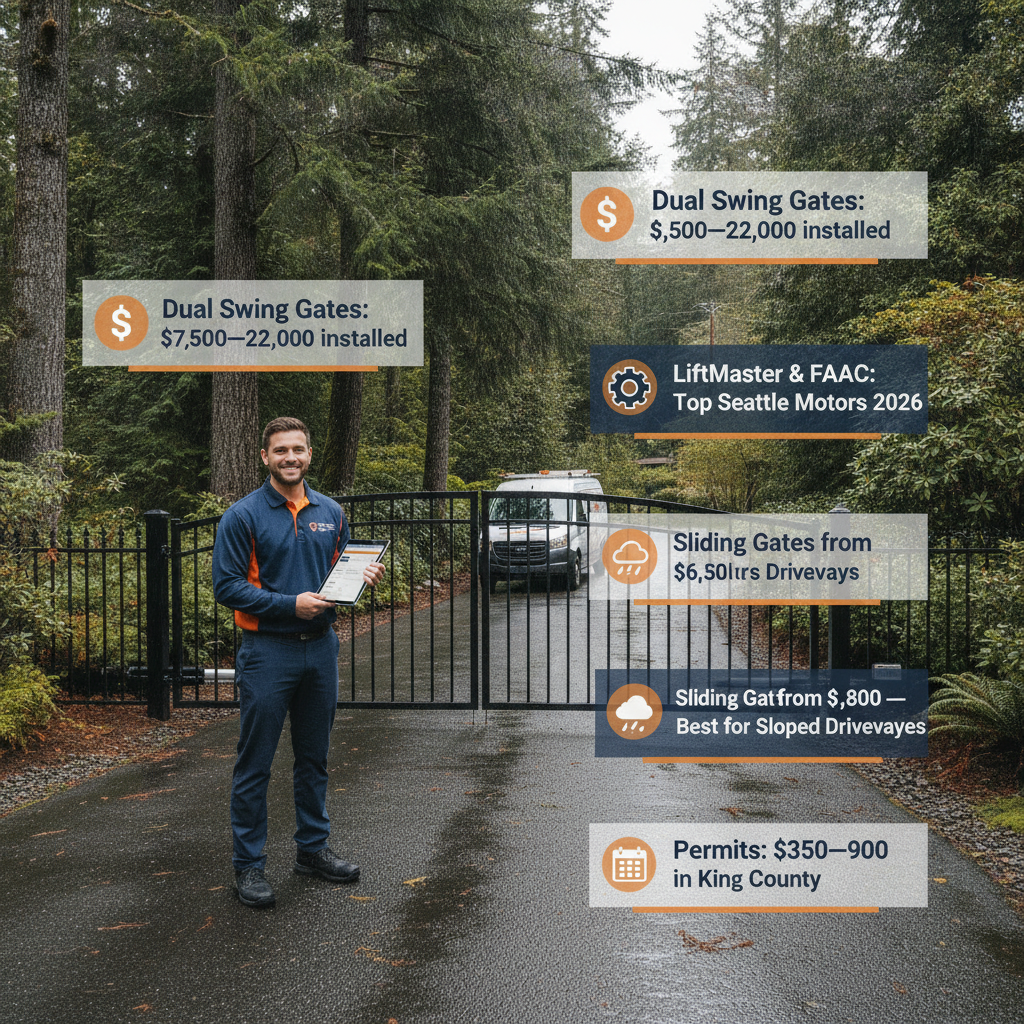
- Dual swing gate systems cost $7,500–$16,000 for residential driveways in neighborhoods like Bellevue, Mercer Island, and Queen Anne.
- Sliding gates on flat lots start around $6,800 but climb to $14,000+ on sloped or irregular terrain common in Capitol Hill and Magnolia.
- Wrought iron is the priciest material at $280–$420 per linear foot fabricated; aluminum runs $160–$260 per linear foot and resists Seattle corrosion better long-term.
- LiftMaster LA400 and FAAC 760 are the top motors specified locally in 2026, priced $1,100–$2,400 for the operator alone.
- Permits add $350–$900 in King County and are required for any gate with electrical connection or over 6 feet in height.
- Most residential installs wrap up in 1–3 days once materials arrive; HOA or commercial projects with conduit runs take 3–7 days.
- Total cost for a full gate system — gate + motor + access control + permit — averages $9,800–$22,000 for a Seattle single-family home in 2026.
How Much Does It Really Cost to Install an Electric Gate in Seattle in 2026?
If you've Googled 'electric gate cost Seattle,' 'automatic gate installation price King County,' or 'how much does a driveway gate cost in the Pacific Northwest,' you already know the answers online are all over the place. One site says $3,000. Another says $30,000. Neither explains why. This guide breaks down the real numbers local installers are quoting in 2026, by gate type, material, neighborhood, and the hidden line items that almost always surprise first-time buyers.
What Are the Main Cost Categories for an Automatic Gate in Seattle?
Before looking at gate-type pricing, it helps to understand the four cost buckets every project carries:
- Gate fabrication or supply — the physical panel(s), either custom-welded locally or ordered from a manufacturer like Mighty Mule, B&B Roadway, or Tymetal.
- Gate operator (motor) — the electromechanical unit that opens and closes the gate. This is often 25–35% of total project cost.
- Foundation and post work — concrete footings, steel posts, and — on sloped Seattle lots — sometimes significant grading or retaining work.
- Access control and wiring — keypads, intercoms, video systems, loop detectors, and conduit runs back to your panel.
Labor in the Seattle metro averages $85–$130 per hour for gate technicians in 2026, reflecting the regional trades cost environment. That's notably higher than Portland ($75–$115/hr) and meaningfully higher than most of the country.
How Much Does a Single Swing Gate Cost in Seattle in 2026?
A single swing gate — one panel hinged to one post — is the most common residential choice on driveways up to 14 feet wide. Here's what local projects are running in 2026:
- Budget aluminum single swing (12 ft panel, LiftMaster LA400 operator, keypad): $4,200–$5,800 installed
- Mid-range steel or iron single swing (12–14 ft, FAAC 402 operator, keypad + loop detector): $6,500–$8,500 installed
- Custom wrought iron single swing (12 ft, decorative pickets, FAAC 760, video intercom): $9,500–$13,000 installed
Neighborhoods with tight lots and older concrete like Seattle proper (Fremont, Wallingford, Beacon Hill) often add $400–$900 in demo and repour costs when existing aprons or pads need modification.
How Much Does a Dual Swing Gate Cost in Seattle in 2026?
Dual swing gates — two panels meeting in the center — are typical for driveways 14–24 feet wide and are popular in Bellevue, Mercer Island, and larger Eastside properties. Costs in 2026:
- Aluminum dual swing (16 ft total, two LiftMaster LA400 operators, keypad): $7,500–$10,500 installed
- Steel picket dual swing (18 ft total, two FAAC 402 operators, intercom): $10,000–$14,000 installed
- Custom wrought iron dual swing (20 ft total, decorative arch, two FAAC 760 or Viking SW-5000 operators, video intercom + app control): $16,000–$22,000 installed
Swing gates require adequate swing clearance — typically 1.1× to 1.2× the panel width in the driveway. On properties in Gig Harbor or Snohomish with longer driveways and flatter terrain, this is rarely an issue. On tighter urban lots, a sliding gate is often the better call.
How Much Does a Sliding Gate Cost in Seattle in 2026?
Sliding cantilever gates are the go-to solution when swing clearance doesn't exist or when a lot slopes toward the street — a very common scenario in Capitol Hill, Magnolia, First Hill, and Tacoma hillside neighborhoods. Pricing in 2026:
- Aluminum cantilever sliding gate (12 ft opening, LiftMaster SL3000 or Apollo 3500, basic keypad): $6,800–$9,200 installed
- Steel sliding gate (16 ft opening, FAAC 844 or Viking SL-1, loop detectors, intercom): $9,500–$13,500 installed
- Heavy-duty steel or iron sliding gate (20 ft opening, FAAC 844 R or Viking SL-3, full access control package): $14,000–$20,000 installed
The cantilever design (no ground track) is strongly preferred in Seattle because track-based systems collect debris, moss, and standing water — all abundant in the Puget Sound climate — and fail faster. Expect a $600–$1,200 premium for cantilever hardware over a standard track slide.
Pro Tip: On sloped driveways, especially those with more than a 5% grade, always request a site-specific engineering assessment before committing to either swing or slide. Seattle installers have seen swing gates that physically cannot open against a rising driveway, and that retrofit correction runs $1,500–$3,500 after the fact.
What Does Gate Material Cost Per Linear Foot in Seattle in 2026?
Material pricing from Seattle-area fabricators and distributors in early 2026:
- Tubular aluminum: $160–$260 per linear foot fabricated. Lightweight, rust-proof, lower motor wear. Top choice for coastal and lakefront lots (Leschi, Seward Park, Lake Washington waterfront).
- Galvanized steel: $200–$310 per linear foot. Strong, weldable, needs quality powder coat to resist the wet season. Repaint cycle every 6–9 years in Seattle's climate.
- Wrought iron: $280–$420 per linear foot. Most visually traditional, heaviest, highest maintenance. Requires annual rust inspection in Seattle's 38-inch annual rainfall environment.
- Wood-infill steel frame: $240–$380 per linear foot. Cedar or redwood planks inside a steel frame — popular in Lynnwood and Auburn neighborhoods with more suburban lot depth. Expect board replacement every 8–12 years.
What Do Gate Motors Cost in Seattle in 2026?
The operator is often the single largest line item. Here's what Seattle installers are pricing for the most common residential brands in 2026:
- LiftMaster LA400 (swing, residential): $1,100–$1,500 supply + install
- LiftMaster SL3000 (slide, residential/light commercial): $1,400–$1,900 supply + install
- FAAC 402 (swing, residential): $1,200–$1,600 supply + install
- FAAC 760 (swing, heavy residential/commercial): $1,800–$2,400 supply + install
- FAAC 844 (slide, commercial): $2,200–$3,000 supply + install
- Viking SW-5000 (swing, heavy residential): $1,600–$2,200 supply + install
- Apollo 3500 (slide, residential): $1,300–$1,800 supply + install
LiftMaster continues to dominate the residential market in King and Snohomish Counties largely because of parts availability through local distributors — a failed board or limit switch can be sourced within 1–2 business days versus 5–10 days for some import brands. FAAC is the preferred choice for heavier gates and commercial settings because of its hydraulic operator design, which handles Seattle's temperature swings (28°F winter nights to 90°F summer days) without pressure changes that affect performance.
What Access Control Costs Should I Budget in Seattle in 2026?
Access control is where a lot of quotes diverge. Basic to full-featured pricing in the Seattle metro:
- PIN keypad only (Doorking, LiftMaster): $350–$600 installed
- Key fob/remote system (up to 50 users): $400–$700 installed
- Audio intercom with keypad: $700–$1,200 installed
- Video intercom with app-based remote open (Doorbird, Aiphone, 2N): $1,400–$2,800 installed
- License plate recognition (LPR) camera system: $2,500–$5,500 installed
- Full HOA system with telephone entry, multi-tenant directory, loop detectors: $4,000–$9,000+ installed
For HOA and multi-family projects in Everett or Lakewood, budget access control as a separate line item — it routinely equals or exceeds the gate panel cost on community entrances. See our HOA and commercial gate page for community-scale pricing detail.
Pro Tip: In Seattle's rain-heavy winters, opt for video intercoms rated IP65 or better. Units rated IP54 or below start fogging and failing within 2–3 wet seasons. Doorbird D2101V and Aiphone IX-DVF-HW are the two models most consistently spec'd by local installers for covered-but-exposed entry columns.
What Do Permits and Inspections Cost for an Electric Gate in Seattle in 2026?
Permit requirements and fees in the Seattle metro in 2026:
- City of Seattle (SDCI): Electrical permit required for any wired gate operator. Fee: $490–$780 depending on scope. Over-the-counter in some cases; full review queue runs 3–6 weeks.
- King County unincorporated: $350–$600 for electrical + structure permit if gate height exceeds 6 ft or posts are set in new concrete.
- Bellevue: $400–$700 for combined electrical/structure permit. Bellevue's Development Services Center typically processes in 2–4 weeks in 2026.
- HOA or CC&R approval: Not a permit, but required before installation in most gated communities. Add 2–6 weeks to your timeline for board review and approval letters.
Skipping permits is a growing problem in the area — and a costly one. Unpermitted electric gate systems are flagged during home sales, require retroactive permitting (often at 1.5× the original permit fee plus a code-compliance inspection), and void most manufacturer warranties. Budget the permit. It protects your investment.
What's the Total Installed Cost for a Full Residential Gate System in Seattle in 2026?
Putting it all together, here's what a full system — gate panel + motor + access control + permit + installation — costs for a typical single-family home in the Seattle metro in 2026:
- Entry-level aluminum single swing, keypad only: $5,500–$8,000
- Mid-range steel dual swing, video intercom, loop detectors: $12,000–$17,000
- Premium wrought iron dual swing, full access control, custom fabrication: $18,000–$28,000
- Cantilever sliding gate, steel, mid-tier access control: $11,000–$16,000
Want to see what different gate styles look like before you commit to a material or design? Use our gate designer tool to visualize options on your property. You can also browse real local installs in our project portfolio.
In One Minute: Seattle Electric Gate Cost Summary for 2026
Single swing gates run $4,200–$13,000 installed depending on material and access control. Dual swing systems range $7,500–$22,000. Sliding gates — often the only option on sloped Seattle lots — cost $6,800–$20,000. Material matters: aluminum is the low-maintenance, corrosion-resistant choice for Puget Sound properties; wrought iron is the premium aesthetic option with higher upkeep. Top motors from LiftMaster, FAAC, Viking, and Apollo run $1,100–$3,000 installed. Permits add $350–$900 and are non-optional for wired systems. Total all-in for a typical Seattle home: $9,800–$22,000.
Frequently Asked Questions: Electric Gate Costs in Seattle 2026
Do I need a permit to install an electric gate in Seattle?
Yes, in nearly all cases. Any gate connected to electrical power — including low-voltage systems — requires at minimum an electrical permit from the City of Seattle or King County, depending on jurisdiction. Gates taller than 6 feet or those with new concrete post footings typically also require a structural permit. Permit fees range from $350–$900 in 2026. Your installer should pull the permits on your behalf as part of the project scope.
How long does electric gate installation take in Seattle?
Most residential single-gate installs take 1–2 days on-site once materials are on hand. Dual swing systems with access control and conduit runs typically take 2–3 days. Custom fabricated gates add 3–6 weeks of lead time for manufacturing before installation begins. HOA or commercial projects run 3–7 days on-site. Permit processing adds 2–6 weeks depending on the jurisdiction.
Is a sliding gate or swing gate better for a Seattle property?
It depends on your lot. Swing gates are simpler and cost less to install and maintain, but they require flat grade and adequate swing clearance (1.1–1.2× the panel width in front of the gate). On sloped driveways — common throughout Capitol Hill, Queen Anne, Magnolia, and many Eastside neighborhoods — a cantilever sliding gate is almost always the correct choice. Sliding gates also perform better in heavy rain and wind because they're not fighting air resistance across a large swinging panel.
Which gate motor brand is most reliable in Seattle's climate?
LiftMaster and FAAC are the two most commonly specified brands by Seattle installers in 2026. LiftMaster (LA400 for swing, SL3000 for slide) wins on parts availability and smart-home integration. FAAC wins on heavy-duty performance — its hydraulic operators handle Seattle's temperature swings and high-cycle commercial use better than most competitors. For residential use, either brand at the correct duty rating will perform well for 10–15 years with annual maintenance.
What's the cheapest way to add an automatic gate to my Seattle driveway?
The lowest-cost path is a single aluminum swing gate on a flat driveway with a basic keypad and a LiftMaster LA400 operator — expect $4,200–$5,800 fully installed. Avoid cutting costs on the motor or foundation: undersized motors and shallow footings are the two most common causes of early failure in Seattle's soil and weather. You can view residential gate options on our residential gate page to understand what's included in different package tiers.
How much do HOA or community electric gates cost in Seattle in 2026?
Community entrance gates are a different scale. A single community slide gate with telephone entry, loop detectors, and commercial-grade operator typically runs $18,000–$35,000 installed. Dual-lane entry/exit systems (one gate each direction) with access management software, LPR cameras, and backup power range from $35,000–$75,000+. HOAs in Bellevue, Kirkland, and south King County communities should budget for a full system audit every 5 years at $800–$1,500 per visit to maintain warranty coverage and UL 325 compliance.
Ready to Get an Accurate Quote for Your Seattle Property?
Every driveway is different — slope, width, soil type, HOA rules, and access needs all affect final cost. The numbers in this guide are based on real 2026 quotes in the Seattle metro, but the only way to get a precise number for your property is a site visit. Reach out to the Interactive Gates team to schedule a no-pressure assessment. We serve homeowners, HOAs, and property managers across King, Pierce, and Snohomish Counties — from Seattle and Bellevue to Tacoma, Everett, and beyond. You'll leave with a written scope, real price ranges, and a clear picture of what your project actually involves.


