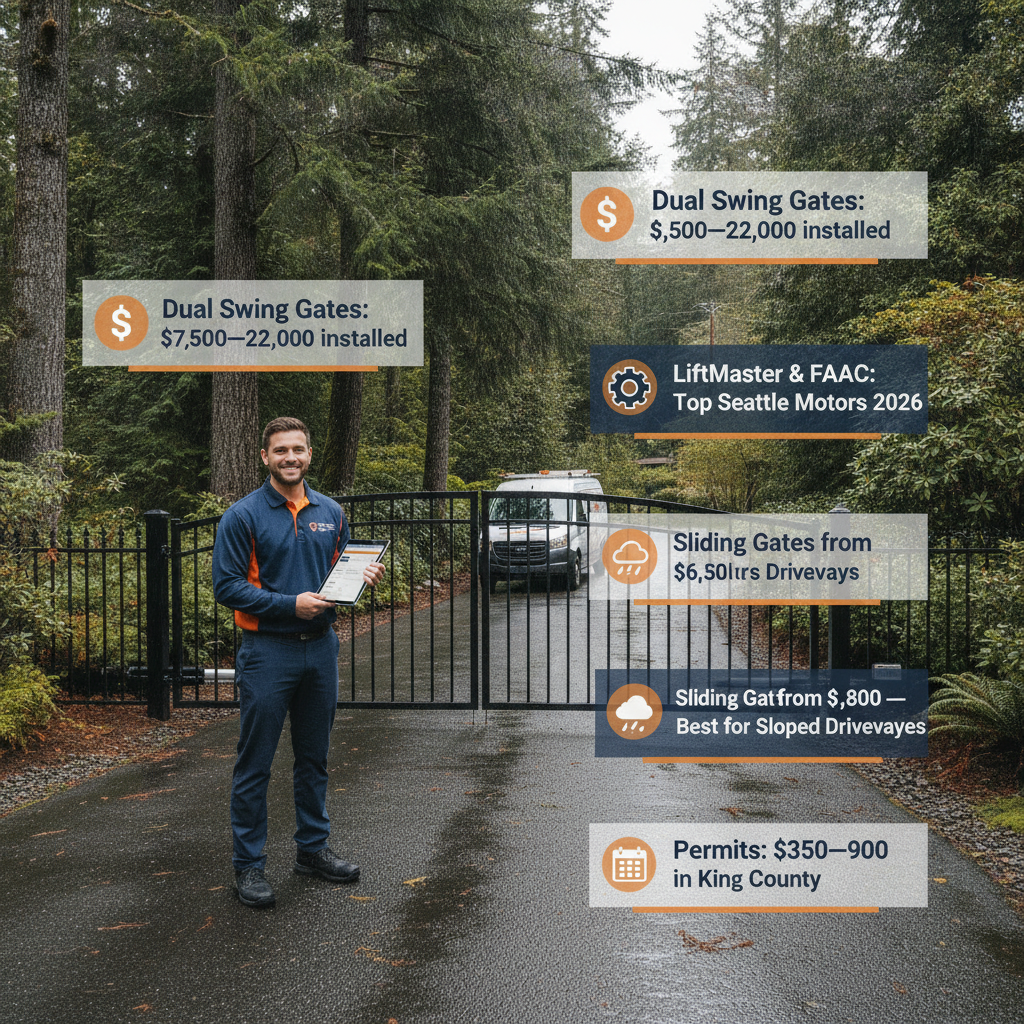
- Entry-level automatic gate systems in Seattle start around $3,800 installed for a basic single-swing aluminum gate with a LiftMaster LA400 opener.
- Mid-range residential projects run $7,500–$14,000 covering dual swing or single slide steel gates with intercom, keypad, and conduit work.
- High-end estate and HOA installations reach $25,000–$60,000+ for bi-parting slide gates, ornamental iron, underground wiring, and multi-user access control.
- Seattle's clay-heavy soils (common in Bellevue, Mercer Island, and Kirkland) add $800–$2,400 to concrete footer and post work compared to sandy lots.
- Permit fees in Seattle and King County run $180–$480 and are required for gates over 6 ft or any gate on a shared-access easement.
- Labor rates in the Seattle metro average $95–$145/hour in 2026, roughly 18–24% higher than the Portland metro due to local wage ordinances.
- Corrosion-resistant finishes (powder coat or hot-dip galvanizing) add $400–$1,100 but are strongly recommended given Seattle's 150+ rainy days per year.
- Most residential electric gate projects in Seattle complete in 3–8 weeks from signed contract to first open, including permit lead time.
You searched 'how much does an automatic gate cost in Seattle,' or maybe 'electric gate installation price Seattle 2026,' or 'what does a driveway gate system actually cost near Bellevue.' You are not alone. Automatic gate pricing is genuinely confusing because the range is enormous — a $4,000 project and a $40,000 project can both be called 'an automatic gate.' This post breaks down every real cost driver so you know exactly what you are paying for before anyone shows up with a quote pad.
How Much Does Automatic Gate Installation Cost in Seattle in 2026?
The honest answer is: $3,800 to $60,000+, and that wide range is not a cop-out — it reflects genuinely different projects. Here is a realistic cost ladder for Seattle-area residential and light-commercial installations in 2026:
- Tier 1 — Basic single swing, aluminum, no intercom: $3,800–$6,500. This covers a powder-coated aluminum swing gate up to 14 ft wide, a LiftMaster LA400 or FAAC 402 opener, one keypad, and a standard loop detector. Common in Auburn, Lakewood, and Lynnwood neighborhoods with flat driveways and clear post placement.
- Tier 2 — Dual swing or single slide, steel, keypad + intercom: $7,500–$14,000. Adds a video intercom (Aiphone or DoorBird), a second opener, conduit runs of 40–80 ft, and a battery backup module. Typical for Bellevue and Gig Harbor homes on half-acre lots.
- Tier 3 — Ornamental iron, bi-parting slide, full access control: $14,000–$28,000. Custom-welded wrought iron or heavy-gauge steel, FAAC 844 or Viking SL-2000 slide operator, app-based access (Doorbird + Linear MDKVP2), underground conduit, and a dedicated 20-amp circuit. Seen frequently in Medina, Clyde Hill, and upper Mercer Island.
- Tier 4 — Estate and HOA systems: $28,000–$60,000+. Includes vehicular-rated crash bollards, full telephone-entry systems (Liftmaster CAPXL), fiber conduit, multiple vehicle loops, pedestrian gates, UPS power backup, and annual maintenance agreements. Common for gated communities in Snohomish County and South Tacoma industrial corridors.
What Drives the Price Up (or Down) for Seattle Gate Projects?
Every automatic gate quote has the same five buckets: gate panel, operator, access control, electrical/conduit, and labor. Seattle adds a sixth bucket that many out-of-state quote tools miss: site-specific soil and terrain work.
- Gate panel material and width: Aluminum panels for a 16-ft opening run $900–$2,200. The same opening in ornamental steel costs $2,400–$5,500. Custom wrought iron starts at $4,800 for a 16-ft span and can exceed $12,000 for arched or decorative designs. Width matters too: every additional foot of gate adds roughly $80–$180 in panel cost and increases the torque requirement of the operator.
- Operator brand and duty cycle: LiftMaster LA400 (residential, 500 cycles/day) lists at $680–$820 per unit in 2026. FAAC 844 (medium commercial, 800 cycles/day) runs $1,100–$1,450. Viking SL-2000 (high-cycle commercial slide, 1,200 cycles/day) lands at $1,600–$2,100. For HOAs with 200+ daily uses, under-specifying the operator is the single most expensive mistake a board can make — expect a motor replacement in 18–30 months instead of 10–15 years.
- Access control complexity: A basic keypad (LiftMaster 387LM) adds $180–$280 installed. A video intercom with cloud storage and app unlock (DoorBird D2101V) adds $620–$950. A full telephone-entry system with 200-user capacity (Linear MDKVP2 or Liftmaster CAPXL) runs $1,400–$3,200 installed, not counting monthly cloud fees of $15–$45/month.
- Electrical and conduit runs: Seattle permit code requires conduit for any buried gate wiring. A standard 50-ft underground conduit run (trenching, 1-inch PVC, pull wire, backfill) costs $12–$22 per linear foot installed. A 100-ft run in rocky soil near Gig Harbor or Snohomish can hit $28–$38/ft. If your panel box needs a new 20-amp breaker and dedicated circuit, add $380–$680.
- Soil conditions and footings: Seattle's glacially deposited soils vary dramatically. Sandy loam in Auburn and Lakewood makes post setting straightforward — a standard 18-inch-diameter by 36-inch-deep concrete footer runs $280–$420 per post. Clay-heavy expansive soils in Bellevue, Kirkland, and Mercer Island require wider, deeper footings (24 inches by 48 inches) and sometimes helical pier anchors, pushing per-post costs to $700–$1,400. Always ask your installer if they have pulled permits in your specific zip code — soil surprises after breaking ground are where budgets blow.
- Slope and grade: Swing gates require a relatively level driveway arc. If your driveway slopes more than 3 inches over the gate's swing radius, you will need either a slide gate (which is flat-track compatible) or grade correction work ($600–$2,800). Neighborhoods like Capitol Hill, Queen Anne, and parts of Tacoma's North End are notorious for this issue. Slide gates on steep cross-slopes need a concrete sill or recessed track, adding $800–$1,600.
Pro Tip: Always request a line-item quote that separates panel cost, operator cost, access control, electrical, and labor. A single lump-sum number makes it impossible to compare bids or understand where value is. Reputable installers in the Seattle market will always break it down.
How Much Do Permits Cost for Automatic Gates in Seattle?
In Seattle proper, a gate permit (filed under 'fence/gate — residential') costs a flat $185–$280 for most residential projects in 2026. King County unincorporated areas run $220–$380. Bellevue and Kirkland are known for slightly higher review fees — expect $280–$480 if your gate touches a shared easement or HOA common area boundary. Tacoma's permit office currently processes gate permits in 10–18 business days for standard residential projects. Snohomish County can run 3–5 weeks if a geotechnical review is triggered by steep slopes or critical area buffers.
Permits are required in all Seattle-area jurisdictions when the gate exceeds 6 ft in height, is installed on a corner lot with sight-line rules, is electrified (which covers virtually every automatic gate), or is on a shared driveway easement. Skipping permits risks a stop-work order, a forced removal, and liability exposure if the gate is ever involved in a safety incident. See our Seattle service area page and Bellevue service page for jurisdiction-specific notes.
Which Automatic Gate Opener Brands Are Best for Seattle's Climate?
Seattle averages 152 rainy days per year and temperatures that hover between 35°F and 82°F with rare hard freezes. The real enemy here is not cold — it is sustained moisture, salt air near Puget Sound, and moss-building humidity. Here is how the major brands hold up in 2026:
- LiftMaster (Chamberlain Group): The most-installed brand in the Seattle residential market. The LA400 (swing) and CSL24UL (slide) are proven performers in damp climates. Sealed motor housings and 24V DC operation make them reliable through Seattle winters. Warranty: 5 years on motor, 1 year on board. Parts widely stocked locally, meaning typical repair turnaround is 1–3 days.
- FAAC (Italian, distributed by GTO/Pro): Preferred for heavier gates (300–500 lbs per leaf). The 844 slide and 400 series swing operators use hydraulic actuators that handle moisture well. Slightly higher upfront cost ($200–$400 more than comparable LiftMaster) but exceptional longevity — 12–18 years in Seattle climates with annual service. Popular on Mercer Island and Gig Harbor estate properties.
- Viking Access Systems: Strong choice for commercial and HOA slide gates (VG-2 and SL-2000 models). Steel gear trains and NEMA 4X rated enclosures hold up well in marine-exposure zones around the Sound. Service network is thinner than LiftMaster — confirm your installer stocks Viking parts before committing.
- Apollo (Nice Group): Budget-friendly swing operators ($520–$750/unit). Acceptable for low-cycle residential use (under 20 cycles/day). Plastic gear components are a known weak point in sustained wet conditions — plan for a full replacement at 6–9 years rather than 10–15.
- Elite (Elite Access Systems): Mid-market slide operator popular for single-family homes with 14–20 ft openings. The 1500 series handles up to 1,000 lbs and 500 cycles/day. Good corrosion resistance with proper conduit sealing.
Pro Tip: For properties within a half-mile of Puget Sound — including West Seattle, Gig Harbor waterfront, and Tacoma's Point Defiance area — specify stainless hardware for all exposed fasteners and hinges. Standard zinc-plated hardware can show rust within 18 months in salt-air proximity, voiding some manufacturer warranties on the gate panel itself.
What Does a Complete Automatic Gate Quote Include in Seattle?
A complete, professional quote from a Seattle-area gate company should itemize: site assessment fee (often credited toward installation), gate panel fabrication or supply, operator unit(s), access control hardware, underground conduit and electrical, concrete footing work, permit application (often handled by the installer for a $75–$150 filing fee), and a commissioning/testing visit. It should also state the warranty separately for parts and labor — look for a minimum of 12 months labor and 3–5 years parts. Review real completed projects in our project portfolio and customer reviews to calibrate what a well-executed Seattle installation looks like.
How Do HOA and Commercial Gate Costs Differ from Residential in Seattle?
HOA and commercial gates in the Seattle area involve several cost layers that residential projects do not. First, the gate itself is typically wider — 20–28 ft bi-parting slide configurations are standard for community entrances, pushing panel costs to $8,000–$18,000 before any operator. Second, telephone-entry systems with 100–500 user capacity (Liftmaster CAPXL or Linear series) run $3,500–$9,000 installed. Third, vehicle loop detectors (typically two — one for entry, one for exit with anti-tailgate logic) add $1,200–$2,800. Fourth, commercial-grade operators (FAAC 844 or Viking SL-2000) specified for 800–1,200 cycles/day run $1,600–$3,200 per unit. A fully equipped HOA entry system in Snohomish County or South King County typically lands between $22,000 and $55,000 total. Visit our HOA and commercial gate page for a full breakdown of what community associations need to budget. If you manage a community in Tacoma or Everett, local setback and fire-department access rules will also affect your gate width and break-away specifications.
In One Minute: Automatic Gate Installation Cost in Seattle 2026
- Basic single-swing aluminum system: $3,800–$6,500
- Mid-range dual swing or slide with intercom: $7,500–$14,000
- Ornamental iron or heavy steel with full access control: $14,000–$28,000
- HOA or estate-level system: $28,000–$60,000+
- Clay soil footings add: $800–$2,400
- Permits: $185–$480 depending on jurisdiction
- Labor rate: $95–$145/hour
- Best all-climate operators: LiftMaster, FAAC, Viking
- Completion timeline: 3–8 weeks from signed contract
Want to visualize gate styles before you commit to a budget? Use our interactive gate designer tool to see how different materials, heights, and styles look on a property like yours.
Frequently Asked Questions: Automatic Gate Costs in Seattle 2026
Do automatic gate installers in Seattle charge for site assessments?
Most reputable installers in the Seattle market charge a site assessment fee of $75–$150, which is typically credited back to your project cost if you move forward. The assessment covers soil type, slope measurement, electrical panel access, conduit routing, and permit jurisdiction confirmation. Skipping this step and getting a phone quote often leads to significant change orders once work begins — especially in hill neighborhoods or clay-soil zones in Bellevue and Kirkland.
Is a $4,000 automatic gate quote realistic in Seattle in 2026?
Yes, but only for a very specific scope: a single-panel aluminum swing gate under 12 ft wide, a basic LiftMaster or Apollo swing operator, one keypad, no intercom, no underground conduit run longer than 20 ft, and a straightforward flat driveway with easy post placement. Add any of those features and the price rises quickly. If a quote at that price level includes a video intercom, steel gate, or significant conduit work, verify carefully what is being omitted.
How long does an automatic gate installation take in Seattle?
From signed contract to first open, most residential projects in the Seattle metro take 3–8 weeks in 2026. The biggest variable is permit turnaround: Seattle proper runs 10–18 business days, Snohomish County can hit 5 weeks for complex sites. Custom-fabricated iron or steel gates add 2–4 weeks of shop time on top of the permit clock. Budget-grade projects using in-stock aluminum panels can occasionally complete in under 3 weeks if permits move quickly.
What maintenance costs should I budget for after installation?
Annual professional service on a Seattle-area automatic gate runs $185–$380 for a single-operator residential system, covering lubrication of drive gears and hinges, loop detector testing, battery backup check, and safety sensor calibration. HOA systems with multiple operators typically run $450–$950/year on a maintenance contract. The biggest ongoing cost risk is skipped lubrication on a slide gate's drive chain or rack-and-pinion — that one neglected item is responsible for roughly 40% of operator motor failures in the Pacific Northwest market.
Can I install an automatic gate myself in Seattle to save money?
Technically possible for the gate panel portion, but not recommended for the operator, electrical, or access control components. Seattle and King County require a licensed electrical contractor for any 120V wiring to the operator, and permits must be pulled by a licensed contractor in most jurisdictions. DIY gate panel setting without proper footings also voids most operator warranties and creates liability under Washington state property code if the gate causes an injury. The labor savings rarely exceed $800–$1,500 and the permitting and warranty risks are substantial.
Does the size of my driveway opening significantly change the cost?
Yes, meaningfully. A 12-ft single-swing opening uses one operator. A 20-ft opening typically requires either a slide gate (one operator, longer track) or bi-parting swing (two operators). Every 4 ft of additional gate width adds roughly $300–$700 in panel cost and may require upgrading to a higher-torque operator ($200–$600 more). For openings over 24 ft, slide gates almost always become the more cost-effective choice because the per-linear-foot panel cost is lower and a single commercial slide operator handles the full span.
If you are ready to move from research to an actual number for your property, our team covers the full Seattle metro — from Gig Harbor to Lynnwood. We will walk your site, confirm your permit jurisdiction, and give you a line-item quote with no pressure and no surprises. Reach out here to get started.