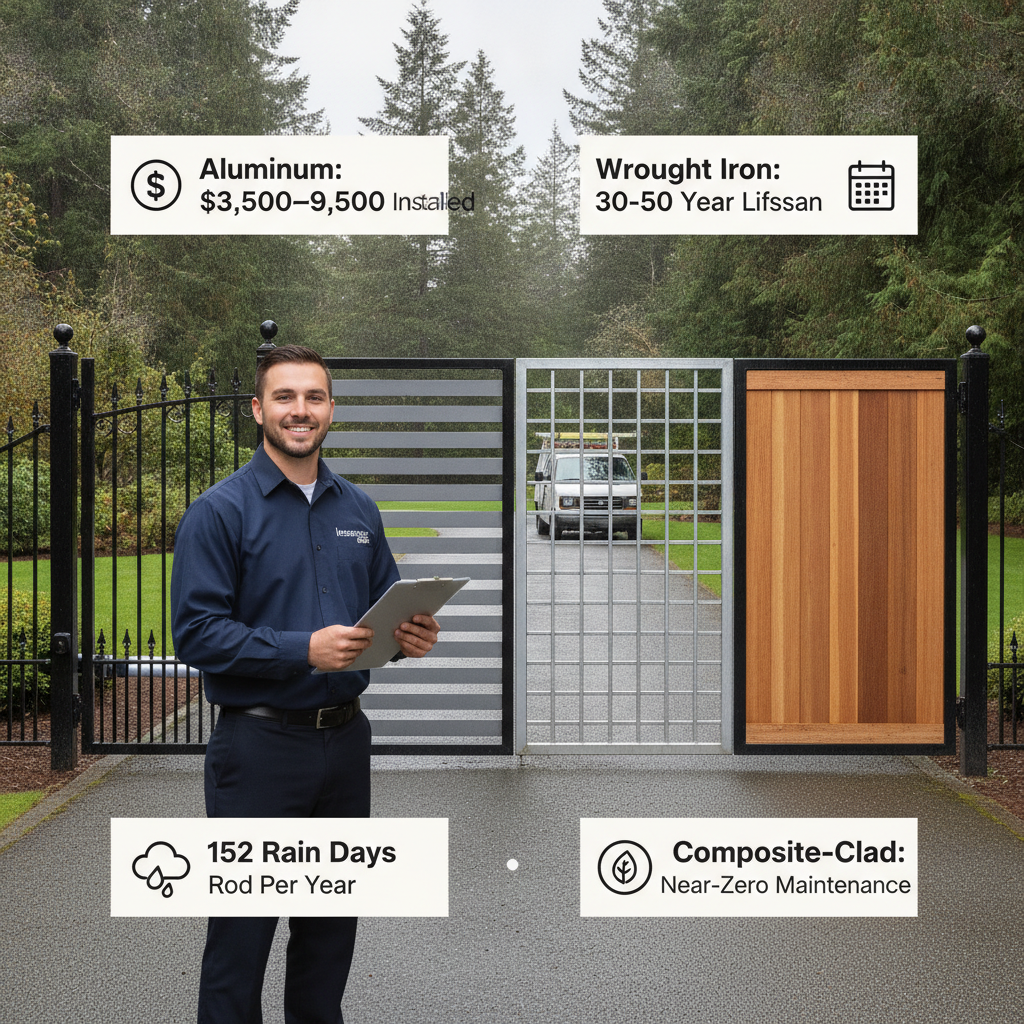
- Wrought iron gates last 30–50 years in Seattle but require annual rust-prevention treatment due to 150+ rain days per year.
- Aluminum is the fastest-growing choice in Seattle neighborhoods — it never rusts, weighs 60% less than steel, and costs $3,500–$8,500 installed.
- Galvanized or powder-coated steel is the strongest option for high-traffic driveways but needs re-coating every 5–8 years in Puget Sound salt air.
- Cedar and redwood gates look stunning in Bellevue and Gig Harbor but require sealing every 1–2 years and rarely last past 15–20 years without serious upkeep.
- Composite wood-look gates ($5,000–$11,000 installed) are gaining traction in 2026 — they mimic cedar grain but need virtually zero weather maintenance.
- Aluminum swing gates for a standard 12-ft residential driveway run $3,500–$6,000 installed; steel runs $4,500–$9,000; wrought iron $5,500–$12,000.
- Salt air in West Seattle, Magnolia, and waterfront Tacoma lots accelerates corrosion on bare steel and iron by 2–3x compared to inland Kirkland or Snohomish lots.
- Most Seattle-area installers recommend aluminum or galvanized steel for automatic gates because lower weight means less motor strain and longer opener lifespan.
What Material Should My Electric Gate Be Made Of in Seattle?
If you've typed something like 'best electric gate material Seattle,' 'will a wrought iron gate rust in Seattle rain,' or 'wood gate vs aluminum gate Pacific Northwest' into Google, you're already asking exactly the right question. Gate material isn't just an aesthetic choice — in a climate with 37–38 inches of annual rainfall, persistent marine humidity, and salt air rolling off Puget Sound, your material choice determines how long the gate lasts, how often it needs service, and how hard your opener motor has to work every single day.
This guide breaks down every major material option — wrought iron, aluminum, mild steel, galvanized/powder-coated steel, raw wood, and composite — through the specific lens of Seattle-area weather, neighborhoods, lot types, and 2026 pricing. By the end, you'll know exactly which material makes sense for your property.
How Does Seattle's Climate Actually Damage Electric Gates?
Seattle averages 152 rain days per year. Add marine air off Elliott Bay and Puget Sound, winter temperatures that hover between 35–45°F (perfect for freeze-thaw cycling in fasteners and welds), and summer humidity that rarely drops below 60% even on sunny days, and you have one of the most demanding gate climates in the continental U.S. — not because of extremes, but because of relentless, low-grade moisture exposure.
The specific failure modes by material: bare iron and steel oxidize at the weld points and bottom rail first, where water pools. Wood absorbs moisture, swells, warps, and eventually rots at the post pocket and bottom pickets. Even aluminum — which doesn't rust — develops white oxidation on untreated surfaces and can corrode at dissimilar-metal contact points (e.g., stainless fasteners in an aluminum frame).
Neighborhoods closest to the water — West Seattle, Magnolia, Ballard, Gig Harbor waterfront, Tacoma's Point Defiance corridor — face the additional challenge of salt-laden air, which strips protective coatings faster. Inland areas like Snohomish, Lynnwood, and Auburn are less aggressive but still see the same rain-day count.
Wrought Iron Electric Gates in Seattle: Pros, Cons & Real Costs in 2026
Wrought iron is the classic choice for estates, traditional homes, and properties where curb appeal and security carry equal weight. A properly fabricated wrought iron gate is essentially a custom piece of metalwork — dense, heavy, and extremely strong. For Seattle properties in neighborhoods like Medina, Mercer Island, or Bellevue's West Lake Sammamish corridor, the aesthetic fits perfectly.
What it costs in 2026: A single-swing wrought iron gate for a 10–14 ft residential driveway runs $5,500–$12,000 installed, depending on design complexity (flat top rail vs. spear-top pickets, scrollwork, custom finials). A dual-swing gate for a 16–20 ft opening will push $9,000–$18,000. Sliding wrought iron gates cost more due to the additional track hardware and heavier motor requirements.
Climate performance: Wrought iron is dense and slow to corrode — but it will corrode in Seattle without maintenance. Bare iron left untreated will show surface rust within 12–18 months near Puget Sound. The standard of care is a hot-dip galvanized base coat plus a high-quality powder coat finish applied at the fabrication stage, followed by annual touch-ups to any chips or scratches. With that regimen, a wrought iron gate realistically lasts 30–50 years in the Pacific Northwest.
Motor implications: Wrought iron is heavy — a 14 ft dual-leaf gate can weigh 400–700 lbs total. This demands a commercial-duty or heavy-duty residential opener. For swing gates, most Seattle installers specify a LiftMaster LA500 or FAAC 391 paired with wrought iron; under-spec'd motors burn out in 3–5 years instead of 10–15. Heavier gates also mean heavier wear on hinges, which need quarterly lubrication in wet climates.
Best for: High-end residential properties in Bellevue, Medina, Mercer Island, Gig Harbor, and Tacoma's Stadium District. Properties where aesthetics and longevity justify a higher upfront cost and an ongoing maintenance commitment.
Aluminum Electric Gates in Seattle: Why They're Dominating in 2026
Aluminum has quietly become the dominant material for new residential electric gate installations in the Seattle metro in 2025–2026, and for good reason. It never rusts (aluminum forms a stable oxide layer instead of flaking rust), it weighs roughly 60% less than steel at the same profile size, and modern powder-coat finishes make it visually indistinguishable from steel or iron to most observers.
What it costs in 2026: A standard aluminum swing gate for a 12-ft driveway runs $3,500–$6,000 installed. A 16–18 ft dual-swing aluminum gate is typically $5,500–$9,500. Sliding aluminum gates for a 14–16 ft opening: $4,500–$8,500. These prices include the opener — typically a LiftMaster LA400, Apollo 1550, or FAAC 740 for sliding gates.
Climate performance: Aluminum is the lowest-maintenance metal gate option in the Pacific Northwest. It requires no annual rust treatment. The powder coat may need touch-up every 8–12 years. At dissimilar-metal contact points (e.g., where aluminum frame meets steel hinge bolts), apply an anti-corrosion compound like Loctite LB 8008 at installation to prevent galvanic corrosion — a step good installers do automatically.
Motor implications: Because aluminum is light, even mid-range residential openers handle it comfortably. A LiftMaster LA400 or Viking SL-1000 sliding gate opener will cycle an aluminum gate 50–100 times per day without strain. This translates directly to longer motor life — 12–18 years vs. the 8–12 you might see with the same opener on a heavier iron gate.
Best for: The vast majority of Seattle-area residential properties — Kirkland, Lynnwood, Auburn, Everett, most of Bellevue's newer developments, and inland Snohomish County lots. Also the go-to for HOAs and multi-family properties that need durability with minimal maintenance costs. See our Lynnwood service area or Auburn gate installations for local examples.
Pro Tip: Ask your installer specifically for 6063-T5 or 6061-T6 aluminum alloy, not the thinner 6063-T1 used in budget imports. The T5/T6 temper designations mean the aluminum has been heat-treated for higher tensile strength — critical for a gate that opens and closes 20,000+ times per year.
Steel Electric Gates in Seattle: Strength vs. Maintenance Trade-Off
Mild steel and galvanized steel gates occupy the middle ground — stronger than aluminum, less expensive than wrought iron, but more demanding in terms of Pacific Northwest maintenance. Steel gates are common for commercial properties, industrial lots in SoDo or the Tacoma tideflats, and high-security residential applications where gate weight itself is a deterrent.
What it costs in 2026: A galvanized and powder-coated steel swing gate for a 12-ft driveway runs $4,500–$9,000 installed. Sliding steel gates for 14–20 ft openings: $5,500–$11,500. Commercial-grade steel cantilever sliding gates for wide industrial openings (20–40 ft): $12,000–$28,000.
Climate performance: Bare mild steel in Seattle is a maintenance nightmare — surface rust appears within 6–12 months. The professional answer is hot-dip galvanization (zinc coating applied by immersion) plus a thermally bonded powder coat. That two-layer system gives you 15–25 years of solid protection, but chips and scratches must be touched up promptly — moisture wicks under the coating and causes rust blister. Realistically, budget for a full re-coat every 7–10 years in Seattle's climate.
Best for: Commercial properties, HOA vehicle entry gates needing a heavier crash deterrent, and high-security residential properties where appearance is secondary to strength. For residential, most homeowners find aluminum gives 90% of the security benefit at half the maintenance cost.
Wood Electric Gates in Seattle: Beautiful but Demanding
Wood gates — typically Western Red Cedar, Redwood, or Douglas Fir — are a popular aesthetic choice in neighborhoods like Queen Anne, Capitol Hill, Phinney Ridge, and the craftsman-heavy blocks of Tacoma's North End. They complement natural landscaping, wooden fences, and cottage-style architecture beautifully. But Seattle's climate makes wood gates a high-maintenance commitment.
What it costs in 2026: A custom cedar swing gate for a 10–12 ft residential driveway runs $3,800–$7,500 installed (cedar or redwood). Douglas fir is slightly cheaper at $3,200–$6,500. Composite wood-look gates (aluminum or steel frame with composite cladding) run $5,000–$11,000 but need far less upkeep.
Climate performance: Untreated cedar in Seattle will begin to show weathering — gray surface oxidation, minor cracking — within one season. Properly sealed cedar with a penetrating oil finish (Penofin or similar) every 12–18 months will look good for 10–15 years. Post pockets (where the gate meets the hinge post or ground) are the highest-failure zone — water pools there, wood rots, and the gate loses structural integrity. Expected lifespan with diligent maintenance: 15–20 years. Without it: 7–10 years.
Motor implications: Wood is heavy and swells in wet weather, increasing load on the opener. Use a heavy-duty operator and ensure the gate is properly sealed before connecting the opener — a swollen gate in January can trip a safety reversal and confuse a homeowner into thinking the opener is broken.
Best for: Homeowners who value natural aesthetics and are genuinely committed to annual maintenance. For those who want the wood look with minimal upkeep, composite cladding on an aluminum frame is the 2026 upgrade path.
Pro Tip: If you love the look of cedar but hate the maintenance, ask your installer about composite-clad aluminum gates. Brands like Trex Fencing and Fiberon supply composite materials that fasten to aluminum frames — they look like real cedar at 10 feet but are essentially maintenance-free in Pacific Northwest weather.
What About Composite and Vinyl Gates in Seattle?
Vinyl (PVC) gates are common in warmer, drier climates but perform poorly in Seattle. They become brittle in sustained cold, fade under UV, and don't handle the structural stress of motorized operation well. Most Seattle installers actively steer clients away from vinyl for automatic gate applications.
Composite-clad gates (aluminum or steel structural frame + composite wood-look cladding) are a different story and are growing fast in 2026. They offer the aesthetic of wood with the structural integrity of metal and no rust or rot. Cost: $5,000–$11,000 for a residential swing gate. Maintenance: wipe-clean, no sealing, no rust treatment. Lifespan: 25–35 years. For Seattle properties, this is increasingly the best-of-both-worlds answer. Check out the Interactive Gates design visualizer to see composite and aluminum styles side-by-side.
Side-by-Side Comparison: Which Gate Material Is Right for Your Seattle Property?
- Wrought Iron: Cost $5,500–$18,000 | Lifespan 30–50 yrs | Maintenance High | Best for: Estate properties, Medina, Mercer Island
- Aluminum: Cost $3,500–$9,500 | Lifespan 25–40 yrs | Maintenance Low | Best for: Most residential properties across the Seattle metro
- Galvanized Steel: Cost $4,500–$11,500 | Lifespan 20–35 yrs | Maintenance Medium | Best for: Commercial, high-security residential
- Cedar/Redwood Wood: Cost $3,200–$7,500 | Lifespan 15–20 yrs | Maintenance High | Best for: Craftsman homes with committed maintenance plans
- Composite-Clad: Cost $5,000–$11,000 | Lifespan 25–35 yrs | Maintenance Very Low | Best for: Homeowners who want wood aesthetics with zero upkeep
Does Gate Material Affect Which Opener or Motor I Need?
Yes — significantly. Gate weight is the primary variable that determines motor sizing. As a rough rule: aluminum swing gates under 300 lbs per leaf can use mid-range residential openers ($350–$650 per operator). Steel and iron gates over 400 lbs per leaf require commercial-duty operators ($600–$1,200 per operator). Oversizing slightly is cheap insurance — a LiftMaster LA500 on an aluminum gate will last longer than the same gate paired with an LA400 at maximum capacity.
For sliding gates, weight matters even more — the motor must pull the gate along a track, and heavier gates wear track hardware and drive systems faster. If you're on a waterfront lot in West Seattle, Gig Harbor, or Tacoma, ask your installer specifically about corrosion-resistant track hardware (stainless or galvanized steel) regardless of what your gate itself is made of. See our Gig Harbor service page and Tacoma service page for location-specific notes.
In One Minute: Electric Gate Materials in Seattle 2026
Aluminum is the best all-around choice for most Seattle homeowners in 2026 — it doesn't rust, is easy on motors, and costs $3,500–$9,500 installed. Wrought iron is the premium pick for estate properties but requires annual rust prevention and heavier openers. Galvanized steel is best for commercial or high-security needs. Cedar wood looks great but needs sealing every 1–2 years and lasts 15–20 years at best. Composite-clad gates are the fastest-growing 2026 category — wood look, metal durability, virtually no maintenance. Salt air near Puget Sound accelerates corrosion on all metals; inland lots get more forgiveness. Whatever you choose, pair it with a correctly sized opener and have it serviced annually.
Frequently Asked Questions: Electric Gate Materials in Seattle
Will a wrought iron gate rust in Seattle's rain?
Yes, if it isn't properly protected. Bare wrought iron will show surface rust within 12–18 months near Puget Sound. The standard solution is hot-dip galvanization plus a high-quality powder coat applied at fabrication, followed by annual touch-ups to any chips. With that regimen, a wrought iron gate realistically lasts 30–50 years in the Pacific Northwest. Without it, you'll be dealing with rust blistering within 3–5 years.
Is aluminum strong enough for a security gate?
For residential and most commercial purposes, yes. Modern 6061-T6 or 6063-T5 aluminum alloy in the 1.5–2 inch wall thickness used for gate frames is extremely strong — far more than needed to deter casual trespassers. It won't stop a vehicle the way a heavy steel crash-rated barrier would, but for residential access control it's completely adequate and is used by the vast majority of Seattle-area installers in 2026.
How often does a wood gate need maintenance in Seattle?
A cedar or redwood gate in Seattle needs a penetrating oil sealant (like Penofin) every 12–18 months to prevent weathering, cracking, and rot. Post pockets and bottom rails should be inspected every spring for early rot signs. Budget 2–4 hours of maintenance labor per year plus $80–$150 in sealant. Without this, a wood gate will look rough in 3–5 years and structurally fail within 7–10 years in Seattle's climate.
What gate material is best for a waterfront lot in West Seattle or Gig Harbor?
Aluminum with a quality powder coat is the top recommendation for waterfront Seattle-area properties. Salt-laden marine air accelerates rust on steel and iron by 2–3x compared to inland lots. If you prefer the look of iron or steel, insist on hot-dip galvanization plus powder coat, and plan for more frequent touch-ups — every 3–5 years rather than 7–10. Composite-clad gates are also excellent for waterfront properties for the same reason: no corrosion risk.
Does gate material affect my homeowner's insurance or HOA approval?
Not directly from an insurance standpoint, though some insurers offer minor premium discounts for security gate installations regardless of material. For HOA approval, the material often matters a great deal — many HOA CC&Rs in Bellevue, Kirkland, and Snohomish County specify allowable materials and colors. Always check your HOA guidelines before ordering. Our team has experience navigating HOA approvals across the Seattle metro; see our HOA gate page for details.
Can I see gate material and style options before committing to an installation?
Yes. Interactive Gates offers an online design visualizer where you can toggle between aluminum, steel, iron, and composite-look styles and see how they'd look at your property. It's a useful first step before scheduling an in-person consultation. You can explore it at visualizer.interactivegates.com. For a quote tailored to your specific lot, driveway width, and neighborhood, visit our contact page or browse residential gate options.
Ready to Choose the Right Gate Material for Your Seattle Property?
The best gate material for your property depends on your budget, how much maintenance you're willing to do, your neighborhood's aesthetic, and how close you are to Puget Sound. If you want a straightforward answer for most Seattle homeowners: aluminum is the smart default in 2026. If you're on a waterfront lot or high-end estate, wrought iron or composite-clad is worth the investment. If you're not sure, the Interactive Gates team has installed hundreds of gates across Seattle, Bellevue, Everett, Tacoma, and beyond — and can walk you through what actually holds up at your specific address. Browse our project portfolio for real local examples, then reach out whenever you're ready to talk numbers.
FAQs