- HOA entry gate projects in Los Angeles run $18,000–$95,000+ depending on gate type, access control, and number of entry lanes.
- Dual-swing and sliding cantilever gates are the two most common HOA formats in Southern California; cantilever wins on slopes and beach-adjacent lots.
- LiftMaster LA500 and FAAC 844 ER are the workhorses for high-cycle HOA swing gates; plan for 500,000–1,000,000 cycles over the system's life.
- Telephone entry, keypad, card/fob, and license-plate recognition (LPR) are the four main access tiers — most mid-size HOAs layer two or three.
- Los Angeles County and city building departments require a permit for any motorized gate over 30 inches wide; plan 3–8 weeks for approval.
- Annual maintenance contracts for HOA gates average $900–$2,400 per entry point; skip them and repair bills spike 3–5× within two years.
- Salt air in coastal communities (Laguna Beach, San Clemente, Rancho Palos Verdes) demands marine-grade hardware and 316 stainless fasteners — budget 15–20% more upfront.
- Fire-department Knox Box or Opticom strobes are required on all gated communities in most LA-area jurisdictions — factor $400–$1,200 per gate into the budget.
What Does an HOA Gate System Actually Cost in Los Angeles in 2026?
Search volume for 'HOA gate cost Los Angeles' has climbed every quarter since 2024, and for good reason: construction costs, labor rates, and smart-access hardware have all moved. If your board is working from a quote you received in 2024 or earlier, throw it out. Here is what communities are actually paying in 2026.
The single biggest variable is not the gate itself — it is the access control stack layered on top of it. A basic sliding gate with a keypad costs a fraction of a full license-plate-recognition system with video intercom and cloud management. Below, we break both ends of the spectrum.
Gate Hardware & Operator Costs (2026 Ranges)
- Single-arm swing gate (up to 16 ft), residential-HOA grade: $4,500–$9,000 installed (operator + ironwork)
- Dual-swing gate pair (two 10–14 ft leaves): $9,000–$18,000 installed
- Cantilever sliding gate (20–30 ft opening): $12,000–$28,000 installed
- V-track sliding gate (same opening, flatter lot): $9,500–$22,000 installed
- Bi-fold speed gate (high-traffic commercial HOA): $22,000–$55,000 installed
- Vehicle crash-rated bollard array (Class K4): $30,000–$70,000 installed
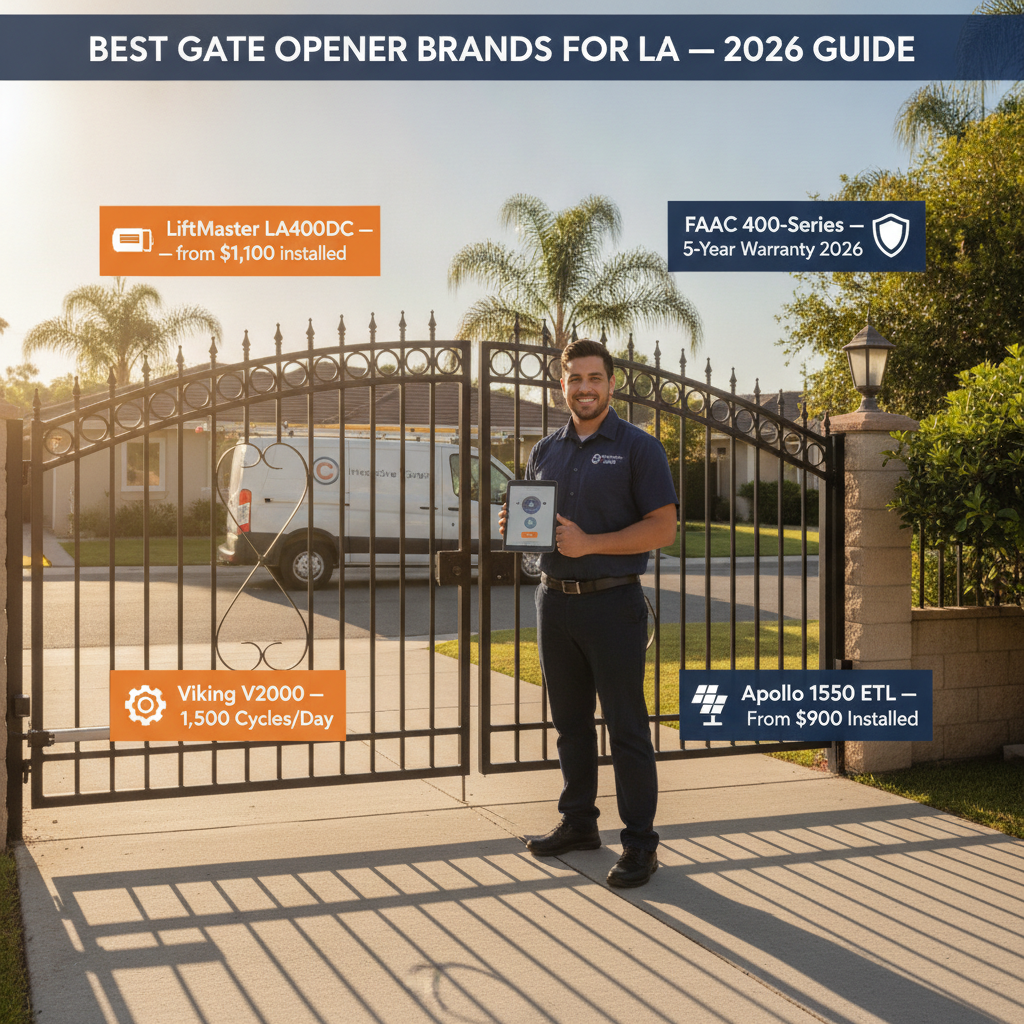
Operator brands dominating the LA-area HOA market in 2026: LiftMaster LA500 / LA400 (swing, 500,000-cycle rating), FAAC 844 ER (swing, hydraulic, marine-grade option), LiftMaster CSW200 / CSL24U (slide, 1,000,000-cycle rating), and Viking Access G40 (slide, popular with mid-size HOAs in the Inland Empire and Orange County). For very high-volume entries — think 300+ homes — FAAC 740 or HySecurity SlideDriver are the go-to operators.
Pro Tip: Cycle count matters more than any other spec for HOA gates. A 200-home community with two entries generates roughly 400–800 gate cycles per day. At 600 cycles/day, a 500,000-cycle operator hits its rated life in under three years. Spec a 1,000,000-cycle unit or a hydraulic operator from the start and you will not be replacing hardware every 30 months.
What Access Control System Does an LA-Area HOA Actually Need?
This is where board members spend the most time debating — and where overspending or under-specifying is most common. The right answer depends on community size, resident demographics, and how many vendors, delivery drivers, and guests enter per day.
Tier 1 — Keypad-Only Entry
Best for: smaller communities (under 60 homes), secondary exits, or pedestrian gates. A DoorKing 1506 or LiftMaster KPW250 keypad runs $350–$650 for the hardware, $200–$400 to install. Codes can be changed remotely. Downside: codes get shared, and there is no audit trail. This tier is essentially obsolete for primary HOA entries in Los Angeles in 2026.
Tier 2 — Telephone Entry / Video Intercom
The standard for most California HOAs. A cloud-managed video intercom like the ButterflyMX or DoorKing 1837 runs $1,800–$4,500 per entry point for hardware, plus $600–$1,200 for installation. Residents get a smartphone app; guests buzz in from a camera kiosk. Monthly cloud fees: $30–$80/month per entry. This is the minimum meaningful access system for a primary HOA gate in 2026.
Tier 3 — Key Fob / Prox Card + Intercom
Adds a card reader alongside the intercom so residents do not have to use their phone every time. HID Global or Allegion card readers cost $400–$900 each. Fob issuance runs $8–$25 per resident fob. For a 150-home community, budget $3,000–$6,000 for the full credential rollout. This is the most popular combination in gated communities across Orange, Rolling Hills Estates, and the San Fernando Valley.
Tier 4 — License Plate Recognition (LPR)
LPR cameras read resident plates and open the gate with zero resident interaction — no fob, no app tap. Hardware: $3,500–$8,000 per lane (camera, controller, software license). Cloud subscription: $80–$200/month. ROI is real for communities with 200+ homes where daily congestion at peak hours frustrates residents. Verkada LPR, OpenALPR / Rekor, and Avigilon are the top platforms in SoCal deployments right now.
Tier 5 — Full-Stack Managed System
LPR + video intercom + card readers + 24/7 cloud management dashboard + remote guard services. Full installed cost: $45,000–$95,000+ for a dual-lane community entry. Monthly managed-services fee: $300–$800. This tier is common in luxury HOAs in Laguna Beach, San Clemente, and gated equestrian communities in Malibu and Hidden Hills.
See real gate system installations at similar properties in our project portfolio.
How Do Los Angeles Building Codes & Fire Department Requirements Affect HOA Gates?
California is one of the most regulation-intensive states for motorized gate systems, and Los Angeles County layers additional requirements on top of state code. Here is what your board needs to know before submitting for permits.
- Permit required: Any motorized gate in an unincorporated LA County jurisdiction or within city limits (Los Angeles, Torrance, Pasadena, etc.) requires a building permit. Expect $450–$1,800 in permit fees and 3–8 weeks for approval in 2026.
- UL 325 compliance: All operators must be UL 325 listed. This is non-negotiable and covers entrapment-protection requirements (photo eyes, edge sensors, loop detectors).
- Fire department Knox Box or key switch: Required at every gated community entry in most LA-area jurisdictions. The Knox Box (Series 3200 or 3275) stores a key so fire apparatus can enter without waiting. Budget $400–$900 for the box plus $150–$300 installation.
- Opticom / Tomar strobe receiver: Some LA County Fire stations require an optical preemption receiver on the gate controller so fire trucks can open the gate remotely. Hardware cost: $600–$1,200 installed.
- Setback requirements: The gate must be set back far enough from the public sidewalk or street that a vehicle can clear the gate while it opens — typically 20 feet minimum for swing gates. Shorter setbacks require a slide gate.
- HOA CC&Rs and architectural review: Even if the city approves a permit, your HOA's own governing documents may restrict gate height, style, or material. Get board approval and architectural committee sign-off before the permit submittal.
Pro Tip: File for your fire department coordination letter at the same time as your building permit — not after. In LA County, the fire review can add 2–4 weeks if it is submitted as a separate sequential step. Many contractors skip this and then get surprised by a re-inspection hold.
What Does Salt Air & Southern California Climate Do to HOA Gate Hardware?
Los Angeles is not one climate — it is six. The gate spec for a community in Laguna Beach is genuinely different from one in Glendale or Pomona. Here is how climate affects your budget and material choices.
- Coastal (within 1.5 miles of the ocean — Laguna Beach, San Clemente, Malibu, Redondo Beach): Salt-laden air oxidizes standard zinc-plated hardware in 18–36 months. Specify 316 stainless steel fasteners and pivot hardware, powder coat with a marine-grade primer, and hydraulic operators (which are sealed) over electro-mechanical ones. Add 15–20% to base hardware cost.
- Inland valleys (San Fernando, San Gabriel, Pomona): Extreme summer heat (110°F+) stresses operator circuit boards. Ensure the operator enclosure is rated for high-ambient temperatures; LiftMaster and FAAC both offer high-temp variants. UV-resistant powder coat is a must on aluminum and wrought iron.
- Fire-zone communities (Malibu, Topanga, Altadena, Diamond Bar hillsides): Battery backup is critical — grid power fails during red-flag events. Spec a minimum 72-hour backup battery or a solar-plus-battery hybrid. See our full breakdown at residential gate options.
- Hillside communities (Rolling Hills, Palos Verdes, Bel Air): Steep driveways eliminate swing gates unless a 20-foot level setback exists. Cantilever slide gates are almost always the right answer here.
What Should an HOA Maintenance Contract Cover in 2026?
California HOAs have a reserve fund obligation, and gate systems are a depreciating capital asset. A proper maintenance contract protects that asset and keeps the HOA's reserve study accurate. For Los Angeles communities, expect the following from a professional annual service plan:
- Two full-service visits per year (lubrication, alignment, hardware torque check, loop-detector test, photo-eye alignment, battery load test)
- UL 325 entrapment-protection verification at every visit
- Remote monitoring of operator error codes (available on LiftMaster myQ commercial and FAAC Connect platforms)
- Priority response SLA (4–8 business hours for a community gate is standard; 2-hour emergency response is a premium tier)
- Annual cost per entry point: $900–$1,600 for standard; $1,600–$2,400 for premium with remote monitoring
Boards that skip maintenance contracts consistently report repair costs of $4,000–$12,000 within 24 months on systems that should have needed nothing more than a $150 service call. The math is not close. Learn more about what a full service plan covers at our HOA and commercial gate page.
In One Minute: HOA Gate Systems in Los Angeles 2026
- Full HOA gate system with access control: $18,000–$95,000+ depending on size and tech stack
- Best operators for high-cycle HOA use: LiftMaster CSL24U, FAAC 844 ER, HySecurity SlideDriver
- Minimum meaningful access control for a primary entry: video intercom + fob reader
- LPR systems pay off at 200+ homes; full-stack managed systems make sense at $1,500+/home price point
- Fire department Knox Box and/or Opticom: required in most LA jurisdictions, budget $400–$1,200
- Annual maintenance contract: $900–$2,400 per entry point — skip it and tripling your repair costs is likely
- Coastal communities need 316 stainless hardware and marine-grade powder coat — not optional
Frequently Asked Questions: HOA Gate Systems in Los Angeles
How much does it cost to install an HOA gate system in Los Angeles in 2026?
A complete HOA gate system — gate, operator, access control, and electrical — runs $18,000–$95,000+ in the Los Angeles area in 2026. A basic dual-swing gate with video intercom and fob readers for a 50-home community typically lands between $22,000–$38,000 all-in. A high-traffic 300-home community with LPR, dual-lane sliding gates, and managed-access services can exceed $90,000. The biggest cost drivers are the number of entry lanes, the access control tier selected, and whether the site requires electrical trenching.
What is the best gate operator brand for a high-traffic HOA in Southern California?
For high-cycle HOA sliding gates, the LiftMaster CSL24U and HySecurity SlideDriver 50 lead the market in SoCal in 2026 — both are rated for 1,000,000+ cycles and handle continuous-duty operation. For swing gates, the FAAC 844 ER hydraulic operator is the top choice for coastal and high-volume sites because its sealed hydraulic mechanism is impervious to salt air and dust. Viking Access G40 is a strong value pick for mid-volume HOA swing gates in the Inland Empire and Orange County.
Does an HOA gate in Los Angeles require a building permit?
Yes. Any motorized gate system installed in an LA city or unincorporated county jurisdiction requires a building permit. Fees range from $450–$1,800 and approval typically takes 3–8 weeks in 2026. Fire department coordination (Knox Box, Opticom receiver) must also be completed and is best submitted concurrently with the building permit to avoid delays. Skipping permits exposes the HOA to stop-work orders, fines, and liability if the gate is ever involved in an injury claim.
Is license plate recognition worth it for a Los Angeles HOA?
LPR makes strong financial sense for communities with 200 or more homes or any community where peak-hour gate queuing is a complaint. Hardware and installation runs $3,500–$8,000 per lane, plus $80–$200/month in cloud subscription fees. The payoff is zero-friction resident entry (no app tap, no fob fumble), a full audit log of every entry, and the ability to issue temporary vehicle credentials to guests digitally. For smaller communities, a video intercom plus fob system delivers most of the same security value at a lower cost.
What fire department requirements apply to gated communities in Los Angeles?
Most LA-area jurisdictions require a Knox Box Series 3200 or 3275 at the entry gate so fire apparatus can access the community without waiting for a gate response. Some stations — particularly in LA County Fire District and Anaheim — also require an Opticom or Tomar optical preemption receiver that allows fire trucks to trigger the gate remotely using an onboard strobe transmitter. Combined budget: $400–$1,200 per gate entry. Your gate contractor should coordinate directly with the responding fire station during the permit process.
How often should an HOA gate system be serviced in Los Angeles?
Twice per year is the industry standard for SoCal HOA gates, and most professional maintenance contracts are structured around two full-service visits annually. At each visit, a technician should lubricate all moving parts, verify photo-eye and loop-detector function, test battery backup, check operator torque settings, and confirm UL 325 entrapment-protection compliance. Coastal communities (within 1.5 miles of the ocean) benefit from a third inspection in late fall to address salt-air corrosion before the rainy season. Annual contract cost: $900–$2,400 per entry point.
Ready to Plan Your HOA Gate System?
Every gated community in the Los Angeles area has a different lot layout, resident count, local fire jurisdiction, and CC&R set — which means your gate system should be designed from the ground up, not picked from a catalog. If your board is in the early planning stage, our contact page is the best place to start a conversation. You can also explore gate styles and configurations for your community using our free gate designer tool before your first site visit.
FAQs