- Powder-coated steel is the most popular gate material in Portland, lasting 20–30 years with proper upkeep in the region's wet climate.
- Aluminum gates never rust and cost $3,800–$9,500 installed — ideal for neighborhoods with heavy moss and constant moisture like Sellwood or St. Johns.
- Wrought iron requires repainting every 3–5 years in Portland's climate or rust sets in within 18–24 months of the first paint failure.
- Cedar and redwood wood gates look stunning but need sealing every 1–2 years and typically last only 10–15 years before structural rot demands replacement.
- Composite and vinyl gates resist moisture completely but are limited to lighter swing-gate applications and top out around 12 ft wide.
- Moss and mildew buildup on any gate can block safety sensors within 6–18 months if the gate faces north or sits under a tree canopy.
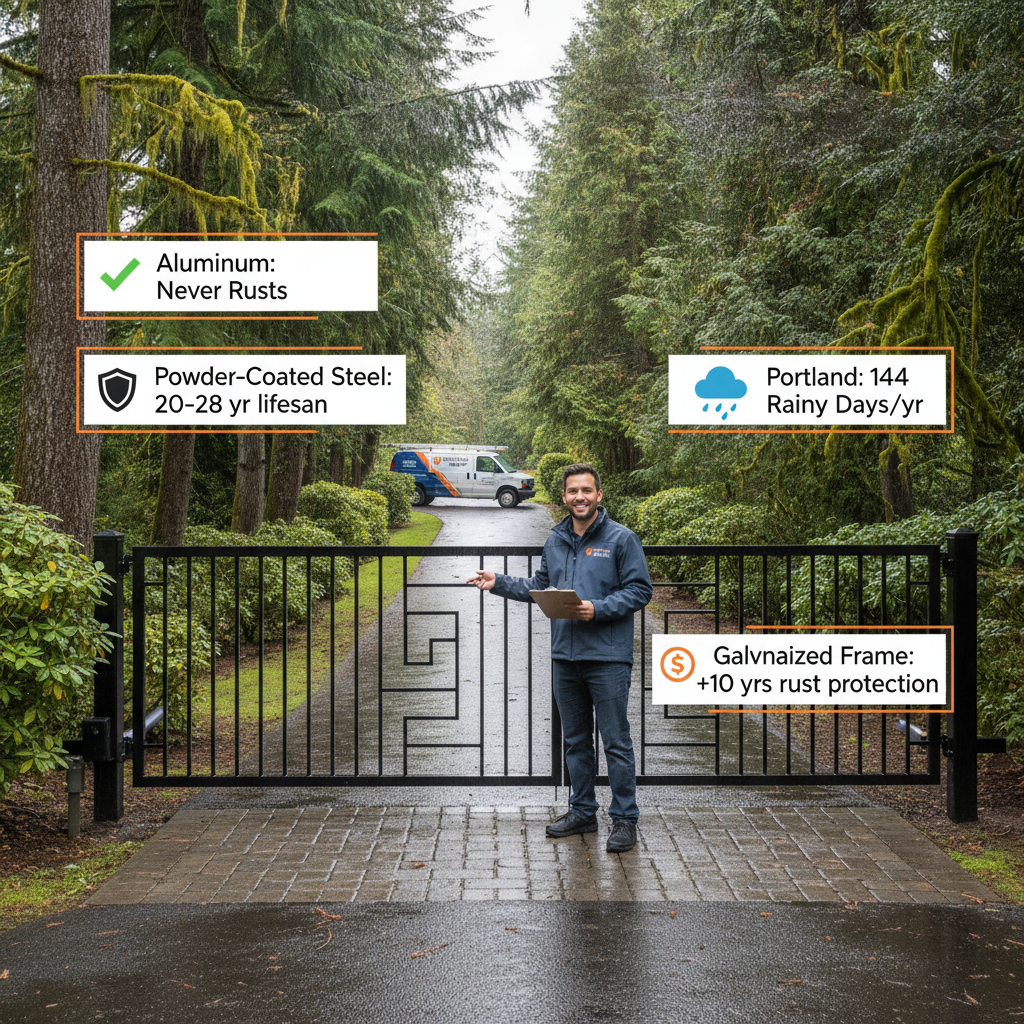
- Galvanized steel tube frames add roughly $400–$900 to a project but can extend a gate's rust-free life by 10+ years in Portland's 144 average rainy days per year.
What Gate Material Actually Lasts in Portland's Rain?
If you're a Portland homeowner Googling 'best gate material for rainy weather,' 'does wood rot on electric gates in the Pacific Northwest,' or 'aluminum vs. steel gate in Portland,' you already know the core problem: this region is unforgiving on outdoor metals, wood, and hardware. Portland averages 144 days of measurable rainfall per year, relative humidity hovers between 75–85% from October through March, and properties in neighborhoods like Hillsdale, Overlook, and Milwaukie often sit under heavy tree cover — meaning gates spend half the year in shade, damp, and organic debris. The material you choose isn't just an aesthetic call. It is a 15-to-30-year financial decision. This guide breaks down every common gate material, what it actually costs installed in the Portland metro in 2026, and which ones local installers see fail first.
How Does Portland's Climate Damage Electric Gates Over Time?
Before comparing materials, it helps to understand exactly what the Pacific Northwest climate does to gate systems. The enemy is not any single rain event — it's the cumulative effect of moisture cycling, biological growth, and thermal contraction.
Portland's winter temperatures typically oscillate between 32°F and 48°F from November through February. That freeze-thaw cycle, mild as it is compared to the Midwest, is enough to work moisture into any micro-crack in a paint coating or wood grain. Once water penetrates, rust or rot begins from the inside out — invisible until the damage is already significant.
Moss and algae are the second major threat. North-facing gates and those shaded by Douglas fir, cedar, or bigleaf maple accumulate a visible moss layer within 12–24 months of installation if untreated. That organic layer holds moisture against the gate surface for weeks after rainfall stops, dramatically accelerating corrosion on bare or lightly coated steel. In areas like Lake Oswego, where lots are heavily wooded and HOA rules often limit chemical spraying, moss management is a recurring maintenance cost.
Finally, Portland's UV index is lower than Southern California but still significant in summer. UV exposure chalks and fades paint coatings over 5–8 years, reducing their protective value even on gates that look fine visually.
What Are the Most Common Gate Materials Installed in Portland in 2026?
Portland installers are currently working with five primary gate materials on residential and light-commercial projects. Here is how each performs in this specific climate.
Powder-Coated Steel
Powder-coated steel is the volume leader in the Portland market, appearing on roughly 55–60% of new residential gate installations. The powder-coating process applies a thermally bonded polymer finish that is significantly thicker and more moisture-resistant than liquid paint. A quality powder coat on 2-inch or 2.5-inch steel tube framing will resist corrosion for 10–15 years before needing touch-up work in Portland conditions — versus 3–5 years for a standard brushed-on enamel paint.
Installed costs for a standard single-swing powder-coated steel gate (12–14 ft, automated) in the Portland metro run $5,500–$11,000 in 2026. A bi-parting swing gate on a wider driveway runs $9,000–$16,500. Sliding steel gates on a flat driveway are $8,500–$18,000 depending on width and panel design.
The key failure point to watch: any chip or scratch in the powder coating — from a delivery truck brushing the gate, a tree branch, or a hailstone — creates an entry point for moisture. Left unaddressed for a full Portland rainy season, that chip can generate a rust bloom 3–4 inches in diameter. Annual touch-up inspection is non-negotiable.
Galvanized Steel
Galvanized steel adds a zinc layer beneath any surface finish, giving it a meaningful corrosion buffer even if the topcoat fails. For Portland properties, galvanized tube framing adds roughly $400–$900 to a gate project but extends rust-free service life by an estimated 10–15 years. Most quality installers in the Portland area now offer galvanized as a standard upgrade on any steel gate over 14 ft wide or any installation facing a water feature, sprinkler line, or dense tree canopy.
Hot-dip galvanizing is more thorough than cold galvanizing spray — ask your installer which process their fabricator uses. Hot-dip is worth the premium in this climate.
Aluminum
Aluminum does not rust. Full stop. That single property makes it exceptionally attractive for Portland's climate, particularly on properties in Gresham or Oregon City where drainage is imperfect and standing water near gate posts is common. Aluminum gates are also lighter — typically 40–55% lighter than equivalent steel — which reduces wear on gate motors over time and can meaningfully extend operator lifespan.
The trade-off is structural rigidity. Aluminum gates wider than 14–16 ft can flex and sag more noticeably than steel over time, particularly in a cantilevered sliding gate application where the panel spans a long distance unsupported. For single driveways under 14 ft, aluminum is arguably the best all-around material choice for Portland.
Installed costs for an automated aluminum swing gate in the Portland market run $3,800–$9,500 for a single swing and $7,500–$14,500 for a bi-parting configuration. Aluminum sliding gates run $7,000–$15,000. These prices include operator, basic keypad, and standard installation — not intercom or video access systems.
Pro Tip: Even though aluminum does not rust, it does oxidize. An oxidized aluminum gate develops a dull, chalky surface within 5–8 years if left uncoated. Ask your fabricator to powder-coat the aluminum panels anyway — it adds $300–$600 but keeps the gate looking sharp and easier to clean of moss and mildew.
Wrought Iron
Wrought iron gates are beautiful. They photograph well, they project security and permanence, and they are genuinely heavy-duty. They are also the highest-maintenance option in a wet Pacific Northwest climate. Wrought iron is porous at a microscopic level in ways that steel tubing is not, and it requires a full repaint — not just touch-up — every 3–5 years in Portland to prevent rust from establishing itself in the textured surface.
If the paint schedule slips even one cycle, visible rust pitting can appear within 12–18 months in Portland's conditions. Repainting a wrought iron gate professionally runs $600–$2,200 depending on gate size and panel complexity. That recurring cost needs to be factored into the total ownership math. For properties in Lake Oswego or Portland's Laurelhurst neighborhood where curb appeal is a priority and owners are committed to maintenance, wrought iron remains a legitimate choice. For busy property managers or HOA boards, it usually is not.
Wood (Cedar and Redwood)
Wood gates — typically cedar or redwood for their natural rot resistance — are common on Portland properties built before 2005 and on rural or semi-rural lots in Hillsboro and Beaverton. A well-built cedar gate is genuinely beautiful and blends naturally into Pacific Northwest landscaping. The problem is lifespan. Even with annual sealing, a wood gate in Portland's climate typically begins showing structural deterioration — post rot, panel warping, bottom rail decay — within 10–15 years. Gates on shaded, north-facing lots or those surrounded by organic mulch or dense plantings often fail closer to 8–10 years.
Installed costs for a wood swing gate (automated) run $4,500–$10,000 in the Portland area. The ongoing cost of sealer (every 1–2 years at $150–$400 professionally applied) and eventual replacement make wood the most expensive option over a 20-year ownership window despite lower upfront pricing.
Wood also interacts poorly with gate motors. Seasonal moisture causes wood panels to expand and contract, which changes the gate's effective weight and geometry throughout the year. Motors that were calibrated in summer frequently trigger force limits or safety reversals by January after the wood has absorbed several months of rain. This is a common service call pattern for Portland gate technicians and one worth understanding before you commit to wood.
Composite and Vinyl
Composite and vinyl gate panels are moisture-impervious, never rot, and never rust. They are also limited in their application: current composite gate panels top out at roughly 12 ft width for swing gates and are not suitable for cantilevered sliding applications because they lack the structural rigidity of metal. For pedestrian gates, courtyard gates, or narrow single-car driveways, composite is a solid option. Installed costs run $3,200–$7,500 for an automated composite swing gate.
Which Gate Material Is Best for Portland HOAs and Multi-Family Properties?
For HOA communities and multi-family properties in the Portland metro, the calculation tips decisively toward powder-coated steel with a galvanized frame or aluminum. HOAs need materials that look professional for years with minimal intervention from board members or property managers. Wood and wrought iron both require maintenance cycles that need to be scheduled, budgeted, and managed — a burden most HOA boards would rather avoid.
A galvanized, powder-coated steel slide gate system serving a 40–80-unit community in a neighborhood like Beaverton or Hillsboro will typically carry a realistic service life of 20–28 years with annual lubrication and biennial inspection. That predictability is worth the higher initial cost versus wood or basic painted steel.
Pro Tip: When comparing bids on any Portland gate project, ask each contractor specifically what grade of steel tubing they use (11-gauge vs. 14-gauge), whether the frame is galvanized, and what powder-coat brand and thickness they specify. Those three details drive the real-world lifespan difference between a gate that looks perfect at year 8 and one that needs patch-painting at year 4.
How Much Does Moss and Mildew Actually Cost Portland Gate Owners?
Biological growth — moss, algae, lichen — is not just cosmetic on an electric gate. Moss holds moisture against the gate surface and, more critically, can physically block photoeye safety sensors. The UL 325 safety standard that governs all automated gate operators in the U.S. requires functional photoeye sensors as a baseline safety requirement. A moss-blocked photoeye is a code compliance issue, not just a nuisance.
Portland installers report that north-facing gates in tree-heavy neighborhoods need photoeye cleaning every 6–12 months as a routine service item. Moss removal from a full gate panel runs $150–$350 as a standalone service call. A biannual maintenance plan that includes lubrication, sensor testing, and biological cleaning typically runs $280–$550 per year in the Portland market and prevents the much larger costs of a sensor replacement ($180–$450 per sensor) or a failed safety test during a property sale inspection.
In One Minute: Portland Gate Materials at a Glance
Portland's wet climate narrows the smart material choices considerably. Aluminum is the lowest-maintenance option and best for moisture-prone properties — just add a powder-coat finish. Galvanized powder-coated steel is the workhorse for most residential and HOA projects, lasting 20–28 years with basic annual care. Wrought iron looks magnificent but demands a strict 3-to-5-year repaint cycle — skip it and rust wins fast. Cedar and redwood wood gates are beautiful at installation but typically need replacement within 10–15 years and cause motor calibration headaches every rainy season. Composite is solid for narrow applications under 12 ft. Whatever material you choose, budget for annual maintenance — Portland's 144 rain days make it non-optional. Want to see how different gate styles look on your property before committing? Try the Interactive Gates gate designer tool to visualize materials and styles on your actual driveway. You can also browse completed Portland area projects in the project portfolio.
Frequently Asked Questions: Electric Gate Materials in Portland
Does aluminum really hold up better than steel on Portland gates?
In terms of corrosion resistance, yes — aluminum cannot rust, which is a significant advantage in Portland's 144-day rainy season. Steel is structurally stronger for wide spans and heavy sliding gates, so most installers use galvanized steel for anything over 14 ft. For single driveways under that width, powder-coated aluminum is often the better long-term value when you factor in zero rust-related maintenance costs over 20+ years.
How often does a steel gate need to be repainted in Portland?
A quality powder-coat on steel should last 10–15 years before the finish degrades enough to need full resurfacing. Spot touch-ups on chips and scratches should happen annually — especially after the first rainy season when any installation damage becomes visible. Liquid-painted steel (not powder-coated) needs full repainting every 3–5 years in Portland's climate, making it a significantly more expensive long-term choice despite lower upfront cost.
Will a wood gate hold up in Portland's rain?
Cedar and redwood have natural rot resistance and can survive 10–15 years in Portland with annual sealing and good drainage at the posts. However, they require more maintenance than any metal option, they interact poorly with gate motor calibration as they expand and contract seasonally, and they almost always need replacement sooner than a metal gate. For most homeowners doing a cost-over-time analysis, metal is the better investment.
Does moss on my gate actually cause problems beyond looks?
Yes. Moss and algae hold moisture against the gate surface and accelerate corrosion on any metal gate. More critically, moss can physically block or coat photoeye safety sensors, which is a UL 325 compliance failure. North-facing Portland gates under tree cover should have sensor cleaning and moss inspection at least twice per year. A blocked sensor on an automated gate is a safety hazard and can also cause the operator to behave erratically or refuse to close.
What is the most cost-effective gate material over 20 years in Portland?
When you factor in installation cost, maintenance, repainting, and expected replacement timeline, galvanized powder-coated steel and aluminum come out closest to even over 20 years — both in the $12,000–$22,000 total-cost-of-ownership range for a standard residential gate project including upkeep. Wood comes in lower upfront but higher over time due to maintenance and earlier replacement. Wrought iron is the most expensive long-term if maintenance is neglected even one cycle.
Do I need a permit to replace my gate material in Portland?
In most cases, replacing a gate panel with a different material on an existing automated gate system does not require a new permit as long as the structural posts and operator are unchanged. However, any new installation or significant structural modification requires a permit through the City of Portland Bureau of Development Services or the applicable jurisdiction in Washington County, Clackamas County, or Multnomah County. Your gate installer should pull the permit — if they suggest skipping it, that is a red flag. Budget $150–$400 for permit fees depending on project scope and jurisdiction.
Ready to Choose the Right Gate Material for Your Portland Property?
The best gate material for your specific property depends on your lot orientation, tree coverage, driveway width, and how much maintenance you realistically want to manage. If you're not sure where to start, reach out for a free consultation — a local technician can walk your property, assess your drainage situation, and recommend the material that makes the most sense for your specific conditions. You can also explore residential gate options or review what other Portland area homeowners have installed in the project portfolio before your first conversation.