
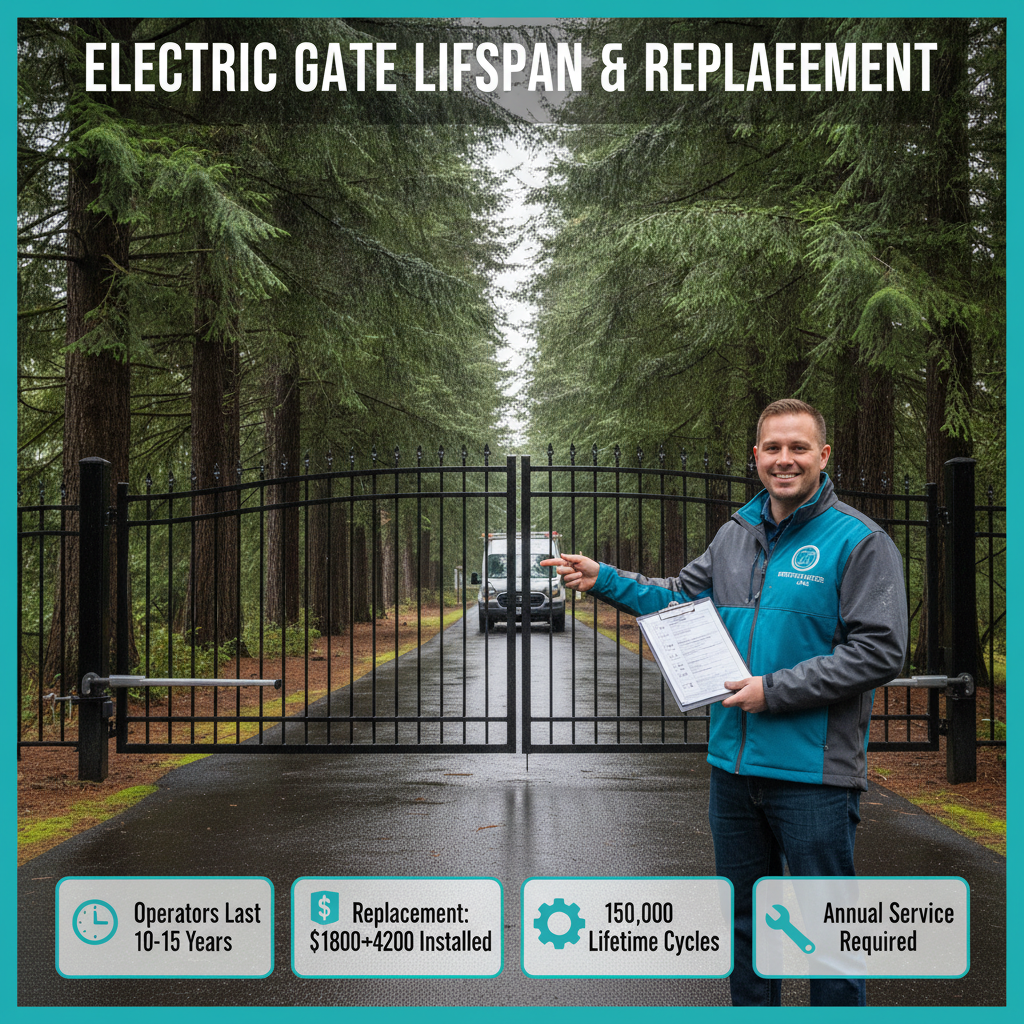
- Swing gate operators last 10–15 years in Portland's wet climate with annual servicing; slide gate operators push 12–18 years on flat driveways.
- Gate panels themselves outlast the operators — powder-coated steel and aluminum panels survive 20–30 years when repainted every 5–7 years.
- Portland's 144+ annual rain days accelerate corrosion on uncoated hardware, cutting hinge and roller lifespan by 30–40% versus drier climates.
- Budget $1,800–$4,200 for a mid-range operator replacement (LiftMaster, FAAC, Viking) installed in the Portland metro in 2026.
- Control boards and safety loops fail first — expect one control board replacement ($280–$550 installed) every 7–10 years.
- HOAs in Lake Oswego and West Hills neighborhoods typically hit full operator replacement at the 12-year mark due to heavy daily cycle loads of 80–150 cycles per day.
- UL 325 entrapment sensors should be tested every 6 months; faulty sensors void manufacturer warranties and expose owners to liability under Oregon premises-liability law.
- Signs you need replacement, not repair: repair quotes exceed 60% of a new operator's cost, parts are discontinued, or the unit has exceeded 150,000 lifetime cycles.
How long should an electric gate last in Portland? What's the actual difference between repairing an aging operator versus replacing the whole system? And how does all that rain — plus the freeze-thaw cycles in Troutdale, Gresham, and the West Hills — actually shorten (or lengthen) a gate's working life? If those are the questions you're Googling at midnight, you're in the right place.
How Long Do Electric Gate Operators Last in Portland's Climate?
Portland sits in a sweet spot of the Pacific Northwest: mild enough that hard freezes are rare, but wet enough (averaging 36–43 inches of precipitation per year depending on neighborhood) that moisture is the number-one enemy of gate hardware. The Willamette Valley's marine climate means gate operators here face a different stress profile than units in Los Angeles or even east of the Cascades.
Here's what real-world lifespan looks like by operator type when properly maintained:
- Swing gate operators (residential): LiftMaster LA500 and FAAC 402 units average 10–14 years in Portland-area residential driveways operating at 20–40 cycles per day. At the heavier end — gated communities in Lake Oswego or condos in the Pearl District — that drops to 8–11 years.
- Slide/rolling gate operators (residential): Viking SL-3000 and LiftMaster RSW12V units handle Portland rain well because the motor is typically enclosed; expect 12–18 years at low-to-moderate cycle counts.
- Commercial slide operators: FAAC 844 and Viking SL-5000 units at commercial properties in Hillsboro's tech corridor or Beaverton industrial parks, cycling 200–400 times per day, average 7–10 years before rebuild or replacement.
- Vertical pivot / vertical lift operators: Less common in Portland but used on steep lots in SW Hills; lifespans mirror commercial slide operators — 8–12 years depending on cycle count and corrosion management.
Pro Tip: Portland's fog and overnight condensation are more corrosive than rain itself. A quality corrosion-inhibiting grease (such as Super Lube 21030 or LPS 3) applied to all exposed pivot points, hinges, and track rollers every 6 months can add 2–4 years to a gate operator's working life in the Portland metro.
How Long Do Gate Panels, Posts & Hardware Last in Portland?
The mechanical operator and the physical gate structure age at very different rates — and confusing the two leads homeowners to unnecessarily replace an entire system when only one component has failed.
- Powder-coated steel panels: 20–30 years with repainting every 6–8 years. Portland's UV index is moderate (lower than Los Angeles), which is actually gentle on powder coat, but sustained moisture can cause paint bubbling at welds. Budget $400–$800 for a professional repaint of a standard dual-leaf residential gate.
- Aluminum panels: Effectively indefinite against corrosion — aluminum oxidizes on the surface but won't rust through. Hinges, latches, and fasteners remain the failure points. A well-maintained aluminum gate in Beaverton or Oregon City can outlast two or three operators.
- Wrought iron panels: 25–40 years with proper painting cycles. Bare iron in Portland's climate will show rust surface blooms within 18–24 months of paint failure. Annual inspection of weld points is critical in neighborhoods like SE Portland where morning fog lingers.
- Concrete and brick pillars: 30–50+ years unless subject to vehicle impact or significant seismic movement. Portland's seismic risk (the Cascadia subduction zone) is worth noting — masonry pillars should be re-pointed every 10–15 years.
- Steel hinges and pins: 8–15 years depending on plating quality; galvanized or stainless steel hinges outperform painted mild steel by a wide margin in the Willamette Valley's wet winters.
- V-groove and flat track rollers (slide gates): 5–10 years; debris from Oregon's leaf litter (big-leaf maples in Gresham and Lake Oswego are notorious) accelerates track wear and should prompt more frequent cleaning.
What Parts Fail First on Portland Electric Gates?
Understanding the failure sequence helps you make smarter repair-vs-replace decisions. Based on typical Portland-area service patterns, here's the order parts tend to give out:
- Safety loop detectors and buried loops (3–7 years): Ground loops embedded in asphalt or concrete driveways degrade faster when subject to Portland's freeze-thaw cycles in February and March, especially in higher-elevation neighborhoods like Sylvan-Highlands or Bull Mountain. Replacement runs $350–$700 installed.
- Control boards (7–10 years): Electronic components dislike humidity cycling. A standard residential control board replacement — LiftMaster, Viking, or FAAC — costs $280–$550 installed in 2026. Commercial-grade boards run $500–$1,100.
- Battery backup units (3–5 years): Lead-acid backup batteries in solar-assist or battery-backup operators lose capacity faster in Portland's temperature swings. Sealed AGM replacements cost $80–$180 per battery plus labor.
- Photo-eye sensors (5–8 years): Alignment drifts from post settling; lens fogging is common in Portland winters. Replacement sensors are $120–$300 installed.
- Limit switches and encoders (8–12 years): These tell the operator where open and close positions are. Replacement is $150–$350.
- Motor and gearbox assembly (10–18 years): This is the heart of the unit. When the motor fails on an older unit, it often triggers a replacement decision because the motor cost approaches the price of a new operator.
Pro Tip: If your gate operator is more than 10 years old and you're facing a control board or motor replacement, get a side-by-side quote for full operator replacement. In Portland's 2026 market, a new LiftMaster LA500 or FAAC 402 installed runs $1,800–$2,800 for a single-swing residential gate — often only $400–$700 more than a major repair on an aged unit, and you get a new warranty.
How Many Cycles Does a Portland Gate Operator Handle Over Its Life?
Gate operators are rated by cycle count, not just years. Understanding this helps HOAs and property managers in communities like Lake Oswego, Beaverton, and Hillsboro plan replacement budgets accurately.
- Residential-grade operators (LiftMaster LA500, FAAC 402, Apollo 1500): Rated for 100,000–150,000 cycles. At a typical residential rate of 20 cycles/day, that's 13–20 years of mechanical life.
- Commercial-grade operators (FAAC 844, Viking SL-5000, LiftMaster CSL24V): Rated for 500,000–1,000,000 cycles. At a busy apartment complex in Gresham cycling 300 times/day, that's 4.5–9 years of mechanical life — which is why commercial maintenance contracts matter so much.
- HOA pedestrian gates: Pedestrian swing operators (FAAC 400 series, LiftMaster LA412) are rated at 60,000–80,000 cycles. A community with 50 active residents using the pedestrian gate 4 times per household daily hits 200 cycles/day — meaning a replacement every 1–2 years without a commercial-rated unit.
When evaluating an existing operator, ask your technician to check the cycle counter if the unit has one (most post-2018 commercial operators do). This single data point tells you more than the calendar age alone.
How Does Portland's Climate Specifically Affect Gate Longevity?
Portland's climate profile creates a specific set of challenges that differ from what you'd read in a generic gate lifespan guide:
- Sustained moisture (not just rain): Portland's drizzle and fog keep metal surfaces damp for days at a time in November–March. This is far harder on bare metal than a single heavy rainstorm followed by sunshine.
- Moderate freeze-thaw in East County: Troutdale, Gresham, and Oregon City see more freeze-thaw cycles than inner Portland, which accelerates ground loop degradation and concrete pillar cracking around anchor bolts.
- Leaf and organic debris accumulation: The Willamette Valley's tree canopy — Douglas fir needles, maple leaves, and cottonwood fluff — collects in slide gate tracks and on photo-eye lenses. Communities in Oregon City and wooded parts of Portland's West Hills should budget for quarterly track cleaning on top of annual full service.
- Algae and moss on gate surfaces: Portland's shade and moisture create ideal conditions for biological growth. Moss on wrought iron gates holds moisture against the metal 24/7, accelerating rust under the paint layer.
- Power outages: Portland's windstorm season (October–January) causes frequent short-duration outages. Battery backup operators are strongly recommended; without backup power, operators with worm-drive gearboxes can lock and require manual disengagement.
Repair vs. Replace: How Do You Decide for a Portland Property?
The 60% rule is a solid starting point: if a repair quote exceeds 60% of a comparable new installation, replacement usually wins on total cost of ownership. But Portland properties have additional factors to weigh:
- Parts availability: Operators older than 15 years may have discontinued control boards. A few brands that were popular in Portland in the early 2010s (Eagle brand, Linear commercial) have sunset their residential lines, making repair increasingly expensive as parts must be sourced used.
- Code compliance: Oregon adopted updated UL 325 entrapment protection requirements that have been enforced progressively since 2016. Older operators without compliant safety edges or monitored photo-eyes may not be repairable to current code — meaning any permitted repair triggers a full upgrade anyway.
- Energy efficiency: Newer operators (post-2022 LiftMaster and FAAC units) consume 30–50% less standby power than units from 2010–2015. Over a 10-year period, the energy savings on a high-cycle property in Salem or Hillsboro can offset $200–$400 of the replacement cost.
- HOA reserve planning: Oregon's HOA reserve study laws (ORS Chapter 94) require communities to budget for major component replacement. If your gate operator is 10+ years old, it should be in the reserve schedule for replacement within 3–5 years regardless of current condition.
If you want to see what a replacement gate would look like before committing, the Interactive Gates gate designer tool lets you visualize styles and configurations for your specific driveway setup.
What Does Gate Operator Replacement Cost in Portland in 2026?
Portland-area 2026 installed pricing for common replacement scenarios:
- Single swing residential (LiftMaster LA500UL or FAAC 402 CBC): $1,800–$2,600 installed, including removal of old unit and electrical reconnection.
- Dual swing residential (LiftMaster LA500UL pair or Apollo 1600 pair): $2,800–$4,200 installed.
- Residential slide gate operator (Viking SL-3000 or LiftMaster RSW12V): $2,200–$3,400 installed.
- Commercial swing operator (FAAC 740 or LiftMaster LA412): $3,500–$6,000 installed depending on gate weight and post reinforcement needs.
- Commercial slide operator (FAAC 844 or Viking SL-5000): $4,500–$9,000 installed.
- Control board-only replacement (mid-range residential): $280–$550 installed.
- Full gate panel replacement (powder-coated steel, 12-ft dual leaf): $2,400–$5,500 fabricated and installed, depending on design complexity.
These figures assume a reasonably accessible driveway with existing conduit and power supply. Steeply sloped driveways (common in SW Portland's West Hills or on Bull Mountain in Tigard) or installations requiring new electrical runs add $300–$800 to the base price. You can explore residential options and request a quote for your specific gate here, or for HOA and commercial projects, see the commercial and HOA gate page.
In One Minute: Electric Gate Lifespan in Portland 2026
Residential gate operators in Portland last 10–15 years at moderate cycle counts; commercial operators last 7–12 years at high cycle loads. Gate panels outlast operators by a decade or more. Portland's year-round moisture is the primary lifespan killer — corrosion-resistant hardware, annual servicing, and track cleaning every quarter (especially in wooded areas) are your main defenses. Control boards and ground loops fail first; motors and gearboxes last longest. If a repair quote tops 60% of replacement cost, or if the unit has passed 12 years and 100,000+ cycles, replace it. 2026 replacement costs range from $1,800 for a basic single swing up to $9,000 for a heavy commercial slide. Check out our portfolio of Portland-area gate installations and customer reviews to see real results from properties like yours.
Frequently Asked Questions: Electric Gate Lifespan in Portland
How long does an average residential electric gate last in Portland, OR?
The mechanical operator typically lasts 10–15 years at a residential cycle rate of 20–40 cycles per day when serviced annually. Gate panels made of powder-coated steel or aluminum last 20–30 years with proper repainting and hardware maintenance. Portland's wet climate accelerates corrosion on unprotected hardware but doesn't significantly shorten panel life if paint integrity is maintained.
What is the most common reason electric gates fail in Portland?
Moisture-related corrosion of hinges, pivot arms, and buried ground loops is the leading cause of premature failure in the Portland area, followed by control board failure due to humidity cycling. Organic debris (leaves, moss, pine needles) clogging slide gate tracks is the third most common service call. Annual lubrication with a corrosion-inhibiting grease reduces all three failure modes.
When should I repair vs. replace my Portland gate operator?
Use the 60% rule: if repair costs exceed 60% of a comparable new installed operator, replacement is usually smarter financially. Additional replacement triggers include discontinued parts (common on operators older than 15 years), non-compliant UL 325 safety systems that can't be updated economically, or a cycle count exceeding the manufacturer's lifetime rating. A technician can read the cycle counter on most post-2018 commercial operators.
Does Portland's rain really shorten electric gate life that much?
Yes and no. Sustained moisture — Portland's drizzle, fog, and weeks of overcast — is harder on bare metal than periodic heavy rain. Properly coated and sealed gates last just as long as comparable installations in dry climates. The real risk is deferred maintenance: skipping a repainting cycle or annual service in Portland's climate creates compounding corrosion that can cut 3–5 years off operator and hardware life.
How much does it cost to replace an electric gate operator in Portland in 2026?
Residential single-swing replacement runs $1,800–$2,600 installed (LiftMaster LA500 or FAAC 402); dual-swing runs $2,800–$4,200. Residential slide operators (Viking SL-3000 or LiftMaster RSW12V) cost $2,200–$3,400 installed. Commercial-grade operators for HOAs or apartment communities range from $3,500 to $9,000 installed depending on gate weight, cycle rating, and site access. These are 2026 Portland-metro figures including labor and haul-away of the old unit.
How often should electric gates in Portland be serviced?
Residential gates should be professionally serviced once per year minimum. High-cycle residential properties (more than 60 cycles/day) and all commercial or HOA gates should be serviced every 6 months. In addition, Portland homeowners with wooded lots should clear slide gate tracks and clean photo-eye lenses every 3 months during fall and winter. Bi-annual UL 325 safety sensor testing is recommended for all properties regardless of cycle count. Contact Interactive Gates to schedule a service visit.
The bottom line for Portland homeowners and property managers: plan for your first major repair around year 7–10, and budget for full operator replacement somewhere between year 10 and year 15. Keep the panels — they almost always outlast the mechanics — and invest in corrosion-resistant hardware upgrades whenever you do open the system up for service. A gate that's well-maintained in Portland's climate will protect your property for 20–25 years before any major structural work is needed. If you're ready to get eyes on your system or want a replacement quote, reach out to the Interactive Gates team and we'll send a technician to your property.


