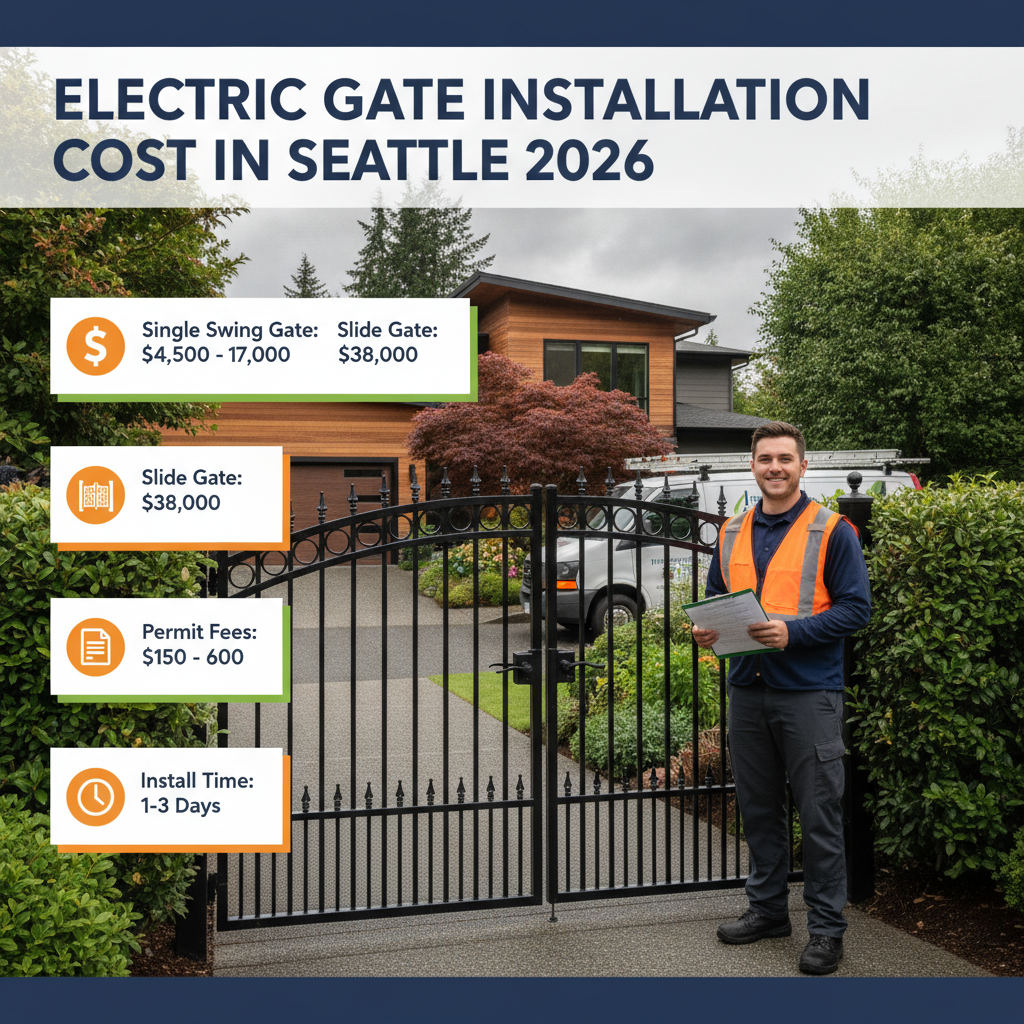
- Entry-level swing gate systems in Seattle start around $4,500 installed in 2026, while high-end dual swing or slide gates with premium access control can reach $28,000+.
- Slide gates cost 20–35% more than comparable swing gates because of the heavier motor, longer track, and additional concrete work.
- LiftMaster, FAAC, Viking, and Apollo are the four brands most commonly specified by Seattle installers in 2026.
- Permit fees in King, Pierce, and Snohomish counties typically add $150–$600 to the total project cost.
- Hilly lots in neighborhoods like Magnolia, Queen Anne, and Gig Harbor often require extra grading or custom arm geometry, adding $500–$2,000 to a swing gate install.
- Corrosion-resistant coatings and stainless hardware add roughly $400–$900 upfront but are strongly recommended given Seattle's 150+ annual rain days.
- Most residential gate projects in the Seattle metro are completed in 1–3 days once permits are issued; commercial HOA projects can run 5–10 days.
- Choosing the wrong motor size is the single most common cost-multiplier — always match duty cycle to actual daily usage before signing a quote.
What Does It Really Cost to Install an Electric Gate in Seattle in 2026?
You've probably Googled something like 'how much does an automatic gate cost in Seattle,' or 'electric gate installation price King County 2026,' and landed on articles quoting national averages that feel completely disconnected from reality. A gate company in Phoenix pricing a flat-lot swing gate has almost nothing to say about what your sloped Bellevue driveway, your HOA setback rules, or your rain-soaked Snohomish property will actually cost. This guide is built entirely around the Seattle metro — real neighborhoods, real terrain, real 2026 labor rates, and real brand pricing from local installers.
How Much Does a Single Swing Gate Cost in Seattle in 2026?
A single swing gate — one panel hinged to a post or pillar — is the most affordable automatic gate configuration and the most common choice on standard residential lots in Auburn, Lynnwood, and Lakewood. In 2026, expect to pay:
- Basic steel single swing gate, LiftMaster LA400 or Apollo 1550 motor, keypad entry: $4,500–$7,500 installed
- Mid-range ornamental iron or aluminum single swing, FAAC 402 motor, keypad + vehicle loop: $7,500–$12,000 installed
- High-end custom steel or wood-clad single swing, Viking SW220 motor, app control + intercom: $12,000–$17,000 installed
Those ranges assume a reasonably flat approach, existing electrical within 50 feet of the gate, and no major concrete demolition. Each of those variables can shift the number significantly — more on that below.
How Much Does a Dual Swing Gate Cost in Seattle in 2026?
Dual swing gates — two panels meeting in the center — are popular in Gig Harbor, Bellevue, and Lake Forest Park where wider driveways and estate-style aesthetics are common. Because you're doubling the mechanical components, expect a meaningful jump:
- Basic dual swing, two LiftMaster LA500UL motors, single keypad: $7,000–$11,000 installed
- Mid-range ornamental iron dual swing, two FAAC 402 motors, video intercom + app: $11,000–$18,000 installed
- Premium custom dual swing, two Viking or FAAC motors, full access-control package: $18,000–$28,000+ installed
Note that dual swing gates require significantly more clear space behind each panel to arc open — a factor that catches many Magnolia and Queen Anne homeowners off guard on narrow setbacks.
How Much Does a Slide Gate Cost in Seattle in 2026?
Slide gates — also called rolling or sliding gates — run on a track parallel to the fence line and are the go-to solution when there isn't room for a swing arc, or when a property sits on a steep grade where a swinging panel would fight gravity. In the Seattle metro, slide gates are extremely common in commercial and HOA settings in Tacoma, Everett, and Gresham-adjacent industrial corridors.
- Basic residential slide gate (up to 16 ft), LiftMaster SL595UL motor: $8,500–$13,000 installed
- Mid-range slide gate (16–24 ft), FAAC 844ER or Viking SL series motor, loop detector: $13,000–$20,000 installed
- Heavy-duty commercial slide gate (24–40 ft), FAAC or Viking high-cycle motor, full access stack: $20,000–$38,000 installed
Slide gates cost more primarily because of the concrete pad and track foundation work, the heavier-duty motor required to move a cantilevered or V-groove panel, and the additional labor to set the posts correctly. In Seattle's clay-heavy soils — common across Snohomish County and parts of South King County — footings must go deeper to prevent frost heave and soil creep, which adds $300–$800 in concrete work alone.
Pro Tip: If your driveway slopes more than 8 degrees toward the street, a slide gate almost always outperforms a swing gate long-term. A swing gate on a slope puts constant lateral stress on the hinge hardware, shortening its lifespan from a typical 10–15 years down to 5–8 years without expensive reinforcement.
What Local Seattle Factors Push the Price Up?
National pricing guides ignore the details that actually drive your final invoice. Here's what Seattle-area homeowners and property managers need to account for in 2026:
- Terrain and slope: Properties in Magnolia, Queen Anne, Beacon Hill, and much of Gig Harbor sit on significant grades. Custom hinge geometry, counterweights, or slope-compensating arm kits for swing gate openers (available from FAAC and Viking) add $400–$1,800 per gate leaf.
- Electrical run distance: Standard installs assume power within 50 feet. Every additional 50 feet of conduit adds roughly $200–$450 in materials and labor. Many rural Snohomish and Pierce County properties require 150–300 feet of conduit, pushing that line item to $600–$1,800.
- Permit requirements: Seattle city limits, Bellevue, Tacoma, and most incorporated King County cities require a building permit for any automatic gate attached to a fence over 6 feet or any gate exceeding certain setback rules. Permit fees range from $150 (smaller jurisdictions) to $600 (City of Seattle), and some projects trigger an electrical permit separately ($100–$250).
- Corrosion protection: Seattle's marine air and 38+ inches of annual rainfall accelerate rust on untreated ferrous metals. Powder-coat upgrades, marine-grade stainless fasteners, and sealed motor enclosures add $400–$900 upfront but are the single best way to protect a 10–15 year investment.
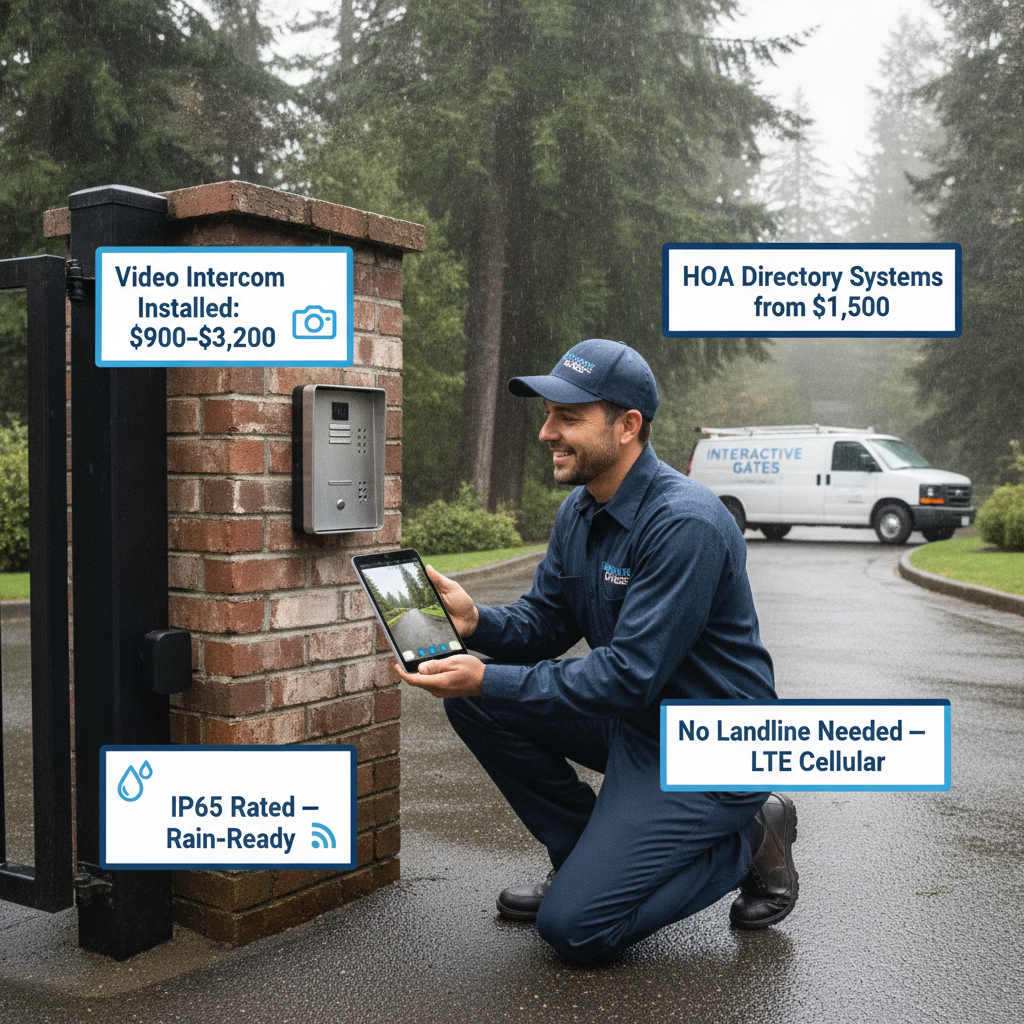
- Access control complexity: A basic keypad entry is usually included in base quotes. Upgrading to a video intercom (like 2N or DoorBird), a cloud-managed access platform (like LiftMaster myQ or Avigilon), or a multi-user app system adds $800–$4,500 depending on the system.
Which Gate Motor Brand Should Seattle Homeowners Choose in 2026?
Brand choice directly affects both upfront cost and long-term reliability. Here's how the four dominant brands shake out for Seattle conditions:
- LiftMaster (Chamberlain Group): The most widely installed brand in the Seattle residential market. The LA400 (single swing) and SL595UL (slide) are workhorses — parts are available at dozens of local distributors, and most gate technicians know them cold. myQ connectivity is solid. Typical motor unit cost: $450–$950 depending on model.
- FAAC (Italian, distributed through US dealers): The premium pick for high-cycle commercial applications and sloped driveways. FAAC's 402 and 844ER are used heavily in Bellevue and Tacoma commercial installs. Hydraulic actuator models handle slope and heavy gates better than most competitors. Motor unit cost: $750–$2,200.
- Viking Access Systems: Strong mid-to-commercial tier option. The SW220 (swing) and SL series (slide) are built for Pacific Northwest rain exposure with sealed housings. Popular with HOA installers in Gig Harbor and Snohomish communities. Motor unit cost: $600–$1,400.
- Apollo Gate Operators: Budget-friendly and widely available, the Apollo 1550 and 3500 series are common on lower-traffic residential installs in Auburn and Lynnwood. Not recommended for gates exceeding 600 lbs or properties with more than 50 daily cycles. Motor unit cost: $350–$700.
Pro Tip: For any gate that will see more than 30–40 cycles per day — think multi-tenant properties, short-term rentals, or busy HOA entrances — always specify a motor rated for at least 100,000 cycles. LiftMaster's SL595UL and FAAC's 844ER both hit that threshold; budget Apollo models typically rate out at 30,000–50,000 cycles.
How Do Seattle Neighborhood and Lot Type Affect the Quote?
Where you live in the metro has a measurable effect on installation complexity and cost. Here's a quick local breakdown:
- Bellevue / Redmond (Eastside): High HOA density, frequent permit reviews, often requires engineered drawings for anything over 6 feet. Add $400–$1,000 for plan review time. See our Bellevue gate installation page for jurisdiction-specific notes.
- Seattle proper (Magnolia, Queen Anne, Ballard): Steep lots, older electrical panels sometimes requiring an upgrade, and City of Seattle permit scrutiny. Budget for $500–$1,500 in site-prep costs beyond a standard quote. Visit our Seattle gate service page for local details.
- Gig Harbor / Tacoma: Marine corrosion risk is higher here than inland. Specify stainless hardware and marine-grade powder coat. Lots often have long driveways requiring extended electrical runs. See our Gig Harbor and Tacoma gate pages for area-specific context.
- Snohomish / Everett / Lynnwood: Clay-heavy soils mean deeper footings. Rural parcels often need 150+ feet of conduit. Permit timelines in Snohomish County can run 3–6 weeks, so start early. Check our Snohomish and Everett pages for details.
- Auburn / Lakewood: Generally flatter terrain and more straightforward installs, making these some of the more cost-predictable areas in the metro. Standard residential installs here tend to come in at the lower end of the ranges above.
What Does a Typical Seattle Gate Installation Timeline Look Like in 2026?
Once a permit is issued, most residential gate installs in the Seattle metro follow this timeline:
- Day 1: Post setting and concrete pour (if new posts are needed). Concrete typically needs 24–48 hours to cure before gate hanging.
- Day 2: Gate panel hanging, motor mounting, conduit and wiring run.
- Day 3: Access control installation, loop detector cutting (if applicable), programming, testing, and owner walkthrough.
Commercial or HOA projects involving multiple lanes, barrier arms, or complex access control stacks typically run 5–10 business days. Permit wait times — not installation time — are usually the longest part of the process: plan on 2–6 weeks depending on jurisdiction. Tacoma and King County unincorporated areas tend to be faster; City of Seattle and Bellevue can take longer during busy construction seasons.
In One Minute: Seattle Electric Gate Installation Cost Summary
Single swing gates run $4,500–$17,000 installed in 2026. Dual swing gates run $7,000–$28,000+. Slide gates run $8,500–$38,000 for commercial-grade setups. LiftMaster dominates the residential tier; FAAC and Viking are preferred for high-cycle or sloped-lot applications. Seattle-specific cost drivers include steep terrain, clay soils, long electrical runs, marine corrosion risk, and permit requirements that vary by city. Most residential installs finish in 1–3 days once permits clear. The best way to protect your investment long-term: specify the right duty-cycle motor upfront and don't skip corrosion-resistant hardware.
Want to see how different gate styles look on your property before committing? Use our Interactive Gates gate designer tool to visualize styles, materials, and colors. You can also browse real completed Seattle-area projects in our project portfolio, or read what local homeowners and property managers have to say on our reviews page.
Frequently Asked Questions: Electric Gate Installation Cost in Seattle 2026
How much does a basic automatic gate cost in Seattle in 2026?
A basic single swing automatic gate — steel or aluminum panel, LiftMaster or Apollo motor, single keypad — typically runs $4,500–$7,500 fully installed in the Seattle metro in 2026. That assumes a flat lot, existing electrical within 50 feet of the gate location, and no permit complications. Sloped lots, longer electrical runs, or premium access control add to the total.
Do I need a permit to install an electric gate in Seattle or King County?
In most cases, yes. The City of Seattle, Bellevue, Tacoma, and most incorporated King County cities require a building permit for automatic gate systems, particularly when attached to a fence over 6 feet or when the gate falls within setback zones. Permit fees typically run $150–$600. Some jurisdictions also require a separate electrical permit. Always confirm with your local planning department before installation begins.
Why do slide gates cost more than swing gates in Seattle?
Slide gates require heavier-duty motors (which cost more), a longer concrete track foundation, deeper footings (especially in clay-heavy Snohomish and South King County soils), and more labor-intensive installation overall. They also typically require a vehicle loop detector cut into the pavement. The extra cost — usually 20–35% more than a comparable swing gate — is often justified on sloped driveways or narrow lots where a swing arc isn't feasible.
Which automatic gate brand is best for Seattle's wet climate?
LiftMaster is the most widely serviced and part-available brand in the Seattle metro, making it the safest choice for most residential installs. For high-cycle commercial applications or steep driveways, FAAC's hydraulic actuators and Viking's sealed motor housings are better suited to the Pacific Northwest's rain and humidity. Regardless of brand, always specify a sealed motor enclosure, marine-grade stainless fasteners, and a quality powder-coat finish.
How long does it take to install an electric gate in Seattle?
The installation itself typically takes 1–3 days for a standard residential project once permits are in hand. Permit wait times are the bigger variable: City of Seattle and Bellevue reviews can take 3–6 weeks during busy seasons, while some smaller jurisdictions move faster. Commercial or HOA projects with multiple access lanes typically take 5–10 business days of on-site work.
Is it worth adding a video intercom or app control to my Seattle gate in 2026?
For most homeowners and property managers, yes — especially if the gate serves a property with frequent deliveries, guests, or rental activity. Systems like 2N, DoorBird, and LiftMaster myQ add $800–$4,500 to the upfront cost but eliminate the need to physically open the gate for visitors and give you a remote audit trail of every entry. In short-term rental markets like Capitol Hill or Gig Harbor, these systems often pay for themselves in reduced property management overhead within the first year.
Ready to Get a Real Number for Your Property?
Every Seattle-area property is different — your slope, your soil, your access-control needs, and your local permit office all play a role in what your gate will actually cost. The ranges in this guide are drawn from real 2026 Seattle metro installs, but the only way to get a number you can actually plan around is a site-specific quote. If you're ready to talk through your project, reach out to our team — we serve homeowners and property managers throughout the Seattle area and are happy to walk you through options without any pressure. You can also explore residential gate options on our residential gate page or learn about HOA and commercial projects on our commercial and HOA gate page.