- Most existing fences can accept an automatic gate — but post strength, footing depth, and panel spacing must be evaluated first.
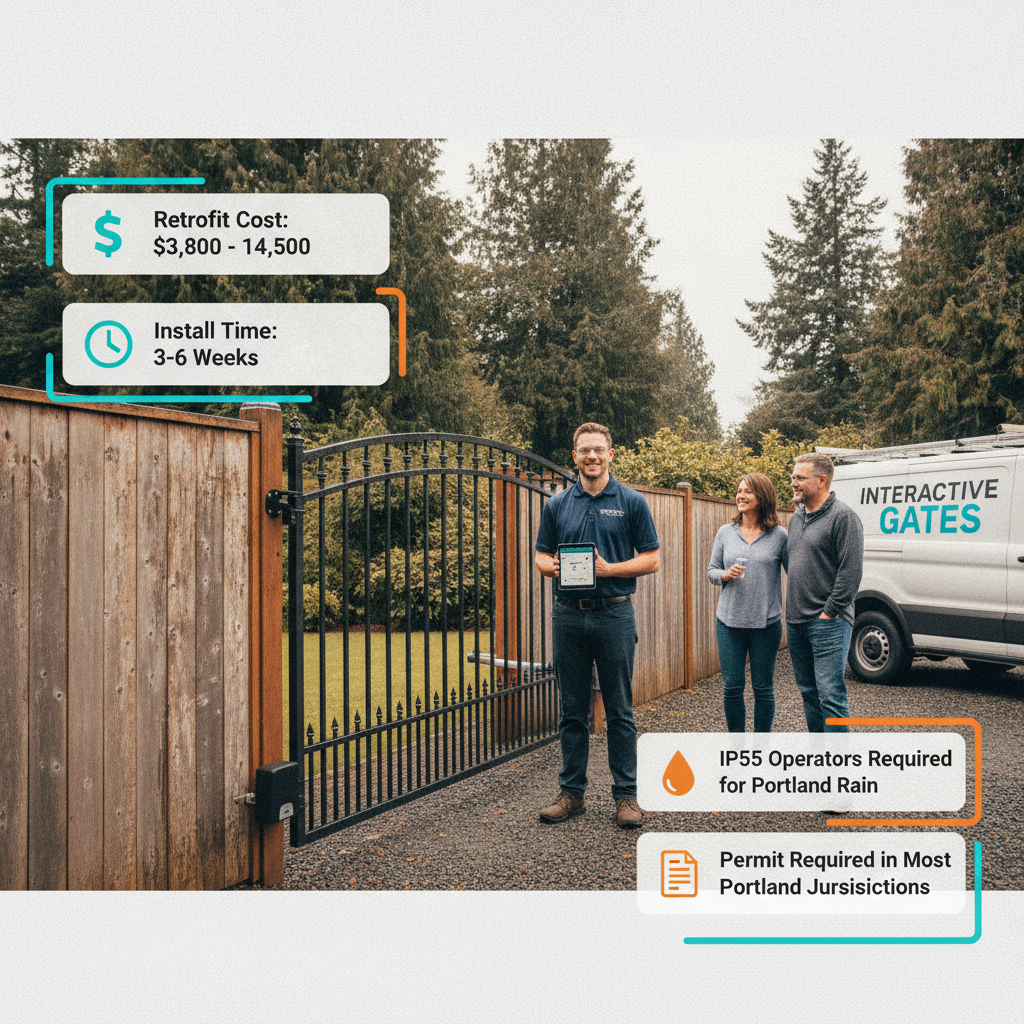
- Retrofit gate installation in Portland typically runs $3,800–$14,500 depending on gate width, material, operator type, and access-control needs.
- Swing gates need at least 90–110 inches of clearance behind the opening; sliding gates need 1.2–1.5× the gate width of clear track run.
- Portland's wet winters demand stainless hardware and sealed operators — budget $300–$600 more for weatherproofing upgrades versus a dry-climate install.
- Permit requirements vary by jurisdiction — Portland city limits, Beaverton, and Hillsboro each have slightly different fence-and-gate permit thresholds in 2026.
- Existing wood posts often need replacement or sister-posting before a motor is hung — undersized posts are the #1 reason retrofit quotes spike.
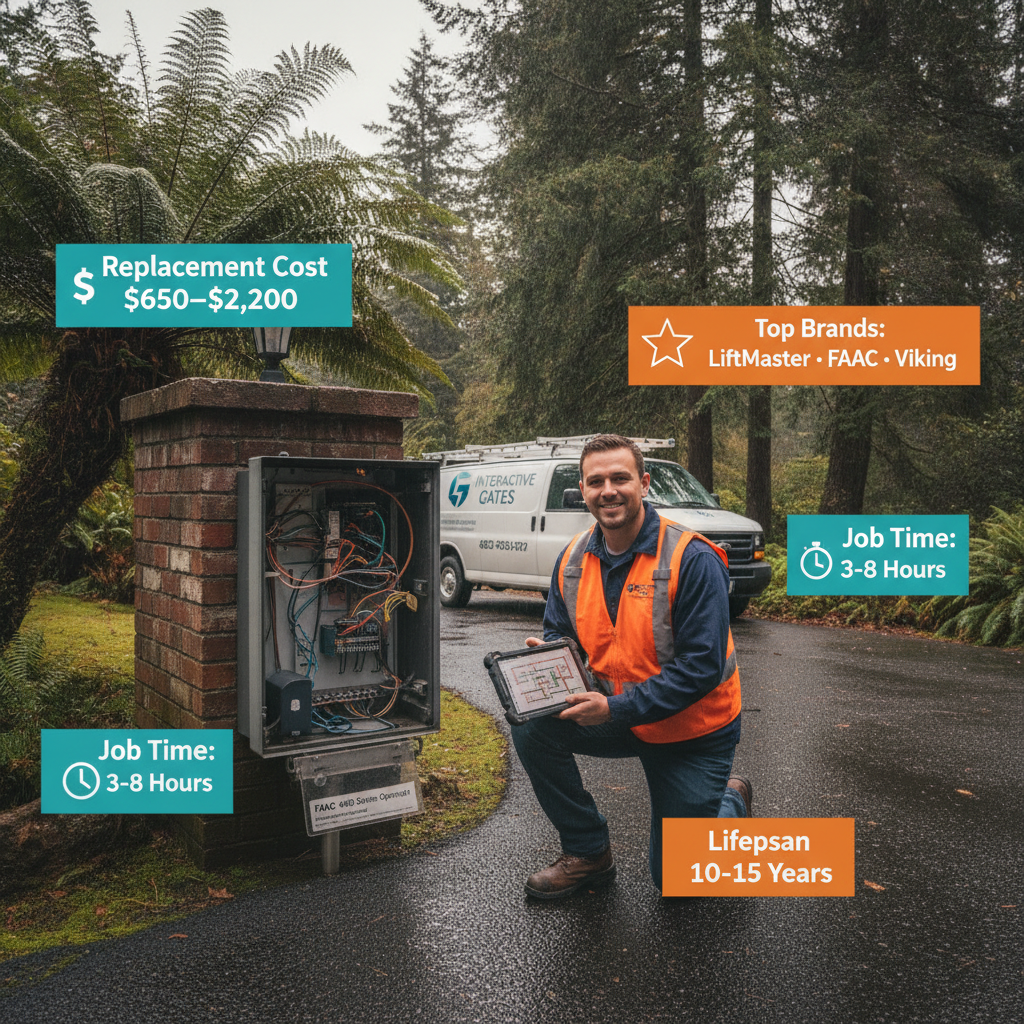
- LiftMaster, FAAC, and Viking are the top operators installed in Portland retrofit projects; Apollo suits lighter residential swing gates on tighter budgets.
- The full retrofit process — assessment, permit, fabrication, install — typically takes 3–6 weeks from first call to first remote open.
Can You Add an Automatic Gate to a Fence That Already Exists in Portland?
You already have the fence. Maybe it went up when you bought the house, or you added it for a dog, a toddler, or plain privacy. Now you want a gate — one that opens when you pull into the driveway without making you step out in a January downpour. You're Googling things like can I add an electric gate to my existing fence Portland, retrofit automatic gate cost Oregon, or do I need a permit to motorize my driveway gate in Portland. This guide answers all of it with real 2026 numbers and Portland-specific context.
Is My Existing Fence Strong Enough to Support a Motorized Gate?
The short answer: maybe — and the posts are almost always the deciding factor. A motorized gate exerts continuous cyclical stress on the hinge post or track mount. A fence built for static panels was never engineered with that in mind.
Here is what an installer checks on day one:
- Post material and diameter. Wood 4×4 posts are almost always insufficient for gates wider than 8 feet. A minimum 6×6 pressure-treated post, or ideally a 3.5-inch-square steel post set in concrete, is the standard retrofit baseline in the Portland market.
- Footing depth. Portland's frost line sits at roughly 12 inches, but best practice for gate posts is 24–36 inches of depth in a concrete collar at least 12 inches in diameter. Shallow footings flex, which misaligns the gate and destroys operators within 2–3 years.
- Post-to-gate weight ratio. A 16-foot, 1.5-inch tubular steel swing gate weighs 250–400 lbs. A 16-foot ornamental iron sliding gate can top 600 lbs. The hinge post must be engineered accordingly.
- Panel spacing and gate opening width. The existing gap in your fence dictates whether you get a single-leaf or dual-leaf swing gate, or whether a slide is even possible given available track space.
In practice, about 60–70 percent of Portland retrofit projects require either replacing the gate posts, adding steel sister posts alongside existing wood posts, or pouring new footings before the operator can be mounted. Budget $400–$1,200 for post and footing work if your current posts are wood.
What Gate Types Work Best as Retrofits in Portland Yards?
Not every gate style suits every existing fence layout. Here is how the three main types stack up for retrofit scenarios across Portland-area lots:
Swing Gates (Single or Dual Leaf)
Swing gates are the most common retrofit choice because they require no track and have fewer moving parts. A single-leaf swing gate works on openings up to about 14–16 feet; beyond that, dual-leaf (bi-parting) is standard. The critical requirement is swing clearance: the gate arc must not sweep over a slope of more than 8–10 degrees, which rules them out for downhill or crowned driveways common in Portland hills neighborhoods like Southwest Hills, Hillsdale, or parts of Lake Oswego without a slope kit. LiftMaster's LA500UL and FAAC's 402 series are the workhorse operators for residential swing retrofits, rated for 500–800 cycles per day and carrying 5-year warranties on electronics.
Sliding Gates
Sliding (cantilever or track-roll) gates are the go-to for sloped driveways and work brilliantly on flat suburban lots in Beaverton, Gresham, or Hillsboro where the fence runs parallel to the house and there is ample track clearance on one side. You need 1.2–1.5× the gate width of clear space along the fence line for the gate to fully retract. A 14-foot opening needs 17–21 feet of open track run. Viking Access V-Slide and LiftMaster SL595 are popular Portland retrofit choices. Cantilever sliders have no ground track, which is a major advantage in Portland winters where debris accumulation in a ground channel causes nuisance stalls.
Vertical Pivot / Vertical Lift Gates
These are specialty solutions for tight lots with zero swing room and no track space. They are more common in commercial retrofit situations in Portland's inner eastside or industrial areas, but some smaller residential lots in dense neighborhoods like Sellwood or Concordia use them. Costs are higher — typically $8,000–$18,000 installed — and they require overhead clearance of at least the gate height plus 2 feet.
Pro Tip: If your driveway slopes more than 5 percent toward the street (common in Portland's West Hills and Lake Oswego hillside streets), a cantilever sliding gate is almost always the better long-term investment over a swing gate — even if swing looks simpler on paper. Slope kits help but add $300–$600 and introduce one more mechanical variable.
How Much Does It Cost to Add an Automatic Gate to an Existing Fence in Portland in 2026?
Here are realistic all-in price ranges for the most common retrofit scenarios, including gate fabrication, operator, access control, wiring, and labor — but not major post replacement (add $400–$1,200 if needed):
- Single-leaf swing gate, 10–12 ft, tubular steel, keypad entry: $3,800–$6,500
- Dual-leaf swing gate, 14–16 ft, ornamental iron, keypad + intercom: $6,500–$10,500
- Single-panel sliding gate, 14 ft, steel, LiftMaster SL595, app control: $5,500–$9,000
- Dual-leaf swing gate, 16–20 ft, powder-coated aluminum, FAAC 402, video intercom: $8,000–$14,500
- Vertical lift gate, commercial-grade, up to 16 ft: $10,000–$20,000+
Material upgrades — switching from painted steel to powder-coated aluminum or adding custom laser-cut panels — add $800–$3,000. Solar backup power (strongly recommended in Portland given winter grid outages in windstorm season) adds $450–$900 per operator.
Do I Need a Permit to Add a Motorized Gate to My Fence in Portland?
Yes, in most jurisdictions. Here is how it breaks down across the Portland metro in 2026:
- City of Portland (Bureau of Development Services): A building permit is required if the gate is motorized and the fence meets or exceeds 6 feet, or if any structural work (new footings, post replacement) is involved. Simple re-gating of an existing opening at 6 feet or under without footing work may fall below the permit threshold, but confirm with BDS before proceeding.
- Beaverton: Beaverton's Community Development department requires a fence/gate permit for motorized installations; fee is typically $75–$185 depending on valuation.
- Hillsboro: Similar to Beaverton — permit required for motorized gates; electrical permit may be separate if a new circuit is run from the panel.
- Lake Oswego: Strict design-review requirements in some neighborhoods; HOA approval may also be needed before a city permit is issued.
- Gresham / Oregon City / Salem: Permit required for structural work and electrical; gate-only cosmetic replacement usually does not trigger a permit.
UL 325 compliance (the national safety standard for automatic gate operators) is non-negotiable regardless of permit status — any reputable installer will spec UL 325-listed operators and entrapment protection sensors. Oregon does not have a separate state-level gate safety code; UL 325 is the operative standard.
How Does Portland's Climate Affect a Retrofit Gate Installation?
Portland averages around 37 inches of rain per year, with most of it landing between November and March. Sustained wet conditions affect retrofit gates in ways that a Southern California or Arizona install does not face:
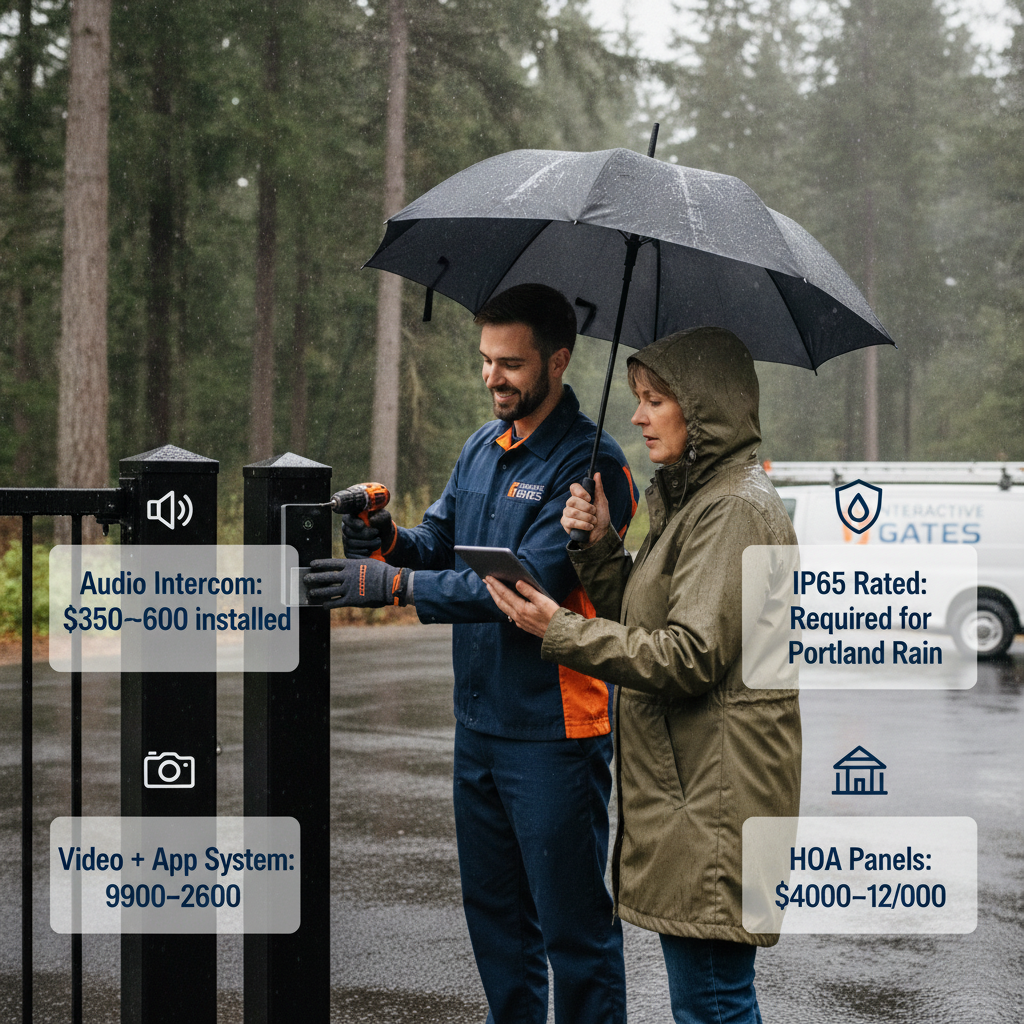
- Operator housing sealing: Budget for IP55 or IP65-rated operators. LiftMaster's commercial LCR and FAAC 402 CBE both carry IP55 ratings as standard. Lesser operators rated only IPX4 show corroded circuit boards within 3–5 winters in Portland conditions.
- Hinge and hardware corrosion: Specify 304 or 316 stainless steel hinges and hardware. Zinc-plated hardware is fine in drier climates but pits visibly within 18–24 months in Portland's rain shadow.
- Wood post swelling: If you are keeping any wood structural elements, specify kiln-dried pressure-treated lumber (ground-contact rated, not just above-ground rated) and use post base hardware that allows drainage — standing water in a post hole is the #1 killer of wood posts here.
- Leaf and debris accumulation: Portland's tree canopy (Doug firs, big-leaf maples, alders) means ground-track sliding gates clog with organic debris in fall. Cantilever sliders eliminate this problem entirely.
- Power outages: The Willamette Valley averages 3–6 significant wind events per winter that cause outages. Every operator should have a battery backup (standard on most modern units) and ideally a solar trickle charger to keep batteries topped during extended cloudy stretches.
Pro Tip: Ask your installer to specify a marine-grade grease (like Mobilith SHC 220 or equivalent) rather than standard lithium grease for all hinge and rack-and-pinion lubrication points. It resists washout in wet conditions 3–4× longer than standard greases, cutting your annual maintenance cost noticeably.
What Access Control Options Work With a Retrofit Gate in Portland?
Adding a motor is only half the equation — you also need a way to open it. Common access control options for Portland residential and small commercial retrofit projects in 2026:
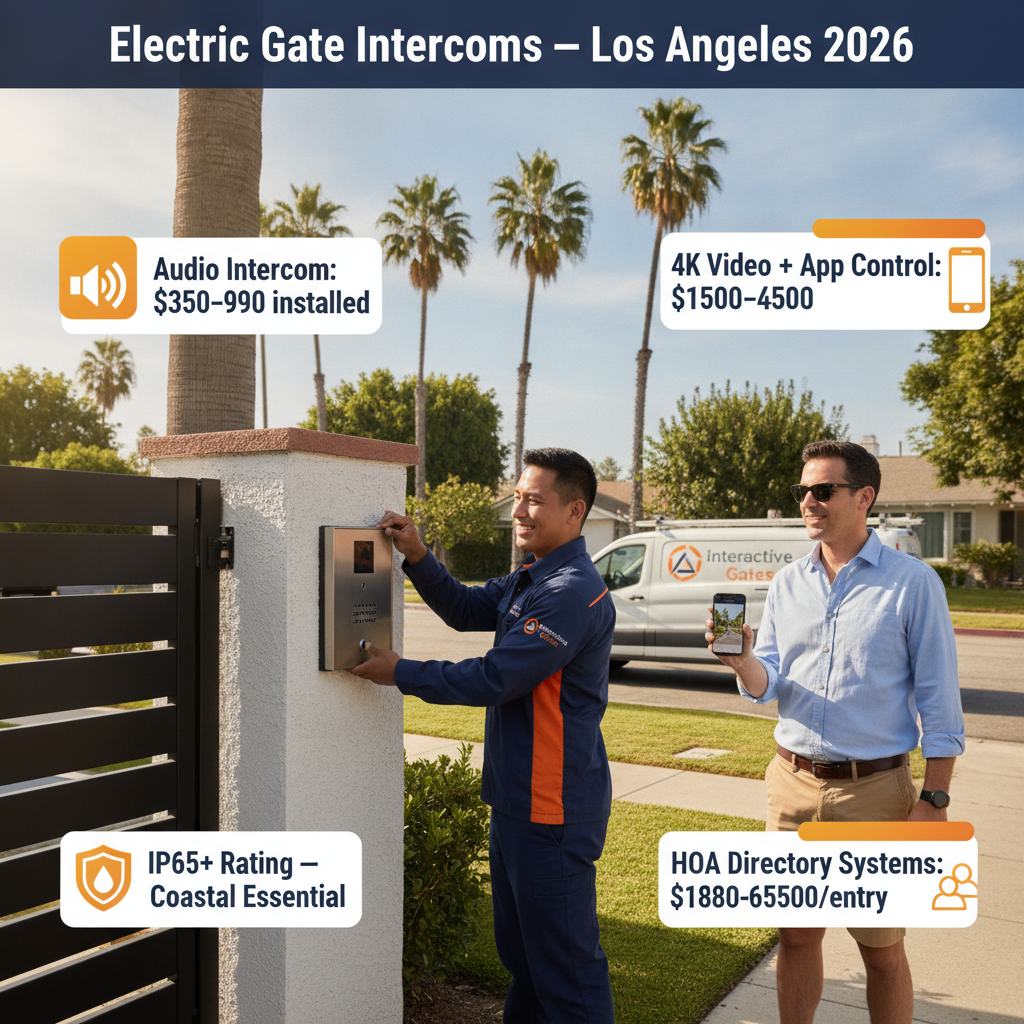
- Keypad entry: $180–$450 hardware; most popular for single-family homes. Linear, DoorKing, and LiftMaster all make weatherproof keypads rated for Portland conditions.
- Key fob / remote: Included with most operators; additional fobs run $25–$65 each. Best for households with few users.
- Smartphone app control: LiftMaster's myQ and FAAC's FAAC Connect platforms allow remote open/close, status alerts, and user management. Requires Wi-Fi at the gate (a Wi-Fi extender or cellular bridge adds $120–$300 if your driveway is far from the house).
- Video intercom: $600–$2,200 hardware; popular in Lake Oswego, SW Portland, and West Linn properties. DoorKing 1835, Aiphone IX series, and Comelit are all well-regarded. Allows two-way video, remote unlock, and visitor logging.
- License plate recognition (LPR): Increasingly popular for longer driveways and small multi-family properties in Portland. Entry-level LPR systems start around $1,800 installed; they eliminate the need to issue fobs to frequent visitors.
For HOA or small multi-family retrofit projects in Portland, see our dedicated commercial and HOA gate page for access-control systems scaled to multiple users.
How Long Does a Retrofit Gate Installation Take in Portland?
A realistic timeline from first phone call to operational gate in 2026:
- Days 1–3: On-site assessment; quote provided.
- Days 4–10: Permit application submitted (if required); lead time varies by jurisdiction — Portland BDS averages 5–10 business days for over-the-counter fence/gate permits in 2026; Beaverton and Hillsboro are typically 3–7 business days.
- Weeks 2–4: Gate fabrication. Custom ornamental iron or laser-cut steel panels take 2–3 weeks; stock tubular steel gates can be ready in 5–7 business days.
- Installation day(s): A standard residential retrofit takes 1–2 days on-site. Post replacement or major electrical work adds a day.
Total elapsed time: 3–5 weeks for standard projects, 5–7 weeks for custom fabrication or complex electrical. Rush installs using in-stock gates and minimal permit requirements can be done in under 2 weeks.
In One Minute: Adding an Automatic Gate to an Existing Portland Fence
- Most fences can accept a motorized gate, but post strength is the gating factor — wood 4×4 posts almost always need upgrading.
- Retrofit costs range from $3,800 for a simple swing gate to $14,500+ for a wide dual-leaf ornamental setup with video intercom.
- Swing gates suit flat driveways; cantilever sliders suit Portland's sloped lots and debris-heavy fall seasons.
- Permits are required in Portland, Beaverton, Hillsboro, and most other metro jurisdictions for motorized gate installs.
- Specify IP55+ operators, stainless hardware, and marine-grade grease for Portland's wet winters.
- Expect 3–6 weeks from assessment to first remote open for a typical project.
Frequently Asked Questions
Can a wood fence post support an automatic gate operator in Portland?
A standard 4×4 wood post cannot reliably support a motorized gate, especially in Portland's wet soil conditions where wood swells and softens over time. A 6×6 pressure-treated post set at least 24–30 inches deep in a concrete collar is the minimum for a gate up to 12 feet wide. For heavier or wider gates, a 3.5- or 4-inch square steel post is recommended. Most installers will assess existing posts during a free site visit and quote any necessary replacement work upfront.
Do I need an electrician to wire a motorized gate in Portland?
If a new 120V circuit is being run from the main panel to the gate operator, Oregon requires that work be done by a licensed electrician, and an electrical permit is needed. If the operator is wired from a low-voltage transformer on an existing circuit within a certain distance, a separate electrical permit may not be required — but requirements vary by jurisdiction. Ask your gate installer whether they carry an electrical contractor license or if they work with a licensed sub for that portion of the job.
What is the best automatic gate operator for wet Portland winters?
LiftMaster's LA500UL (swing) and SL595 (slide) and FAAC's 402 CBE series are the most frequently specified operators for Portland residential retrofits in 2026. Both carry IP55 ratings, have proven track records in the Pacific Northwest, and include battery backup. FAAC is particularly popular for heavier ornamental iron gates. Apollo 1500 and 3500 series are solid budget-friendly options for lighter residential swing gates up to 850 lbs.
Will adding an automatic gate increase my Portland home's value?
Generally yes — particularly in higher-value neighborhoods like Lake Oswego, West Linn, SW Portland, and Dunthorpe where gated entries are considered a premium feature. Realtors in the Portland metro commonly cite gated driveways as a positive listing point that supports asking price, though quantified ROI varies. Security, curb appeal, and convenience are the three value drivers buyers respond to most.
How do I know if my driveway slope is too steep for a swing gate?
A slope of more than 8–10 percent grade at the gate opening point typically makes a standard swing gate impractical without a slope kit, which adds cost and a mechanical variable. Measure by placing a level on the driveway and measuring the rise over a 12-inch run. If the gap exceeds about 1 inch of rise per foot of run, ask your installer to evaluate both a swing-with-slope-kit option and a cantilever slider. Most Portland installers will measure grade during a free assessment.
Can I add a gate to a chain-link fence in Portland?
Yes. Chain-link fences are common retrofit candidates, especially in Gresham, Hillsboro, and industrial-adjacent properties. The fence framework itself can often accept a slide gate on the existing posts if they are steel and properly set. However, most homeowners upgrade to a more decorative gate material (tubular steel or aluminum) when adding a motor, using the chain-link fence for perimeter continuity and a contrasting gate style at the driveway. Chain-link swing gates are also possible but are less popular aesthetically for residential fronts.
Thinking About Adding a Gate to Your Portland Property?
Whether you have a wood privacy fence in Beaverton, an ornamental iron perimeter in Lake Oswego, or a chain-link boundary in Gresham, the retrofit process starts with one honest site assessment. We serve the full Portland metro — check our service pages for Portland, Beaverton, Hillsboro, Lake Oswego, and Gresham. If you already have a style in mind, you can explore options on our gate designer tool before your consultation. When you are ready to talk specifics, our contact page is the fastest way to schedule a free site visit. No pressure — just a real look at what your fence can support and what the project will actually cost.