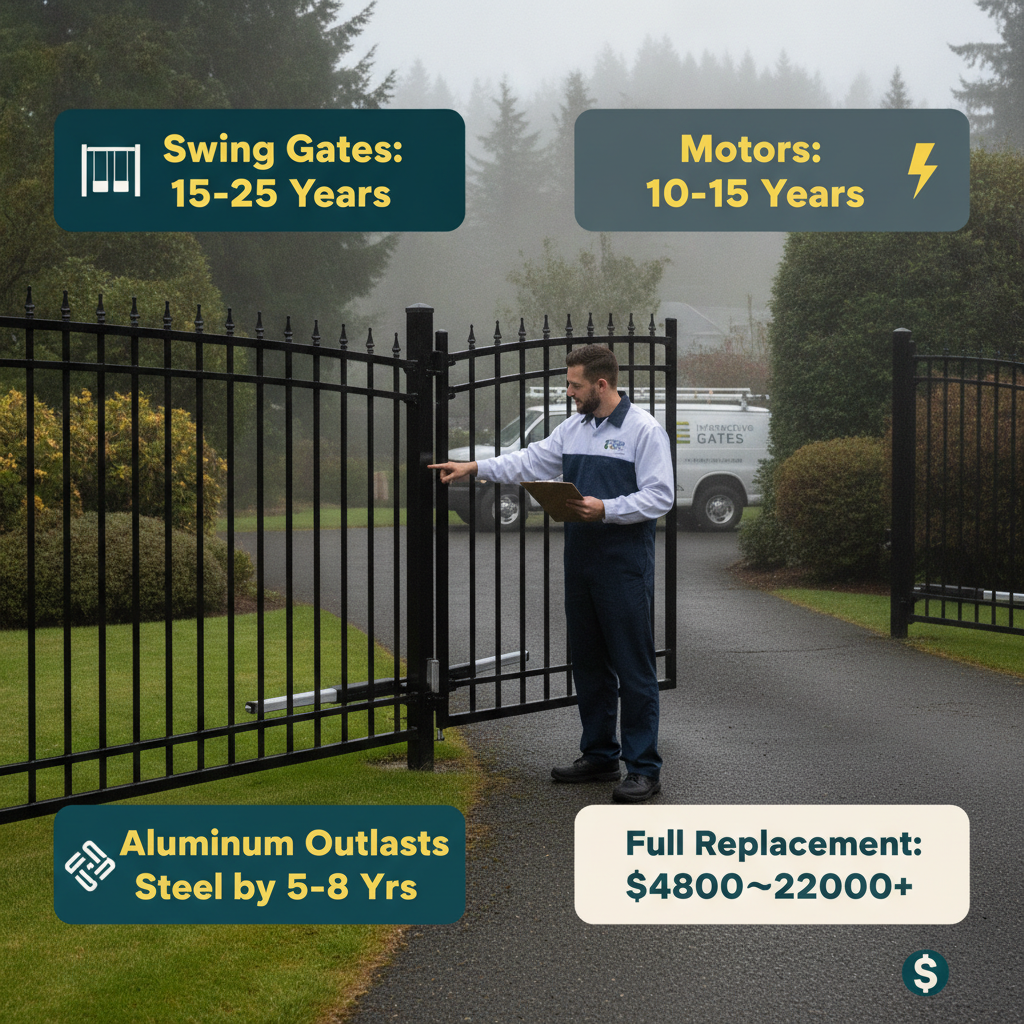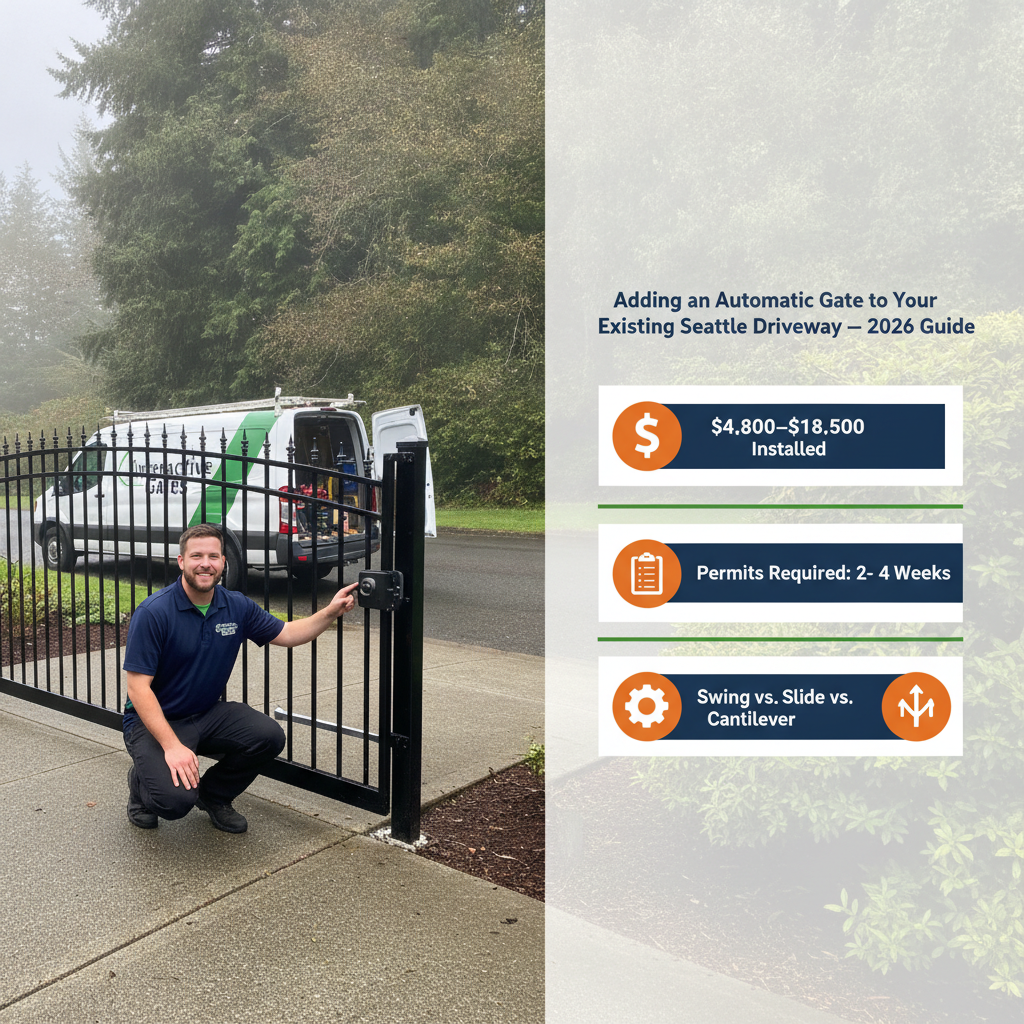
- Most existing Seattle driveways can accept an automatic gate — but slope, width, and surface type all affect which style works.
- Swing gates need at least 14–16 ft of flat clearance behind the gate panel; Seattle's hilly lots often force a slide or cantilever design instead.
- Full installed cost for adding a gate to an existing driveway runs $4,800–$18,500 in 2026, depending on gate type, material, and access-control package.
- Most residential projects take 1–3 weeks from site survey to first open cycle, assuming no permit delays.
- King County and most Seattle-area cities require a building permit for any motorized gate structure over 6 ft or attached to a fence/wall.
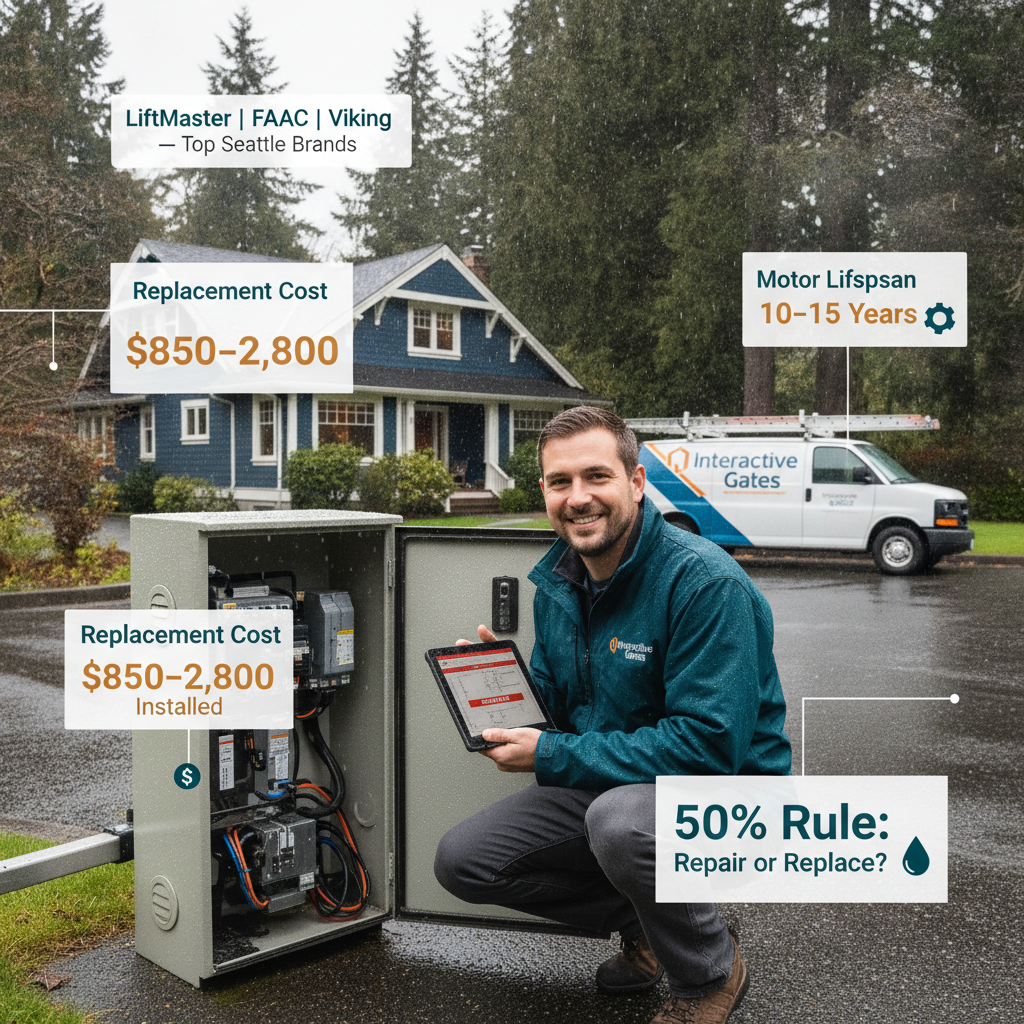
- LiftMaster, FAAC, and Viking are the three most-installed operators in the Seattle metro for retrofit driveway gate projects in 2026.
- Solar power is viable on south- and west-facing driveways in Seattle, but a wired 110V backup circuit is strongly recommended given the region's overcast winters.
- HOA communities in Bellevue, Sammamish, and Gig Harbor typically add $1,200–$3,500 to project cost for multi-user access-control integration.
So You Want a Gate — But the Driveway Already Exists
You've probably typed something like 'can I put an electric gate on my existing driveway Seattle' or 'how much does it cost to add an automatic gate to a driveway in Bellevue' into Google. Maybe you've watched a neighbor's new sliding gate glide open in Magnolia and wondered if your sloped lot in Queen Anne could handle the same thing. The short answer is: almost certainly yes — but the details matter enormously. This guide walks you through every real-world factor a Seattle-area homeowner or HOA board needs to evaluate before signing any contract in 2026.
What Does 'Adding a Gate to an Existing Driveway' Actually Mean?
When your driveway already exists, the concrete, asphalt, or gravel surface is already poured or laid. You're not starting from scratch. What you are doing is engineering a gate system around that fixed surface — which introduces constraints a brand-new build doesn't have. The three core tasks are: (1) setting gate posts or columns in the ground alongside the existing apron, (2) running power (wired or solar) to the operator, and (3) integrating an access-control device — keypad, intercom, app, or card reader. Each step is achievable on an existing driveway, but each one requires a site-specific assessment.
Does My Seattle Driveway Slope Disqualify Me From a Swing Gate?
This is the number-one question installers answer on Seattle residential sites. Seattle's terrain — the hills of Capitol Hill, the grades in Laurelhurst, the steep drops in West Seattle — means a lot of driveways have a noticeable grade change within the first 10–20 feet of the apron. Swing gates (single or dual leaf) open by arcing backward into your property. If the driveway rises more than 6–8 inches across the swing arc, the gate panel will drag or bind on the pavement surface before it fully opens.
The rule of thumb used by most local installers: if your driveway grade exceeds roughly 8% within 15 feet of the gate post, a swing gate is unlikely to work without significant grading. In that scenario, a sliding gate or cantilever gate is almost always the correct retrofit solution. Cantilever gates — which roll on a track mounted to posts rather than a ground-level rail — are especially popular on Seattle driveways because they handle grade changes and don't require cutting a track groove into existing asphalt or concrete.
Pro Tip: Before any installer visit, walk your driveway with a 4-foot level and measure how much rise or drop you have across the first 15 feet past the gate opening. Share that number with your installer — it immediately narrows the gate style options and prevents expensive change orders later.
How Wide Is My Driveway — And Does That Affect the Gate Style?
Standard residential driveways in Seattle range from 10 to 14 feet wide for single-lane drives and 18 to 24 feet for double-wide or shared driveways common in Bellevue and Kirkland neighborhoods. Gate width selection follows from driveway width, plus a few inches of clearance on each post side.
- Single swing gate: works best on openings up to 14 ft. Wider than that and the single panel becomes very heavy for residential operators.
- Dual swing gates (bi-parting): ideal for 14–24 ft openings. Each leaf is roughly half the total width, keeping panel weight manageable.
- Slide gate: requires a run of wall, fence, or clear ground alongside the driveway equal to 1.0–1.25× the gate panel width. On a 16-ft opening you need roughly 18–20 ft of clear run on one side.
- Cantilever slide gate: needs approximately 1.5× the gate opening in clear run — so a 16-ft opening needs about 24 ft of lateral space. Common on larger lots in Gig Harbor and Snohomish.
- Vertical pivot/lift gate: used where no lateral or rearward swing space exists — common in tight urban driveways in Capitol Hill or First Hill, though cost runs higher ($12,000–$22,000 installed).
What Permits Does Seattle or King County Require for a Driveway Gate?
This is the piece most homeowners don't investigate early enough. In 2026, the City of Seattle requires a building permit for any motorized gate system attached to a fence or wall, or for any freestanding gate structure where the operator post exceeds 6 feet in height or the gate is part of a larger fence project. King County has similar requirements for unincorporated areas. Bellevue, Redmond, and Kirkland each have their own permit thresholds, but all three require permits for motorized gates that modify an existing access point to a public right-of-way.
Typical permit costs in the Seattle metro: $200–$650 for residential, $450–$1,400 for commercial or HOA projects. Permit timelines average 2–4 weeks for over-the-counter residential approvals and 4–8 weeks for projects that require a land-use review (common in historic districts like Pioneer Square or on shoreline-adjacent lots in Lakewood or Tacoma). Your installer should pull the permit — if they suggest skipping it, that is a red flag.
How Much Does It Cost to Add an Automatic Gate to an Existing Driveway in Seattle in 2026?
Below are real 2026 installed price ranges for the Seattle metro, covering gate fabrication, posts, operator, basic access control (single keypad or loop detector), and standard electrical connection. These ranges assume the driveway surface itself does not need replacement — just the gate system is being added.
- Single swing gate — steel tubular, 10–12 ft, LiftMaster LA500 operator: $4,800–$7,200 installed
- Dual swing gate — ornamental iron, 14–16 ft, FAAC 402 operator: $7,500–$11,000 installed
- Slide gate — steel, 14–18 ft, Viking SL-2000 operator: $8,200–$13,500 installed
- Cantilever slide gate — steel, 16–20 ft, FAAC 844 operator: $9,500–$15,000 installed
- Wood-clad or composite swing gate — 12–14 ft, LiftMaster CSW200 operator: $6,800–$12,000 installed
- Aluminum driveway gate — powder-coated, 14 ft dual swing, Apollo 1500 operator: $5,900–$9,400 installed
- Vertical pivot gate — commercial-grade, 14–18 ft: $12,000–$18,500 installed
Add-ons that frequently increase Seattle retrofit project costs: trenching through existing concrete or asphalt for conduit ($800–$2,200), retaining wall or post-footing engineering on sloped lots ($600–$1,800), solar panel kit with battery backup ($1,100–$2,400), and video intercom with smartphone app integration ($900–$2,800).
Pro Tip: On slopes or clay-heavy soils common in South Seattle and Auburn, ask your installer to specify a post-footing depth of at least 36–42 inches and use a concrete collar with rebar. Undersized footings on Seattle's expansive soils are the leading cause of post lean within 3–5 years of installation.
What Operator Brand Should I Choose for a Seattle Retrofit Project?
Three brands dominate the Seattle retrofit market in 2026 for good reason:
- LiftMaster (by Chamberlain Group): The most widely installed residential operator in the region. The LA500 (single swing), CSL24UL (slide), and CSW200 (dual swing) are all available with myQ smartphone connectivity out of the box. Parts availability at local distributors is excellent. Expect 80,000–100,000 cycles rated lifespan.
- FAAC (Italian-engineered, US-distributed): Preferred on mid- to heavy-duty residential and HOA gates. The FAAC 402 (swing) and 844 (slide) handle heavier steel panels common on Bellevue and Medina estate gates. Rated to 100,000+ cycles with proper annual service. Slightly higher upfront cost but lower long-term service frequency.
- Viking Access: Strong in commercial and HOA slide/cantilever applications across the Seattle metro. The SL-2000 and SL-3000 models are workhorses on heavy cantilever gates in industrial-adjacent neighborhoods like SoDo and SODO-adjacent Beacon Hill. Rated 200,000–500,000 cycles in commercial configurations.
Apollo (now part of Nice/Home Controls) is a solid value pick for budget-conscious residential swing gate projects — the Apollo 1500 runs $3,800–$5,500 installed and handles panels up to 16 ft / 500 lbs. It's popular in Auburn and Lynnwood neighborhoods where the gate is primarily for privacy rather than high-cycle security use.
Can I Power the Gate With Solar in Seattle's Climate?
Yes — but with important caveats. Seattle averages only about 152 sunny days per year, and October through March bring extended stretches of heavy overcast. A solar-only system on a north-facing or tree-shaded driveway will struggle to maintain adequate charge for reliable daily operation through winter. The practical recommendation from most local installers: use a solar kit with a properly sized AGM or lithium battery bank (at least 20Ah for low-cycle residential, 40Ah+ for higher-cycle or HOA applications) AND run a 110V conduit stub to the operator enclosure as a hardwired backup. The conduit costs relatively little during initial installation but avoids an expensive retrofit later if solar proves insufficient.
South- and west-facing driveways — common in parts of Seattle's Rainier Valley, parts of Bellevue's west slope, and Gig Harbor's harbor-facing lots — perform meaningfully better with solar and can often run solar-primary year-round with a proper 30W+ panel.
HOA Driveway Gate Retrofits in Seattle: What's Different?
HOA communities — particularly those in Sammamish, Issaquah, and the gated communities around Gig Harbor — face additional complexity when retrofitting a gate onto an existing community driveway or entrance. Key differences versus a single-family retrofit:
- Access control must accommodate all residents simultaneously — typically requiring a cloud-managed system (LiftMaster CAPXLV, Doorking, or Openpath) rather than a simple keypad.
- Operator duty cycle matters: a community entrance used by 80 homes may cycle 200–400 times per day. Residential-duty operators are not appropriate — commercial-duty operators (Viking SL-3000, FAAC C720) rated at 500,000+ cycles are required.
- HOA projects almost always trigger a full permit and sometimes a traffic-engineering review if the gate is within 50 feet of a public road intersection.
- Budget accordingly: HOA retrofit projects in the Seattle metro run $18,000–$55,000 for dual-gate entrance configurations with full access-control integration, versus $8,000–$15,000 for a basic single residential gate.
If your HOA board is evaluating options, the commercial and HOA gate page has specific guidance on multi-user access systems and what to include in an RFP.
In One Minute: Adding an Automatic Gate to Your Seattle Driveway
- Almost any existing driveway can get an automatic gate — slope and width determine which style.
- Hilly Seattle lots often require a slide or cantilever gate rather than a swing gate.
- Installed cost ranges from roughly $4,800 for a simple residential swing to $18,500+ for vertical or HOA configurations in 2026.
- LiftMaster, FAAC, and Viking are the proven operator brands for Seattle retrofit projects.
- Permits are required in Seattle, Bellevue, Kirkland, and most King County jurisdictions — budget 2–8 weeks and $200–$650 for residential permits.
- Solar is viable on south/west-facing driveways but always run a hardwired backup conduit.
- HOA community gates need commercial-duty operators and cloud-managed access control — budget $18,000–$55,000 for full entrance configurations.
Frequently Asked Questions
Will adding an automatic gate damage my existing concrete or asphalt driveway?
The gate posts themselves are set in the ground alongside the driveway edge, not through the driving surface, so impact on your existing pavement is minimal. The only time existing pavement is cut is when conduit for power or a ground-loop detector needs to be trenched across the driveway opening. A competent installer will saw-cut cleanly, run conduit, and patch with matching material — the repair is typically barely visible within a year.
How long does the installation take on an existing Seattle driveway?
For a straightforward residential swing or slide gate on an existing driveway with power already accessible nearby, installation typically takes 1–2 days of on-site work. Factor in 1–3 weeks of lead time for gate fabrication (custom steel or iron panels are not off-the-shelf), plus permit processing time of 2–4 weeks for most Seattle-area jurisdictions. Total timeline from deposit to first open cycle: 3–6 weeks is realistic in 2026.
Can I keep my existing fence or wall and just add a gate opening?
Yes — this is one of the most common retrofit scenarios. If you have an existing wood, vinyl, or chain-link fence, a gate opening can be framed into it by removing a section and setting new posts at the correct spacing. The gate is then hung or installed between those posts. The existing fence does not need to be replaced. If the existing fence posts are already in good structural condition and correctly spaced, costs are lower because no new column construction is needed.
Do I need a separate electrical circuit for the gate operator?
Most residential gate operators run on a standard 110V/15A circuit. If your main panel is within 100 feet of the gate location, running a dedicated circuit typically costs $400–$900. If you're on the far side of a large lot and trenching distance is significant, costs can reach $1,500–$2,500. Solar with battery backup is an alternative that avoids trenching entirely — practical on south-facing driveways with good sun exposure, as discussed above.
What is the lifespan of a gate added to an existing driveway?
The gate panel itself — steel, aluminum, or iron — should last 20–40 years with proper finish maintenance (repainting or powder-coat touch-up every 5–10 years). The operator has a rated cycle life: residential LiftMaster units are rated at 80,000–100,000 cycles, FAAC at 100,000+ cycles, and commercial Viking units at 200,000–500,000 cycles. At 10–15 daily cycles on a residential driveway, a residential operator typically lasts 15–25 years. Annual servicing — lubrication, hardware check, safety sensor test — is the single biggest factor in reaching the top of that range.
Can a HOA legally require residents to pay for a gate retrofit on an existing community entrance?
Generally yes, if the HOA's CC&Rs give the board authority to levy special assessments for capital improvements — and most do. The process typically requires a board vote, advance notice to members, and sometimes a member vote depending on assessment size thresholds in the CC&Rs. It's worth having the HOA's legal counsel review the specific governing documents before the board commits to a project. Many HOA boards in Sammamish, Issaquah, and Bellevue communities have completed exactly this process for gate retrofit projects in 2025–2026.
Ready to See What's Possible on Your Driveway?
If you're curious what an automatic gate would look like on your specific property before committing to anything, the Interactive Gates gate designer tool lets you experiment with styles, materials, and colors in minutes. When you're ready for a real site assessment — where an installer actually measures your driveway width, checks your grade, evaluates power options, and gives you a written quote — the contact page is the right next step. You can also browse completed Seattle-area projects in the project portfolio or read what local customers say on the reviews page. No pressure, no obligation — just real information for a real decision.