- Most Portland driveways can accept an automatic gate — but slope, soil type, and setback rules often require site-specific engineering before installation begins.
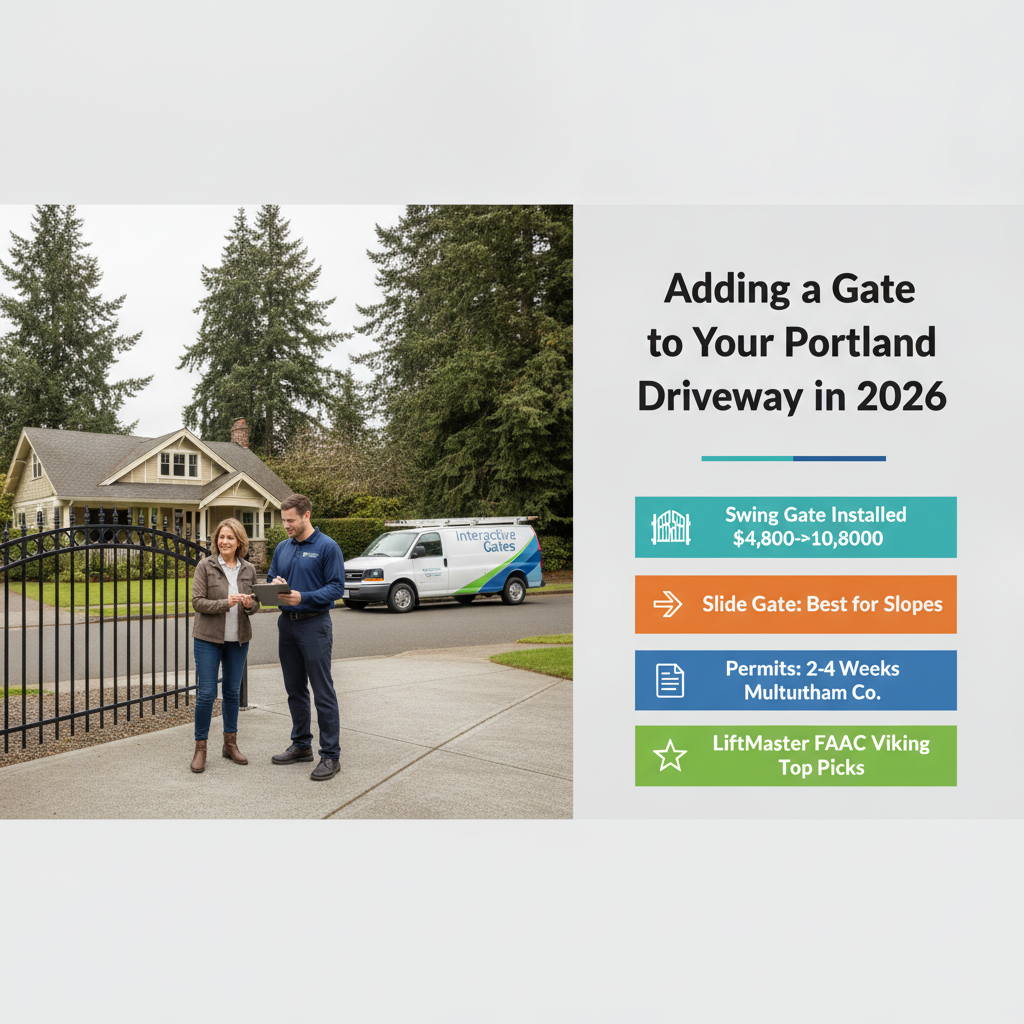
- Budget $4,800–$14,500 installed for a complete swing or slide gate system on an existing driveway, including motor, post footings, and access control.
- Hillside lots in SW Portland, Lake Oswego, and West Linn typically need slide or vertical-lift gates because steep grades prevent swing gates from opening safely.
- Oregon UBC requires a minimum 12-inch-deep concrete footing for gate posts on driveways — deeper if your soil has high clay content, which is common in the Portland Basin.
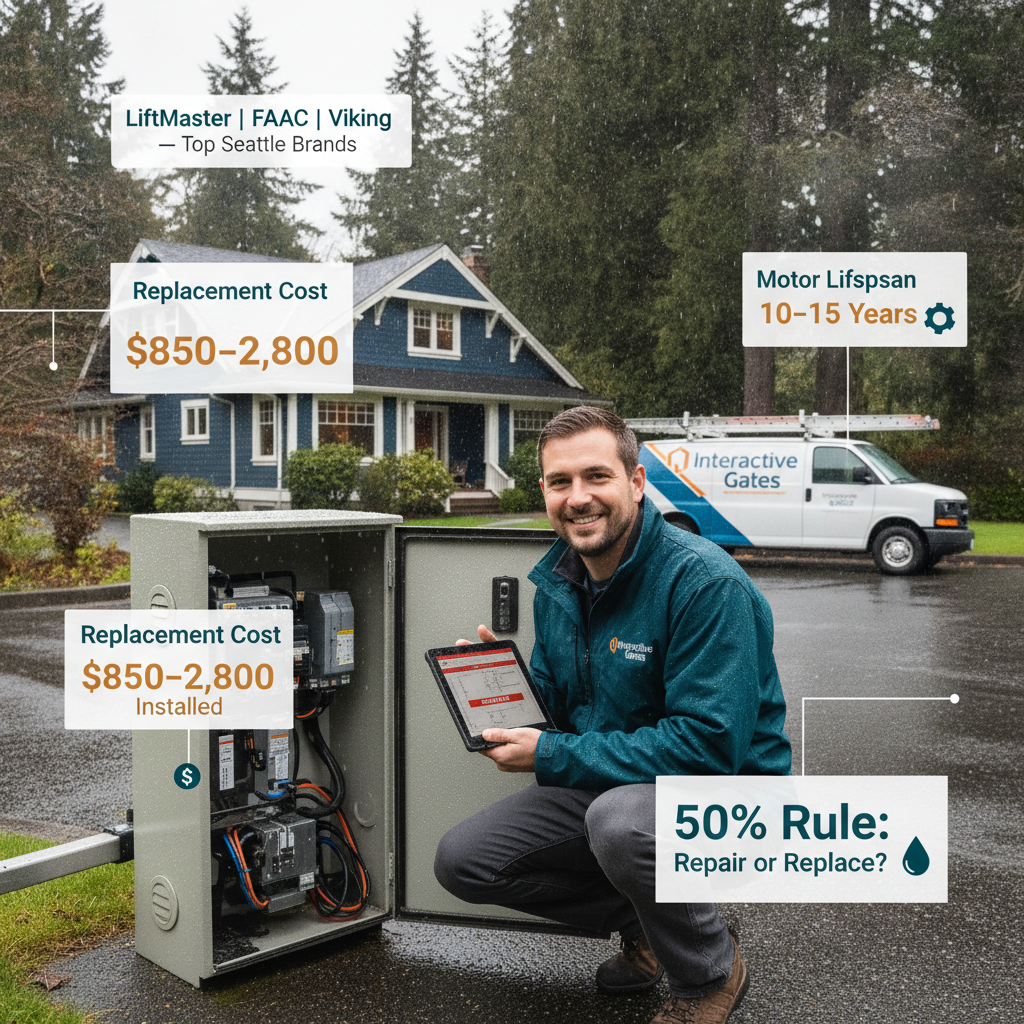
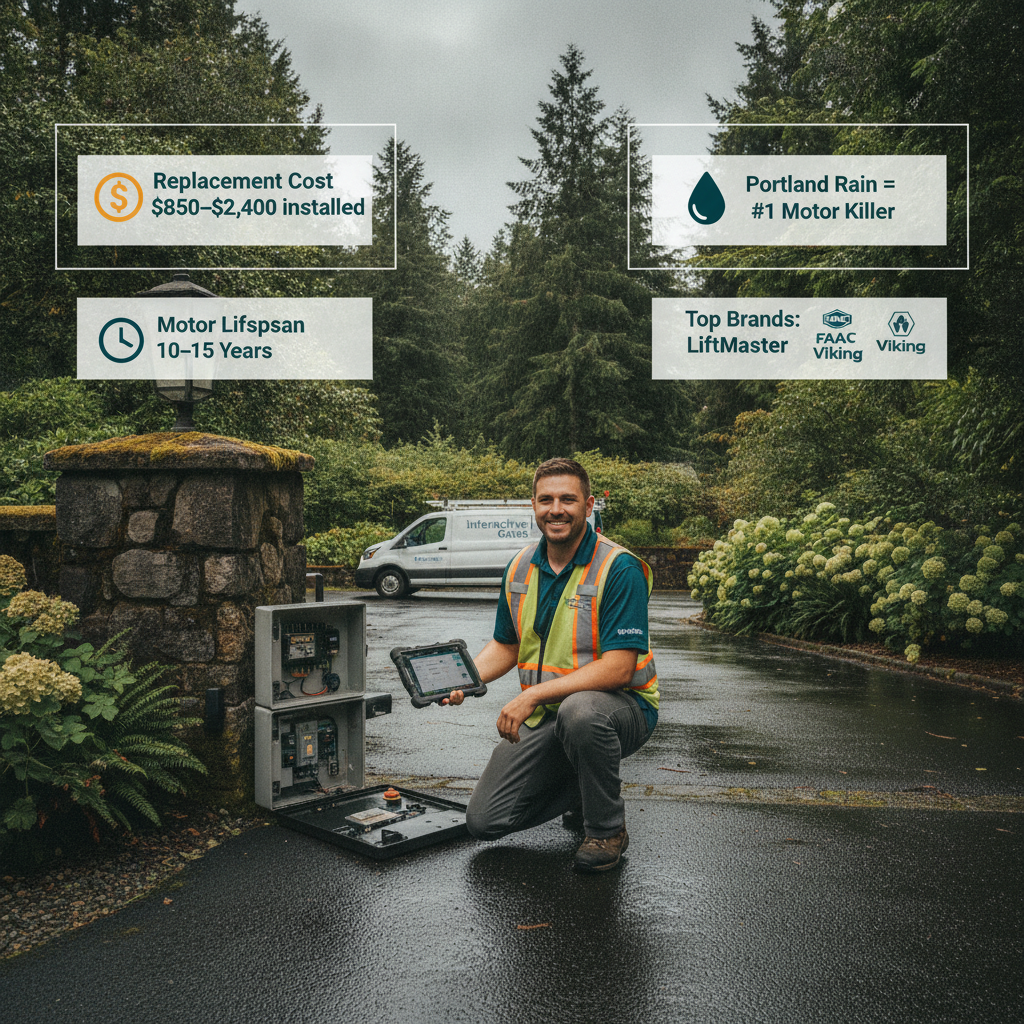
- LiftMaster, FAAC, and Viking are the top motor brands chosen for Portland's wet climate; all three carry IP55 or higher weatherproof ratings for Pacific Northwest rain cycles.
- Permit requirements vary by city — Portland proper and Beaverton both require a building permit for gate structures over 6 feet tall or attached to a fence over 3 feet.
- Access control add-ons (keypad, intercom, camera, app-based entry) add $600–$3,200 to the base project cost depending on system complexity.
- Most retrofit projects are completed in 1–2 days once permits are in hand — plan 2–4 weeks for permitting in Multnomah County.
Can You Actually Add an Automatic Gate to a Driveway That Already Exists?
If you're typing 'can I add an automatic gate to my existing driveway in Portland' or 'how much does it cost to add a gate to a driveway in Oregon,' you're not alone — this is one of the most common calls we get across Portland, Beaverton, Hillsboro, and Lake Oswego. The short answer is yes, most of the time. The longer answer depends on four things: your driveway's width and slope, the soil conditions at the post locations, your local setback rules, and how much access control complexity you want layered on top. This guide walks you through every variable a Portland homeowner or HOA board needs to understand in 2026.
What Makes a Portland Driveway a Good Candidate for an Automatic Gate?
Not every driveway is plug-and-play, but the majority qualify with minor modifications. Here's what installers evaluate on a site visit:
- Driveway width: Single-lane driveways (10–12 ft wide) typically use one swing leaf or a single slide gate. Double-wide driveways (16–24 ft) often use dual swing leaves or a bi-parting slide system. Anything wider than 24 feet may require a cantilever slide or a bi-parting design with a center post.
- Grade and slope: Swing gates require the ground to be relatively level at the arc of travel — generally no more than 6–8% grade. Portland neighborhoods like Hillsdale, Multnomah Village, Eastmoreland's hillside streets, and much of Lake Oswego push past that threshold regularly. In those cases, a slide gate or vertical-lift gate is the correct solution.
- Soil and footing depth: Portland's Willamette Valley soils are clay-heavy, especially in the east side flats and the West Hills. Clay soils expand and contract with moisture, which can shift shallow footings. Oregon UBC requires a minimum 12-inch footing for gate posts; most reputable installers pour 18–24-inch footings here to account for the clay movement cycle.
- Setbacks and easements: Portland's Bureau of Development Services (BDS) enforces front-yard setback rules that vary by zone. In R2 and R5 zones, a gate at the driveway apron often needs to sit at least 18–20 feet back from the property line to allow a car to queue off the street while the gate opens. If your driveway is short, a slide gate is almost always the answer.
- Existing fence or wall tie-in: If you already have a fence or masonry wall along the driveway, posts may tie into those structures — saving cost. But block walls must be inspected for rebar continuity before anchoring a motor-driven gate to them.
Pro Tip: Before calling for quotes, measure your driveway width at the widest point, walk the slope from the gate line to 10 feet inside the property, and check your Portland zoning map (available at portlandmaps.com) for your setback requirements. Installers who show up with that data can give you a firm quote on the first visit instead of a broad range.
How Much Does It Cost to Add an Automatic Gate to an Existing Driveway in Portland in 2026?
Here are real installed price ranges for Portland-area driveway gate projects in 2026. These figures include gate panel fabrication or supply, motor and hardware, concrete footings, basic wiring, and a keypad or loop detector — but not premium access control systems or decorative upgrades.
- Single swing gate, steel, 10–12 ft wide: $4,800–$7,200 installed
- Dual swing gate, steel, 16–20 ft wide: $6,500–$10,800 installed
- Single slide gate, steel, 12–14 ft wide: $6,200–$9,400 installed
- Bi-parting slide gate, steel, 20–24 ft wide: $8,500–$14,500 installed
- Aluminum ornamental single swing, 10–12 ft: $5,500–$8,000 installed
- Vertical-lift gate (hillside/short driveway): $9,000–$16,000 installed
- Wood-clad or cedar privacy panel gate: Add $800–$2,500 to any steel base price
What drives cost upward in Portland specifically? Clay soil requiring deeper footings adds $300–$700. Sloped driveways requiring custom fabrication add $500–$1,500. Permit fees in Multnomah County run $180–$450 depending on project valuation. If you're in a historic district overlay (Ladd's Addition, Irvington, Eastmoreland) expect additional design-review steps that can add 3–6 weeks to the timeline.
Which Gate Style Works Best for Portland Driveways?
The three main automatic gate types each suit different Portland driveway situations:
- Swing gates are the most popular and most affordable choice for flat driveways in neighborhoods like Beaverton, Hillsboro, Gresham, and the east Portland flats. They require clearance for the gate leaf to arc inward (or outward, but outward swing toward a public street is rarely permitted). A 16-ft double swing gate needs roughly 8 feet of swing clearance on each side — make sure you have it before committing.
- Slide gates are the go-to for sloped lots, short driveways, or properties where swing clearance is blocked by a retaining wall, tree, or garage door proximity. Slide gates travel parallel to the fence line and need a 'stacking space' equal to roughly 1.5 times the gate width — so a 14-ft slide gate needs about 21 feet of clear run beside the driveway opening. This is usually achievable in most Portland single-family lots.
- Vertical-lift gates are less common but ideal for very steep West Hills driveways, tight urban lots in inner SE or NE Portland, or commercial entries where horizontal space is at a premium. They open like a parking garage arm but with a full-panel gate. Cost is higher — expect $9,000–$16,000 — but they solve problems swing and slide cannot.
What Motor Brands Hold Up in Portland's Rain and Humidity?
Portland averages 37 inches of rain annually, with a near-constant drizzle season from October through April. Motor selection matters more here than in drier climates. The top three brands for Portland driveways in 2026 are:
- LiftMaster (LA400, LA500 series): The most widely installed residential swing gate operator in the Pacific Northwest. The LA500 handles gates up to 18 feet and 850 lbs, is rated for 1,000+ cycles per day, and integrates with myQ smart home systems. IP55 weatherproof rating handles Portland rain without issue. Operator unit runs $650–$950 before installation.
- FAAC (400 and 760 series): Italian-engineered, hydraulic swing operators that are nearly maintenance-free in wet climates. The hydraulic design means no exposed gearbox to rust. Popular on higher-end residential properties in Lake Oswego and Oregon City. Operator unit runs $900–$1,400 before installation.
- Viking (VG Series slide operators): The preferred slide gate operator for Portland's sloped-lot market. The VG25 handles gates up to 25 feet and 1,200 lbs. Fully enclosed drive system resists debris and moisture. Operator unit runs $750–$1,100 before installation.
All three brands offer battery backup — essential in Portland where windstorms knock out power several times each winter. A battery backup module adds $150–$300 and ensures your gate opens and closes during an outage.
Pro Tip: If your driveway gate is more than 150 feet from your electrical panel, ask your installer about a solar-assist kit. Portland gets enough UV even in winter to maintain a battery through most outage scenarios — LiftMaster's SOLKIT1 pairs directly with the LA series and adds roughly $400 to the project.
Do You Need a Permit to Add a Gate to Your Driveway in Portland?
Yes — in most cases. Here's how it breaks down by jurisdiction:
- Portland (Multnomah County): A building permit is required for any gate structure over 6 feet tall or any gate attached to a fence that itself required a permit. Gate operators are treated as electrical work and require an electrical permit as well. Plan for $180–$450 in permit fees and 2–4 weeks processing time at BDS.
- Beaverton: Beaverton follows Washington County Community Development rules. Gates on residential driveways under 6 feet generally do not require a building permit, but electrical work still requires an electrical permit. Timeline: 1–2 weeks.
- Hillsboro: Similar to Beaverton. Building permit triggered at 6 feet. Hillsboro has slightly faster permit processing — typically 1–2 weeks for residential gate projects.
- Lake Oswego: Stricter design review for properties in overlay zones near the lake and in historic neighborhoods. Expect 3–5 weeks and potentially a design review fee of $200–$400 on top of standard permit fees.
- Gresham and Oregon City: Both follow Multnomah County and Clackamas County rules respectively. Generally 2–3 weeks, fees $150–$350.
- Salem: Marion County permits required for structures over 6 feet; Salem has a dedicated online permit portal that often processes in 1–2 weeks for straightforward gate projects.
What Access Control Options Can You Add to an Existing Driveway Gate?
Once the gate and motor are in place, access control is where the system becomes truly functional. Common add-ons for Portland homeowners in 2026:
- Keypad entry: The baseline. A surface-mount or post-mount keypad adds $250–$500 installed. LiftMaster's 387LM is the most popular residential keypad in this market.
- Vehicle loop detectors: Cut into the driveway asphalt or concrete, loops trigger the gate to open as your car approaches from inside. Essential for safety. Add $300–$500 installed per loop.
- Video intercom: Systems like the DoorBird D2101V or the Liftmaster CAPXLV connect to your smartphone and let you see and speak with visitors before granting access. Add $600–$1,400 installed depending on camera resolution and brand.
- App-based cloud access (myQ, FAAC Connect, AeroPoint): Remote open/close and real-time alerts via smartphone. Add $200–$500 for the gateway hardware; some systems have a $10–$15/month cloud subscription.
- License plate recognition (LPR): More common in HOA or commercial settings but growing in high-end residential. AI cameras read plates and auto-open for registered vehicles. Add $1,500–$3,200 installed.
- Telephone entry system: Required for most HOA driveway gates in Oregon. A resident dials their unit number, the visitor speaks to them, and they press 9 to open the gate. Systems like the Linear AE-100 or Doorking 1812 are standard. Add $800–$2,500 installed.
How Long Does the Retrofit Installation Actually Take?
Once permits are approved, a typical driveway gate retrofit in Portland takes 1–2 days on-site. Here's the general sequence:
- Day 1, morning: Dig and pour post footings (18–24 inches deep in Portland clay). Footings must cure for 24–48 hours before post installation — this is the most common scheduling gap.
- Day 1 or Day 2: Set gate posts, hang gate panels, install motor and hardware. Run conduit to electrical panel or junction box. Connect access control wiring.
- Final: Program keypad/intercom, test safety sensors (UL 325 photo-eye and edge sensor testing is required), adjust gate speed and auto-close timer. Walkthrough with homeowner.
Total elapsed calendar time from signed contract to completed installation: typically 3–6 weeks in 2026, driven almost entirely by permit processing time. Projects in Beaverton and Hillsboro with faster permit turnarounds often wrap in 2–3 weeks.
In One Minute: Adding an Automatic Gate to a Portland Driveway
Most Portland driveways can accept an automatic gate retrofit. Flat lots in Beaverton, Gresham, and east Portland typically use swing gates ($4,800–$10,800 installed); sloped lots in the West Hills, Lake Oswego, and Oregon City need slide or vertical-lift gates ($6,200–$16,000). Portland clay soil means footings must go 18–24 inches deep. Building and electrical permits are required in most jurisdictions — budget 2–4 weeks for Multnomah County processing. LiftMaster, FAAC, and Viking are the top motor brands for Pacific Northwest rain cycles, all with IP55+ weatherproof ratings. Access control add-ons (keypad, intercom, app access) run $250–$3,200 depending on complexity. Once permits are issued, installation is typically 1–2 days on-site.
Design your Portland driveway gate with our free visualizer toolFrequently Asked Questions
Can I add an automatic gate to a sloped driveway in Portland?
Yes, but slope determines which gate type is viable. Driveways with more than 6–8% grade at the gate line cannot use a standard swing gate because the gate leaf will drag on the ground or bind mid-swing. Slide gates or vertical-lift gates are the correct solution for Portland's many hillside lots. A qualified installer will measure your grade on the first visit and specify the right system. Expect to pay $1,000–$3,000 more for a slide gate compared to an equivalent swing gate due to the longer track and heavier hardware required.
Do I need a permit to install a driveway gate in Portland OR?
In most cases, yes. Portland proper requires both a building permit and an electrical permit for automatic gate installations. The building permit is triggered when a gate structure exceeds 6 feet in height or is attached to a permitted fence. Electrical work on the motor and access control always requires an electrical permit regardless of gate height. Permit fees typically run $180–$450 in Multnomah County, and processing takes 2–4 weeks in 2026. Suburban cities like Beaverton and Hillsboro have slightly simpler processes and faster turnarounds.
How wide does my driveway need to be for an automatic gate?
A standard single-car driveway at 10–12 feet wide accommodates a single swing leaf or single slide gate with room to spare. A double-wide driveway at 16–24 feet typically uses dual swing leaves or a bi-parting slide. Beyond 24 feet, you'll need a cantilever slide with no center post or a bi-parting system with a removable or buried center bollard. There is no minimum width requirement — even a 9-foot service lane can be gated — but wider openings significantly increase cost due to heavier panel fabrication and more powerful motors.
Which automatic gate motor is best for Portland's wet climate?
LiftMaster's LA series, FAAC's hydraulic operators, and Viking's VG series slide operators are all well-matched to Portland's 37-inch annual rainfall and extended damp season. All three carry IP55 or higher enclosure ratings. FAAC's hydraulic design is particularly rain-resilient because there is no exposed gearbox to corrode. For swing gates on flat lots, the LiftMaster LA400 or LA500 is the most common and cost-effective choice. For slide gates on sloped lots, Viking's VG25 is the market standard. Battery backup is strongly recommended on all systems given Portland's winter windstorm frequency.
How long does it take to install a gate on an existing driveway?
On-site installation typically takes 1–2 days once permits are in hand. The footing pour on Day 1 requires a 24–48-hour cure before posts can be set, so most projects span two on-site days. The bigger time variable is permitting: Multnomah County (Portland) averages 2–4 weeks for residential gate permits in 2026, while Beaverton and Hillsboro often process in 1–2 weeks. From signed contract to a fully operational gate, expect a total elapsed time of 3–6 weeks depending on jurisdiction and installer scheduling.
What access control system should I use for a residential driveway gate in Portland?
For a single-family home, the most practical starting point is a keypad plus in-ground vehicle loop detectors — total add-on cost around $550–$1,000. Adding a video intercom (DoorBird, LiftMaster CAPXLV) lets you screen visitors remotely via smartphone and is worth the extra $600–$1,400 for most homeowners. App-based cloud control (myQ, FAAC Connect) adds another $200–$500 and gives you remote open/close and real-time alerts. HOAs and multi-family properties typically require a telephone entry system such as the Linear AE-100 or Doorking 1812 ($800–$2,500 installed), which allows residents to grant visitor access from any phone.
Ready to See What Your Driveway Can Support?
Every driveway is different — slope, soil, width, and setbacks all shape what system will work best and what it will realistically cost. If you're in Portland, Beaverton, Hillsboro, Lake Oswego, Gresham, Oregon City, or Salem, the most useful next step is a site visit from someone who knows local permit requirements and Pacific Northwest soil conditions. Reach out to Interactive Gates to schedule a no-pressure consultation, or browse completed Portland-area projects to get a feel for what's possible on driveways similar to yours.