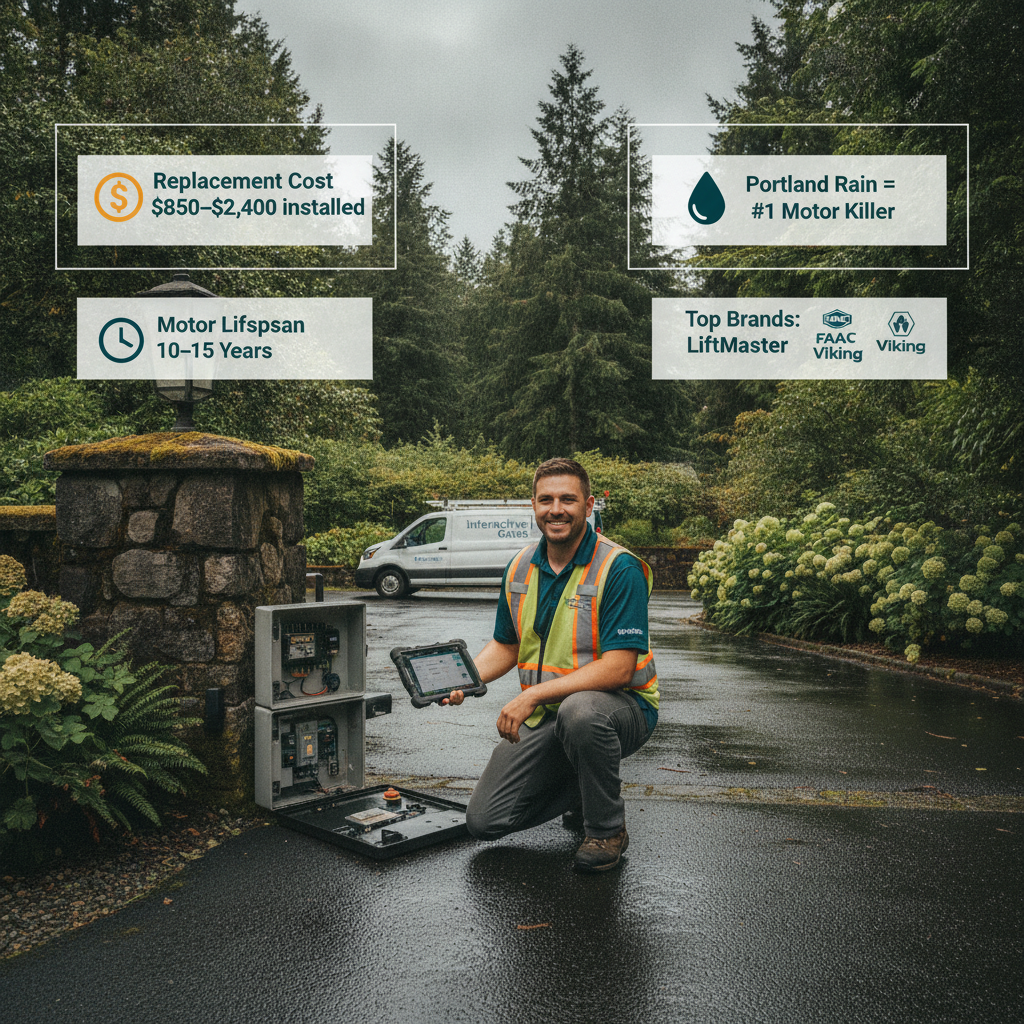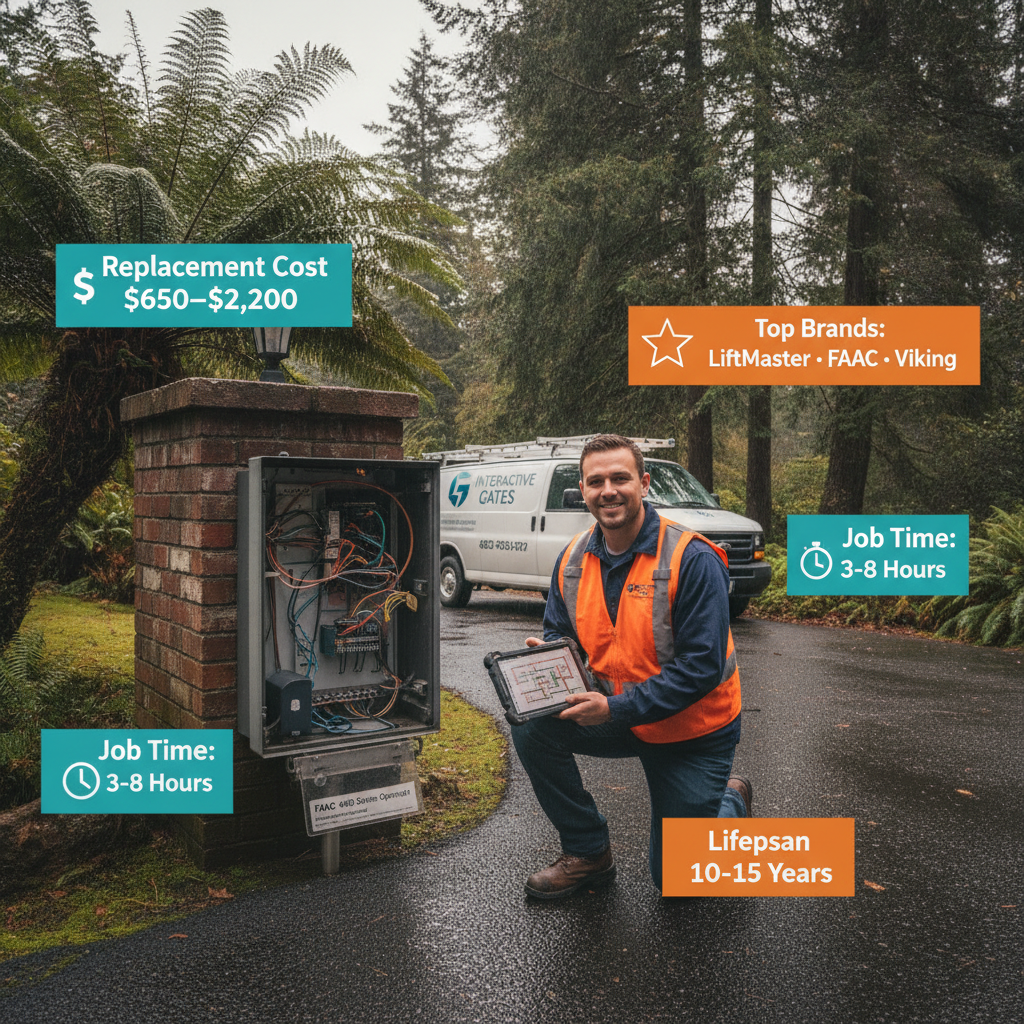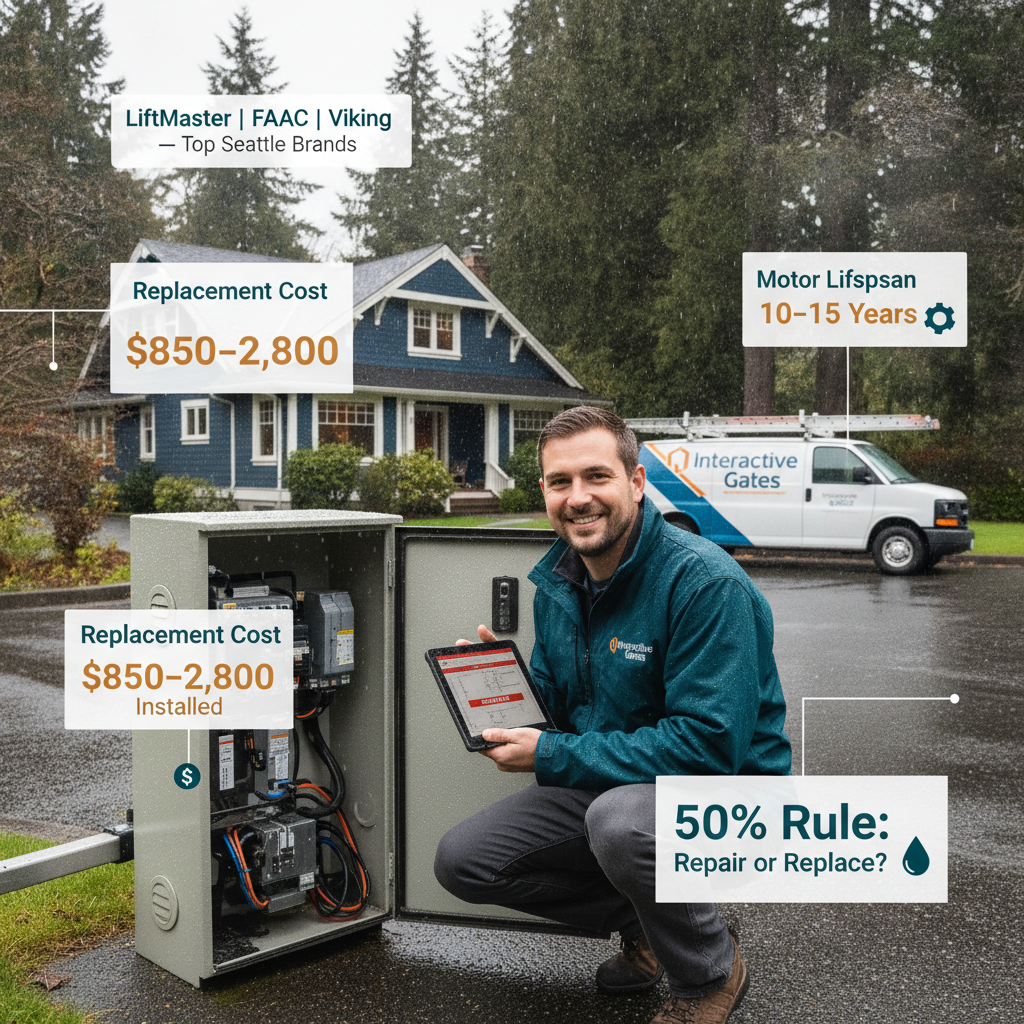
- Motor replacement in Seattle runs $850–$2,800 installed depending on gate type, operator brand, and labor access.
- Most residential gate operators last 8–15 years with annual maintenance; salt air near Puget Sound and heavy rain can cut that to 6–10 years.
- Cycle count matters more than age — a motor rated for 500 cycles/day failing at 200 cycles/day often means a wiring or sensor issue, not end-of-life.
- LiftMaster, FAAC, and Viking are the top brands in Seattle; Apollo suits lighter residential gates; Elite Access handles high-volume HOA use.
- Repair is worth it under $400; once repair quotes exceed 50–60% of a new operator's installed cost, replacement wins financially.
- Permit requirements vary by city — Bellevue and Tacoma typically require electrical permits for motor swaps involving new conduit runs; Seattle proper does as well.
- Lead times in 2026 run 1–3 weeks for most operators; FAAC commercial units can take 3–5 weeks if not in local distributor stock.
- Cold, wet Pacific Northwest winters stress capacitors and limit boards — budget for a weatherproof enclosure upgrade ($120–$280) when replacing older motors.
Is Your Seattle Gate Motor Dead or Just Sick? Here's How to Tell
Homeowners in Bellevue, Queen Anne, and Gig Harbor are searching 'electric gate motor stopped working Seattle,' 'gate opener keeps reversing,' and 'how much to replace gate motor Seattle 2026' every week. The frustrating part is that a truly dead motor and a motor that just needs a $90 capacitor replacement look almost identical from the outside — both leave your gate sitting still and your driveway blocked. This guide walks you through the diagnostic, the cost math, and the brand choices that hold up in Seattle's wet, windy, and occasionally freezing climate.
What Causes Gate Motors to Fail in Seattle's Climate?
Seattle's weather is uniquely hard on gate operators. Annual rainfall averages 38–40 inches, but it's the persistent drizzle from October through April — not the occasional downpour — that does the most damage. Moisture seeps into control boards, corrodes terminals, and causes capacitors to swell. Properties within a mile of Puget Sound, Elliott Bay, or Lake Washington face an added salt-air corrosion load that accelerates terminal oxidation by 30–40% compared to inland Snohomish or Auburn locations.
The five most common failure modes Seattle technicians see in 2026 are: 1) failed capacitors ($90–$180 part + labor), 2) corroded or shorted control boards ($220–$480 to replace), 3) burned motor windings from extended stall cycles (usually end-of-life), 4) failed limit switches ($75–$160), and 5) water-damaged transformer/power supply units ($110–$260). The first four are often repairable; burned windings almost always mean full motor replacement.
Pro Tip: Before calling for service, check your breaker and the operator's built-in diagnostic LED. LiftMaster operators flash a code sequence that maps to specific faults in their manual — a flashing '4-2' pattern, for example, points to an RPM sensor issue, not a dead motor. That 30-second check can save you a $150 diagnostic call.
How Much Does Gate Motor Replacement Cost in Seattle in 2026?
Installed prices in the Seattle metro have risen roughly 8–12% since early 2025, driven by labor costs and continued supply-chain pressure on imported European operators. Here are realistic 2026 ranges by gate type:
- Single residential swing gate (LiftMaster LA400, Apollo 1550-ETL, Viking DS series): $850–$1,350 installed. Single-arm operators in this class handle gates up to 16 feet and 500 lbs and are the most common swap in neighborhoods like Ballard, Beacon Hill, and Phinney Ridge.
- Dual swing gate (FAAC 402 pair, LiftMaster LA500 pair, Viking DS-2000 pair): $1,400–$2,100 installed. Dual operators require synchronized programming and typically add 1.5–2 hours of labor over a single swap.
- Residential sliding gate (LiftMaster SL595, Viking SL series, Elite Access SL-1000): $1,100–$1,900 installed. Chain-drive units on heavier cantilever gates at the upper end of that range.
- Commercial/HOA swing or slide (FAAC 740, Viking DJ series, Elite Access UL325-compliant units): $1,800–$2,800 installed. High-cycle commercial operators rated 1,000–3,000 cycles/day; mandatory for gated communities under Washington State UL 325 compliance rules.
- Barrier arm operators (LiftMaster LACX, BFT Giotto, FAAC 615): $950–$1,600 installed. Common in Tacoma and Lakewood apartment complexes and mixed-use parking facilities.
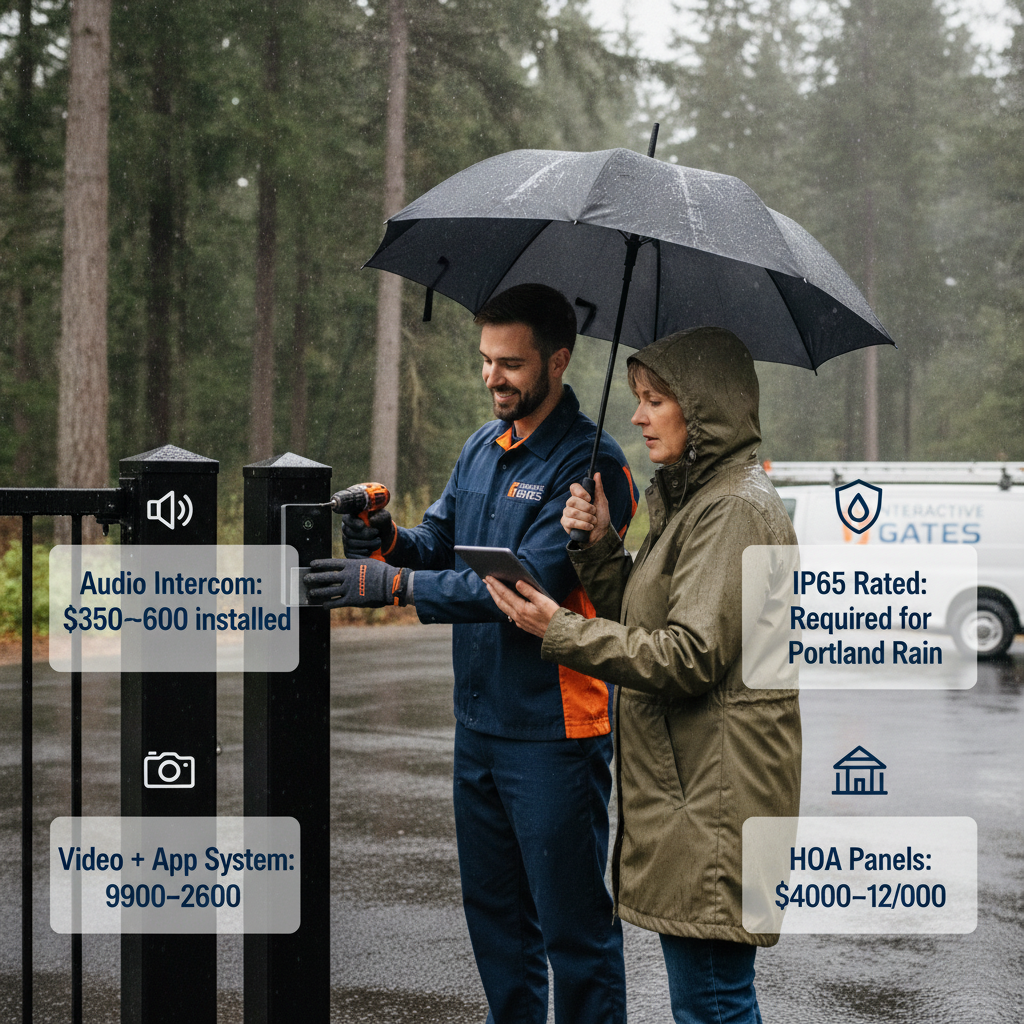
Labor alone typically runs $180–$380 for a straightforward residential swap — two to three hours at $90–$125/hour. Add $120–$280 if the existing conduit or enclosure needs upgrading to current weatherproofing standards, and $80–$200 if new wiring runs are required to a secondary keypad or intercom.
Repair vs. Replace: The Decision Framework Seattle Homeowners Should Use
The 50% rule is the clearest guideline: if the repair quote exceeds 50% of the total installed cost of a new operator, replace it. Here's how that plays out in real numbers. A LiftMaster LA500 residential swing operator costs roughly $1,050 installed new in 2026. If your technician quotes $540 to replace the control board and capacitor on a 12-year-old unit, you're at 51% — replacement wins, because the aging motor windings, gears, and wiring harness will likely fail within the next 2–3 years anyway.
Repair is clearly the right call when: the gate is under 6 years old, the failed part is a sensor, limit switch, or capacitor (all under $200 parts), or the operator itself is a premium unit like a FAAC 740 or Elite commercial operator that would cost $2,200+ to replace — in those cases, a $400–$600 board repair is excellent ROI.
Age-based rule of thumb for Seattle operators: under 6 years — repair anything under $350; 6–10 years — repair minor parts only (sensors, limits, capacitors); 10–15 years — repair only if under 40% of replacement cost; over 15 years — replace. The persistent moisture exposure in Seattle's climate compresses these timelines by roughly 15–20% compared to drier inland climates.
Which Gate Motor Brands Hold Up Best in Seattle's Wet Climate?
Not all operators are created equal for Pacific Northwest conditions. Here's what local installers are recommending in 2026:
- LiftMaster (Chamberlain Group): The most widely installed residential brand in the Seattle market. The LA400 and LA500 swing operators feature sealed enclosures and a solid track record in wet climates. MyQ connectivity is a bonus for remote monitoring. Typical residential lifespan in Seattle: 10–14 years with annual service. Replacement motor assembly: $320–$580 parts only.
- FAAC (Italian-made, distributed regionally): The premium choice for heavy gates and high-cycle commercial applications. FAAC operators use oil-bath lubrication that actively resists moisture ingress — a major advantage in Seattle. The 402 (swing) and 740 (swing/slide commercial) are workhorses. Downside: parts lead times can run 3–5 weeks from regional distributors. Lifespan: 12–18 years. Replacement motor: $480–$980 parts only.
- Viking Access Systems: Strong performer in the mid-range residential and light-commercial space. The DS-2000 dual swing and SL series slide operators are popular in Bellevue, Kirkland, and Mercer Island HOAs. Good parts availability locally. Lifespan: 10–14 years. Replacement motor: $380–$620 parts only.
- Apollo Gate Operators: Best suited for lighter residential gates (under 350 lbs, under 16 feet). Popular in Snohomish County and Gig Harbor acreage properties. Less robust in high-moisture conditions than FAAC or LiftMaster sealed units. Lifespan: 8–12 years in Seattle climate. Replacement motor: $280–$460 parts only.
- Elite Access Systems: The go-to for UL 325-compliant HOA and commercial installations. The SL-1000 and DJ-1000 handle 1,500–3,000 daily cycles and include entrapment protection sensors as standard. Lifespan: 15–20 years commercial-rated. Replacement motor: $620–$1,100 parts only.
Pro Tip: When replacing a motor on a gate that's 8+ years old, always ask your installer to replace the safety reversal sensors and the loop detector (if equipped) at the same time. Those components are often as old as the motor and typically cost $120–$240 combined — avoiding a second service call six months later is worth every dollar.
Do You Need a Permit to Replace a Gate Motor in Seattle?
This question trips up a lot of homeowners. In most cases, a like-for-like operator swap — same voltage, same wiring path, no new conduit — does not require a separate electrical permit in Seattle proper, Bellevue, or Tacoma. However, if the replacement involves running new low-voltage or line-voltage conduit, upgrading from a battery-backup system to a hardwired unit, or adding a new keypad or intercom circuit, an electrical permit is typically required. Permit fees in King County run $85–$175 for minor electrical work. Always confirm with your installer whether the planned scope triggers a permit requirement — unlicensed electrical work can create issues at resale. You can also check Interactive Gates' service coverage for your specific city at Seattle, Bellevue, or Tacoma.
How Long Will a New Gate Motor Last in Seattle?
A new residential operator installed correctly in 2026 should deliver 10–15 years of service life in the Seattle climate with one annual maintenance visit. That maintenance visit — typically $120–$200 — includes lubricating the drive mechanism, inspecting and cleaning terminals, testing safety reversal per UL 325, and checking the control board for moisture ingress. Skip it for three or four years and you're realistically compressing that 10–15 year lifespan down to 7–9 years. HOA and commercial operators rated for 1,000+ daily cycles can last 15–20 years under a proper maintenance contract.
In One Minute: Electric Gate Motor Replacement in Seattle
If your Seattle gate motor stops working, start with a quick diagnostic check (breaker, LED fault code, sensor obstruction) before assuming the worst. Repair costs $90–$480 for minor parts; full motor replacement runs $850–$2,800 installed depending on gate type and brand. Use the 50% rule: if repair exceeds half the replacement cost, replace. LiftMaster and FAAC are the top picks for Seattle's wet climate; FAAC's oil-bath lubrication is especially well-suited to persistent moisture. New operators last 10–15 years residential with annual service. Permits are usually not required for like-for-like swaps but may apply if wiring changes are involved. Lead times in 2026 run 1–3 weeks for most brands. See installation examples in the Interactive Gates portfolio and read what Seattle-area customers say on the reviews page.
Frequently Asked Questions: Gate Motor Replacement in Seattle
How do I know if my gate motor needs to be replaced or just repaired?
Start with a professional diagnostic, which costs $95–$150 in the Seattle area. If the fault is a capacitor, limit switch, or sensor — all under $200 in parts — repair is the clear call. If the control board is fried or the motor windings are burned, get a replacement quote and apply the 50% rule: repair costs exceeding half of installed replacement cost make replacement the smarter financial choice, especially on operators older than 10 years.
What is the most reliable gate motor brand for Seattle's rainy climate?
FAAC operators are widely regarded by Seattle-area installers as the most moisture-resistant, thanks to their oil-bath lubrication and sealed enclosures. LiftMaster is the most common residential choice with solid weatherproofing and excellent parts availability. For budget-conscious residential buyers, Viking Access is a strong mid-range alternative with good local parts support in the King County and Snohomish County markets.
How much does it cost to replace a gate motor in Seattle in 2026?
Installed costs range from $850–$1,350 for a single residential swing operator, $1,400–$2,100 for dual swing operators, $1,100–$1,900 for residential sliding gate operators, and $1,800–$2,800 for commercial or HOA-grade units. Labor typically runs $180–$380 for a standard swap, with additional costs if conduit upgrades or new wiring runs are needed.
How long does a gate motor replacement take?
A standard residential motor swap takes 2–4 hours for a single operator and 3–6 hours for a dual swing setup. Add 1–2 hours if access wiring (keypad, intercom, or loop detector) needs to be reconfigured. Commercial replacements on HOA gates with multiple access points can run a full day. Parts lead times in 2026 are 1–3 weeks for LiftMaster, Viking, and Apollo; 3–5 weeks for FAAC commercial units not held in local distributor inventory.
Does replacing a gate motor require a permit in Seattle?
A like-for-like motor swap on existing wiring typically does not require a permit in Seattle, Bellevue, or Tacoma. However, if the replacement involves new conduit runs, voltage changes, or the addition of new access-control circuits, an electrical permit is required. Permit fees in King County run $85–$175 for minor electrical scope. Your installer should advise on whether your specific job triggers a permit requirement.
Can I replace my gate motor myself to save money?
Technically possible for experienced DIYers, but not recommended. Gate operators involve 120V or 240V line voltage, require precise limit-switch programming, and must meet UL 325 entrapment protection standards in Washington State. An improperly programmed or installed operator can fail safety reversals and create liability. Most installer warranties (and many manufacturer warranties) are voided by DIY installation. The labor savings of $180–$380 rarely justify the risk, especially given the liability exposure if the gate injures a person or vehicle.
Ready to Get Your Seattle Gate Motor Diagnosed or Replaced?
Whether your gate stopped mid-cycle this morning or you're planning ahead before the next rainy season hits, the right move is a professional diagnostic first. Interactive Gates serves homeowners, property managers, and HOA boards across the Seattle metro — from Everett and Lynnwood in the north to Gig Harbor in the south. If you're still deciding on gate style or planning a full replacement, the Interactive Gates gate designer tool lets you visualize options before committing. When you're ready to talk specifics, the contact page is the fastest way to reach the team.