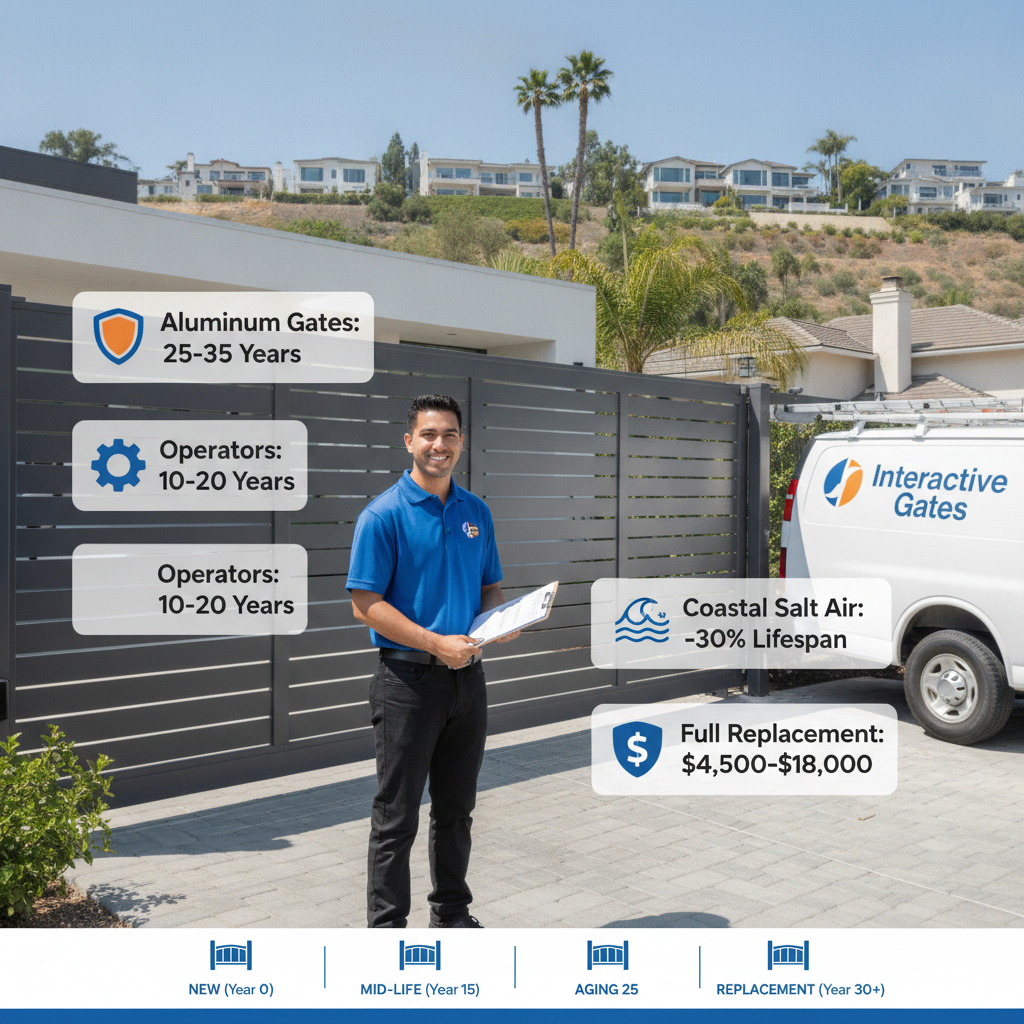
- Sliding gates last 20–30 years in most LA climates when lubricated every 6 months and the track is kept debris-free.
- Swing gates average 15–25 years, but hillside properties in areas like Rolling Hills or Laguna Beach see hinge wear accelerate replacement by 3–5 years.
- Gate operators typically last 10–15 years — brands like FAAC and LiftMaster commercial-grade units push closer to 15–20 years with annual service.
- Salt-air corrosion near the coast (San Clemente, Laguna Beach, Palos Verdes) can cut raw steel gate lifespan by 30–40% without proper powder-coat maintenance.
- Replacement cost in LA ranges from $4,500 to $22,000+ depending on material, style, and access-control complexity.
- UL 325 safety sensor replacement is required every 5–7 years regardless of how old the gate itself is.
- Aluminum gates resist corrosion best in coastal ZIP codes and can outlast wrought iron by 8–12 years with equivalent maintenance.
- Most LA gates need full replacement between years 18 and 25 — postponing past that window usually costs more in cumulative repairs than replacement.
How Long Do Electric Gates Last in Los Angeles?
If you just moved into a property in Los Angeles and found an existing automatic gate, or you're budgeting for a new one, you're probably asking: how long does an electric gate actually last in Southern California? And is the old gate on your driveway still worth maintaining — or is it costing you more than a fresh installation would?
Those are exactly the right questions. Gate lifespan in LA isn't a simple number. It depends on the gate material, the operator brand, your distance from the coast, whether the property sits on a slope, and how consistently the gate has been serviced. This guide breaks it all down with real numbers, neighborhood context, and clear signals that tell you it's time to replace rather than repair.
What Is the Average Lifespan of an Automatic Gate in Los Angeles?
The gate panel (the physical door) and the gate operator (the motor and control board) age on different timelines, and understanding both prevents expensive surprises.
Gate panels by material:
- Wrought iron: 18–30 years. Highly durable structurally, but iron oxidizes in humid coastal air. Properties in San Clemente or Laguna Beach should expect the lower end of that range without annual painting or powder-coat touch-ups.
- Powder-coated steel: 15–25 years. More affordable than iron but more vulnerable to corrosion once the coating chips — especially in salt-spray zones within 3 miles of the Pacific.
- Aluminum: 25–35 years. Naturally corrosion-resistant and the smart choice for coastal LA properties. Weighs less, which also reduces operator wear. Trade-off: it dents more easily and looks thinner than iron.
- Wood (cedar or redwood): 10–18 years. Popular in residential neighborhoods like Los Feliz or Silver Lake for aesthetic reasons. Warping and rot are the main failure modes — LA's dry summers alternate with damp winters and that cycle is hard on timber.
- Vinyl-wrapped: 12–20 years. UV degradation is the primary concern in the Inland Empire and San Fernando Valley where summer heat regularly tops 100 °F.
Gate operators by brand:
- LiftMaster (residential, CSL and SL series): 10–15 years, rated for 1,000–3,000 cycles per day.
- LiftMaster LA400 / LA500 (commercial-grade): 12–18 years, rated up to 20 operations per hour continuously.
- FAAC 844 / 400 series: 15–20 years when serviced annually. FAAC's Italian-engineered hydraulic actuators hold up especially well in high-use residential and light-commercial settings.
- Viking Access V2000 / V5000: 12–18 years, very popular in gated communities across Orange County and the South Bay.
- Apollo 1500 / 1600: 10–15 years for residential swing gates; solid entry-level option for lower-cycle driveways.
- Elite (US Automatic): 10–14 years; budget-friendly but controller boards are more susceptible to power-surge damage without a proper UPS backup.
Does Southern California's Climate Affect Gate Lifespan?
Yes — and the effect varies dramatically by zip code, which many homeowners don't realize.
Coastal zones (Laguna Beach, San Clemente, Palos Verdes, Santa Monica, Malibu): Salt-laden marine air attacks bare metal at the molecular level. Iron and carbon steel begin showing surface rust within 2–4 years of a compromised coating. Hinges, rollers, and weld points are the first failure spots. Aluminum panels and stainless-hardware fittings add 8–12 years to gate life versus standard steel in these areas. Annual inspection plus touch-up paint or powder-coat reapplication every 5–7 years is non-negotiable.
Inland and valley zones (San Fernando Valley, Inland Empire, Pomona Valley): Extreme UV and dry heat cause paint chalking and plastic component degradation. Control boards, wiring insulation, and rubber safety edges typically need replacement every 5–8 years rather than the standard 7–10. Heat also thickens lubricants — operators need a lighter-viscosity grease (silicone-based rather than petroleum) to prevent motor overload in July and August.
Hillside properties (Rolling Hills, Rolling Hills Estates, Bel Air, Calabasas foothills): Slope puts constant gravitational torque on swing-gate hinges. Gates on 8%+ grades that would last 22 years on a flat Burbank lot may need hinge replacement at year 12 and full operator replacement at year 14 on a hillside driveway in Rolling Hills. Sliding gates are usually preferred on steep grades precisely because they don't fight gravity — but they still need track cleaning after every rain event to prevent debris-related motor burnout.
Pro Tip: If your property is within 2 miles of the Pacific Ocean, specify marine-grade stainless steel hardware (316 grade, not 304) for all hinges, bolts, and operator mounting brackets at installation. The upcharge is roughly $200–$400 but can add 5–10 years to component life in salt-air environments like Laguna Beach.
What Are the Warning Signs That My Gate Is Near End of Life?
Most LA gates don't fail suddenly — they give 12–24 months of warning signals that many property owners ignore until the gate stops working entirely (usually at 7 a.m. on a Monday).
- Increasing hesitation on open or close: If the gate pauses, stutters, or reverses without obstacle contact, the operator is working harder than its rated torque allows. Early-stage: $300–$600 tune-up. Late-stage: $1,200–$2,800 operator replacement.
- Visible rust at weld points or hinge bases: Surface rust is cosmetic. Rust at structural welds or hinge pivot points is structural — the gate is weakening where it carries the most load. Repair requires grinding, rewelding, and refinishing: $800–$2,500 depending on extent.
- Sagging panels: Swing gates that sag at the latch end are experiencing hinge wear or post movement. A 1-inch sag means a 3–5-inch drag-to-failure arc unless hinges are replaced. Post realignment runs $600–$1,800; if the post has heaved (uncommon in LA but possible after a wet El Niño season), you may be looking at $2,500–$5,000 in concrete work.
- Control board error codes cycling repeatedly: Most modern operators (LiftMaster, FAAC, Viking) display error codes. If you're resetting the same code more than twice per month, the underlying hardware is failing — not the software.
- Significantly increased electricity draw: A failing motor draws 20–40% more amperage before it dies. If your gate is on a dedicated circuit with a smart breaker or energy monitor, a sustained spike is a reliable end-of-life indicator.
- Gate is 18+ years old and hasn't been regularly serviced: At this age in the LA climate, a gate with no service history is statistically likely to have compromised wiring insulation, degraded safety-sensor loops, and worn drive components — all simultaneously.
When Is It Cheaper to Replace Than to Repair?
This is the question property managers and HOA boards struggle with most. The honest answer follows a simple rule: when the cost of the next 24 months of projected repairs exceeds 60% of replacement cost, replace.
In practical LA numbers: if a full gate replacement runs $9,000 and you're looking at $1,800 in repairs this year plus a probable $3,500 operator replacement next year plus $1,200 in misc parts over 24 months — that's $6,500 in repairs versus $9,000 to replace. Replace. You get a 20-year clock reset, a warranty (typically 1–3 years on parts and labor), and modern UL 325 safety compliance.
For HOAs managing multiple gates across a community, see our HOA and commercial gate page for community pricing tiers and multi-gate service agreements that reduce per-unit costs significantly.
What Does Gate Replacement Cost in Los Angeles in 2026?
Replacement pricing in LA has risen 8–12% since 2024 due to steel tariff impacts and contractor labor rates. Here's what to budget by scope:
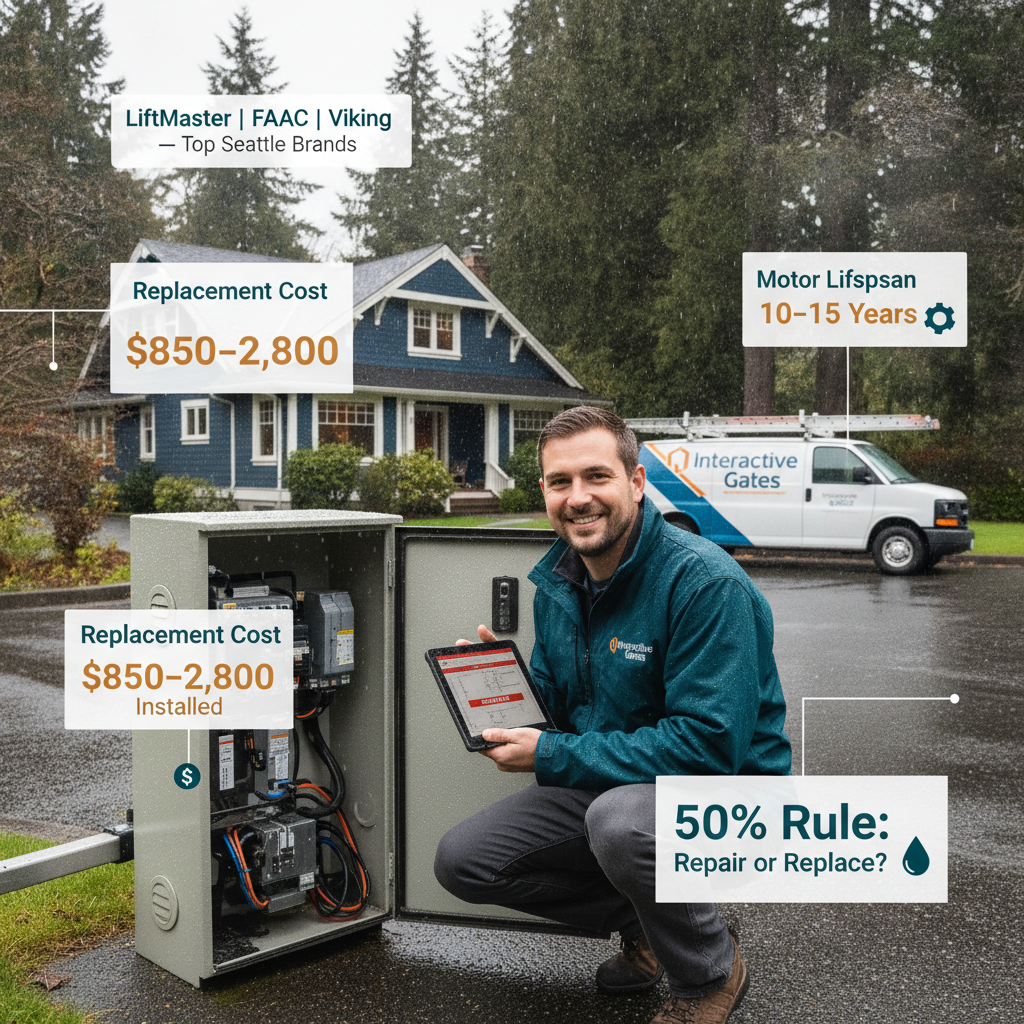
- Operator-only replacement (existing panel reused): $1,400–$3,800 depending on brand and gate weight.
- Single residential swing gate, aluminum, new install: $4,500–$8,500 including operator, post footings, and basic keypad.
- Single residential sliding gate, powder-coated steel: $5,500–$10,500 including track, operator, and loop detector.
- Dual swing gate, wrought iron, full replacement: $9,000–$18,000 depending on panel width, ornamental complexity, and access-control upgrades.
- High-end estate gate (custom wrought iron or aluminum, video intercom, multiple access credentials): $18,000–$35,000+.
- Commercial/HOA sliding gate (20–40 ft span): $14,000–$28,000.
Permit costs in the City of Los Angeles add $350–$750 for most gate projects; unincorporated LA County and individual cities like Orange vary. Always confirm with your local building department before installation.
Pro Tip: If your gate panel is still structurally sound but your operator has failed, operator-only replacement is almost always the right call — you save 40–60% versus full replacement and get a brand-new motor warranty. Have a technician verify the panel's structural integrity before committing either way.
How Can I Extend My Gate's Lifespan?
The homeowners who get 28 years out of an LA gate instead of 18 all do the same five things consistently:
- Annual professional service: Lubrication, torque calibration, safety-sensor testing, board inspection — runs $150–$350 per visit and catches $80 problems before they become $2,000 problems.
- Track and drainage maintenance: Sliding gate tracks accumulate leaves, grit, and sediment after LA's rainy-season deluges. Clear the track monthly October through April.
- Touch-up paint or powder-coat every 5–7 years: Especially critical in coastal and valley zones. Don't wait for visible rust — address coating chips within 30 days.
- Surge protection: LA's grid experiences micro-surges during summer AC peak demand. A dedicated surge protector on the gate circuit ($75–$150 installed) protects the control board and extends operator life.
- Limit unnecessary cycles: Every open-close cycle is counted by the operator. If your household averages 20 cycles per day, consider a longer auto-close delay to reduce full-cycle count over time.
Want to see what a replacement gate could look like on your property before committing? Use the Interactive Gates gate designer tool to preview styles, materials, and configurations in minutes.
In One Minute: Electric Gate Lifespan in Los Angeles
Aluminum gates last longest in coastal LA — 25–35 years versus 15–25 for steel. Wrought iron is structurally excellent but demands coastal maintenance. Operators last 10–20 years depending on brand and use; FAAC and LiftMaster commercial-grade units lead longevity. Salt air, intense UV, and hillside torque are LA's three main lifespan killers — address all three with material selection, annual service, and proper hardware. Replace when 24-month projected repairs exceed 60% of replacement cost. Budget $4,500–$18,000 for most residential replacements in 2026. Consistent annual service is the single highest-ROI action a gate owner can take.
Frequently Asked Questions: Electric Gate Lifespan in Los Angeles
How long does a typical residential electric gate last in Los Angeles?
Most residential electric gates in LA last 15–30 years for the panel and 10–20 years for the operator, depending on material, brand, maintenance history, and proximity to the coast. Properties in salt-air zones near Laguna Beach or San Clemente typically see the lower end of those ranges with standard steel, while aluminum gates on well-maintained inland properties can exceed 30 years.
Do I need to replace my gate operator if the gate panel is still good?
Not necessarily. If the panel is structurally sound — no significant rust at structural welds, no sagging, no cracked or bent infill — operator-only replacement is a cost-effective path. Operator replacement runs $1,400–$3,800 in LA and restores full functionality with a new warranty, saving 40–60% versus full gate replacement.
What's the biggest threat to gate lifespan in Southern California?
It depends on your location. Coastal properties face salt-air corrosion as the primary threat — aluminum construction and marine-grade stainless hardware are the best defenses. Inland and valley properties face UV degradation and extreme heat that degrade wiring, plastics, and lubricants faster. Hillside properties experience accelerated hinge and operator wear from constant gravitational torque on swing gates.
How often should an electric gate in Los Angeles be serviced?
Annual professional service is the baseline for most residential gates — roughly $150–$350 per visit. Coastal properties, high-cycle driveways (15+ cycles per day), and gates older than 12 years benefit from bi-annual service. HOA and commercial gates typically require quarterly inspection under their maintenance agreements.
Are there any LA or California codes that affect how long I can keep an old gate?
California doesn't mandate gate retirement by age, but UL 325 requires that automatic gate safety entrapment devices (edge sensors, photoelectric eyes, loop detectors) meet current standards. If your gate was installed before 2000, it almost certainly lacks compliant safety features — and any service company working on it is legally required to bring entrapment protection up to code as part of the repair. This typically adds $400–$900 to a service call on older gates.
Is it worth buying a home with an existing automatic gate that's 15 years old?
Yes, with due diligence. Ask for service records, have a gate technician inspect the panel, operator, wiring, and safety sensors before close of escrow, and budget $500–$1,500 for any deferred maintenance items. A 15-year-old gate that's been annually serviced likely has 5–10 good years left. One with no service history could need $3,000–$6,000 in immediate work — or full replacement within 2–3 years.
Ready to Assess Your Los Angeles Gate?
Whether you're trying to decide if your existing gate has more life in it or you're planning a full replacement, our team works across LA — from Rolling Hills to Orange to Laguna Beach. Browse real completed projects in our project portfolio or reach out for a no-pressure site assessment. We'll give you an honest read on what your gate actually needs — repair, service, or replacement — and back it up with numbers.