- LiftMaster, FAAC, Viking, and Apollo are the four most-installed gate opener brands on Seattle driveways in 2026.
- Entry-level openers start around $650–$900 installed; commercial-grade units for heavy wrought iron run $2,200–$4,500+ installed.
- Corrosion resistance matters more in Seattle than almost anywhere else — salt air from Puget Sound and near-constant moisture destroy inferior motors in 3–5 years.
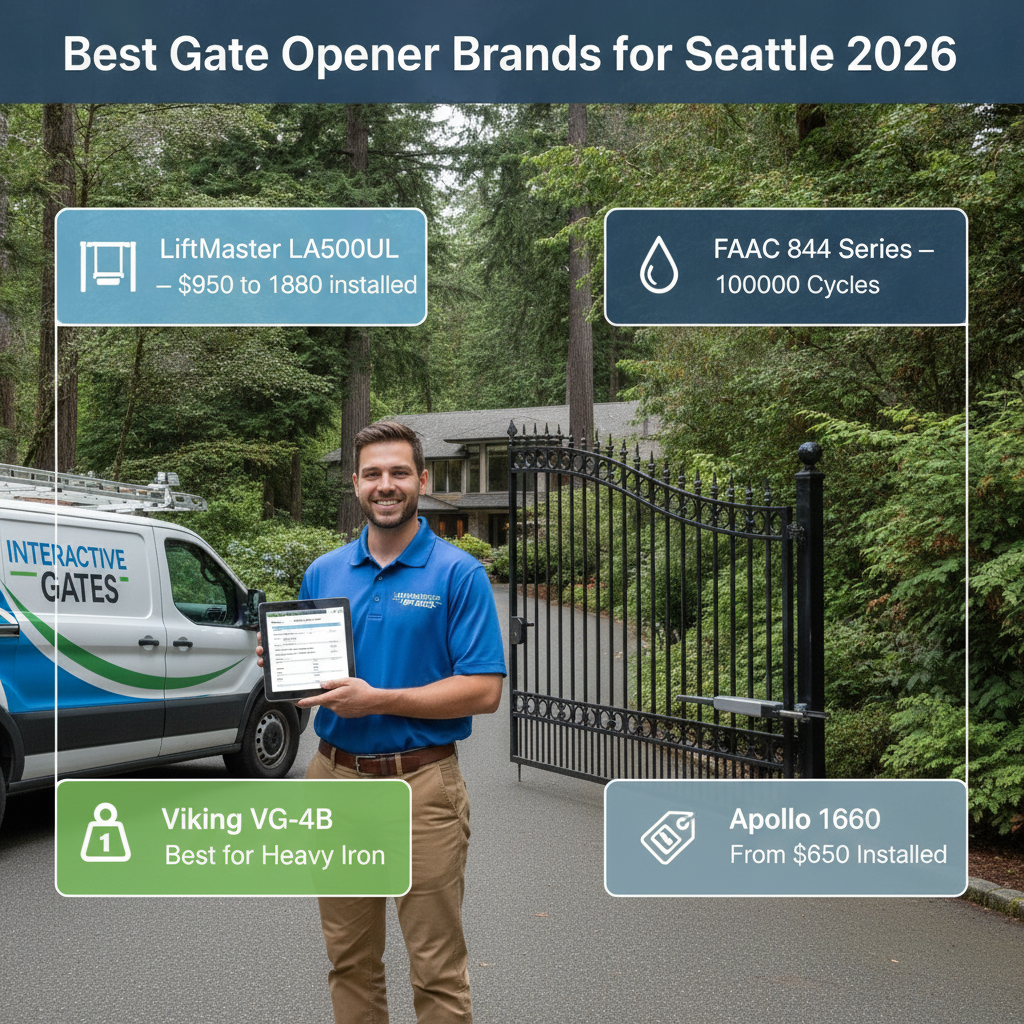
- LiftMaster LA500UL is the most popular swing-gate opener on residential lots west of I-5 because of its sealed motor housing and myQ connectivity.
- FAAC 844 and 884 series dominate commercial and HOA slide-gate installs in Bellevue and Kirkland thanks to oil-bath lubrication that thrives in wet climates.
- Viking Access VG-2F and VG-4B are the go-to for heavy ornamental iron gates over 800 lb on waterfront properties in Gig Harbor and Tacoma.
- Apollo 1600 series offers the lowest upfront cost for lighter aluminum gates and works well on smaller Lynnwood and Everett lots.
- Cycle ratings differ wildly — budget openers are rated 500–1,000 cycles/year; commercial units handle 50,000+ cycles/year.
Which Automatic Gate Opener Should You Buy for a Seattle Driveway in 2026?
You've got an ornamental iron gate sitting at the end of your Bellevue driveway, or maybe a cedar wood slider on a Snohomish hobby farm — and you're wondering: Which gate opener actually survives Seattle weather? What brand do installers trust? Am I overpaying? These are exactly the questions Seattle homeowners and property managers type into Google every day, and the answers are more nuanced than any brand's marketing copy will tell you.
Seattle's climate is the silent variable that nobody in the manufacturer's catalog acknowledges. Average annual rainfall of 38 inches, humidity that rarely drops below 70%, salt-laced marine air on the west side of the metro, and freeze-thaw cycles in Snohomish County and the South Sound all conspire to eat gate openers alive — unless you pick the right one. This guide breaks down the four brands Interactive Gates installs most often in the Seattle metro, with real 2026 pricing, cycle ratings, and honest pros and cons for each.
Why Does Climate Matter So Much When Choosing a Gate Opener in Seattle?
Most gate opener failures in Seattle are not electrical — they're mechanical corrosion. Zinc-plated mild steel hardware rusts through in as little as 18 months on properties within two miles of Puget Sound in areas like Gig Harbor and Des Moines. Plastic gear sets absorb moisture, warp, and strip. Even powder-coated aluminum arms pit and oxidize when salt air finds a scratch.
The opener brands that perform well here share a few traits: sealed or oil-bath motor housings, stainless steel or marine-grade hardware on pivot points, conformal-coated control boards, and robust thermal cut-outs that prevent overheating during the occasional August heat event (Seattle hit 100°F+ in 2021 and 2024 — it happens). When you're comparing brands, ask your installer about IP ratings on the circuit board enclosure. Anything below IP54 is a liability in this climate.
LiftMaster Gate Openers: Best All-Around Choice for Seattle Residential?
LiftMaster is the brand most Seattle homeowners have already heard of — and for residential swing gates, it earns that reputation. The LA400 and LA500UL series are the workhorses. The LA400 handles gates up to 500 lb per leaf and is rated for roughly 25,000 cycles over its service life, which at a typical suburban household doing 8–12 cycles per day works out to 6–8 years before needing a rebuild or replacement. The LA500UL bumps gate weight capacity to 850 lb and adds UL 325 commercial listing — critical if you have an HOA or commercial property in Bellevue or Auburn.
Installed cost in the Seattle metro in 2026: $950–$1,800 for a single-arm swing gate opener, depending on gate weight, conduit runs, and whether you're adding the myQ smart-home integration module ($89–$129 extra). The myQ platform lets you open, close, and monitor the gate from your phone — handy for letting in a contractor while you're at work downtown.
LiftMaster's Achilles heel in Seattle is its standard control board enclosure. The NEMA 4 box on the LA series is adequate but not exceptional in heavy rain. Ask your installer to add a drip-cap hood and silicone-seal the conduit entries — a $40 addition that meaningfully extends board life. On properties in Gig Harbor or Lakewood with direct waterfront exposure, upgrading to a Viking or FAAC unit may be smarter long-term despite the higher upfront cost.
Pro Tip: LiftMaster's myQ diagnostics can flag low battery backup voltage, gate obstruction counts, and motor temperature spikes — review the app log at your annual service visit to catch problems before they become failures.
FAAC Gate Openers: Why Italian Engineering Dominates Seattle Commercial Installs
FAAC (Fabbrica Automatismi Apriscancelli — yes, it's Italian, and yes, the engineering shows it) has built its global reputation on oil-bath lubrication systems that laugh at wet climates. The FAAC 844 and 884 series slide-gate operators are the most common commercial units Interactive Gates installs in Bellevue, Kirkland, and Redmond business parks, as well as gated communities in Lake City and Broadmoor.
Here's why oil-bath matters in Seattle: instead of relying on grease fittings that get washed out by rain or dry out between service visits, the FAAC motor sits partially submerged in hydraulic oil inside a sealed casing. Moisture, grit, and temperature swings have almost no effect on internal components. The 844 series is rated for up to 100,000 cycles — at a busy commercial property running 60 cycles per day, that's nearly 5 years of continuous use before a rebuild.
Installed cost in Seattle in 2026: $2,400–$4,800 for a FAAC slide-gate system including rack, motor mount, and basic access control wiring. Add $600–$1,200 for a Bluetooth keypad or card reader integration. FAAC also makes a well-regarded swing-gate series (the 402 and 415 series) popular on residential properties in Bellevue estates with gates in the 600–1,200 lb range per leaf.
The trade-off: FAAC units require oil changes every 18–24 months (roughly $150–$250 at a service visit). Skip that maintenance and you void the warranty. They're also more complex to troubleshoot — you really want a certified FAAC dealer doing repairs, not a generalist electrician.
Viking Access Gate Openers: The Heavy-Hitter for Ornamental Iron and Waterfront Properties
If you have a serious gate — ornamental wrought iron over 800 lb per leaf, a long commercial slide gate over 1,200 lb, or a bi-parting driveway gate on a sloped lot in Tacoma or Gig Harbor — Viking Access is where the conversation starts. The VG-2F (swing) and VG-4B (slide) are built in the US, use powder-coated cast aluminum housings, and carry some of the highest cycle ratings in the residential-commercial crossover space: the VG-4B is rated for 200,000 cycles at full duty cycle.
Viking's climate performance in the Pacific Northwest is exceptional. The sealed DC motor and thermoplastic drive components resist moisture intrusion, and the auto-close timer with obstruction sensing meets current UL 325 2026 revisions — an increasingly important compliance point for HOA communities in Snohomish County and Pierce County that carry liability insurance tied to safety code compliance.
Installed cost in Seattle in 2026: $1,800–$3,500 for a Viking swing-gate system; $3,200–$5,500 for a heavy slide-gate system including rack and mounting hardware. Viking is not the budget option — but on a 1,200 lb custom-fabricated iron gate, it's also not the place to save $400 upfront and spend $2,000 on a replacement motor in year four.
Apollo Gate Openers: The Value Play for Lighter Gates on Smaller Seattle Lots
Apollo (now part of the Ghost Controls parent group) occupies the value end of the professional-grade market. The Apollo 1600 series swing-gate opener is a solid performer for aluminum or lightweight steel gates up to 500 lb, and it's frequently specified on smaller residential lots in Lynnwood, Everett, and Auburn where the gate is primarily decorative rather than a serious security perimeter.
Apollo's cycle rating of roughly 15,000–20,000 cycles over service life is honest for its price class. Installed cost in Seattle in 2026: $650–$1,100 for a single Apollo swing opener, making it the most accessible entry point for homeowners who want automation without a four-figure opener bill. The Apollo app provides basic open/close functionality, though it's not as feature-rich as myQ or FAAC's cloud platform.
The honest caveat: Apollo's control board housing is rated IP44 — fine for occasional rain splash, not ideal for Seattle's sustained horizontal rain events. If you're on the west side of Capitol Hill, in the Phinney Ridge area, or anywhere that catches full maritime weather, ask your installer about an aftermarket NEMA 4X cover. At $55–$80, it's cheap insurance.
Pro Tip: Apollo makes excellent solar-ready models (the 1500 series) that pair well with battery backup — particularly useful on rural lots in Snohomish County where power outages during windstorms can leave a gate locked closed for 12–36 hours.
Side-by-Side: Which Brand Fits Your Seattle Property?
Here's how to think about it practically. Light aluminum residential gate under 400 lb, budget-conscious: Apollo 1600, $650–$1,100 installed. Mid-weight residential swing gate 400–800 lb, smart-home integration important: LiftMaster LA500UL, $950–$1,800 installed. Heavy ornamental iron or a commercial/HOA slide gate: FAAC 844/884 or Viking VG-4B, $2,400–$5,500 installed depending on gate weight and complexity. Waterfront or high-humidity property needing maximum corrosion resistance: FAAC oil-bath or Viking sealed-DC series, regardless of gate size.
You can also browse real completed installations across the metro in our project portfolio to see which brands and gate styles work in properties similar to yours before committing to anything.
In One Minute: Automatic Gate Opener Brands in Seattle 2026
LiftMaster LA400/LA500UL: best value for residential swing gates, 25,000-cycle rated, $950–$1,800 installed, good smart-home integration. FAAC 844/884: best commercial slide gate, 100,000-cycle oil-bath motor, $2,400–$4,800 installed, requires biennial oil changes. Viking VG-2F/VG-4B: best for heavy ornamental iron and high-duty-cycle properties, 200,000-cycle rated, $1,800–$5,500 installed. Apollo 1600: best budget option for lightweight aluminum gates, 15,000–20,000 cycles, $650–$1,100 installed, upgrade the enclosure for Seattle weather. Climate factors that matter most: sealed or oil-bath motor housings, IP54+ board enclosures, stainless pivot hardware, thermal cutouts. Annual maintenance ($150–$350) extends any opener's life by 30–50% regardless of brand.
Frequently Asked Questions About Gate Openers in Seattle
How long do automatic gate openers last in Seattle's wet climate?
With annual maintenance, a quality opener from LiftMaster, FAAC, Viking, or Apollo typically lasts 10–15 years in Seattle. Budget or improperly protected openers in high-moisture zones (especially near Puget Sound) can fail in 4–6 years. FAAC's oil-bath system and Viking's sealed DC motors are specifically engineered for sustained wet-climate performance and tend to hit the longer end of that range.
What is the most important feature to look for in a Seattle gate opener?
Moisture and corrosion protection above everything else. Look for IP54 or higher on the control board enclosure, sealed or oil-bath lubrication on the motor, and stainless steel or marine-grade zinc hardware on all external pivot points. Smart-home connectivity and solar compatibility are nice bonuses, but they mean nothing if the motor housing rusts through in year three.
Is LiftMaster or FAAC better for a residential Seattle driveway?
For most residential swing gates under 800 lb, LiftMaster's LA500UL is the better value — lower installed cost, widely available parts, and excellent myQ app integration. For gates over 800 lb per leaf, commercial applications, or properties with waterfront exposure, FAAC's oil-bath engineering justifies the higher price. Both are excellent when properly installed and maintained.
How much does a gate opener installation cost in Seattle in 2026?
Installed costs range from $650 for a basic Apollo single-arm opener on a lightweight aluminum gate up to $5,500+ for a heavy-duty Viking or FAAC system on a large ornamental iron gate with full access-control integration. The midpoint for a typical residential project — LiftMaster or Viking on a 600–800 lb swing gate with a keypad — falls around $1,400–$2,200. See our residential gate page for more detail on what affects your specific quote.
Do I need a permit to install a gate opener in Seattle?
In most Seattle-area jurisdictions, a standalone gate opener replacement does not require a permit. New gate and opener installations that involve trenching for conduit, electrical sub-panel work, or structural posts set in concrete typically do require a permit from the city or county building department. King County and Pierce County have slightly different thresholds — your installer should pull any required permits as part of the project scope.
Can I get a free design estimate before committing to a gate opener brand?
Yes — Interactive Gates offers free on-site consultations across the Seattle metro, and you can also use our online gate designer tool to visualize gate styles before anyone visits your property. For a full quote tailored to your specific gate weight, driveway geometry, and access-control needs, visit our contact page to schedule a no-pressure site visit.
Ready to Choose the Right Opener for Your Seattle Gate?
The right gate opener brand is the one matched to your gate's weight, your property's microclimate, and your expected cycle volume — not just whatever's on sale or whatever your neighbor installed. If you're in Bellevue, Tacoma, Snohomish, or anywhere in between, reach out to Interactive Gates for an honest assessment. We'll tell you exactly which unit fits your situation — and which ones we'd steer you away from even if the margin were better for us.