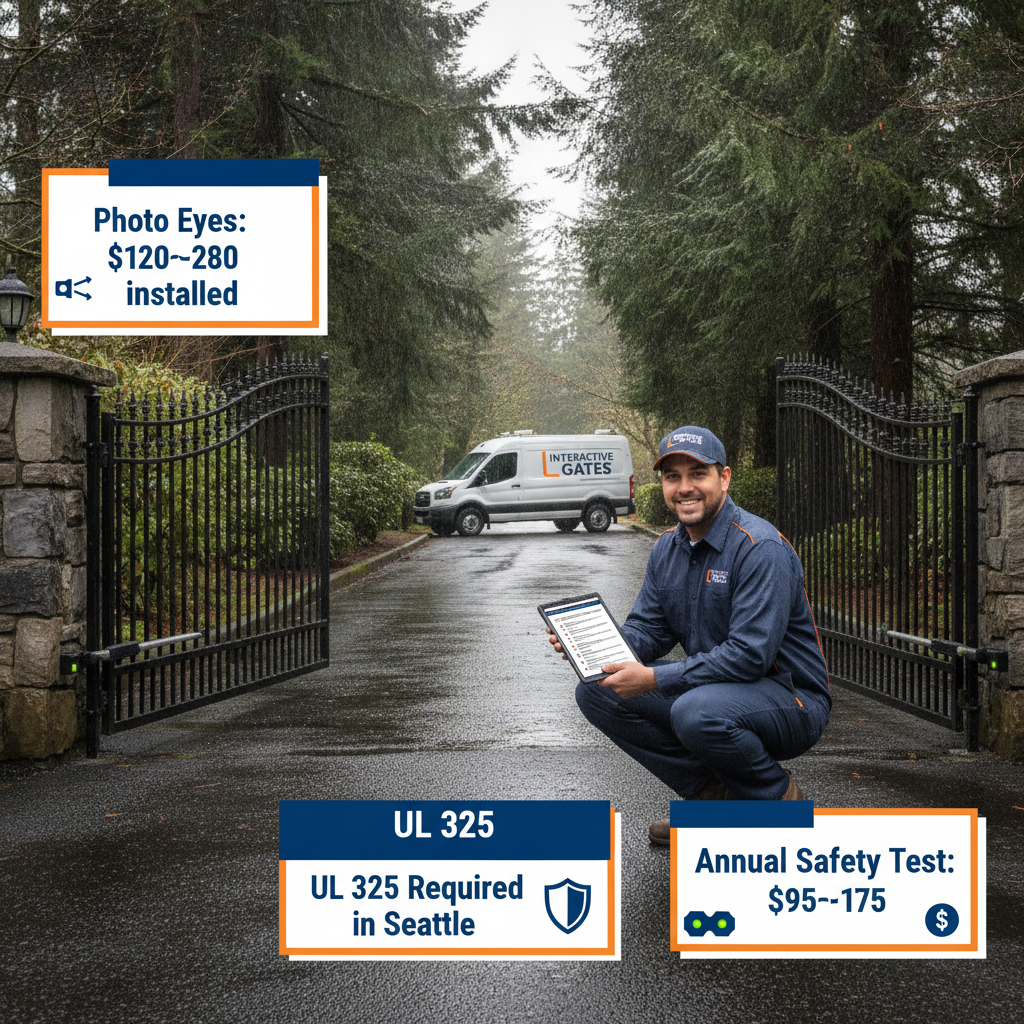
- UL 325 compliance is mandatory in Seattle — every new automatic gate must meet the 2026 edition of this nationally recognized entrapment-protection standard.
- Photo-eye sensors cost $120–$280 per pair installed and are non-negotiable on swing and slide gates used by vehicles.
- Edge sensors (contact edges) run $180–$350 and are required on pedestrian-accessible gates under Seattle's current interpretation of UL 325.
- An annual safety inspection costs $95–$175 in the Seattle metro — King County HOAs with high-cycle gates often require semi-annual checks.
- Swing gates need a minimum 24-inch clearance zone behind the pivot post, enforced during inspections in Bellevue and Kirkland.
- Battery backup is code-encouraged in Seattle due to frequent windstorm outages — most installers include it as a standard line item in 2026 proposals.
- FAAC and LiftMaster both offer built-in obstruction sensing that meets 2026 UL 325 without a separate add-on sensor in most configurations.
- Non-compliant gates face fines up to $1,500 per violation in some Seattle-area jurisdictions during a complaint-triggered inspection.
What Safety Features Does Seattle Law Actually Require on an Automatic Gate in 2026?
You just got a quote for an automatic gate and the proposal lists a bunch of add-ons you're not sure you actually need. Photo eyes. Edge sensors. Loop detectors. Obstruction reversals. Which of these does Seattle code require, which are optional upgrades, and which are pure upsells? If you manage an HOA in Bellevue or own a driveway gate in Magnolia, that distinction matters — both for your budget and your liability.
This guide breaks down every safety feature category, what each one does, what it costs in 2026, and exactly when it's required versus recommended in the Seattle metro area. No filler. Just what a local expert would actually tell you at the gate.
How Does UL 325 Affect Automatic Gates in Seattle in 2026?
UL 325 is the Underwriters Laboratories standard for door, drapery, gate, louver, and window operators. In Seattle and throughout Washington State, any automatic gate operator sold or installed commercially must bear the UL 325 listing. The 2026 edition tightened entrapment-zone requirements, specifically expanding the number of tested obstruction scenarios from 8 to 11 for swing gate operators.
What this means practically: your gate operator itself must be UL 325 listed, AND the installation must include the entrapment-protection devices that the operator's listing requires. A LiftMaster LA400UL or FAAC 390SA will ship with a sensor kit; installing the operator without connecting those sensors voids the listing and your liability protection. During permit inspections in Seattle, Bellevue, and Everett, inspectors check for the UL label on the operator AND for connected, functional sensors.
Beyond UL 325, the City of Seattle's Land Use Code requires that any gate on a property accessible to the public — including HOA common entrances — must not create a trapping hazard for pedestrians. That standard is enforced by SDCI (Seattle Department of Construction and Inspections) and can result in stop-work orders or retroactive compliance demands on older installations.
What Are the Non-Negotiable Entrapment Protection Devices for Seattle Gates?
UL 325 defines seven entrapment-protection zones (Zones 1 through 7) for swing gates and four for slide gates. In practice, most residential and light-commercial installations in Seattle require protection in two or three of these zones. Here is what that translates to on a typical driveway gate:
- Photo-eye (photoelectric sensor) set: Two infrared beam sensors mounted across the gate opening. If the beam is broken while the gate is closing, the gate stops and reverses. Required on virtually every powered vehicle gate. Installed cost in Seattle in 2026: $120–$280 per pair, depending on wiring distance and bracket complexity. LiftMaster RSL12U and FAAC XP20B are the two most commonly specified models locally.
- Reverse-on-contact (contact/pressure edge): A rubberized sensing edge along the leading edge of the gate. When it contacts an object — a child, a dog, a tire — the gate reverses. Required on pedestrian-accessible gates per UL 325 Zone 2 and Zone 3 guidance. Installed cost: $180–$350 for a standard residential gate leaf.
- Inherent force-limiting (auto-reverse): Built into every UL 325-compliant operator. The motor controller monitors amp draw; if resistance spikes — meaning something is in the way — it cuts power and reverses. This is standard in LiftMaster LA400, FAAC 402, Viking GP-SS, and Apollo 1500 series. No separate cost; it's inside the operator.
- Open-collector output / secondary entrapment protection: On high-use gates (defined as more than 25 cycles per day under UL 325), a second independent entrapment device is required in addition to the photo eye. This is usually a loop detector or a secondary contact edge. Installed cost: $150–$300.
Pro Tip: If your gate serves a school, daycare, or multi-family building in Seattle, ask your installer specifically about UL 325 high-use classification. Many residential installers default to the low-use sensor package, which may not satisfy SDCI on a property with more than 25 vehicle passes per day.
What Loop Detectors Do, What They Cost & When They're Required in Seattle
Vehicle loop detectors are wire loops buried in the driveway pavement that sense a vehicle's metal mass via electromagnetic induction. They serve two functions: triggering the gate to open as a vehicle approaches (exit loop), and holding the gate open until the vehicle has fully cleared (safety loop). Without a safety loop, a swing or slide gate can close on the rear of a vehicle still in the opening.
In Seattle, safety loops are code-required on any gate where a vehicle can be partially in the opening when the timer initiates closing. That covers virtually every driveway swing gate with an auto-close timer. Exit loops are required or strongly recommended on any gate serving a street with traffic, so vehicles exiting don't have to stop in a travel lane waiting for the gate to respond to a remote signal.
Cost breakdown for 2026 Seattle installs:
- Single safety loop (exit or safety): $280–$450 installed, including saw-cut, loop wire, detector card, and asphalt/concrete patch.
- Dual loop package (entry + safety): $480–$750 installed.
- Virtual loop (radar-based, no saw-cut): $350–$550 per unit. Popular in Gig Harbor and Snohomish where long driveways make saw-cut loops impractical or where pavers can't be disturbed.
Radar-based virtual loops (such as the Sensata Radar from BEA) are increasingly specified on Seattle-area properties with decorative pavers, radiant-heated driveways, or existing conduit runs that make physical loop installation disruptive.
What Optional Safety Features Are Worth Adding in the Pacific Northwest?
Beyond code minimums, Seattle's specific climate and terrain create conditions where certain upgrades pay for themselves faster than national averages suggest.
- Obstruction warning lights (LED strobes): Mounted on gate posts, these flash when the gate is in motion. Required on commercial sites; optional for residential. Cost: $80–$160 per unit installed. Useful in Seattle's gray winter months when visibility near gate openings is limited by rain and low light.
- Pedestrian gate interlocks: If your property has both a vehicle gate and a pedestrian pass-through gate, an interlock prevents both from opening simultaneously, eliminating the entrapment pinch zone between them. Cost: $200–$400 for the relay wiring and logic board add-on.
- Battery backup with auto-open failsafe: As covered in our residential gate guide, Seattle averages 10–15 significant windstorm-related outages per year. A battery backup that holds 50–300 cycles on a full charge costs $350–$800 installed depending on the operator platform. It also allows the gate to default to open during a prolonged power failure — an important fire-code consideration for gated communities.
- Thermal-protection overload cutout: Standard in FAAC and LiftMaster commercial operators, but absent on some budget brands. If the motor overheats (common during long summer days when a gate cycles 60+ times), thermal cutout shuts it down before damage occurs. Verify your operator has this before purchase.
- Horn/audible alert: A short beep before the gate starts moving. Required on some commercial installs; a cheap add-on ($60–$120) that meaningfully reduces the risk of a child or pet being caught off-guard.
How Much Does a Full Safety-Compliant Gate Installation Cost in Seattle in 2026?
To put real numbers on what a code-compliant, UL 325-listed gate system costs in the Seattle area in 2026, here are three representative scenarios:
- Single-family residential swing gate (low-use, under 25 cycles/day): Operator + photo eyes + contact edge + single safety loop + battery backup: $4,800–$8,500 total installed. This covers properties in Auburn, Lakewood, and similar suburban lot sizes.
- Dual-swing gate, upper SFH neighborhood (Medina, Clyde Hill): Two operators + dual photo eye sets + dual contact edges + dual safety loops + keypad + video intercom + battery backup: $12,000–$22,000. The wide range reflects gate material (aluminum vs. custom steel) and driveway prep complexity.
- HOA or multi-family slide gate (high-use, 50–200 cycles/day): Commercial operator + photo eyes + dual contact edges + dual vehicle loops + UPS battery system + access control panel: $18,000–$38,000. See our HOA and commercial gate page for a detailed breakdown by community size.
Pro Tip: Always request a written confirmation from your installer that the completed system meets UL 325 requirements and that the sensor connections have been tested to the operator manufacturer's spec. This one sentence in your paperwork matters enormously if there is ever a liability claim after an entrapment incident.
How Often Do Safety Sensors Fail on Seattle Gates & What Does Testing Cost?
Photo eyes are the most failure-prone safety component on a Seattle gate, specifically because of moss, moisture, and spider webs obscuring the beam path. In the Pacific Northwest climate, photo eye misalignment or contamination is the leading cause of gate safety failures — ahead of motor issues and loop detector failures.
Realistic failure timeline: photo eyes on an unprotected outdoor bracket in Seattle typically need realignment or cleaning every 12–18 months. Contact edges last 5–8 years before the rubber hardens and loses sensitivity. Loop detectors, if properly installed with sealed connections, last 10–15 years.
Annual safety inspection costs in the Seattle metro in 2026:
- Basic sensor test + photo eye alignment: $95–$130
- Full safety audit (sensors, edges, loop, force test, auto-reverse test): $145–$175
- HOA multi-gate audit (per gate): $110–$160, often bundled into annual maintenance contracts at a discount
In One Minute: Automatic Gate Safety in Seattle 2026
UL 325 is the floor, not the ceiling. Every automatic gate in Seattle must have a UL-listed operator with inherent force-limiting, plus photo eyes and contact edges matched to how the gate is used. Vehicle gates serving more than 25 cycles per day need a second independent entrapment device. Loop detectors are required any time a gate auto-closes on a timer. Optional upgrades — strobes, audible alerts, pedestrian interlocks, battery backup — are strongly worth considering given Seattle's weather and windstorm history. Budget $4,800–$8,500 for a code-compliant residential gate system; $18,000–$38,000 for a high-use HOA or commercial slide gate. Have sensors tested annually; photo eyes need cleaning or realignment every 12–18 months in the Pacific Northwest.
Frequently Asked Questions: Automatic Gate Safety in Seattle
Is UL 325 compliance legally required for my Seattle driveway gate?
Yes. Any automatic gate operator sold or installed in Washington State must carry a UL 325 listing, and the installation must connect and activate the entrapment-protection devices that listing requires. SDCI enforces this during permit inspections, and non-compliance can result in a stop-work order or a retroactive compliance demand. The 2026 edition of UL 325 expanded tested entrapment zones for swing gates, so older operators installed before 2024 may not meet current standards.
Do I need photo eyes AND a contact edge, or is one enough?
It depends on how your gate is classified under UL 325. For a low-use residential gate (under 25 cycles per day) with no pedestrian access, photo eyes alone may satisfy the standard. If pedestrians — including children — can access the gate area, a contact edge on the leading gate edge is required as a secondary entrapment device. Your installer should conduct a site survey to determine which zones apply before specifying the sensor package.
What happens if my gate injures someone and I don't have the required safety sensors?
Liability exposure is severe. In Washington State, a property owner who operates a non-UL-325-compliant gate that causes injury faces civil liability for negligence per se — meaning the absence of a required safety device is itself evidence of negligence, without needing to prove additional fault. Insurance carriers have denied claims on this basis. Beyond civil liability, some Seattle-area jurisdictions can levy fines of up to $1,500 per violation during a complaint-triggered inspection.
How often should I test my gate's safety sensors in Seattle?
At minimum, once a year — but realistically twice a year in the Seattle metro. The Pacific Northwest climate (rain, moss, spiders, temperature swings from 28°F to 95°F) degrades photo eye alignment and contact edge sensitivity faster than in drier climates. A simple test: place a 2x4 flat on the ground in the gate's path and trigger a close cycle. The gate must stop and reverse before making contact. If it doesn't, call a technician immediately.
Are there Seattle-specific codes beyond UL 325 I need to know about?
Yes. The City of Seattle's Land Use Code (SMC 23.54) includes provisions about gates on property boundaries accessible to the public. King County also has local amendments to the International Fire Code that require gates serving more than four dwelling units to have an emergency-access mechanism (Knox Box or keypad override) so fire apparatus can enter without delay. Bellevue enforces a minimum 24-inch clearance zone behind swing gate pivot posts. Always confirm local amendments with your permit office or a local installer familiar with your specific jurisdiction.
Can I install gate safety sensors myself to save money?
Technically yes for the physical mounting, but practically inadvisable. UL 325 requires that the sensor be connected to the operator's designated input terminal and tested to the operator's force-reversal specification. Improper wiring — a common DIY mistake — can cause the sensor to appear active while actually being ignored by the control board. If an entrapment incident occurs after a DIY sensor install, your insurance carrier will examine the wiring, and an improper connection could void your coverage. Have a licensed gate technician at minimum verify and test any sensors you install yourself.
Ready to Make Sure Your Seattle Gate Is Actually Safe?
Whether you're installing a new gate from scratch, retrofitting sensors on an existing system, or managing an HOA that needs a full safety audit, the best starting point is a site evaluation from a technician who knows UL 325 and Seattle's local code amendments. You can reach the Interactive Gates team here, browse real Seattle installations on our project portfolio, or use our gate designer tool to start thinking through your gate type and layout before the first conversation. No pressure — just useful information from people who do this every day in the Pacific Northwest.
FAQs