- UL 325 compliance is mandatory for every automatic gate installer in Oregon — non-compliant installs can void your homeowner's insurance.
- Entrapment protection costs $150–$600 depending on sensor type; photo eyes are the most common residential solution starting at $175 installed.
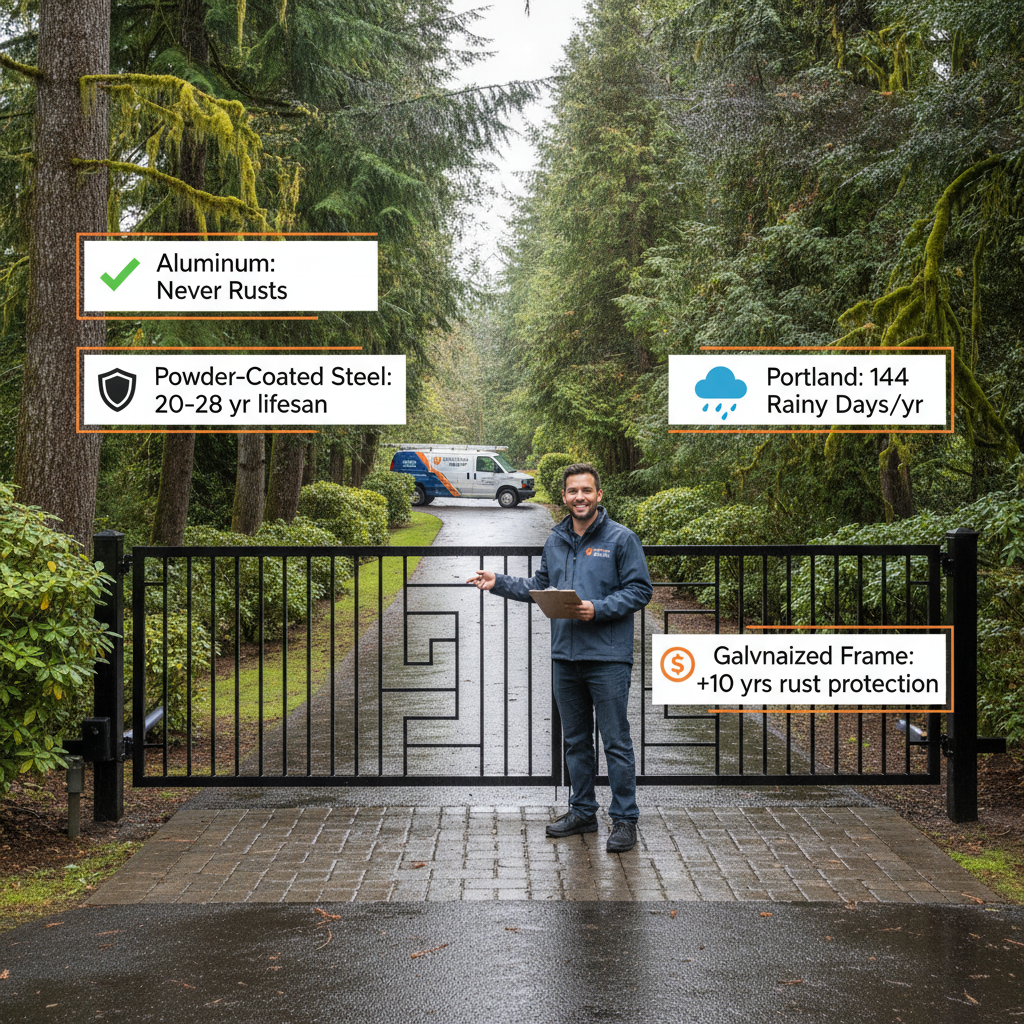
- Portland's wet winters demand IP65-rated or higher sensors — cheaper IP54 units fail within 18–24 months in the Willamette Valley's 144 average rainy days per year.
- Edge sensors (contact safety edges) add $200–$450 and are required by UL 325 on any slide gate with a pinch-point gap under 16 inches.
- Access-control keypads, intercoms, and smart apps are optional but dramatically increase daily usability and resale value — budget $300–$1,800 for these add-ons.
- Gate operators must be re-tested after any major repair — force-limit settings drift over time and should be checked every 12 months.
- Most Portland HOA and commercial gate projects now spec FAAC or LiftMaster RSL12U with integrated obstacle detection rather than retrofitting separate sensors.
- Non-compliant residential gates face fines starting at $500 under Oregon OSHA and local AHJ inspections, especially in Lake Oswego and Beaverton's active permit environments.
What Safety Features Does My Automatic Gate Actually Need in Portland?
Homeowners and property managers in Portland type questions like 'do electric gates have to have safety sensors,' 'what happens if my gate hits someone,' and 'is my automatic gate up to code in Oregon' into Google every single day. The short answer is: yes, there are hard legal requirements — and they apply to every automated driveway gate in Multnomah, Washington, and Clackamas counties, whether you're in a new Lake Oswego custom home or a 1990s Beaverton neighborhood retrofit. This guide breaks down what's mandatory, what's smart-but-optional, and what Portland's rainy climate does to safety hardware over time.
What Does UL 325 Mean and Does It Apply to My Portland Gate?
UL 325 is the Underwriters Laboratories safety standard that governs automatic gate operators sold and installed in the United States. Every gate operator manufactured after 1994 must comply with it, and every installer in Oregon is expected to follow its requirements at the job site. If your installer hands you paperwork that doesn't reference UL 325, that's a red flag. The standard covers two critical areas: entrapment protection zones and operator force limits.
There are seven defined entrapment zones around an automated gate — the spaces where a person (especially a child) could be caught between the gate and a post, wall, column, or the ground. For each of those zones, UL 325 mandates at least one of the following: a monitored entrapment sensor, a non-contact sensor (like a photo eye), a contact sensor (like a safety edge), an inherent entrapment-sensing system built into the operator itself, or a combination. In Portland, where permit-pulling is required for most residential gate installs and the city actively inspects commercial properties, non-compliance isn't a theoretical risk — it's a practical liability that can result in permit revocation, insurance denial, and civil lawsuit exposure.
For homeowners in Lake Oswego, Beaverton, and Portland proper who have gates installed before 2020, it's worth having a technician audit your entrapment zones — especially if the gate was installed by a handyman or a now-defunct company.
What Entrapment Sensors Are Required — and What Do They Cost in Portland in 2026?
The two most common entrapment-protection methods for residential Portland gates are photo-eye sensors and safety edges (also called contact reversing edges). Here's how they compare in 2026:
- Photo-eye sensors (non-contact): A transmitter and receiver beam is placed across the gate opening. If anything breaks the beam while the gate is closing, the gate reverses. Installed cost: $175–$320 per pair. Best for swing gates and most slide gates. Requires alignment — which is tricky on uneven Portland driveways.
- Safety edges / contact reversing edges: A pressure-sensitive rubber strip mounts to the leading edge of the gate. Contact with any object triggers a reversal. Installed cost: $200–$450 depending on gate length and wiring complexity. Required under UL 325 when a slide gate's gap between the gate and a fixed structure is less than 16 inches.
- Monitored entrapment protection (loop detectors): Vehicle-detection loops buried in the driveway pavement sense the presence of a vehicle and hold the gate open or prevent closure. Cost: $400–$900 installed, including saw-cutting and sealing the pavement. Portland's freeze-thaw cycles in winter can stress loop wire over time — use direct-burial rated wire.
- Inherent entrapment sensing (built-in motor feedback): Modern operators from LiftMaster (RSL12U), FAAC (B680H), and Viking (DC2000) detect motor resistance spikes and reverse automatically. This counts as a primary entrapment protection method under UL 325 when calibrated correctly. It does NOT replace a secondary method for commercial applications.
Pro Tip: Portland's rainfall and temperature swings between December lows near 34°F and August highs near 82°F cause photo-eye lenses to fog, misalign, and fail. Specify IP65-rated photo eyes (like the Liftmaster PROBK5 or FAAC XP20D) and budget for a re-alignment check every spring. A misaligned photo eye that keeps triggering false reversals is the #1 reason Portland residents call us saying 'my gate won't close.'
What Safety Features Are Optional but Worth It in Portland?
Beyond the legal minimums, a well-specified Portland gate system in 2026 typically includes a handful of smart add-ons that improve daily safety and usability:
- Vehicle exit loop detectors: A separate inductive loop on the exit side detects a departing car and opens the gate automatically — eliminating the temptation to tailgate or use your phone while fumbling for a remote. Cost: $350–$700 installed.
- Warning lights and audio alarms: Amber strobe lights and a buzzer that activate 2–3 seconds before the gate begins moving. Strongly recommended for gates near pedestrian traffic, schools, or shared driveways. Cost: $80–$200 installed.
- Intercom and video systems: Two-wire or cellular intercoms (BAS-IP, DoorBird, or LiftMaster's CAPXLV) let residents see and speak to visitors before granting access. Range: $400–$1,800 installed depending on camera quality and app integration.
- Keypad access with PIN: Gated entry keypads like the Viking K-1QLM or LiftMaster KPWR5 allow visitors, contractors, and delivery services a guest PIN. Cost: $300–$550 installed.
- Battery backup systems: Portland experiences an average of 4–6 significant wind events per year that cause power outages. A battery backup module (LiftMaster 485LM or FAAC 390 internal battery) keeps the gate operable for 50–100 cycles during an outage. Cost: $150–$350 installed.
- Smart phone access / cloud control: LiftMaster's myQ ecosystem, FAAC's ConnectA2P, and Viking's VS-CLOUD all allow remote open/close and access logs via smartphone. Useful for Airbnb hosts, property managers in Gresham, and HOA boards in Hillsboro. Cost: $200–$600 depending on existing operator compatibility.
What Do Portland's Local Codes Add on Top of UL 325?
Oregon doesn't have a statewide gate-specific code beyond requiring UL 325 compliance, but local jurisdictions add nuance. Multnomah County and the City of Portland require a building permit for most new automated gate installs — the permit fee runs $85–$250 depending on project value. Washington County (covering Beaverton, Hillsboro) and Clackamas County (Oregon City, Lake Oswego) have similar permit requirements and often require a rough inspection before the gate is operational.
For commercial properties and HOA-controlled gates, Oregon OSHA's General Industry standards (OAR 437) apply, and the Authority Having Jurisdiction (AHJ) can require third-party inspection for gates that serve more than a single-family residence. HOA-controlled gates in communities like those in Oregon City and Lake Oswego are treated as commercial applications and must meet the full commercial tier of UL 325, which mandates two independent entrapment-protection methods per hazard zone — not just one. See our full resource for HOA and commercial gate installations.
Pro Tip: If you're in Portland proper and your gate installer tells you 'we don't pull permits here,' walk away. The City of Portland Bureau of Development Services actively cross-references new electrical permit applications and contractor license numbers. An unpermitted gate that later causes an injury will be an uninsured event — full stop.
How Does Portland's Climate Affect Gate Safety Hardware?
This is the detail most out-of-state gate companies miss when they quote Portland projects. The Willamette Valley averages 144 rainy days annually, with sustained periods of drizzle, fog, and heavy rainfall from October through April. Here's what that does to safety hardware:
- Photo-eye lenses collect condensation and road grime — causing false activation or failure to activate. Clean lenses monthly October–April and replace any unit that fails IP65 splash testing.
- Safety-edge wiring corrodes at gate-pivot connection points — use marine-grade heat-shrink connectors, not standard butt splices, at every junction exposed to weather.
- Buried loop detector wire absorbs ground moisture — Portland's clay-heavy soils hold water longer than sandy or loam soils, stressing loop insulation. Use direct-burial PE-jacketed 14-gauge loop wire, not standard thermostat wire.
- Operator motor housing seals degrade — operators rated NEMA 3R (rain-resistant) are the minimum; NEMA 4 (watertight) is preferred for fully exposed Portland installations. FAAC's 844 ER and LiftMaster's RSL12U both carry NEMA 4-equivalent ratings.
- Freeze events (rare but real) — Portland averages 7–12 nights per year below freezing, concentrated in January. Gate hinges, tracks, and photo-eye mounting brackets can seize. Specify stainless hardware and apply a dry-film lubricant (not WD-40) to all pivot points before winter.
How Often Should Safety Features Be Tested and What Does That Cost?
Under UL 325, gate operators must be tested after installation, after any major repair, and — practically speaking — at least once every 12 months. A professional safety-and-force test from an Interactive Gates technician in the Portland area runs $95–$175 for a residential gate and is often bundled with an annual maintenance visit. During that test, the technician will:
- Verify photo-eye beam alignment and response time (should reverse within 0.5 seconds of beam break)
- Test safety-edge contact force with a calibrated 40-lb cylinder per UL 325 Section 40.2
- Check and reset operator force limits (closing force must not exceed 40 lbs sustained; stopping force 130 lbs peak for residential)
- Confirm warning light and audible alarm timing (2-second pre-movement warning minimum)
- Inspect loop detector sensitivity settings and test with a vehicle
- Review battery backup charge state
If you have a gate that hasn't been tested in over two years, or one that was installed before 2019, schedule an audit. You can request a residential safety inspection through our contact page, or browse completed projects in our portfolio to see what a properly specified Portland gate installation looks like.
In One Minute: Portland Automatic Gate Safety 2026
Every automated gate in Portland must comply with UL 325 — no exceptions. That means at minimum one entrapment-protection device per hazard zone: photo eyes ($175–$320/pair installed), safety edges ($200–$450), loop detectors ($400–$900), or a factory-integrated sensing system in a modern operator like the LiftMaster RSL12U or FAAC B680H. Portland's wet climate demands IP65-rated sensors, marine-grade wiring connections, and NEMA 4 operator housings. The City of Portland and Washington/Clackamas counties require permits for new installs ($85–$250). HOA and commercial gates must meet the commercial UL 325 tier — two independent entrapment methods per zone. Optional but strongly recommended: vehicle exit loops ($350–$700), battery backup ($150–$350), warning lights ($80–$200), and smart-access control ($300–$1,800). Annual safety testing runs $95–$175 and is the single best way to catch sensor drift and force-limit creep before they cause an incident.
Frequently Asked Questions About Automatic Gate Safety in Portland
Is it legal to install an automatic gate in Portland without safety sensors?
No. Any automatic gate operator installed in Portland — residential or commercial — must comply with UL 325, which mandates at least one entrapment-protection method per hazard zone. Installing a gate without the required sensors is a code violation, can void your homeowner's insurance, and exposes you to personal liability if someone is injured. The City of Portland Bureau of Development Services requires a building permit for most new gate installations, and the permit inspection will check for sensor compliance.
What is the difference between a photo eye and a safety edge on a gate?
A photo eye is a non-contact sensor: a beam of infrared light crosses the gate opening, and if that beam is broken by a person, animal, or object while the gate is closing, the gate reverses. A safety edge (also called a contact reversing edge) is a pressure-sensitive rubber strip on the gate's leading edge — physical contact triggers the reversal. Photo eyes are more common on swing gates; safety edges are often required on slide gates with narrow pinch-point gaps under 16 inches. Both can be used together for belt-and-suspenders protection.
How long do gate safety sensors last in Portland's wet climate?
IP65-rated photo-eye sensors in Portland typically last 7–12 years with annual cleaning and alignment checks. Budget-grade IP54 units often fail within 18–24 months due to condensation infiltration. Safety-edge contact strips on slide gates last 8–15 years, but the rubber degrades faster with UV exposure — not a huge factor in Portland, but worth inspecting annually. Wiring connections are the most common failure point; marine-grade heat-shrink connectors should be used at all exposed junctions.
Do HOA gate systems in Portland have stricter requirements than residential gates?
Yes. HOA-controlled and commercial gate installations are held to the full commercial tier of UL 325, which requires two independent entrapment-protection methods per hazard zone instead of one. They are also subject to Oregon OSHA General Industry standards (OAR 437) and may require an Authority Having Jurisdiction (AHJ) inspection before operation. HOA boards in communities across Lake Oswego, Beaverton, and Oregon City should work with a licensed gate contractor who has documented commercial UL 325 installation experience.
What happens if my automatic gate hits a car or person?
If your gate lacks required UL 325 safety sensors, or those sensors were non-functional at the time of the incident, you bear full liability. Homeowner's insurance policies often include an exclusion for 'mechanical equipment not installed to code.' Oregon premises liability law (ORS 105.685) applies, meaning a property owner who knew or should have known about a hazard can be found negligent. If your gate is more than three years old and has never been safety-tested, this is the most important reason to schedule an inspection now.
Can I add safety sensors to an old gate opener, or do I need a new operator?
Most gate operators manufactured after 2000 have accessory terminals for photo eyes and safety edges, so a retrofit is usually feasible at $175–$600 depending on sensor type and wiring complexity. However, operators manufactured before 1994 predate UL 325 entirely and should be replaced — modern operators from FAAC, LiftMaster, and Viking have inherent entrapment sensing built in, dramatically simplifying compliance. A technician can assess your existing operator during a safety audit and give you a retrofit-vs-replace recommendation. Use our gate designer tool to start exploring replacement options, or browse residential gate solutions on our site.
Ready to Make Your Portland Gate Safer?
Whether you're auditing a gate that's been in place for a decade, planning a new installation in Beaverton or Gresham, or managing an HOA community that needs a compliance review, the right first step is a professional safety assessment. Our technicians know Portland's permit environment, climate quirks, and the specific sensor and operator combinations that hold up over time in the Willamette Valley. Reach out through our contact page whenever you're ready — no pressure, just straight answers.