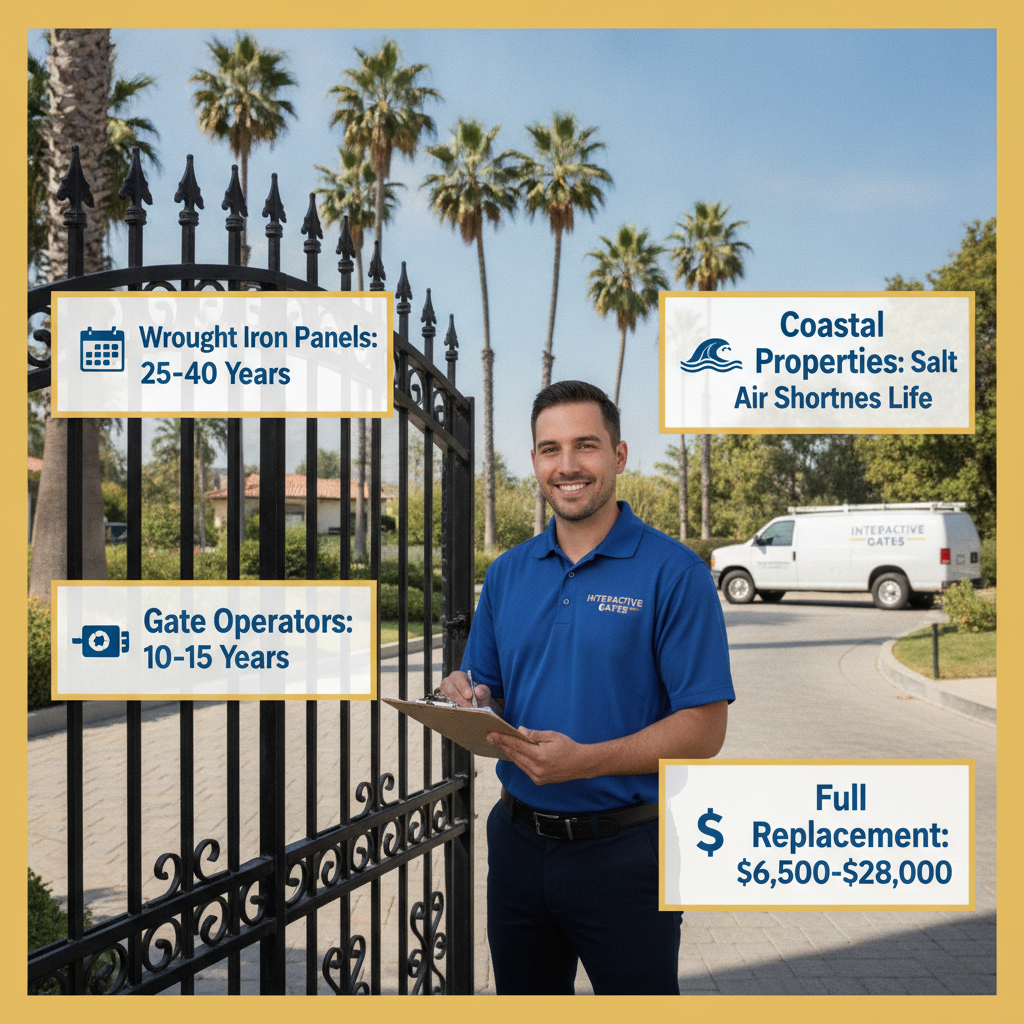
- Wrought iron gates last 40–60+ years in Seattle but require rust-prevention coating every 3–5 years due to the wet climate.
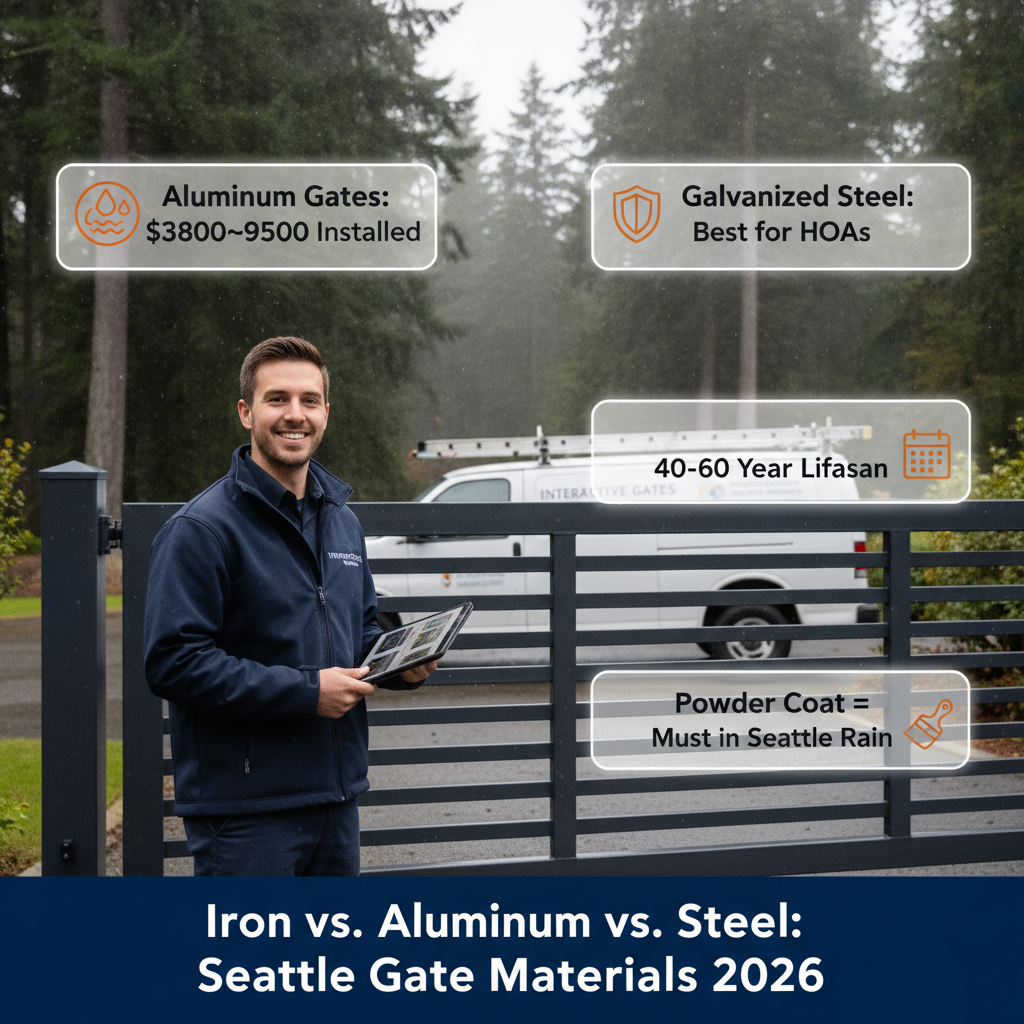
- Aluminum gates cost $3,800–$9,500 installed and never rust — making them the fastest-growing choice in coastal and lakefront neighborhoods.
- Steel (tubular/mild steel) gates run $4,200–$12,000 installed and offer the best strength-to-cost ratio for high-traffic driveways.
- Powder coating adds $400–$900 to any metal gate and is nearly mandatory in Seattle's 150+ rainy days per year environment.
- Gate material directly affects motor choice — a heavy wrought iron dual swing gate may need a FAAC 391 or Viking SL-3000, not a residential LiftMaster.
- HOA boards in neighborhoods like Medina and Mercer Island increasingly specify aluminum or galvanized steel to cut long-term maintenance budgets.
- Galvanized steel adds roughly $600–$1,200 to fabrication cost but can double corrosion resistance compared with bare mild steel in Seattle rain.
- Typical gate material decision adds or saves $1,500–$4,000 over a 10-year ownership window when you factor in repainting, rust repair, and motor strain.
You're shopping for an electric gate and the installer hands you three options: wrought iron, aluminum, or steel. The price tags are different, the weights are wildly different, and nobody seems to explain what actually matters for a Seattle driveway that sees eight months of drizzle, moss-friendly humidity, and the occasional hard freeze in Snohomish or Auburn. Which material holds up, which corrodes, and which one quietly destroys your gate opener in year four? This guide breaks it all down with real 2026 numbers.
Why Does Gate Material Matter More in Seattle Than in Most U.S. Cities?
Seattle averages roughly 152 rainy days per year, and neighborhoods east of the Cascades get that number in spades. But even west-side cities like Everett, Lynnwood, and Tacoma sit in a marine climate where relative humidity stays above 70% for most of the year. That moisture environment is the number-one enemy of bare metal. Oxidation, surface rust, and galvanic corrosion all accelerate when metal stays damp for long stretches — which is exactly what happens to an uncoated gate hinge sitting in a Gig Harbor driveway from October through April.
The practical consequence: the same mild-steel gate that lasts 25 years in Phoenix may need a full re-weld and repaint job in as few as 10–12 years in the Puget Sound basin if the coating is neglected. That math changes your total cost of ownership significantly, which is why choosing the right material upfront is one of the highest-leverage decisions you'll make in the whole gate project.
What Is Wrought Iron and Is It Really Still Used in 2026?
True wrought iron — a hand-worked, slag-containing iron with a fibrous grain — is rarely manufactured new in 2026. What most installers and homeowners call a 'wrought iron gate' is actually a decorative mild steel gate fabricated to look like classic ironwork: vertical pickets, scrollwork, and spear tops. Authentic antique wrought iron gates do exist in historic homes in Capitol Hill and Madrona, but new installations use mild steel formed to mimic the aesthetic.
That distinction matters because mild steel rusts more aggressively than true wrought iron when bare. A quality powder coat or epoxy primer is not optional in Seattle — it's the difference between a gate that looks sharp in 2036 and one that's shedding orange flakes by 2029. Expect to re-coat a Seattle 'wrought iron'-style gate every 4–6 years, or every 3 years if the gate faces southwest and gets direct rain exposure without a covered entry structure.
Installed cost for a decorative mild steel swing gate (single or dual) in Seattle: $5,500–$14,000 depending on width, design complexity, and motor package. A simple 10-foot single swing with a LiftMaster LA500UL opener sits toward the lower end; an ornate 16-foot dual swing with FAAC 391 operators and a keypad/intercom stack lands at the top.
How Does Aluminum Compare for Seattle Driveways in 2026?
Aluminum is the material that has gained the most market share in the Pacific Northwest over the past five years, and for good reason: it does not rust. Period. Aluminum forms a thin, self-sealing oxide layer when exposed to air, and Seattle rain accelerates that passivation rather than damaging it. A properly powder-coated aluminum gate installed in Bellevue today should need zero rust-prevention maintenance for its entire service life.
The trade-off is strength and weight in a different direction than you might expect. Aluminum is lighter — a 16-foot aluminum dual swing gate might weigh 280–350 lbs compared with 480–620 lbs for an equivalent mild steel gate. That lighter weight means smaller, less expensive motors (a LiftMaster RSL12UL or Apollo 1550 ETL often suffice), lower stress on posts and hinges, and faster open/close cycles. For driveways that cycle 30–60 times daily — think a busy Lakewood rental property or a Bellevue tech executive's home — the lower mechanical stress adds years to operator life.
Aluminum does dent more easily than steel if a vehicle makes contact, and intricate scrollwork is harder to fabricate cleanly in aluminum at lower price points. Most aluminum gates use a cleaner, more contemporary design language: horizontal slats, vertical bars, or modern geometric patterns. That aesthetic actually aligns well with the modern craftsman and mid-century homes prevalent in Seattle's Eastside suburbs.
Installed cost for aluminum driveway gates in the Seattle metro in 2026: $3,800–$9,500 for residential single or dual swing; $5,200–$13,000 for a slide gate on a sloped or space-constrained lot. The lower motor and maintenance costs mean total 10-year cost often beats mild steel even when the gate itself costs slightly more upfront.
Pro Tip: If your property is within a half-mile of Puget Sound, Lake Washington, or any saltwater inlet — think Gig Harbor waterfront, Tacoma's Point Defiance area, or Mercer Island shoreline — aluminum is almost always the smarter call over steel. Salt-laden air dramatically accelerates oxidation on any ferrous metal and can degrade even quality powder coat within 5–7 years.
Where Does Steel (Tubular and Galvanized) Fit In?
When installers say 'steel gate,' they usually mean one of two things: tubular steel (hollow square or rectangular tubing welded into a frame and picket pattern) or galvanized steel (steel that has been hot-dip coated in zinc before fabrication or after welding). These are the workhorses of the commercial and high-security gate world, and they show up frequently in HOA entry gates, apartment complexes, and industrial properties across Auburn, Everett, and south Tacoma.
Tubular steel offers excellent rigidity and impact resistance at a moderate price. A 16-foot dual swing tubular steel gate runs roughly $4,200–$10,000 installed with a standard residential motor package. It's heavier than aluminum but lighter than thick solid-plate designs, and it fabricates cleanly into almost any style. The corrosion risk is real: tubular steel must be powder-coated and ideally primed with a rust-inhibiting epoxy before the topcoat. Plan on recoating every 5–7 years in a Seattle climate.
Galvanized steel adds a zinc layer that sacrificially corrodes before the base steel does — effectively buying you an extra 10–15 years of corrosion resistance in wet climates. The added fabrication cost is $600–$1,200 for a standard residential gate, but for a gate expected to run 25+ years with minimal maintenance, it's almost always worth it. Many HOA and commercial specifications in the Seattle metro now require hot-dip galvanizing as a baseline, especially after corrosion-related gate failures in older Snohomish County communities became a maintenance budget issue in 2023–2024.
How Does Gate Weight Affect Your Electric Opener Choice?
This is the piece most homeowners miss entirely. Gate weight is the primary driver of operator sizing, and getting it wrong is expensive. An undersized motor cycling a 500-lb wrought iron gate will burn through a capacitor or gearbox in 18–24 months — a $600–$1,400 repair that was entirely avoidable.
Here's a simplified 2026 weight-to-motor guide for Seattle residential gates:
- Aluminum swing gate up to 350 lbs per leaf: LiftMaster LA500UL, Apollo 1550 ETL, or Viking E-50 — roughly $900–$1,600 per operator installed.
- Tubular steel swing gate 350–600 lbs per leaf: LiftMaster LA400UL (high-cycle), FAAC 400 CBAC, or Viking E-60 — roughly $1,100–$1,900 per operator installed.
- Heavy wrought iron/decorative steel swing gate 600–900 lbs per leaf: FAAC 391, Viking SL-3000, or HySecurity SwingSmart DC — $1,800–$3,200 per operator installed.
- Slide gates up to 1,200 lbs: LiftMaster RSL12UL, FAAC 746, or Viking SL-3000UL — $1,400–$2,800 installed.
- Heavy commercial slide gates 1,200–4,000 lbs: HySecurity SlideDriver 50, FAAC 844 — $3,500–$7,000+ installed.
Your installer should perform a gate weight calculation before specifying any operator. If they quote you a motor without knowing the gate's finished weight and material, that's a red flag.
What Do 2026 Material Costs Look Like Across Seattle Neighborhoods?
Labor rates and material sourcing vary across the metro. Fabrication shops serving Capitol Hill, Queen Anne, and Bellevue tend to charge a 10–20% premium over shops in Auburn or Lakewood, partly due to demand and partly due to the design complexity those neighborhoods typically request. Here's a rough 2026 installed cost grid across materials and gate types for the Seattle area:
- Aluminum single swing (10–12 ft), basic design: $3,800–$5,500
- Aluminum dual swing (14–18 ft), mid-range design: $6,500–$9,500
- Tubular steel single swing (10–12 ft): $4,200–$6,800
- Tubular steel dual swing (14–18 ft): $7,000–$12,000
- Galvanized steel dual swing (14–18 ft): $8,000–$13,500
- Decorative mild steel ('wrought iron' style) dual swing: $8,500–$14,000
- Aluminum slide gate (residential, up to 20 ft): $5,200–$10,500
- Steel slide gate (commercial, up to 24 ft): $8,000–$18,000
These figures include fabrication, powder coating, motor, standard access control (keypad or remote), and basic installation labor. Intercom systems, video cameras, loop detectors, and permit fees add $400–$3,000 depending on scope. You can browse completed local projects on our project portfolio to see finished examples across material types.
Pro Tip: Ask your fabricator for the specific powder coat formula used and whether it includes a zinc-phosphate primer layer beneath the topcoat. In Seattle's climate, a single-stage powder coat without primer can begin showing micro-corrosion at welds within 3–4 years. A two-stage system (epoxy primer + powder topcoat) is worth the extra $150–$300.
Which Material Do HOAs in the Seattle Area Choose Most Often?
Based on projects across Bellevue, Gig Harbor, and Snohomish communities, HOA boards trend toward galvanized steel or aluminum for entry gates, specifically because of maintenance predictability. A community of 120 homes cannot budget for emergency rust remediation on a gate that a contractor installed with inadequate coating 8 years ago. The shift is real: in 2026, aluminum and galvanized steel account for an estimated 65–70% of new HOA gate installations in King and Pierce counties, up from roughly 45% in 2021.
HOA boards also respond to insurance and liability considerations. A gate that corrodes at the hinge point and fails in the open position — or worse, drops onto a vehicle — creates both a liability claim and a community relations problem. Specifying aluminum or hot-dip galvanized steel is increasingly a governance best practice, not just a material preference. If your community is evaluating a gate system, our HOA and commercial gate page outlines the options we design for multi-unit communities.
Can You Visualize Your Gate Before You Commit to a Material?
Yes — and you should. Material and style decisions are much easier to make when you can see the gate on a property that resembles yours. Our gate design visualizer lets you toggle between styles and see how different material aesthetics (horizontal aluminum slat vs. vertical steel picket vs. decorative ironwork) read on a residential driveway. It takes about five minutes and saves a lot of 'I didn't realize it would look like that' conversations after fabrication begins.
In One Minute: Seattle Gate Material Decision Guide 2026
Choose aluminum if your property is near water, you want zero rust maintenance, or you prefer a modern/contemporary look. Budget $3,800–$9,500 for residential swing gates. Choose galvanized steel if you want maximum strength and longevity with good corrosion resistance — ideal for HOAs and high-cycle driveways. Budget $8,000–$13,500 for dual swing. Choose decorative mild steel ('wrought iron' style) if you want ornate ironwork aesthetics and commit to recoating every 4–6 years. Budget $5,500–$14,000. Always specify two-stage powder coating (epoxy primer + topcoat) regardless of material. Match your motor to your gate's finished weight — not its category — to avoid burnout and premature repairs. Factor in 10-year total cost, not just install price: aluminum and galvanized steel almost always win that calculation in the Pacific Northwest climate.
Frequently Asked Questions About Gate Materials in Seattle
Does aluminum dent easily if a car hits the gate?
Aluminum is softer than steel and will dent or bend on significant vehicle impact rather than resisting or cracking. However, modern 6061-series aluminum alloy used in quality gate fabrication is substantially stronger than household aluminum. A slow, low-speed nudge will dent it; a hard impact will bend a panel. Steel gates are more likely to hold shape on impact but may transfer force to the post or operator. For high-vehicle-traffic driveways, steel or a heavy-duty aluminum profile is the better choice.
How often does a steel gate in Seattle need to be repainted or recoated?
A tubular mild steel gate with a quality two-stage powder coat (epoxy primer plus polyester topcoat) in the Seattle climate should hold finish integrity for 6–9 years before any recoating is needed. Touch up chips and scratches immediately with matching rust-inhibiting paint — exposed bare steel in Seattle's humidity can begin surface-rusting within 48–72 hours. Gates in covered entry structures or under a portico will extend that interval to 10–12 years.
Will my HOA approve an aluminum gate, or do they require wrought iron style?
Most HOA CC&Rs in King, Pierce, and Snohomish counties specify style (picket spacing, height, color) rather than material. Aluminum can be fabricated to look nearly identical to a traditional picket steel gate. We recommend pulling your CC&R's architectural guidelines and presenting a material specification to the architectural committee before ordering — a simple one-page spec sheet from your installer is usually sufficient for approval. Our HOA gate page includes documentation templates we provide to communities we work with.
What is the lifespan difference between aluminum and galvanized steel gates in a wet climate?
A quality aluminum gate in Seattle's climate can reasonably last 30–50 years with only cosmetic maintenance (occasional cleaning and powder coat touch-ups). Hot-dip galvanized steel has a similar ceiling — 35–50 years — because the zinc coating sacrificially protects the base steel even when the powder coat chips. Bare mild steel without galvanizing, if neglected, may need structural weld repair or full replacement in as few as 15–20 years in the Pacific Northwest.
Does gate material affect how fast the gate opens?
Yes, indirectly. A lighter aluminum gate can be programmed to open and close faster than a heavy steel gate using the same motor, because there's less inertia to accelerate and decelerate safely. FAAC and Viking operators both allow speed adjustment in their programming menus. A typical residential aluminum swing gate can complete a full open cycle in 10–14 seconds; a heavy steel gate on the same operator class may take 16–22 seconds. On high-cycle commercial properties, that difference adds up in vehicle queue times.
Can I get a gate in Seattle that looks like wood but uses a metal frame for durability?
Yes — composite infill panels or cedar/redwood slats mounted in a steel or aluminum frame are a popular hybrid in neighborhoods like Ballard, West Seattle, and parts of Tacoma where a natural look is preferred but gate longevity is a concern. The metal frame provides structural integrity and carries the hinge load; the wood or composite infill provides the aesthetic. Expect a modest premium of $500–$1,500 over a comparable all-metal gate. Ask your installer whether the infill attachment method allows for panel replacement without full gate removal, which is important when wood weathers unevenly over 8–12 years.
Ready to Pick the Right Gate Material for Your Seattle Property?
Material choice is the decision that ripples through every other part of your gate project — cost, motor size, maintenance schedule, and what it looks like in ten years. If you're still weighing options or want a site-specific recommendation based on your driveway layout and climate exposure, our team is happy to walk through it with you. Browse our completed projects on the portfolio page, read what neighbors have said on our reviews page, or head to the residential gate page to explore your full range of options. When you're ready to talk specifics, the contact page gets you to a real person — no chatbot, no call center.