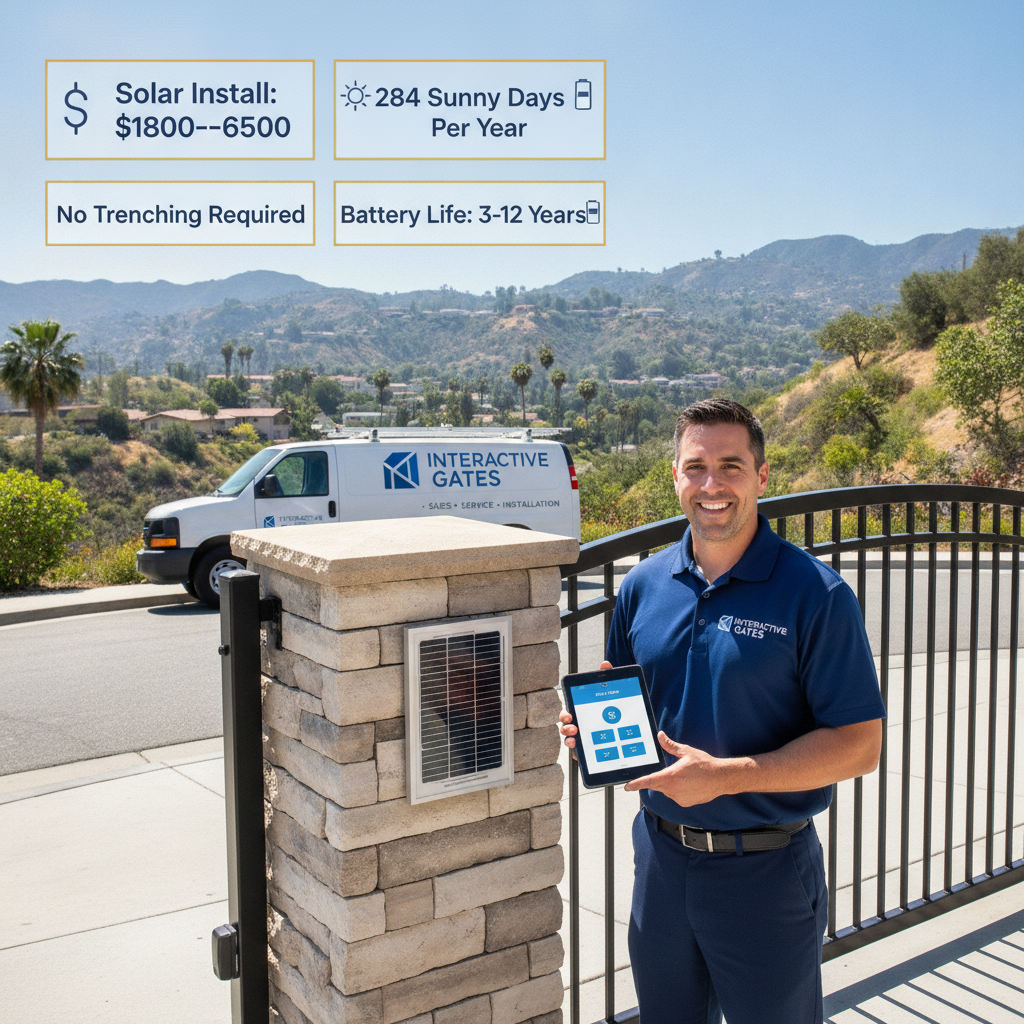
- Solar gate systems in Los Angeles cost $1,800–$6,500 installed in 2026, depending on panel wattage, battery backup, and gate type.
- LA's 280+ annual sunny days make solar the most viable gate power source of any major U.S. metro.
- A single 20W–40W panel is enough for a residential swing or slide gate running 30–60 cycles per day.
- LiftMaster, Viking, and Apollo all manufacture solar-ready operators with integrated charge controllers built for Southern California conditions.
- Most solar gate systems pay back their premium cost in 3–5 years through eliminated trenching, conduit, and utility connection fees.
- Rolling Hills, Malibu, and Laguna Beach hillside lots benefit most — trenching 150 ft of conduit can cost $4,000–$9,000 and solar eliminates it entirely.
- Battery backup is non-negotiable: a properly sized AGM or lithium pack keeps your gate running through 5–7 cloudy days without recharging.
- HOA and Title 24 compliance in California does not restrict solar gate panels, but panel placement must meet local setback and aesthetic review rules.
Is a Solar-Powered Electric Gate Worth It in Los Angeles in 2026?
You've probably typed something like solar electric gate Los Angeles cost, or can I install a gate without running power to it? Maybe your driveway sits 120 feet from the nearest outlet, or your property is in the hills above Rolling Hills where trenching through bedrock is an expensive nightmare. Whatever brought you here, you're asking exactly the right question — and in Los Angeles in 2026, the answer for most properties is a clear yes. This guide breaks down real installed costs, which operators work best in SoCal conditions, and exactly which lots are the best candidates for going solar.
How Does a Solar-Powered Gate System Actually Work?
A solar gate system has four components working together: a photovoltaic panel (or two), a charge controller, a deep-cycle battery bank, and a solar-compatible gate operator. The panel converts sunlight to DC electricity, the charge controller regulates voltage so the battery isn't overcharged, and the battery powers the operator on demand — day or night, sun or overcast. The gate operator itself doesn't 'know' it's solar-powered; it simply draws from the battery instead of a wall outlet.
For a standard residential single swing or slide gate running 30–60 cycles daily, a 20W panel paired with a 12V 18Ah AGM battery is the minimum viable setup. Most professional installs in LA use 30W–40W panels to build in headroom for cloudy January weeks and higher-cycle driveways. Multi-gate or high-traffic commercial entries typically step up to 60W–80W dual-panel arrays with 24V lithium battery packs rated at 40Ah–100Ah.
How Much Does a Solar Electric Gate Cost in Los Angeles in 2026?
Here's where homeowners need real numbers, not vague ranges. Costs in the LA metro in 2026 break down as follows:
- Entry-level residential solar kit (20W panel, AGM battery, basic operator): $1,800–$2,800 installed. Suitable for low-traffic driveways in Orange or San Clemente with 20–35 cycles per day.
- Mid-range residential (30W–40W panel, upgraded lithium battery, LiftMaster or Viking solar operator): $3,000–$4,500 installed. The sweet spot for most LA homeowners with a single gate and moderate traffic.
- Premium residential (dual 40W panels, 24V lithium pack, FAAC or Viking DC operator, keypad or app access control): $4,500–$6,500 installed. Common in Laguna Beach, Malibu, and hillside properties where trenching is impractical.
- Commercial solar gate entry (80W+ array, dual operators, vehicle loop detectors, intercom): $7,500–$14,000 installed. HOA front gates, equestrian properties, and large estate entries.
Compare those figures to the alternative: running a standard 120V circuit to a remote gate location. Trenching and conduit alone runs $35–$65 per linear foot in LA's rocky hillside terrain. A 150-foot trench — common on large lots in Rolling Hills or above PCH in Malibu — adds $5,250–$9,750 to a hardwired installation before you've even bought the operator. Solar eliminates that line item entirely.
Pro Tip: Always ask your installer for a 'solar vs. hardwired' cost comparison in writing. On any property where the gate is more than 60 feet from an existing 120V circuit, solar almost always wins on total installed cost — even before factoring in ongoing electricity savings.
Which Gate Operators Are Solar-Compatible in Los Angeles in 2026?
Not every operator runs efficiently on battery DC power. Here are the brands and models that actually perform well in Southern California conditions:
- Viking Access V2000DC / V2500DC: DC-powered swing gate operators purpose-built for solar. Handle up to 1,000 lb gates, rated for 100+ cycles per day on a full charge. Viking's solar kit bundles a 20W panel and charge controller — add a 30W panel for LA hillside installs. Street price: $1,100–$1,500 per operator.
- LiftMaster LA400DC / LA412DC: Industry-standard DC swing operators. The LA400DC runs on a 12V battery and pairs cleanly with LiftMaster's 20W solar panel kit. Myq-compatible for app-based access. Operator price: $900–$1,300.
- Apollo 1500ETL Solar Kit: A purpose-built solar swing gate system with integrated 10W panel, battery, and operator. Best for light-duty residential gates under 600 lb. Installed: $1,900–$2,600 complete.
- FAAC 402 CBC / 422 CBC: Italian-engineered DC operators popular on contemporary estate gates in Los Angeles hillside neighborhoods. Extremely quiet, 24V systems require a 40W+ panel setup but deliver premium cycle counts (up to 200 cycles/day). Operator: $1,400–$1,900 each.
- USAutomatic Sentry 300 Solar: Budget-friendly option for light residential swing gates, includes 10W panel. Works well in LA's climate but undersized for heavy gates or steep driveways — limit to gates under 400 lb.
Does Los Angeles Sun Actually Support Solar Gates Year-Round?
Los Angeles averages 284 sunny days per year — the highest of any city in our three-market footprint. Even in December and January, LA averages 5.8–6.2 peak sun hours per day, compared to Portland's 1.8–2.1 hours in the same months. What this means practically: a 30W panel in Laguna Beach generates roughly 174 watt-hours per day in winter — more than enough to power 40–60 gate cycles on a 12V system that draws about 2–3Wh per cycle.
The coastal marine layer in areas like Santa Monica, Venice, and San Clemente can reduce panel output by 10–20% on overcast mornings, but a properly sized battery bank (18Ah minimum, 30Ah recommended) compensates easily. The real edge case is a prolonged June Gloom stretch — LA's notorious May–June marine layer — where 5–7 consecutive low-sun days can drain a minimum-spec battery. Spec a 30Ah or larger battery if your gate is on the Westside or coastal Orange County.
Which Los Angeles Properties Are the Best Candidates for Solar Gates?
Solar makes the most financial and practical sense in specific situations:
- Long driveways (60 ft or more from power): Hillside estates in Rolling Hills, Bell Canyon, and the Santa Monica Mountains where running conduit through compacted soil or decomposed granite is $4,000–$9,000+.
- New construction where electrical rough-in wasn't planned: Adding a gate to a finished driveway without a nearby circuit means trenching through hardscape — often $60+ per foot through concrete or pavers.
- Agricultural, equestrian, and rural parcels: Properties in the Antelope Valley, Agua Dulce, or Saddleback Valley where utility power may not reach the gate location at all.
- Rental properties and vacation homes: Owners who want zero monthly utility cost associated with gate operation.
- HOA secondary access gates: A rear pedestrian or emergency vehicle gate that would cost $3,000+ to trench power to — solar is often $1,500 less expensive total.
Solar is a less obvious choice for gates in dense urban neighborhoods (Hollywood Hills, Silver Lake, Los Feliz) where the gate is typically within 30 feet of a garage outlet — in those cases, hardwiring is simpler and not dramatically more expensive.
Pro Tip: If you're on a corner lot or have a side-yard gate, check whether your exterior outlet or landscape lighting circuit passes within 40 feet. A short conduit run may cost only $400–$700, making hardwired the faster and simpler path. Solar earns its premium on distance.
Are There Local Permits or HOA Rules That Affect Solar Gate Panels in LA?
California's Solar Rights Act (Civil Code Section 714) protects homeowners' right to install solar energy systems — including gate panels — and limits HOA authority to restrict them based on aesthetics alone. An HOA cannot outright prohibit a solar panel on your gate post, but it can require that panels meet reasonable aesthetic standards (e.g., flush-mounted, specific colors, not visible from the street).
For permitting: a solar gate panel at 20W–40W is below the threshold requiring a full solar permit in most LA County jurisdictions. However, the gate operator installation itself still requires an electrical permit in most cities. Always confirm with your local building department — cities like Long Beach, Glendale, and Torrance have their own inspection requirements separate from LA County.
View our work on solar and standard gate installations in our project portfolio to see how panel placement is handled on different property types.
What's the Maintenance Picture for a Solar Gate in Los Angeles?
Solar gate systems have fewer moving parts than hardwired systems (no transformer, no AC-to-DC converter prone to failure), but they do have their own maintenance checklist:
- Panel cleaning: LA's dry climate means dust accumulates fast. Clean panels with a damp cloth every 2–3 months — dirty panels lose 10–25% efficiency. Budget $0 (DIY) or $50–$80 per visit for a service call.
- Battery replacement: AGM deep-cycle batteries last 3–5 years in LA's heat (high temps accelerate sulfation). Lithium iron phosphate (LiFePO4) batteries last 8–12 years but cost 2–3x more upfront. The lithium premium pays off on any gate you plan to keep long-term.
- Charge controller inspection: Annual check of voltage settings and connections. Usually bundled into a standard gate service visit ($95–$175 in the LA metro in 2026).
- Operator lubrication and hardware: Same schedule as any electric gate — every 6–12 months depending on cycle count. See our residential gate service page for what's included in a standard tune-up.
In One Minute: Solar Electric Gates in Los Angeles 2026
Solar-powered gate systems cost $1,800–$6,500 installed in LA in 2026. They make the most sense when your gate is 60+ feet from an existing power source, eliminating $4,000–$9,000 in trenching costs. LA's 284 sunny days per year make solar more reliable here than almost anywhere in the country. Best operators for SoCal: Viking V2000DC, LiftMaster LA400DC, FAAC 402 CBC, and Apollo 1500ETL. Spec a 30W+ panel and 30Ah battery minimum for coastal properties prone to June Gloom. Batteries need replacement every 3–5 years (AGM) or 8–12 years (lithium). California law protects your right to install solar gate panels even in HOA communities.
Frequently Asked Questions: Solar Electric Gates in Los Angeles
Can a solar gate work in Los Angeles during cloudy weather?
Yes. A properly sized battery bank — 18Ah minimum, 30Ah recommended for coastal areas — stores enough energy to run a residential gate for 5–7 days without any solar input. June Gloom on the Westside is the most common stress test, and a 30Ah AGM or any lithium pack handles it comfortably. Gates drawing 2–3Wh per cycle can complete 40–60 operations per day even after two consecutive overcast days on a full charge.
How long does a solar gate battery last in Los Angeles heat?
AGM (sealed lead-acid) deep-cycle batteries last approximately 3–5 years in LA's climate, where summer temperatures regularly exceed 90°F — heat accelerates plate sulfation and shortens AGM lifespan. Lithium iron phosphate (LiFePO4) batteries are far more heat-tolerant and last 8–12 years with minimal degradation. If your gate is in a sun-exposed location in the San Fernando Valley or Inland Empire, lithium is worth the 2–3x upfront premium.
Do I need a permit to install a solar gate panel in Los Angeles?
A small gate panel (20W–40W) typically falls below the threshold requiring a solar-specific permit, but the gate operator installation itself requires an electrical permit in most LA County cities. Requirements vary by city — Los Angeles, Long Beach, and Torrance each have their own building departments. Your installing contractor should pull the appropriate permit; if they don't offer to, ask specifically before work begins.
What is the best solar gate opener brand for a hillside property in LA?
For hillside properties — particularly steep driveways in Rolling Hills, Malibu, or the Hollywood Hills — the FAAC 402 CBC or Viking V2500DC are the strongest choices. Both run on 24V DC systems (more torque, more efficient over long wiring runs), handle gates up to 1,100–1,300 lb, and operate cleanly on a 40W–60W solar array with a lithium battery. LiftMaster's LA412DC is a solid mid-tier option for slopes under 15 degrees with gates under 800 lb.
Can an HOA in California prohibit a solar panel on a gate post?
No. California Civil Code Section 714 — the Solar Rights Act — prohibits HOAs from outright banning solar energy systems, including small gate panels. An HOA may impose reasonable aesthetic conditions (panel color, mounting angle, visibility from street), but those conditions cannot make installation significantly more expensive or effectively block it. If your HOA sends a denial letter, cite Civil Code 714 in your written response.
Is a solar gate cheaper than a hardwired gate in Los Angeles?
It depends on distance. When the gate is within 30–40 feet of an existing 120V outlet, hardwiring is often $300–$700 cheaper total. When the gate is 60 feet or more from power — common on large lots, hillside properties, and rural parcels — solar is almost always less expensive because it eliminates trenching costs of $35–$65 per linear foot. On a 150-foot run, solar can save $5,000–$9,000 in avoided excavation alone, making the solar premium pay back immediately.
Ready to Find Out If Solar Is Right for Your Gate?
If you're not sure whether your property is a good solar candidate, the best first step is a site assessment — not a sales call. A qualified installer will measure the distance from your nearest circuit, evaluate your daily cycle count, assess panel placement options, and give you a side-by-side solar vs. hardwired cost comparison. Explore gate styles and configurations using our gate designer tool, browse real installations in our portfolio, or reach out to our Los Angeles team with your property details. We're happy to answer questions before you commit to anything.