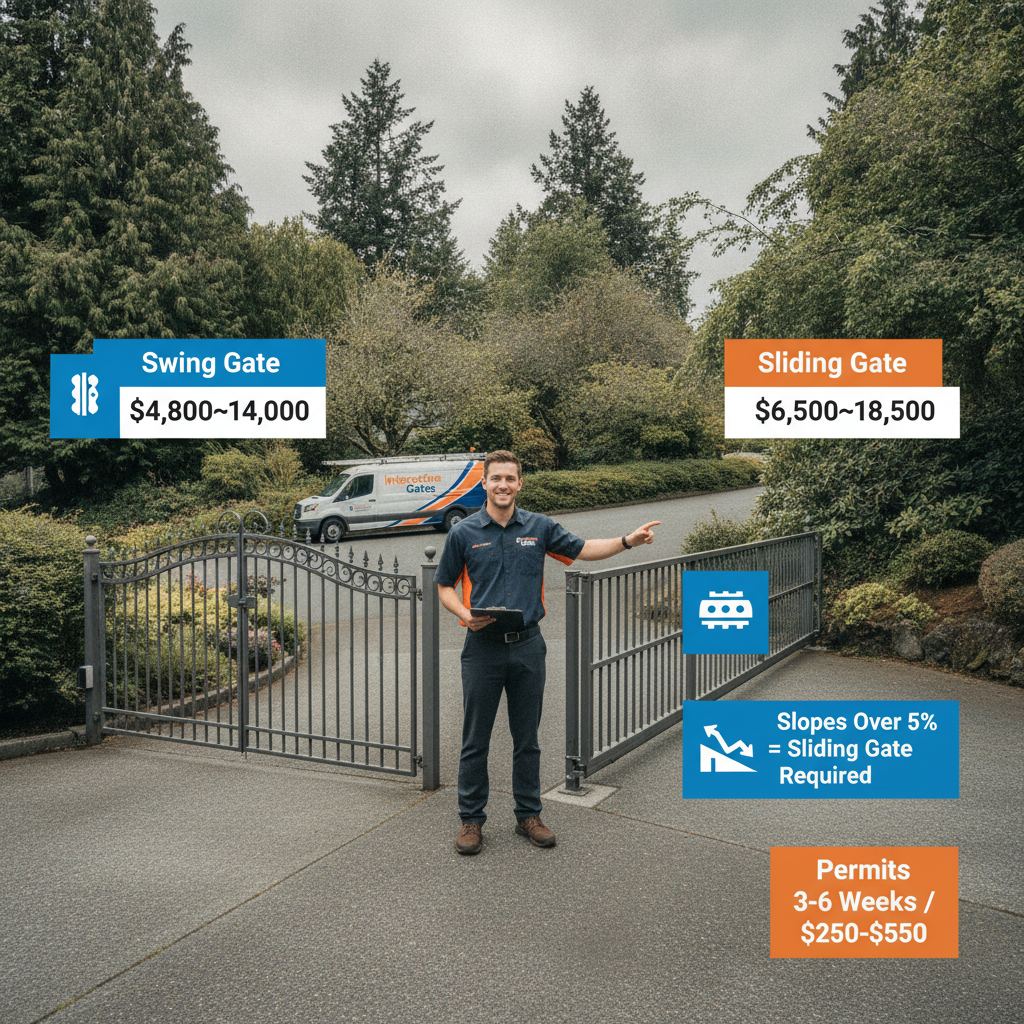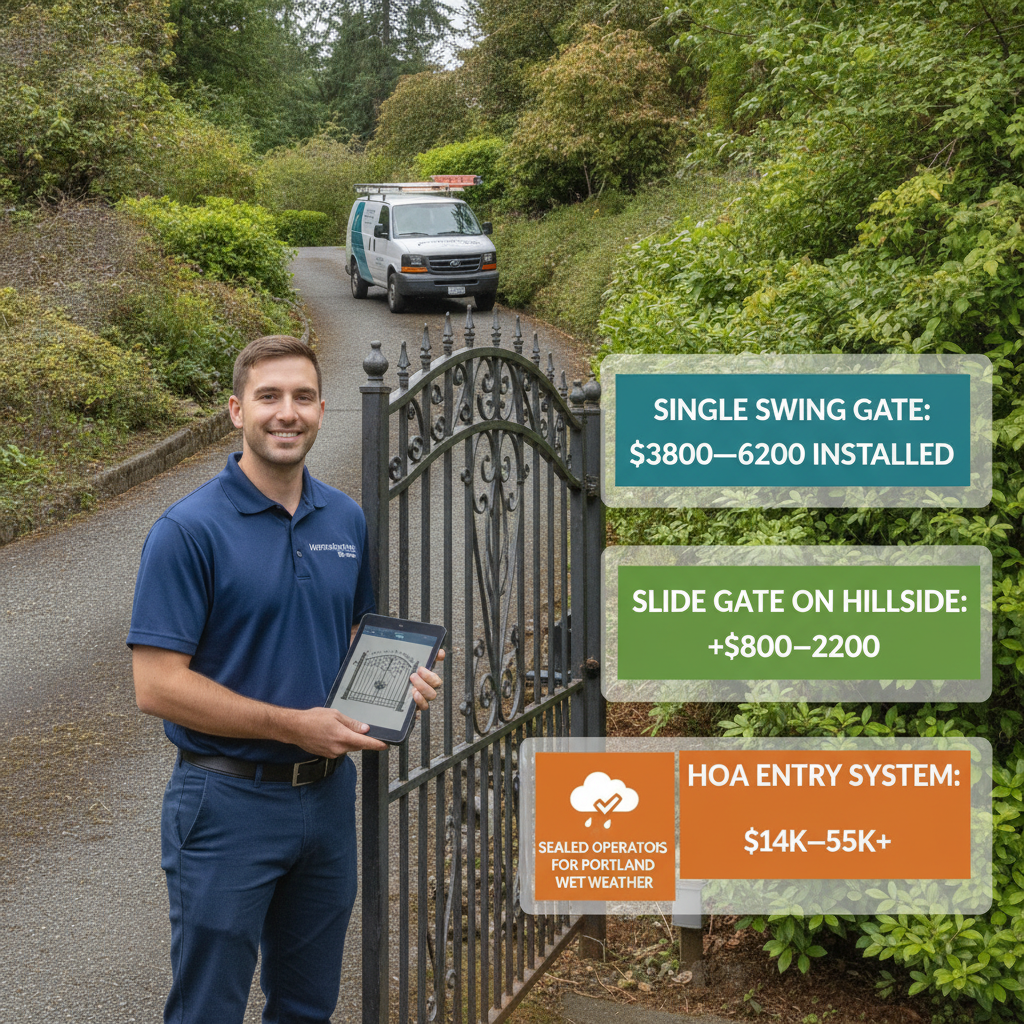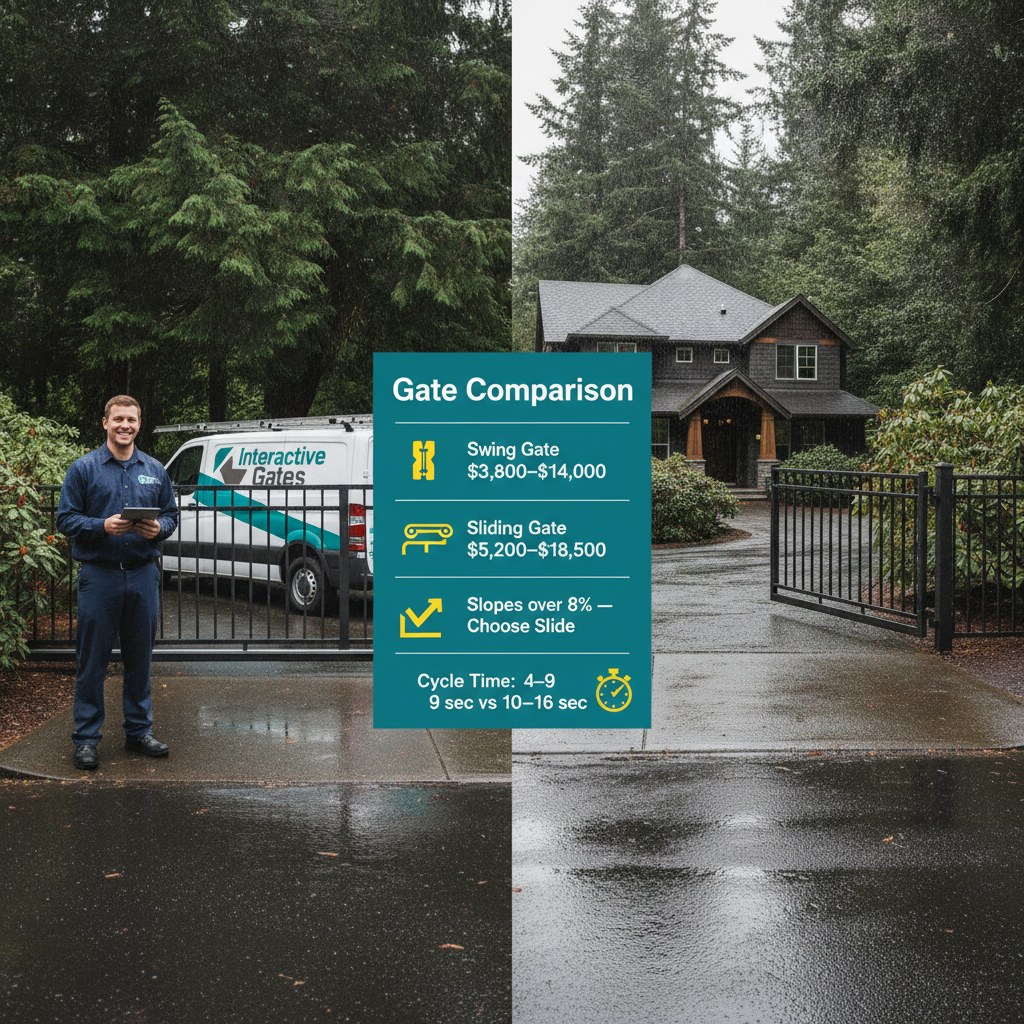
- Swing gates cost $3,800–$14,000 installed in Portland; sliding gates run $5,200–$18,500 depending on width, material, and operator brand.
- Flat driveways favor swing gates — slopes steeper than 8% make swing-arm operators work harder and wear out 30–40% faster in Portland's wet winters.
- Sliding gates need 1.2× the gate width in clear run-back space along the fence line — a 14-ft gate needs roughly 17 ft of level track room.
- LiftMaster LA500 and FAAC 770 are the top swing operators for Portland; Viking SL-1000 and LiftMaster CSL24V lead the sliding-gate category locally.
- Portland's 100+ annual rain days accelerate track corrosion on budget sliding systems — specify hot-dip galvanized or stainless track hardware.
- HOA communities in Lake Oswego and Beaverton almost always choose slide gates for their faster cycle times (4–6 sec vs. 8–14 sec for swing).
- Permit required for any motorized gate in Portland city limits — budget $180–$340 and 2–4 weeks for approval through Portland Bureau of Development Services.
- Typical ROI break-even on the extra cost of a slide gate vs. swing gate is 4–6 years when factoring reduced maintenance on sloped lots.
Swing Gate or Sliding Gate — Which One Is Right for My Portland Driveway?
Homeowners in Portland search these questions constantly: Does a swing gate work on a sloped driveway? How much room does a sliding gate need? Which type holds up better in Pacific Northwest rain? If you live in the West Hills, a flat lot in Beaverton, or a long rural parcel in Gresham, the answer is different — and getting it wrong means an operator that fails in two years or a gate that physically cannot open in winter mud. This guide breaks down every real variable so you can decide with confidence before spending a dollar.
How Does Each Gate Type Actually Work?
A swing gate is hinged on one or two posts and arcs outward (or inward) like a giant door. A single-leaf swing gate is ideal for driveways up to 12 ft wide; a bi-parting (double) swing works up to 20–24 ft. The operator — typically a linear actuator like the LiftMaster LA500 ($420–$560 unit cost) or a ram arm like the FAAC 770 ($480–$640) — pushes and pulls the leaf through its arc.
A sliding cantilever gate rolls sideways along a track or hangs on rollers without touching the ground. It requires a post-free opening (no center post) and clear run-back space along the fence line equal to 110–120% of the gate width. Common operators include the Viking SL-1000 ($550–$780) and the LiftMaster CSL24V ($490–$720), both rated for Portland's wet climate with sealed motor housings and corrosion-resistant drive gears.
A sliding V-track gate uses a ground rail — cheaper to install but notorious in Portland because silt, moss, and water pooling in the track cause jamming every winter. Cantilever is almost always the smarter call here.
Which Gate Type Works on a Sloped Portland Driveway?
This is the single biggest variable in the Portland metro. The West Hills, parts of Lake Oswego along the bluff, and many lots in Oregon City sit on grades between 5% and 18%. Here is how each gate type handles slope:
- Swing gates on slopes up to 5%: Fine with standard installation. The arc clears the pavement without modification.
- Swing gates on slopes 5–12%: Requires a raked or stepped gate design so the bottom rail follows the grade. Add $400–$900 to fabrication cost. Operator works harder on the uphill stroke, reducing actuator lifespan from a typical 80,000–100,000 cycles to roughly 55,000–70,000 cycles.
- Swing gates on slopes over 12%: Not recommended. The gate either drags on pavement at the bottom of the arc or leaves a large gap at the top — both are security and safety failures.
- Sliding (cantilever) gates on any slope: Operate independently of ground grade because the gate hangs and slides horizontally. This is why sliding gates dominate commercial and HOA entries in hilly Portland neighborhoods. The trade-off is that the run-back area along the fence must be level or within 2% grade — otherwise the rollers drift and bind.
Pro Tip: If your Portland driveway slopes more than 8%, get a site visit before committing to swing. An experienced installer will measure the actual grade with a digital level and tell you whether a raked swing gate or a cantilever slider is the better long-term investment for your specific lot.
How Much Do Swing Gates and Sliding Gates Cost in Portland in 2026?
Prices below reflect full installed cost — gate panel fabrication, operator, safety sensors, control board, wiring, concrete footings, and basic access-control keypad. They do not include intercom systems, camera integrations, or permit fees.
- Single-leaf swing gate (8–12 ft, steel or aluminum): $3,800–$7,500
- Bi-parting swing gate (14–20 ft, steel or aluminum): $6,500–$14,000
- Cantilever sliding gate (12–16 ft, steel or aluminum): $5,200–$10,800
- Cantilever sliding gate (18–24 ft, heavy commercial steel): $9,500–$18,500
- Operator upgrade to FAAC or Viking (vs. entry-level Apollo): add $300–$700
- Raked/stepped gate fabrication on sloped lot: add $400–$900
- Hot-dip galvanized hardware package (recommended for Portland rain): add $250–$550
- Portland BDS permit fee: $180–$340 flat
Labor rates for gate installers in Portland run $85–$130 per hour in 2026. A straightforward single-leaf swing takes 4–6 hours; a cantilever slide on a wide opening can take 8–14 hours including track alignment and operator commissioning. See real project photos from the Portland area in our project portfolio.
How Much Space Does a Sliding Gate Need in Portland Driveways?
The most common reason homeowners abandon a sliding gate plan is not budget — it is run-back space. Here are the hard numbers:
- A 12-ft cantilever gate needs approximately 14.5 ft of clear fence line on the opening side (no cross-fence, no utility box, no landscaping in the way).
- A 16-ft gate needs about 19–20 ft of run-back.
- A 20-ft gate needs 24–25 ft.
- The cantilever beam (the rearward extension that counterbalances the gate) also adds 10–15% to the gate length behind the opening post — that section sits inside the property.
On narrow urban lots in Portland neighborhoods like Sellwood, St. Johns, or inner Southeast, run-back space is frequently the deal-breaker. Lots in outer Gresham, Hillsboro, and Salem-area properties almost always have enough room. If your fence line is tight, a bi-parting swing gate that opens inward (toward the house) is often the elegant solution — as long as the driveway is flat enough and long enough that a vehicle doesn't block the inward arc.
Curious what different gate styles actually look like on a property like yours? Try our gate designer tool to visualize swing vs. slide configurations in your color and material choices before committing.
Which Gate Type Holds Up Better in Portland's Rain and Moss Climate?
Portland averages 144 rain days per year and rarely gets the drying UV that Southern California provides. That moisture profile affects swing and sliding gates differently:
- Swing gate hinges: The top vulnerability. Cheap zinc-plated hinges rust through in 3–5 years. Specify 304 or 316 stainless hinges, or heavy-duty hot-dip galvanized weld-on hinges. Replace them at the first sign of surface rust — a seized hinge puts enormous side-load stress on the actuator arm.
- Swing gate operator housing: LiftMaster LA500 and FAAC 770 both carry IP44 or IP55 weatherproof ratings — adequate for Portland. Apollo 1550 (budget tier) is only IP42 and sees premature board failures in the West Hills micro-climate where morning fog is thick. Budget an extra $200–$400 for a proper operator enclosure cover if your gate faces prevailing southwest rain.
- Sliding gate V-track (ground rail): A moss and debris trap in Portland. After one wet season the rail fills with organic matter, and the gate drags or stops mid-cycle. Cantilever design eliminates this entirely — the gate never touches the ground.
- Cantilever roller carriages: Sealed bearing cartridges in Viking and LiftMaster cantilever hardware are rated for 1,000,000 cycles and tolerate standing water. The open-bearing budget rollers sold by some regional suppliers corrode within 2–3 wet seasons. Ask your installer specifically for sealed, grease-packed roller carriages.
- Gate panel coatings: Powder coat over sandblasted steel holds well in Portland for 8–12 years. Galvanized-then-powder-coated is the premium spec and can last 20+ years with annual wax. Raw aluminum (anodized or mill finish) doesn't rust but can pit from road salt on Hwy 26 and I-205 corridors in rare winter ice events.
How Fast Does Each Gate Type Open and Why Does It Matter?
Cycle speed matters most for high-traffic entries: HOAs, apartment buildings, commercial lots, and properties where delivery vehicles queue at the gate. Here are realistic 2026 cycle times:
- Single-leaf swing gate (12 ft, LiftMaster LA500): 10–14 seconds full open
- Bi-parting swing gate (16 ft total, dual LA500): 12–16 seconds (both leaves must clear before vehicle enters)
- Cantilever slide gate (14 ft, Viking SL-1000): 4–7 seconds full open
- Cantilever slide gate (20 ft, LiftMaster CSL24V): 6–9 seconds full open
For residential driveways with one or two vehicles per hour, swing speed is perfectly fine. For the Beaverton and Lake Oswego HOA communities that see 50–200 vehicle entries daily, a 14-second swing cycle creates queuing — and queuing creates tailgating, which defeats security. Sliding gates are the standard specification for any community gate serving more than roughly 30 vehicles per day.
Pro Tip: Most operators let you adjust open/close speed within a range. A Viking SL-1000 set to its fastest cycle (4 sec) puts more mechanical stress on the end stops and rollers. Running it at 5.5–6 seconds extends component life significantly without meaningfully affecting throughput for residential use.
What Does Portland Code Require for Motorized Gates?
Portland Bureau of Development Services requires a building permit for any motorized vehicle gate, regardless of property type. The permit covers:
- UL 325 compliance for the operator (standard on all major brands)
- Entrapment protection: photo-eye sensors (mounted at bumper height, 6 in. above grade) and a secondary device — typically an edge sensor or loop detector
- Emergency disconnect accessible without power
- Minimum 14-ft clear width for driveways serving a residence (Portland standard); 16 ft for commercial
Permit fees run $180–$340 and approval takes 2–4 weeks for residential, 3–6 weeks for commercial or HOA gates. Gresham and Hillsboro have similar requirements through their own permitting offices. Oregon City runs through Clackamas County Building and may require a separate site plan if the gate is near a public right-of-way. Full breakdown in our HOA and commercial gate guide.
Which Type Is Right for Portland HOAs and Multi-Family Properties?
HOA boards in Portland and surrounding communities ask us this question every month. The decision tree is straightforward:
- Choose sliding (cantilever) if: entry is wider than 14 ft, daily traffic exceeds 30 vehicles, the fence line has run-back room, or the lot is on a grade over 8%.
- Choose swing if: the opening is 12 ft or less, traffic is light (under 20 vehicles/day), the lot is flat, and run-back space is constrained.
- Choose bi-parting swing if: the opening is 16–24 ft, the lot is flat, and aesthetics (grand estate look) outweigh cycle-speed needs.
For HOA projects, we recommend getting a formal site assessment before the board votes on a budget — the difference between a $7,000 swing gate and a $12,000 cantilever install can look identical on paper but dramatically different in practice once you account for the slope and traffic volume. Browse verified HOA and residential projects from Portland-area customers on our customer reviews page.
In One Minute: Swing vs. Slide Gate in Portland 2026
- Swing gate: $3,800–$14,000 installed, best on flat lots under 12 ft wide, slower cycle (10–14 sec), more vulnerable to slope-related wear.
- Cantilever slide gate: $5,200–$18,500 installed, works on any grade, faster cycle (4–9 sec), needs 120% run-back space, better for HOA/commercial traffic.
- Portland climate tip: Specify hot-dip galvanized hardware and sealed roller carriages — it adds $250–$550 upfront and saves $800–$2,000 in premature replacement costs.
- Top operators locally: LiftMaster LA500 / FAAC 770 (swing), Viking SL-1000 / LiftMaster CSL24V (slide).
- Permit required in Portland, Beaverton, Gresham, and Hillsboro — budget $180–$340 and 2–6 weeks.
- Slope over 8%? Sliding cantilever is almost always the better long-term investment.
Frequently Asked Questions
Can a swing gate open on a sloped driveway in Portland?
Yes, but with limits. Slopes up to about 5% are handled with standard installation. Between 5–12%, the gate panel must be raked or stepped to follow the grade, adding $400–$900 to fabrication cost and shortening operator lifespan by 20–30%. Slopes above 12% are generally not suitable for swing gates — a cantilever sliding gate is the correct solution on steep Portland-area driveways.
How much run-back space does a sliding gate need?
A sliding cantilever gate needs clear fence-line run-back equal to about 120% of the gate width. A 12-ft gate needs roughly 14–15 ft; a 16-ft gate needs 19–20 ft; a 20-ft gate needs 24–25 ft. That space must be free of cross-fences, utility equipment, and major landscaping, and ideally within 2% grade so the rollers track smoothly.
Which gate type is faster to open?
Sliding cantilever gates are significantly faster — typically 4–9 seconds for a full cycle versus 10–16 seconds for swing gates. For residential driveways with light traffic, the difference is barely noticeable. For HOA communities or commercial entries serving 30+ vehicles daily, the faster cycle time of a sliding gate prevents queuing and tailgating.
What operator brands do Portland installers recommend in 2026?
For swing gates, the LiftMaster LA500 and FAAC 770 are the two most recommended operators in Portland due to their IP-rated housings, proven reliability in wet climates, and available local parts. For sliding gates, the Viking SL-1000 and LiftMaster CSL24V are the top picks, both featuring sealed motor housings and corrosion-resistant drive systems suited to 140+ rain days per year.
Do I need a permit for a sliding or swing gate in Portland?
Yes. Portland Bureau of Development Services requires a building permit for any motorized vehicle gate, swing or slide. Fees run $180–$340 for residential projects and approval typically takes 2–4 weeks. Surrounding cities like Beaverton, Gresham, Hillsboro, and Oregon City have similar requirements through their own permitting offices. Operating an unpermitted motorized gate can result in fines and forced removal.
Is a cantilever sliding gate harder to maintain in Portland rain?
Not if it is specified correctly. The key is avoiding V-track (ground rail) designs, which collect moss, silt, and debris in Portland's wet seasons. True cantilever gates have no ground contact and are far easier to maintain. Annual maintenance — roller inspection, lubrication of the drive chain or belt, sensor cleaning — takes about 45–60 minutes and costs $120–$200 through a professional service visit. Properly maintained cantilever hardware from Viking or LiftMaster routinely lasts 15–20 years in the Pacific Northwest climate.
Ready to Figure Out Which Gate Fits Your Portland Property?
Whether your lot is flat in Hillsboro, steeply pitched in the West Hills, or a sprawling acreage in Oregon City, the right gate type depends on your specific grade, opening width, traffic volume, and run-back space. Our team does site assessments across the Portland metro — no pressure, just real measurements and honest recommendations. Reach out here to schedule yours, or explore residential gate options on our residential gate page to get a sense of styles and configurations before we talk.