- Most automatic gates in Seattle last 15–25 years on the structure, but motors and control boards often need replacement at the 8–12 year mark.
- Pacific Northwest rainfall (37–45 inches per year in Seattle) accelerates rust, corrosion, and seal degradation faster than in drier climates.
- Wrought iron gates corrode 2–3× faster without annual powder-coat touch-ups in Seattle's wet, salty coastal air near Puget Sound.
- Gate operators rated for 500,000+ cycles (like LiftMaster CSW200 or FAAC 844) are worth the premium in high-traffic HOA and commercial settings.
- Expect a full motor replacement every 10–15 years, costing $900–$2,800 installed depending on brand and gate weight.
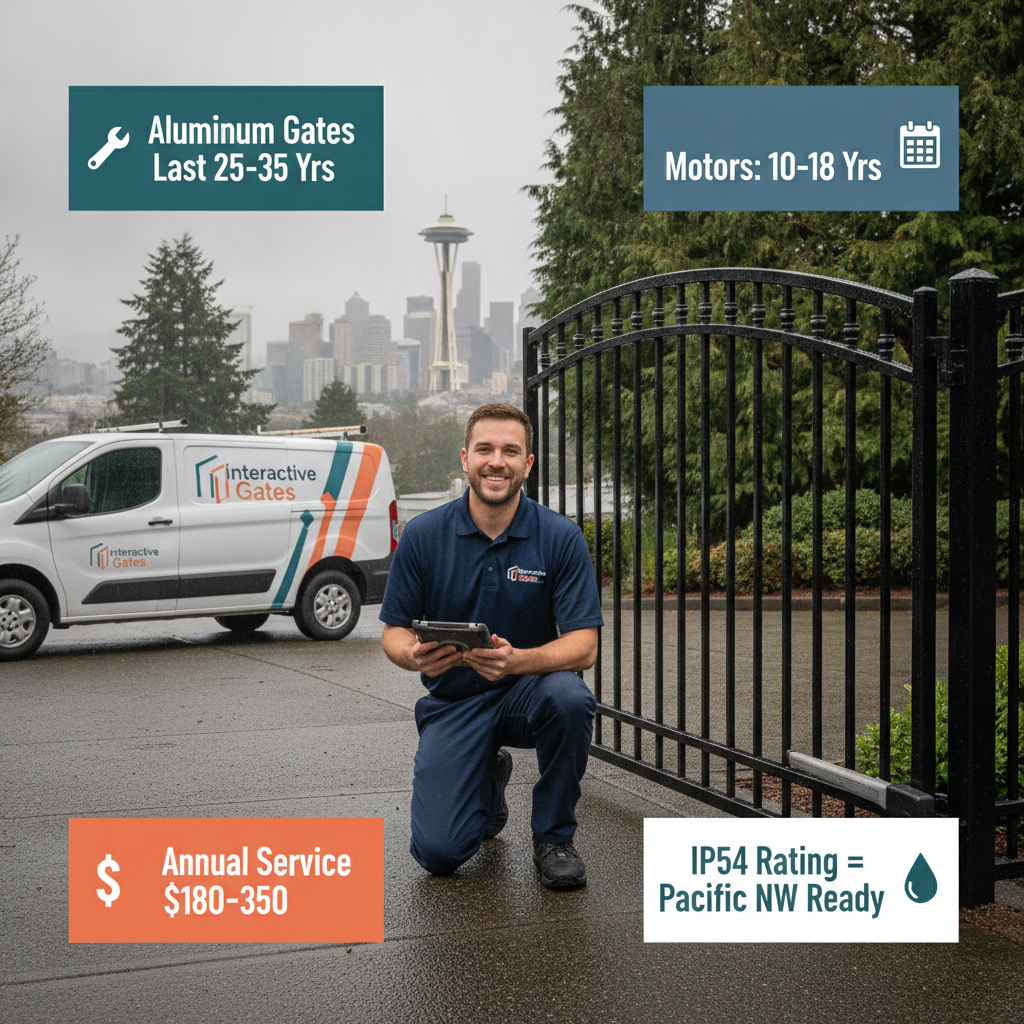
- Annual professional maintenance in Seattle runs $180–$350 and can double your operator's working life.
- Local building codes in King County and Snohomish County require UL 325 compliant safety sensors — non-compliant older gates must be updated or replaced.
- Signs your gate needs replacement vs. repair become critical after year 10 — this post tells you exactly what to look for.
How Long Does an Automatic Gate Last in Seattle, WA?
Homeowners across Bellevue, Tacoma, and Gig Harbor are asking the same things right now: 'My gate is acting up — is it worth fixing or should I replace it?' 'How many years should I expect from a gate motor in the Seattle rain?' 'What's making my gate rust out faster than my neighbor's in Arizona?' These are real questions, and the answers depend on material, motor brand, maintenance habits, and — critically — the specific climate challenges of the greater Seattle area. Let's break it all down with hard numbers and local context.
What Is the Average Lifespan of an Automatic Gate in the Seattle Area?
In Seattle's wet marine climate, a well-maintained automatic gate system has two separate lifespans to track: the physical structure (the gate itself) and the mechanical/electronic components (motor, control board, safety sensors, wiring).
Gate structure lifespan by material:
- Powder-coated steel or wrought iron: 20–30 years with repainting every 5–7 years. Without maintenance, surface rust appears in as little as 3–5 years near Puget Sound or the Lake Washington shoreline.
- Aluminum: 25–35 years. Aluminum doesn't rust, making it one of the smartest long-term investments for Seattle homeowners in areas like Lynnwood, Everett, or Auburn where salt-laden air is a factor.
- Galvanized steel with powder coat: 20–28 years. The galvanized zinc layer adds meaningful corrosion protection before the powder coat layer even comes into play.
- Wood (cedar or redwood): 10–18 years. Seattle's rainfall warps, rots, and swells wood panels faster than in most U.S. markets. Cedar lasts longer than pine but still requires sealing every 2–3 years minimum.
- Vinyl/PVC: 20–30 years structurally, though UV fading can dull appearance after 10–12 years even in Seattle's overcast conditions.
Gate operator (motor) lifespan by usage and brand:
- Residential swing arm operators (LiftMaster LA500, Nice ROX600): 10–15 years with annual servicing. Rated for 300,000–500,000 cycles.
- Residential slide gate operators (LiftMaster CSW200, FAAC 741): 12–18 years. Track and roller wear is a bigger concern in Seattle than motor failure — debris and pine needles clog tracks year-round.
- Commercial/HOA operators (FAAC 844, Elite SL1000B, LiftMaster RSW12V): 15–20 years in medium-traffic settings. These are cycle-rated at 1,000,000+ and handle Seattle's rainy-season open/close spikes better than residential-grade units.
If you want to see what gate styles and operators make sense for your property before committing, try the Interactive Gates gate designer tool — you can visualize materials and styles in minutes.
How Does Seattle's Climate Specifically Shorten (or Lengthen) Gate Life?
Seattle averages 37–45 inches of rain per year depending on whether you're in the city proper, the Eastside (Bellevue, Kirkland), or further south toward Tacoma and Lakewood. That consistent moisture, combined with mild but persistent temperatures, creates unique wear patterns.
The biggest climate threats to gates in the Seattle metro:
- Oxidation and rust on steel/iron: The marine layer from Puget Sound carries salt particles that catalyze rust on bare or chipped metal. Neighborhoods on Mercer Island, West Seattle, and along the Sound shoreline see this most aggressively.
- Motor seal degradation: Moisture intrusion into operator housings — especially in cheaper units without IP54 or IP55 ingress protection ratings — corrodes circuit boards and motor windings. This is the number-one cause of premature motor failure in the Pacific Northwest.
- Debris accumulation on slide gate tracks: Seattle's abundant evergreen trees drop needles, cones, and small branches directly onto ground tracks. Clogged tracks force slide gate motors to work 30–40% harder, dramatically shortening their service life.
- Freeze-thaw cycles in winter: While Seattle rarely drops below 25°F, the Eastside and Snohomish County areas like Snohomish and Everett see enough freeze-thaw cycles to expand and contract ground posts, slowly shifting gate alignment over years.
- UV and moss growth: Overcast skies reduce UV fade but increase moss and algae on horizontal surfaces, particularly wood and rough-textured vinyl.
Pro Tip: When specifying a gate operator for any Seattle-area property, always request a unit with at least an IP54 weatherproofing rating. LiftMaster's CSW200 and FAAC's 844 both meet this standard and include thermal overload protection — critical for motors running in cold, damp conditions from November through March.
What Are the Warning Signs My Seattle Gate Needs Repair vs. Full Replacement?
This is the question most homeowners get wrong — they either over-repair a dying system or prematurely replace hardware that just needs a tune-up. Here's the honest breakdown:
Signs you likely need repair ($150–$900 range):
- Gate moves slowly or hesitates — usually a limit switch, battery, or track cleaning issue
- Remote or keypad stops working — often a control board reset or receiver replacement
- Gate reverses without hitting anything — safety sensor misalignment, common after Seattle windstorms
- Grinding or squealing — hinge lubrication or worn nylon drive wheels on slide operators
- One arm of a dual swing gate lags — sync adjustment on the control board
Signs you likely need full or partial replacement ($900–$5,000+ range):
- Operator is 12+ years old and has had 3 or more repairs in the past 24 months
- Control board has been replaced once already and is failing again
- Gate frame is visibly warped, cracked welds, or has structural rust penetrating through metal (not just surface rust)
- Motor runs but produces no movement — internal gearbox failure, often uneconomical to repair on units over 10 years old
- System uses pre-2008 safety sensors that do not meet current UL 325 standards — King County code enforcement has flagged these in several HOA communities near Bellevue and Gig Harbor
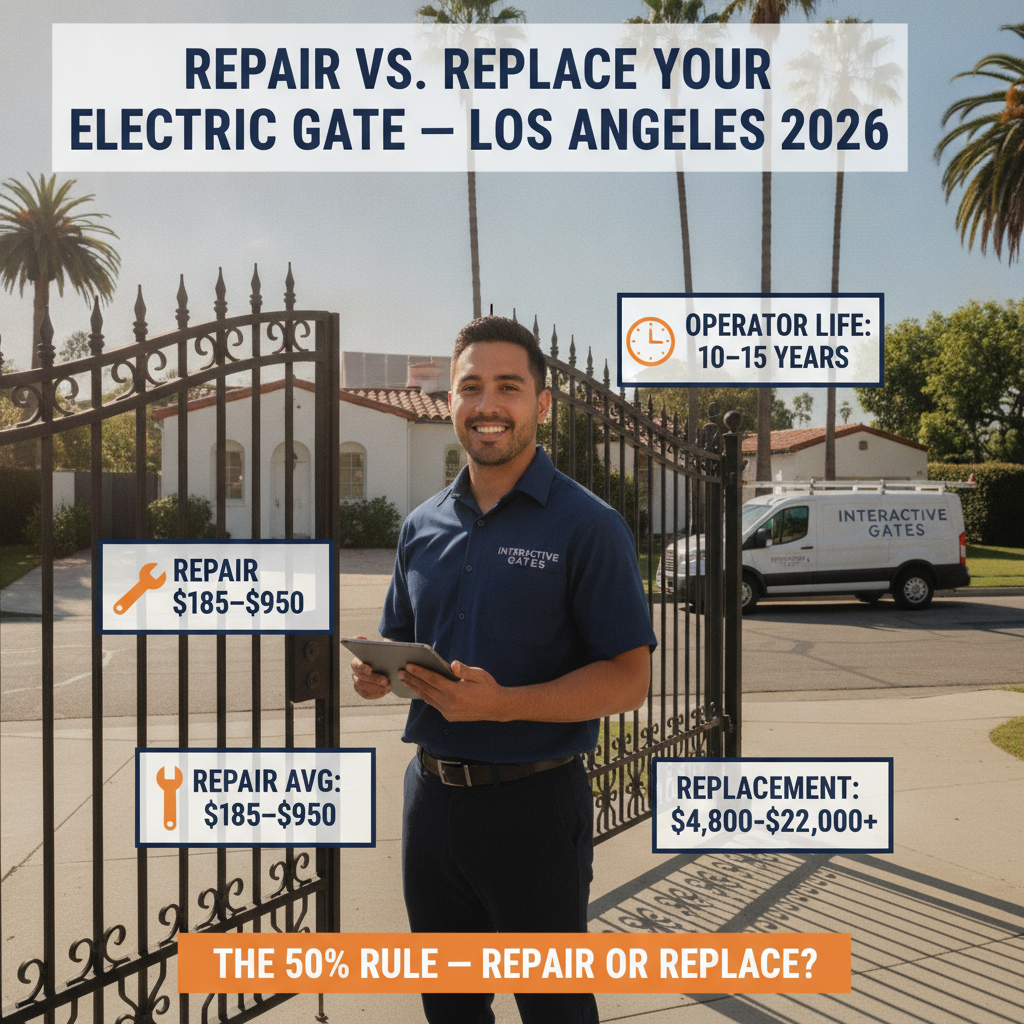
A useful rule of thumb in 2026: if repair costs exceed 50% of what a new equivalent operator would cost installed, replace it. New residential operators run $900–$2,100 installed for swing gate systems and $1,100–$2,800 for slide gate systems in the Seattle metro, so that repair-vs-replace threshold is typically around $450–$1,400.
How Much Does Gate Maintenance Cost in Seattle in 2026?
Preventative maintenance is the single highest-ROI action a Seattle homeowner or property manager can take on a gate system. Here's what to budget:
- Annual single-gate residential tune-up: $180–$280. Includes hinge and arm lubrication, limit switch check, sensor alignment, battery test, and remote re-sync.
- Annual dual-gate or slide gate residential service: $240–$350. Track cleaning and roller inspection add time.
- HOA or commercial multi-gate maintenance contract: $400–$900 per visit, typically quarterly. Many Seattle-area HOA boards in communities near Auburn and Lynnwood lock in annual maintenance agreements to stay ahead of UL 325 compliance inspections.
- Rust treatment and powder-coat touch-up: $200–$600 depending on gate size. Do this every 5–7 years on steel gates or whenever chipping is visible.
- Track replacement (slide gates): $300–$700 for residential, $700–$1,800 for commercial. Tracks in Seattle's climate should be inspected every 3 years for embedded debris and rail deformation.
Pro Tip: Schedule your annual gate service in September or early October — before Seattle's heavy rain season begins in November. Technicians catch failing seals, corroded terminals, and weak batteries while conditions are dry enough for a thorough inspection. Waiting until January means diagnosing problems in the rain and often a longer service queue.
Which Gate Brands Hold Up Best in Seattle's Wet Climate?
Not all operators are built for Pacific Northwest conditions. Based on real-world performance in the Seattle metro, here's how the top brands rank for longevity in wet climates:
- FAAC (Italian engineering): Consistently top-performing in high-rain markets. The FAAC 844 and FAAC 391 are both IP55-rated and use sealed oil-bath gearboxes that resist moisture intrusion. Commercial lifecycle rated to 1,000,000 cycles. Price installed: $2,200–$4,500 for commercial swing applications.
- LiftMaster (Chamberlain Group): The CSW200 commercial slide operator and LA500 residential swing operator both have strong Seattle-area track records. MyQ connectivity is useful for remote diagnostics. Residential installed: $1,100–$2,400.
- Nice/HySecurity: HySecurity's HySmart and StrongArm commercial operators are built for harsh environments and are popular in Seattle industrial and multi-family properties. Expect $3,000–$6,500 installed for commercial-grade units.
- Mighty Mule / Ghost Controls: Budget-tier residential operators at $600–$950 installed. Fine for low-traffic vacation properties or secondary gates, but typically last only 6–10 years in Seattle's climate without diligent maintenance. Not recommended for primary daily-use gates.
- Elite Gates (Elite SL1000B, ES101): Good mid-range option for residential slide gates. IP54 rated, 500,000-cycle rating, installed at $1,200–$2,100 in the Seattle area.
In One Minute: Seattle Automatic Gate Lifespan Recap
Here's everything compressed for quick reference:
- Gate structures: 15–35 years depending on material (aluminum lasts longest in Seattle's wet climate).
- Gate operators: 10–18 years residential, 15–20 years commercial with annual maintenance.
- Seattle's rain, salt air, and debris are the top three lifespan killers — all manageable with the right operator spec and maintenance schedule.
- Annual maintenance costs $180–$350 residential, $400–$900 HOA/commercial and can add 5–8 years to operator life.
- Replace (don't repair) when: the unit is 12+ years old, has had multiple board failures, or repair cost exceeds 50% of replacement installed cost.
- Best brands for Seattle's climate in 2026: FAAC, LiftMaster, HySecurity — all IP54/55 rated with strong local service networks.
- UL 325 compliance is non-negotiable — older gates in King and Snohomish County HOAs are being flagged regularly.
Want to see what a new gate would look like on your property before calling anyone? The Interactive Gates gate visualizer lets you design your gate in real time. For specific pricing and site assessments, visit the residential gate page or the HOA and commercial gate page.
Frequently Asked Questions: Automatic Gate Lifespan in Seattle
How often should I have my automatic gate serviced in Seattle?
Once per year is the minimum for residential gates in the Seattle area. Given the volume of rain, debris, and temperature swings between November and March, many homeowners with daily-use gates choose twice-yearly service — once in September before rain season and once in April after it. Annual service runs $180–$350 for a single residential gate and is the most cost-effective thing you can do to extend operator life.
Do automatic gates rust faster in Seattle than in other cities?
Yes, meaningfully so. Seattle's combination of high annual rainfall (37–45 inches), proximity to Puget Sound salt air, and consistent humidity creates accelerated oxidation conditions for bare or insufficiently coated steel and iron. Aluminum gates are inherently rust-proof and are the best structural choice for properties near the water in areas like Gig Harbor, West Seattle, or Mercer Island. For steel gates, annual inspection of powder-coat integrity and immediate touch-up of any chips is essential.
What is the most common reason automatic gates fail in the Pacific Northwest?
Moisture intrusion into the operator housing is the leading cause of premature gate failure in the Seattle metro. When water reaches the control board or motor windings — particularly in operators without IP54 or higher weatherproofing — corrosion causes erratic behavior, board failure, and eventually total motor failure. Specifying a weatherproof operator from the start and keeping the housing sealed and mounted off the ground are the two most impactful prevention steps.
Can I repair a gate that's 15 years old, or should I just replace it?
It depends on what's failing. If the structure is sound and only the operator needs work, repair can make sense — particularly if the motor is a premium brand like FAAC or HySecurity with parts still readily available. But if the control board has already been replaced once, the motor is showing gearbox wear, and the gate is also showing structural rust, replacement is almost always the better financial decision. Use the 50% rule: if repair cost exceeds half of a new installed system, replace it.
Do Seattle area HOAs have specific rules about automatic gates?
Yes. King County and most municipalities in the greater Seattle area require that all automated vehicular gate systems comply with UL 325, the national safety standard governing automatic gate operators, entrapment protection, and safety sensor placement. Many HOA communities are actively auditing older gate systems — particularly those installed before 2010 — for compliance. Non-compliant systems can expose HOA boards to liability. Interactive Gates provides compliance assessments for HOA properties throughout the Seattle metro.
What's the best gate material for the Seattle climate in 2026?
For longevity with minimal maintenance, aluminum is the clear winner in Seattle's wet climate. It doesn't rust, holds paint well, and is available in styles that closely mimic wrought iron or ornamental steel at a lower long-term cost of ownership. Powder-coated galvanized steel is a strong second choice if aesthetics require a heavier look. Wood gates, while popular in rural areas of Snohomish County, require the most upkeep and have the shortest structural lifespan in the Pacific Northwest's persistent moisture.
Ready to Talk About Your Gate?
Whether your gate is ten years old and behaving strangely, or you're planning a new installation in Bellevue, Tacoma, or anywhere across the Seattle metro, the best next step is a conversation with a local expert who knows the climate, the codes, and the brands. Browse the project portfolio to see real local installs, read what other Seattle-area homeowners say on the reviews page, or reach out directly through the contact page — no pressure, just honest answers.