- Most existing Portland driveways can be gated — but slope, surface type, and utility lines determine which gate style works and what it costs.
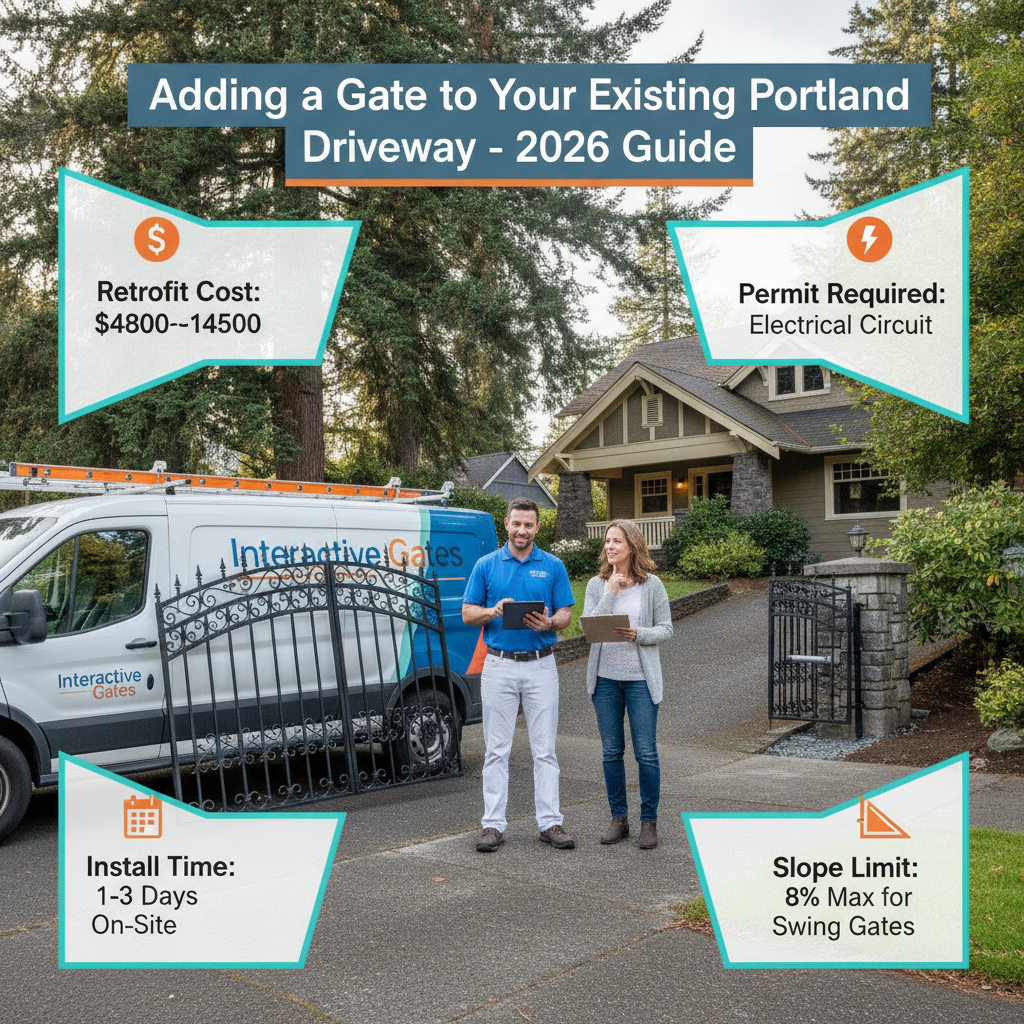
- Retrofit installation typically runs $4,800–$14,500 installed in the Portland metro, depending on gate width, material, and site complexity.
- Swing gates need 10–14 ft of clearance behind each leaf; sloped driveways steeper than 8% almost always require a slide or vertical-lift gate instead.
- Concrete footer work adds $400–$900 per post on most Portland sites where existing posts or pillars can't be reused.
- Oregon utility locates (811) are free and legally required before any post digging — schedule 3 business days in advance.
- Most retrofit projects take 1–3 days on-site once permits (if required) are approved; Multnomah County permit review averages 5–10 business days in 2026.
- LiftMaster, FAAC, and Viking dominate Portland retrofit installs because their operators handle variable-voltage grid power common in older NE and SE Portland neighborhoods.
- Adding access control (keypad, intercom, app) at install time saves $600–$1,200 versus retrofitting it later as a separate project.
Can You Actually Add an Automatic Gate to an Existing Driveway in Portland?
Can I add an automatic gate to my existing driveway? Will my sloped lot work? Do I need a permit just to gate my own driveway? These are the exact questions Portland homeowners type into Google — and the answers depend heavily on your specific lot, soil, and street setup. Whether you're in a craftsman bungalow in Sellwood, a newer build in Beaverton, or a larger property in Lake Oswego, this guide walks you through every real-world factor so you can plan your retrofit with confidence and a clear budget in mind.
What Makes a Portland Driveway 'Retrofittable' for an Automatic Gate?
Before a gate installer ever shows up at your property, four site factors determine whether your project is straightforward or complex: slope, surface, width, and existing structures. Portland's terrain is famously varied — flat grid streets in inner SE, steep hillside access roads in the West Hills and Lake Oswego, and everything in between.
Slope is the biggest variable. Swing gates — the most common residential choice — require a relatively level arc. The UL 325 safety standard and most manufacturer specs allow a maximum of 8% grade across the swing path before the operator starts fighting gravity on every cycle. If your driveway slopes more than that at the gate line, a slide gate (which runs along a track parallel to the fence line) or a vertical-pivot lift gate is typically the right answer. Vertical lifts are rarer and expensive ($12,000–$22,000 installed) but handle extreme Portland hillside conditions that nothing else can.
Surface type matters for slide gates specifically. A slide gate needs a level, solid track base — concrete or compacted asphalt — running at least the full width of the gate opening alongside the fence line. Gravel or soft soil requires track foundation work, adding $800–$2,000 to the project.
Width drives gate panel cost more than anything else. Single-lane residential driveways in Portland are typically 10–14 ft wide; double-car driveways run 16–20 ft. A 14 ft ornamental steel swing gate panel costs roughly $1,800–$3,200 in material alone in 2026. A 20 ft bi-parting swing pair jumps to $3,500–$6,500 in panels before labor or operator.
Existing structures — brick pillars, concrete posts, old wooden posts — can sometimes be reused if they're plumb, solid, and the right spacing. An installer will probe them for rot or cracking and check footing depth. Reusing good pillars saves $800–$1,800 in concrete and masonry work.
Pro Tip: If you're not sure about your slope, measure it yourself before calling for a quote. Stand at the gate line with a 4-ft level and a tape measure. Hold the level flat, then measure the gap between its low end and the ground. A 4-inch gap over 4 feet equals a 8.3% grade — the edge of swing-gate territory. Share that number with your installer and you'll get a much faster, more accurate estimate.
Do You Need a Permit to Install a Gate on Your Portland Driveway?
This is where Portland homeowners often get surprised. The short answer: it depends on fence height and whether structural work is involved. The City of Portland's Bureau of Development Services (BDS) generally does not require a standalone building permit for a gate and operator if the gate is attached to an existing compliant fence and no new retaining walls or significant grading are involved. However, electrical permits are a different story.
Any new 120V or 240V circuit run to power your gate operator requires an electrical permit in Multnomah County. As of 2026, that permit costs $180–$320 for a standard residential circuit and requires inspection. Your installer's licensed electrician typically pulls this permit as part of the job — always confirm this before signing a contract. If they say 'we'll just tap an existing outdoor outlet,' that's a red flag; a continuous-duty gate operator needs a dedicated circuit.
In Beaverton (Washington County) and Lake Oswego, similar rules apply, though each jurisdiction has its own fee schedule. Gresham and Oregon City occasionally require a combination permit if the gate posts require excavation within certain setback distances. Budget 5–10 business days for permit review and always ask your installer who pulls the permits — it should never be the homeowner's responsibility on a full-service install.
For properties in HOA-governed communities, a separate architectural review approval is almost always needed before you even apply for a city permit. Check with your HOA board first; review timelines in Portland-area HOAs range from 2 weeks to 60 days. You can explore how HOA gate projects are typically structured in our commercial and HOA gate planning guide.
What Does It Cost to Add an Automatic Gate to an Existing Portland Driveway in 2026?
Here's what Portland homeowners are actually spending in 2026, broken down by scenario:
- Basic single-swing gate, flat lot, aluminum panel, 12 ft wide: $4,800–$7,200 installed. Includes LiftMaster LA500 or equivalent operator, one keypad, wiring, and a new concrete footer.
- Mid-range bi-parting swing gate, ornamental steel, 16 ft opening, moderate slope: $8,500–$12,000 installed. FAAC 844 or Viking SW4900 operator pair, phone app integration, video intercom, two footers.
- Slide gate, 16 ft, steel, flat site with existing track base: $7,500–$11,000 installed. LiftMaster SL595 or equivalent, keypad, loop detector, access control panel.
- High-end custom estate gate, ornamental iron, 20 ft bi-parting, hillside lot with grading: $14,000–$22,000+ installed. Includes custom fabrication, FAAC 844 operators, full BAS integration, video intercom, and possible retaining work.
Labor in the Portland metro runs $85–$130/hour for gate installation crews in 2026. A typical single-gate retrofit takes 8–14 labor hours across a 1–2 day installation. Electrical subcontract work (trenching, conduit, panel connection) adds $600–$1,400 depending on distance from the main panel to the gate post.
If your existing driveway is in a neighborhood like Eastmoreland, Laurelhurst, or West Hills where mature trees and roots are common, expect to add $300–$700 for root-safe conduit routing and hand-digging near tree drip lines. Portland's urban canopy rules can restrict where you trench.
Which Gate Operator Works Best for Portland's Climate and Power Grid?
Portland's climate is mild but persistently wet — averaging 37 inches of rain per year — and older neighborhoods like NE Alberta, SE Division, and North Portland deal with aging electrical infrastructure that can produce voltage fluctuations. Your operator choice should account for both.
LiftMaster LA500 / LA400 (swing gates): The most-installed residential swing operator in Portland in 2026. Built-in thermal protection, 24V DC motor, handles up to 500 lbs per leaf, and integrates with the myQ app natively. Retail replacement cost: $480–$650. Excellent for standard residential gates in most Portland neighborhoods.
FAAC 844 (swing gates): Italian-engineered, widely used on heavier ornamental iron gates and estate properties. Self-locking hydraulic mechanism means no separate lock needed and the gate holds position during power outages without a battery backup. Popular in Lake Oswego and West Hills properties. Operator cost: $700–$950 each.
Viking SW4900 (swing gates): Heavy-duty, UL listed, rated for 9,000 cycles/month — the right choice if you have high traffic (rental properties, multi-family with shared gate). Handles up to 18 ft leaves. Operator cost: $850–$1,100.
LiftMaster SL595 (slide gates): The workhorse slide operator for Portland commercial and residential slide installations. Rack-and-pinion drive, 115V or 230V, handles gates up to 1,500 lbs and 50 ft. Excellent noise dampening — important in quiet Portland residential streets. Operator cost: $1,100–$1,400.
All of the above operators are compatible with solar backup panels — increasingly relevant as Portland homeowners deal with winter ice storms that knock out grid power in the West Hills and Tualatin Valley areas. A solar backup kit adds $350–$700 to the install but keeps your gate functional during multi-day outages.
Pro Tip: Request a dual-mode operator (AC primary, DC battery backup) rather than a pure AC operator if your Portland neighborhood experiences outages during winter storms. The West Hills and Skyline Road areas lose power 2–4 times per winter on average — and a gate stuck in the closed position during an outage is a genuine safety and access problem.
What Access Control Should You Add at the Same Time?
Adding access control during the initial installation is always cheaper than returning later. Here's what Portland homeowners are choosing in 2026 and what each adds to the project cost:
- Keypad entry (surface-mount, weatherproof): $180–$350 installed. Brands: LiftMaster 877MAX, DoorKing 1506, Linear. Essential minimum for any retrofit.
- Telephone entry / video intercom: $650–$1,800 installed. Allows visitors to call your cell and you to open the gate remotely. Most popular option for Lake Oswego and Beaverton residential. Brands: DoorKing 1835, Aiphone JO series, 2N Helios IP.
- Smartphone app control (myQ, FAAC Connect, ButterflyMX): $0–$200 added when using a compatible operator. Lets you open/close from anywhere — popular among Portland homeowners who travel frequently or manage rental properties remotely.
- Vehicle loop detectors: $280–$450 per loop, installed in the driveway surface. Required by UL 325 for most commercial applications; highly recommended for residential to prevent gate from closing on a vehicle. Typically one loop on each side of the gate.
- Key fob / clicker transmitters: $30–$60 each. Simple, reliable, still the fastest way to open a gate from a car.
For a look at the full range of access control options and how they compare for Portland properties, our Portland service page covers the local context in detail. You can also browse completed projects in our area on the project portfolio to see what access control setups other Portland homeowners have chosen.
How Long Does a Retrofit Gate Installation Take in Portland?
From first call to first open-close cycle, here's a realistic timeline:
- Site assessment and quote: 1–3 days after initial contact
- Permit application (if electrical permit required): 5–10 business days for Multnomah County BDS review in 2026
- Material lead time: Standard aluminum or steel panels in stock: 1–5 days. Custom ornamental iron or fabricated panels: 3–6 weeks.
- On-site installation: 1 day (simple single-gate, flat lot) to 3 days (complex hillside, slide gate with foundation work, full access control)
- Electrical inspection: Typically scheduled within 3–5 business days of request in Multnomah County
Total realistic timeline for a standard Portland retrofit: 2–4 weeks from signed contract to operational gate, assuming no custom fabrication. Complex projects with custom ironwork can run 6–9 weeks. Plan accordingly if you have a seasonal deadline — Portland installers get booked out 3–5 weeks in summer and late spring.
Are There Specific Challenges for Portland Neighborhoods?
Yes — and knowing them in advance saves money and frustration.
Inner SE and NE Portland (Sellwood, Hawthorne, Alberta Arts): Older homes with narrow lots (25–33 ft wide) often have driveways only 9–11 ft wide. Gates can be installed but custom narrow panels and precise hinge placement are required. Older electrical panels (60–100A) sometimes need an upgrade before adding a gate circuit — add $800–$2,500 if your panel is pre-1990.
West Hills and Skyline: Steep grades, rocky soil, and long distances from the street to the house mean longer conduit runs ($12–$18/linear ft) and potential rock excavation for footers ($400–$900 extra). Slide or vertical-lift gates are often the only viable option on steeper lots. Homeowners here also benefit most from solar backup given the outage frequency.
Lake Oswego and Dunthorpe: Larger lots, wider driveways, strong demand for estate-style ornamental iron or wrought iron. HOA and city aesthetic guidelines are stricter — expect design review. Our Lake Oswego gate installation page covers local requirements in more detail.
Beaverton and Hillsboro: Newer construction with more standardized lot layouts makes retrofit generally simpler. Wider streets, more prevalent conduit-ready builds, and Washington County permit offices that are slightly faster than Portland BDS. See our Beaverton gate service page for local specifics.
Gresham and Oregon City: More rural character at the edges means longer driveways, sometimes unpaved approaches, and occasional need for solar-primary power where running conduit from the house is cost-prohibitive. Solar gate systems (Viking VSP24 or FAAC solar kit) make strong economic sense for long-driveway properties here.
In One Minute: Adding a Gate to Your Portland Driveway
Most Portland driveways can be retrofitted with an automatic gate — but slope, surface, and site complexity determine whether you need a swing, slide, or vertical-lift design. Expect to spend $4,800–$14,500 for a typical residential retrofit in 2026. You'll need an electrical permit for the new circuit; the permit takes 5–10 days through Portland BDS. LiftMaster, FAAC, and Viking are the most common operators, with battery or solar backup strongly recommended for West Hills and hillside properties. Add access control at install time to save $600–$1,200 versus doing it later. Most projects complete in 1–3 on-site days, with a full 2–4 week timeline from contract to completion for in-stock materials.
Frequently Asked Questions
Will a swing gate work on my sloped Portland driveway?
It depends on the degree of slope at the gate line. Swing gate operators can handle up to approximately 8% grade reliably. Beyond that, the motor fights gravity on every open or close cycle, leading to premature wear and potential safety issues. If your driveway slopes more steeply — common in the West Hills, Lake Oswego hills, and parts of Southwest Portland — a slide gate or vertical-lift gate is the appropriate solution. An on-site assessment by an experienced installer will confirm which option applies to your specific lot.
Do I need a permit to install an automatic gate in Portland?
A building permit is generally not required for a gate attached to an existing compliant fence with no new structural work. However, an electrical permit is required in Multnomah County for any new 120V or 240V circuit serving the gate operator. This permit costs $180–$320 and requires a final inspection. In Beaverton (Washington County), similar rules apply with slightly different fees. Your installer's licensed electrician should pull this permit as part of a full-service installation.
How long does a gate retrofit installation take in Portland?
On-site installation typically takes 1–3 days depending on site complexity. The full project timeline from signed contract to operational gate runs 2–4 weeks for in-stock materials, factoring in electrical permit review (5–10 business days at Portland BDS) and material delivery. Projects requiring custom ornamental iron fabrication extend to 6–9 weeks. Portland installers typically book 3–5 weeks out in peak season (April through September).
Can I add app control and a video intercom to my new gate?
Yes, and doing it at the initial installation is strongly recommended. Adding a video intercom (DoorKing, Aiphone, or 2N Helios IP) at install time adds $650–$1,800 to the project. Smartphone app control is $0–$200 extra when using a compatible operator like LiftMaster (myQ) or FAAC (FAAC Connect). Retrofitting access control as a separate later project typically costs $600–$1,200 more than bundling it with the gate installation, because the electrician must return and re-trench or re-run conduit.
What happens to my gate during a Portland power outage?
Without battery backup, most 115V AC operators will hold the gate in its last position — meaning if it was closed when power went out, it stays closed and manual release is required. A battery backup module (typically $180–$350 added at install) allows full automatic operation for 24–72 hours during an outage. For West Hills and Tualatin Valley properties that average 2–4 outages per winter, a dual-mode AC/DC operator or solar backup kit is strongly recommended.
Will my existing brick or concrete pillars work for the new gate?
Existing pillars can often be reused, saving $800–$1,800 in new footer and masonry work. An installer will check that the pillars are plumb (within 1/4 inch), crack-free, have a footing depth of at least 24 inches (Portland frost line is shallow but soil saturation is a real factor), and are spaced correctly for your chosen gate width. If they pass inspection, hinge plates or weld-on hardware can be anchored directly into the masonry. If the pillars are damaged, out of plumb, or the wrong spacing, new posts are the more reliable and ultimately more cost-effective choice.
Ready to Get a Real Quote for Your Portland Driveway?
The best next step is a site visit — because slope, soil, panel spacing, and distance from your electrical panel all affect the final number in ways no online calculator can fully capture. If you're ready to explore your options, take a look at our residential gate services page for an overview of what we install throughout the Portland metro, or try the Interactive Gates gate designer tool to get a visual sense of gate styles before your consultation. When you're ready to talk specifics, our contact page makes it easy to schedule an assessment with no obligation.