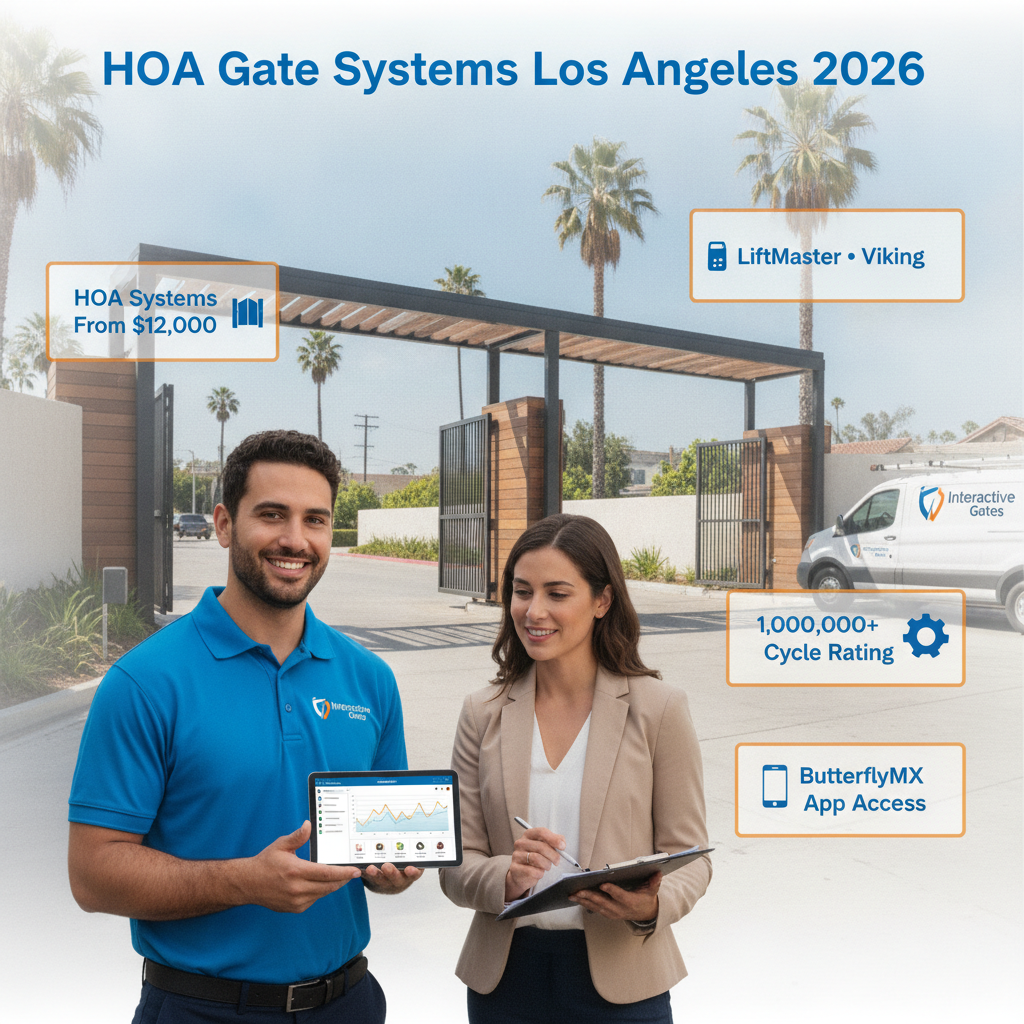
- Entry-level HOA gate systems in Los Angeles start around $8,500 for a single swing gate with a basic keypad; full community builds run $45,000–$120,000+.
- LiftMaster, FAAC, and Viking are the three most-installed commercial operators in LA-area HOA projects in 2026, each rated 1,000,000+ cycles.
- Cloud-based access control (ButterflyMX, Swiftlane, DoorKing) now handles visitor management, delivery access, and resident credentials from one app.
- LA County and most city codes require UL 325-compliant safety edges, photo eyes, and a monitored entrapment zone on every vehicular gate.
- Annual maintenance contracts for HOA gates run $1,800–$6,000 depending on gate count, operator type, and access-control complexity.
- Slide gates dominate HOA driveways in flat communities; swing gates are common in hillside enclaves like Rolling Hills and Laguna Beach where lots are wider.
- Permit timelines in LA City average 6–10 weeks; Orange County cities like Orange and San Clemente average 3–6 weeks.
- ROI studies show HOA property values increase 5–9% when a controlled-access gate system is added to a previously open community.
What does a gate system actually cost for an HOA in Los Angeles? Which operator brand holds up under 200+ daily cycles in the heat of the San Fernando Valley? Does your Laguna Beach or Rolling Hills community need a single-gate setup or a full dual-lane entry with a call box and license-plate recognition? These are the real questions boards and property managers are Googling right now, and this guide answers every one of them with current 2026 pricing, brand breakdowns, and LA-specific code requirements.
Why HOA Gate Systems in Los Angeles Are Different From Residential Installs
A homeowner in Los Angeles buying a driveway gate for a single-family home is solving a simple problem: control who drives in, deter opportunistic crime, add curb appeal. An HOA board is solving a much more complex problem — managing access for hundreds of residents with different schedules, dozens of vendors, multiple delivery services, emergency responders, and guests, all through one or two entry points that must operate reliably 365 days a year in the LA heat.
The failure modes are also different. A residential gate that breaks strands one family. An HOA gate that breaks strands 80 households, creates a liability exposure, and generates an emergency repair bill that the board has to explain at the next meeting. That context drives every decision below: operators, access systems, maintenance contracts, and redundancy planning.
How Much Does an HOA Gate System Cost in Los Angeles in 2026?
Cost varies enormously based on community size, gate style, access-control sophistication, and whether you are building new or retrofitting. Here is a realistic breakdown by project tier:
Tier 1 — Small community, single entry (20–60 units): One 14–18 ft slide gate or dual swing gate, FAAC B614 or LiftMaster LA500 commercial operator, a DoorKing 1835 telephone entry system, and two photo-eye safety loops. All-in installed: $12,000–$22,000.
Tier 2 — Mid-size community, dual-lane entry (60–150 units): Separate entry and exit lanes, Viking SL3000 or FAAC 760 operators, ButterflyMX video intercom with app-based visitor management, loop detectors, UPS battery backup. All-in installed: $28,000–$55,000.
Tier 3 — Large or luxury community, full access-control ecosystem (150+ units): Dual-lane entry plus secondary pedestrian gate, LiftMaster RSW12V or FAAC 790 heavy-duty operators, license-plate recognition (LPR) camera integration, Swiftlane or Verkada cloud access platform, guardhouse wiring, emergency vehicle pre-emption. All-in installed: $60,000–$120,000+.
These ranges assume standard concrete or asphalt approach pads are already in place. If trenching for conduit, pouring new footings, or running 200A electrical service to the gate column is required, add $3,500–$12,000 depending on distance from the panel.
Pro Tip: Always budget a 15% contingency on HOA gate projects in Los Angeles. Soil conditions in hillside communities like Rolling Hills and Laguna Beach regularly require over-excavation and engineered footings that add cost after the trench is open.
Which Gate Operator Brands Do LA HOAs Actually Use in 2026?
Three brands dominate the LA-area HOA market. Here is how they compare on the metrics that matter to a board: duty cycle, heat tolerance, parts availability, and 2026 installed cost.
LiftMaster (Chamberlain Group) — RSW12V and LA500: The RSW12V is the workhorse of mid-to-large HOA slide gate installs across the San Gabriel Valley and South Bay. It is rated for continuous-duty operation, handles gates up to 1,800 lbs and 40 ft, and runs on a 12V DC battery system that keeps the gate moving during the frequent power brownouts LA sees during August heat events. The LA500 swing operator handles dual-leaf gates up to 18 ft per leaf and 850 lbs. LiftMaster's myQ commercial integration means residents can use a smartphone app alongside physical credentials. Installed cost for the RSW12V: $4,800–$7,200 per operator.
FAAC (Italian engineering, US distribution): FAAC operators are preferred in luxury and high-cycle communities — think gated enclaves in Orange and San Clemente. The FAAC 760 (slide) and FAAC 790 (heavy slide) are both rated to 1,000,000+ cycles and designed for operators that run 400–600 times per day. FAAC's XBAT battery backup integrates cleanly into the operator housing. Parts are available through multiple LA-area distributors with same-day availability for common wear items. Installed cost for the FAAC 760: $5,200–$8,500 per operator.
Viking Access Systems: Viking's SL3000 slide operator and SW3000 swing operator are common in HOA retrofits because they install without major electrical upgrades in many cases — the DC motor platform tolerates existing 15A circuits better than some competitors. Viking is also well-supported by local techs throughout LA County and the Inland Empire. Installed cost for the SL3000: $4,200–$6,800 per operator.
Apollo and Elite are excellent residential brands but are generally not specified for HOA use above 60 units in 2026 — their duty-cycle ratings and parts ecosystems are not built for the volume a busy community gate sees.
What Access Control System Should an LA HOA Use in 2026?
Access control is where HOA gate projects have changed most dramatically in the last two years. Traditional telephone entry systems (DoorKing, Aiphone) are still installed and still work reliably, but cloud-based video intercoms now offer features that telephone systems simply cannot match: video verification of visitors, QR-code guest passes, delivery PIN codes, audit logs accessible from any browser, and integration with property management software.
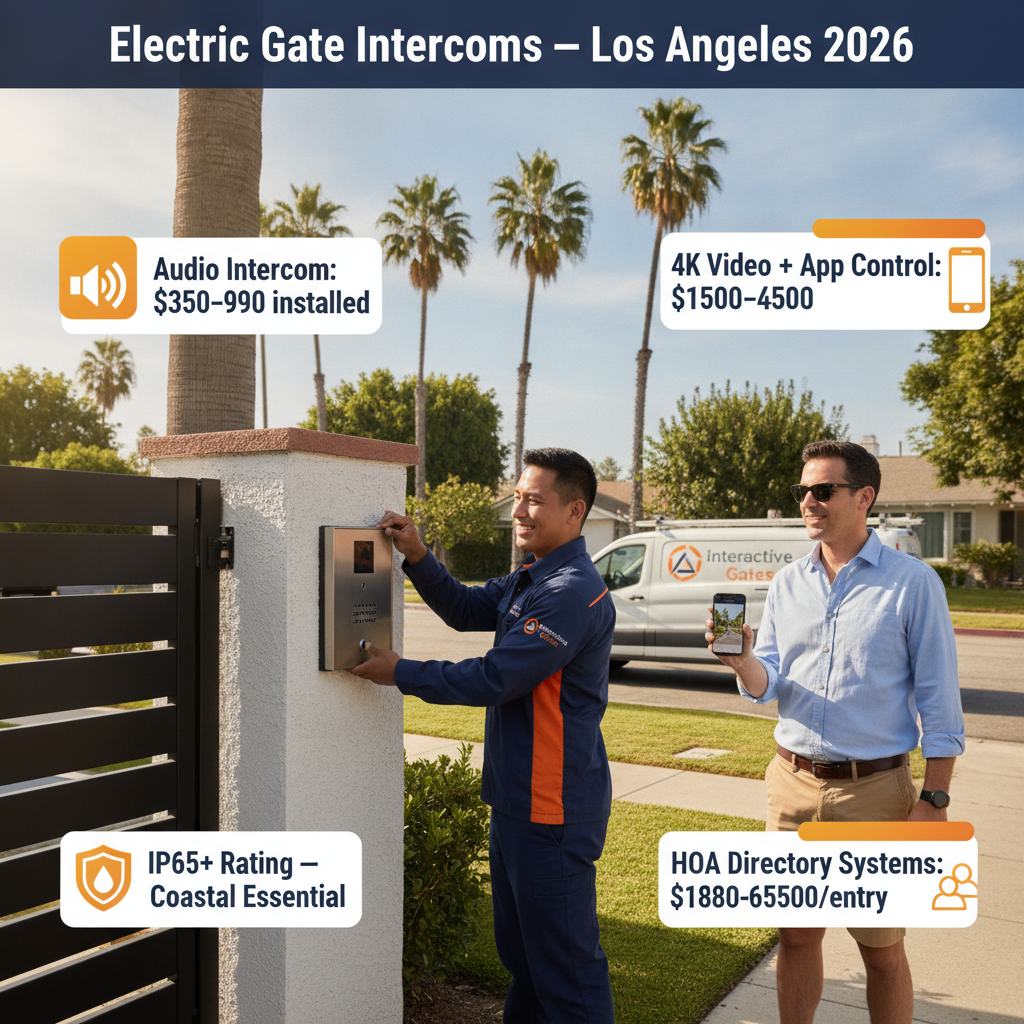
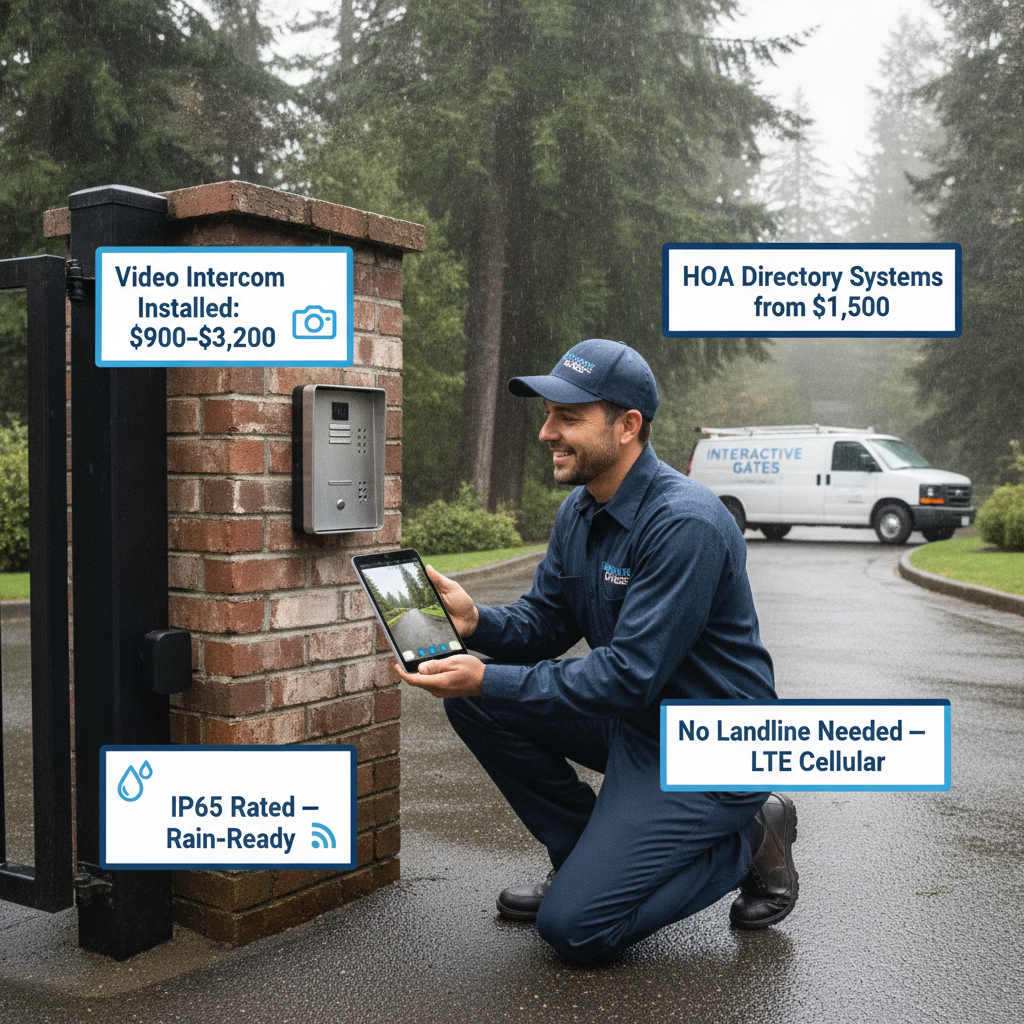
DoorKing 1835/1836 telephone entry: Still the most cost-effective option for communities under 80 units where residents want simplicity. Residents add their phone number to the directory; visitors call from the keypad and press 9 (or a custom code) to open the gate. No app required, no internet dependency. Installed: $1,800–$3,500.
ButterflyMX video intercom: The leading cloud platform in LA-area HOA installs in 2026. Residents receive a call on their smartphone with live video from the entry panel; they can admit visitors with one tap. The system integrates with property management platforms including Yardi and RealPage. It also generates a time-stamped photo log of every entry event — valuable for liability and security reviews. The ButterflyMX panel replaces the traditional call box with a 7-inch touchscreen. Installed: $3,200–$6,000 per entry lane, plus a SaaS subscription of approximately $80–$150/month per community.
Swiftlane and Verkada for large communities: Communities with 150+ units or luxury positioning often pair LPR cameras with a Swiftlane or Verkada access platform. License plates of registered residents are enrolled; the gate opens automatically as they approach. Guests receive a mobile credential or time-limited PIN. These systems require more IT infrastructure and ongoing administration, but they eliminate the 'tailgating' problem common at busy community entries. Full LPR + cloud-access system: $12,000–$30,000 installed, plus subscription fees.
What Does LA Code Require for HOA Gates in 2026?
Every vehicular gate at an HOA entry in Los Angeles County must comply with UL 325 (2018 edition as adopted), which means:
- Presence detection in the entrapment zone (either a loop detector beneath the pavement or a monitored photo-eye pair on both sides of the gate)
- A hard-wired or wireless safety edge on the leading edge of slide gates and on the face of swing gate leaves
- An automatic reverse function: if the gate contacts an object during closing, it must reverse within 2 seconds
- Emergency access: a Knox Box or padlock shackle provision for fire department entry (required by LA County Fire and most municipal fire departments)
- A visible warning placard at each entry/exit lane
The City of San Clemente and Orange County cities have adopted the same UL 325 framework but add a local requirement for reflective tape on gate leaves visible from 200 ft at night — a detail that surprises boards doing their first install.
Permit timelines: LA City Building and Safety is currently running 6–10 weeks for HOA gate permits (as of Q1 2026). Cities in Orange County — Orange, San Clemente — run 3–6 weeks. Plan accordingly; a summer installation that skips permit review is an HOA liability problem, not a shortcut.
Pro Tip: Ask your installer to pull the permit as the contractor of record. In California, if an unlicensed or uninsured sub pulls the permit under a general contractor umbrella and something goes wrong, the HOA — not the GC — often absorbs the liability. Verify C-61/D28 (automatic gate) licensing before signing any HOA gate contract.
How Much Does HOA Gate Maintenance Cost in Los Angeles?
An HOA gate running 300–600 cycles per day accumulates wear at a rate no residential gate ever does. Without a formal maintenance schedule, the two most common failure modes are: worn drive wheels on slide gates (replacement: $400–$900 per wheel set) and failed capacitors or control boards on swing operators (replacement: $280–$650 per board). Both are entirely preventable with bi-annual service.
Typical HOA maintenance contract pricing in Los Angeles in 2026:
- Single gate, basic PM twice yearly: $1,800–$2,800/year
- Dual-lane entry, full PM quarterly: $3,200–$5,500/year
- Large multi-gate community with LPR and cloud access: $5,000–$8,000/year
Contracts should specify response time for emergency calls. In a community of 100+ units, a four-hour emergency response window is the minimum acceptable standard; many LA-area HOA contracts now specify a two-hour window for after-hours failures.
See real completed HOA projects in the LA area in our project portfolio, and explore what other communities have experienced in our customer reviews.
Swing Gate vs. Slide Gate: Which Is Right for Your LA Community?
This is the most common physical design question HOA boards ask. The answer depends almost entirely on the width of the entry throat and the available space on each side of the lane.
Slide gates: Required when the entry throat is narrower than 24 ft, when there is a slope across the driveway, or when the community is in a flat grid neighborhood (South Bay, Inland Empire, San Fernando Valley). A slide gate needs clear space equal to the gate length plus 2 ft on the opening side — a 20 ft gate needs 22 ft of run room. Slide gates are lower maintenance in high-cycle environments because the drive wheel and rack system is more robust than a swing arm under heavy use.
Swing gates: Better suited to wider entries (30 ft+) and hillside communities like Rolling Hills and Laguna Beach where lot widths accommodate the swing arc. Dual swing leaves (two panels meeting in the center) are the most visually elegant option for luxury communities. Each leaf requires a separate operator. Swing gates should not be installed on cross-slopes greater than 2% without engineering review — the leaf will drag on the pavement at the low end of the arc.
In One Minute: HOA Gate Systems in Los Angeles 2026
Small community single-gate installs run $12,000–$22,000; dual-lane mid-size builds run $28,000–$55,000; full luxury installs with LPR and cloud access run $60,000–$120,000+. LiftMaster, FAAC, and Viking are the right operator brands for HOA use — residential brands like Apollo are not rated for the cycle counts a busy community gate sees. Cloud intercoms (ButterflyMX, Swiftlane) are replacing telephone entry systems for communities that want video verification and delivery management. UL 325 compliance, Knox Box provisions, and a C-61/D28 licensed contractor are non-negotiable in every LA jurisdiction. Annual maintenance contracts ($1,800–$8,000 depending on scope) are far cheaper than emergency repairs and extend gate lifespan by 5–10 years.
Frequently Asked Questions About HOA Gate Systems in Los Angeles
How long does an HOA gate installation take from contract to completion in Los Angeles?
From signed contract to operational gate, budget 10–16 weeks in most LA jurisdictions. Permitting alone takes 6–10 weeks in LA City; fabrication of custom steel gates runs 3–5 weeks; installation of operator, electrical, and access control takes 2–5 days on site depending on scope. Communities with existing concrete approach pads and nearby electrical panels move faster. Hillside sites requiring engineered footings add 1–2 weeks for soils engineering and concrete cure time.
Can an HOA gate system integrate with our existing property management software?
Yes, if you choose a cloud-based access platform. ButterflyMX integrates natively with Yardi Voyager, RealPage, Entrata, and Building Link. Swiftlane integrates with most major property management platforms via API. Traditional telephone entry systems (DoorKing) do not integrate with PM software — resident directories must be managed manually. If your HOA is on a major property management platform, confirm API compatibility before selecting an access control brand.
What happens when the power goes out — will HOA residents be stuck outside?
Not if the system is specified correctly. LiftMaster RSW12V and FAAC operators with XBAT battery backup both maintain full gate operation for 200–500 cycles after grid power loss — enough to handle a typical LA brownout or rolling outage. Most HOA specs also include a manual release mechanism and a separate pedestrian gate that operates independently. Some communities add a small solar panel array to trickle-charge the backup batteries, which extends off-grid operation indefinitely during daylight hours.
How many access credentials does a typical HOA gate system support?
DoorKing systems support 1,000–10,000 directory entries depending on model. ButterflyMX is limited only by your subscription tier and supports unlimited residents in its standard HOA plan. RFID and proximity card readers (the most common resident credential in LA HOA projects) typically support 10,000–100,000 enrolled cards depending on the controller. For communities with more than 500 units, confirm controller capacity with your installer before specifying hardware.
Does adding a gate system actually increase property values in an HOA community?
Multiple real estate studies and HOA management analyses published between 2023 and 2026 show a consistent 5–9% increase in unit resale values when a previously open community adds controlled-access gate infrastructure. The effect is strongest in communities where comparable gated neighborhoods exist nearby, because buyers can directly compare listing prices. The gate system also tends to reduce insurance premiums for the HOA master policy by 3–8%, partially offsetting the annual maintenance cost.
What is the lifespan of an HOA gate operator in Los Angeles?
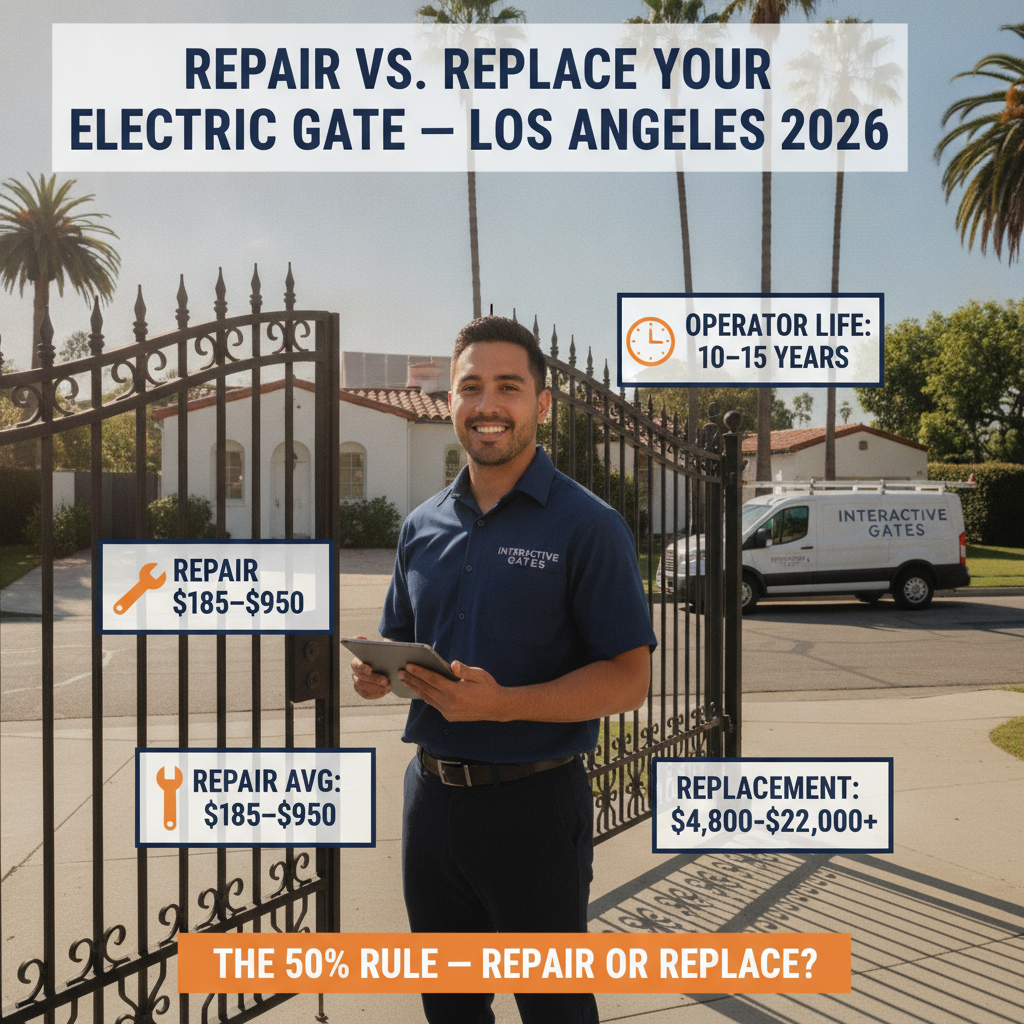
Commercial operators specified for HOA use — LiftMaster RSW12V, FAAC 760/790, Viking SL3000 — are rated for 1,000,000+ cycles. At 400 cycles per day, that is approximately 6.8 years to the rated cycle count. In practice, well-maintained operators in LA communities typically last 10–15 years because actual daily cycles are lower than peak-hour estimates suggest, and annual service (lubrication, drive wheel inspection, control board firmware updates) extends mechanical life significantly. Budget for operator replacement at the 12-year mark in your HOA reserve study.
Ready to Get a Real Number for Your Community?
Every HOA gate project in Los Angeles is different — the entry geometry, the resident count, the access-control requirements, and the local permit timeline all shape the final scope and cost. The best next step is a site visit with a licensed C-61/D28 gate contractor who can measure the entry throat, assess the electrical service, and give your board a written proposal with itemized costs rather than a ballpark estimate. If you want to explore gate styles before the site visit, the Interactive Gates design visualizer lets you see different gate configurations on a property photo in minutes. When you are ready to talk specifics, the contact page is the fastest way to schedule a no-pressure site assessment for your community. You can also review HOA and commercial gate options to understand the full range of what is available before your board meeting.