
- Annual HOA gate maintenance contracts in Portland run $480–$1,200 per gate depending on gate type, operator brand, and access-control complexity.
- Portland's wet winters cause 40–60% more rust and hinge wear than inland Northwest climates, so biannual lubrication is the local minimum.
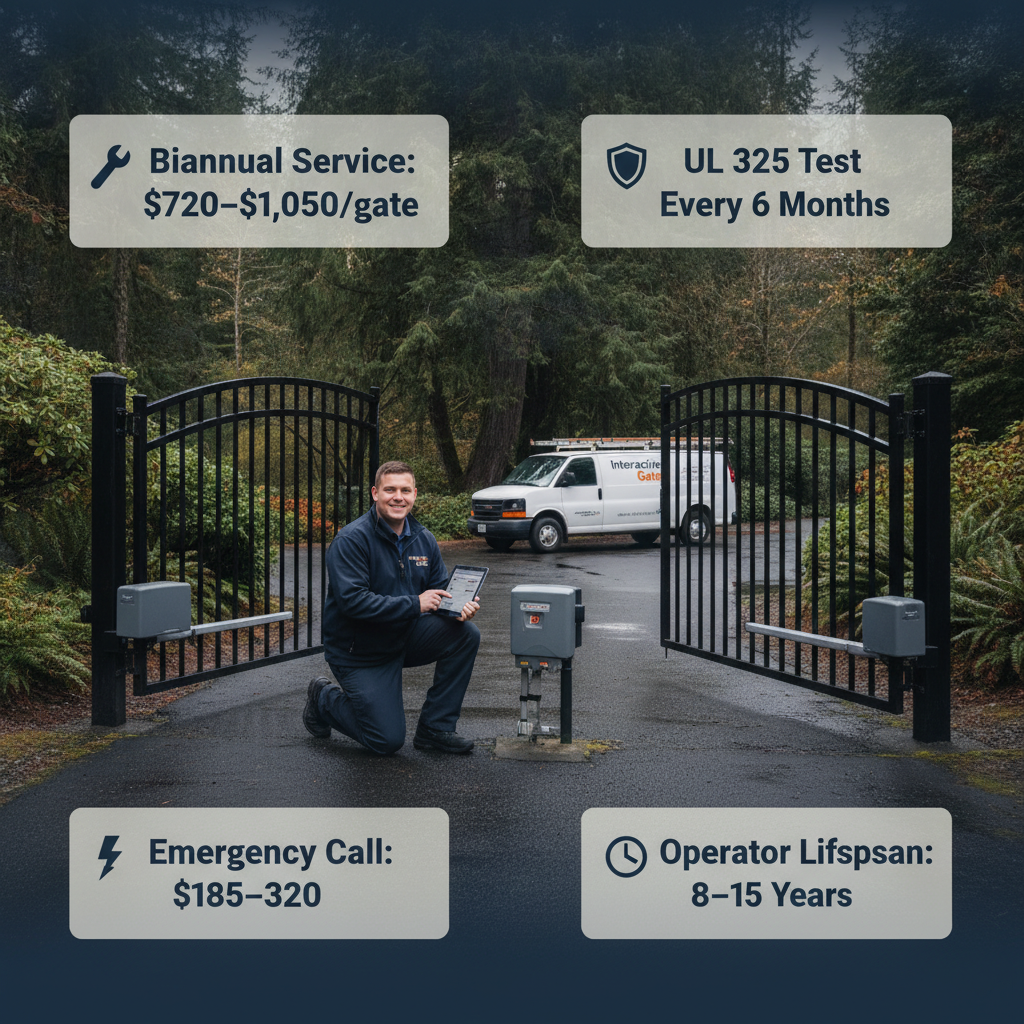
- UL 325 safety-sensor testing is required every 6 months for any gate in a community with pedestrian traffic — Oregon law mirrors federal UL standards.
- LiftMaster, FAAC, and Viking are the three most-serviced HOA operators in the Portland metro and all recommend 250,000-cycle inspections or 12-month intervals, whichever comes first.
- Emergency after-hours gate repair calls average $185–$320 in Portland, making a proactive maintenance plan the cheapest form of insurance.
- HOA boards in Lake Oswego and West Hills face steeper service costs due to longer travel windows and elevated gate complexity (dual-leaf swing gates, video intercoms).
- Slide gates on flat lots in Beaverton and Hillsboro typically cost 15–20% less to maintain than swing gates on pitched driveways common in the Tualatin hills.
- A full access-control audit — keypads, fobs, app credentials, intercom firmware — should run once per year and takes 1–2 hours per entry point.
What Does HOA Gate Maintenance Actually Cover in Portland in 2026?
You're on the HOA board, the gate starts grinding every morning at 7 a.m., and three residents have already emailed. Sound familiar? Every Portland-area community with an automatic gate eventually faces the same questions: What exactly needs to be serviced? Who is responsible? How often? And what is this going to cost the reserve fund? This guide answers all of them with real 2026 numbers — no filler, no guesswork.
Portland's climate is the starting point for every maintenance decision. The metro averages 144 days of measurable rainfall per year, and winters regularly bring freezing fog in the West Hills and black ice in Gresham and Troutdale. That combination of sustained moisture and occasional hard freeze accelerates corrosion on springs, hinges, and exposed motor housings faster than almost any other Pacific Northwest market. A maintenance schedule built for Phoenix will fail in Portland by summer.
What Components Must an HOA Service on an Automatic Gate?
A properly scoped HOA gate maintenance visit touches every mechanical and electronic layer of the system. Here is what a licensed gate technician should inspect, lubricate, or test at each service interval:
- Gate operator motor and gearbox: Check for overheating, unusual draw on the amp meter, and gear wear. LiftMaster's LA500 and CSL24UL series flag motor faults through onboard diagnostics; FAAC's 844 and 400 series use LED error codes that a technician reads on-site.
- Drive hardware: For slide gates — rack, pinion, and trolley wheels. For swing gates — ram seals on hydraulic arms (FAAC, HySecurity) or worm gears on electromechanical arms (LiftMaster, Viking). Hydraulic fluid levels on Viking or HySecurity slide operators should be checked and topped to manufacturer spec.
- Hinge pins, pivot points, and ground track: Portland rain causes grit and rust to build up in the gate track and on hinge pins. A tech should clean, inspect for wear, and apply a silicone-based or NLGI-2 grease rated for wet climates — never WD-40, which washes out in the first rain.
- Safety devices — UL 325 compliance: Photo-eye sensors (entrapment protection), loop detectors, and edge sensors must be physically tested to confirm they stop or reverse the gate when triggered. Oregon does not issue HOA-specific gate codes beyond UL 325, but liability exposure for a non-compliant gate is severe. Test every 6 months minimum.
- Access control hardware: Keypad firmware updates (Doorking, Linear, Aiphone), fob/credential database audit, intercom speaker and camera testing, app-based access (Liftmaster myQ, DoorKing DKS Connect) token review.
- Electrical and battery backup: HOA gates should have a battery backup capable of operating the gate through a 24-hour power outage — common in Portland's windstorm season (November through February). Test battery capacity, not just whether the backup kicks on.
- Gate structure itself: Weld points, frame straightness, and finish coat. Powder-coated steel gates in Portland should be inspected for paint bubbling or rust bleed at welds annually; aluminum and galvanized steel gates every 18 months.
Pro Tip: Ask your gate contractor to provide a written inspection checklist that maps directly to UL 325 Section 18 requirements. If a vendor cannot produce one, that is a red flag — especially for HOAs in Lake Oswego or West Hills where homeowners are litigious about property liability.
How Often Should Portland HOA Gates Be Serviced?
The correct service frequency depends on cycle volume — how many times per day the gate opens and closes — and on gate type. Here is the framework used by most Portland-area gate companies in 2026:
- Low-volume communities (under 50 cycles/day): Annual professional service plus one DIY inspection mid-year. This covers most smaller HOAs in Beaverton, Hillsboro, or Oregon City.
- Medium-volume communities (50–150 cycles/day): Biannual professional service — one visit in March (post-winter) and one in September (pre-rain season). Typical for Gresham or Lake Oswego communities of 30–80 homes.
- High-volume communities (150+ cycles/day): Quarterly professional service. Applies to larger Portland metro communities near commuter corridors, gated apartment complexes, or mixed-use HOAs. At 150+ cycles daily, a gate operator can hit its 250,000-cycle inspection threshold in as little as 4–5 years.
Portland's November–February window is when the most gate failures occur. Scheduling a preventive visit in late September or early October — before the rainy season peaks — catches worn seals, low fluid, and corroded contacts before they fail on a cold Tuesday morning when residents need to get to work.
What Does HOA Gate Maintenance Cost in Portland in 2026?
Here is a realistic 2026 cost breakdown for Portland-area HOA communities. All figures reflect the metro market including inner Portland, Beaverton, Lake Oswego, Hillsboro, Gresham, Oregon City, and Salem.
- Single gate, annual service contract (1 visit/year): $480–$680
- Single gate, biannual service contract (2 visits/year): $720–$1,050
- Single gate, quarterly service contract (4 visits/year): $1,100–$1,800
- Dual-gate entry (two operators, one entry point), biannual: $1,050–$1,600
- Access control audit add-on (keypad, fob, intercom, app): $150–$350 per entry point
- UL 325 safety certification letter (for HOA insurance purposes): $95–$175 per gate
- Battery backup replacement (12V or 24V system): $180–$320 including labor
- Hydraulic fluid service (HySecurity or FAAC hydraulic operators): $110–$210
- Emergency after-hours call (nights/weekends): $185–$320 trip charge, plus parts
Communities with more complex setups — video intercom systems (Aiphone, DoorBird, 2N), multi-lane vehicle detection loops, or solar-powered operators — should add 20–35% to base service costs due to additional diagnostic time. HOAs in Lake Oswego frequently fall into this category given the prevalence of high-spec entry systems in that market.
Pro Tip: Many Portland gate contractors offer a multi-gate discount of 10–15% if your HOA has two or more entry points under the same service contract. Always ask for this in writing before signing an annual agreement.
Which Gate Operator Brands Are Most Common in Portland HOA Communities?
Brand choice affects both service cost and parts availability. Here is what Portland technicians see most often in 2026 and what HOA boards should know about each:
- LiftMaster (CSL24UL, LA500, SW402): The most common residential HOA operator in the Portland metro. Parts are widely stocked locally, app integration via myQ is stable, and field technicians know the platform well. Maintenance labor costs tend to be slightly lower because diagnosis is fast.
- FAAC (844 ER, 400 series, 8008): Preferred for higher-cycle HOAs and commercial-adjacent communities. The hydraulic models handle Portland's steep driveways well. Slightly higher parts cost, but FAAC operators regularly reach 10–15 years with proper service.
- Viking Access (V2000, S20): Popular in mid-size HOAs across Beaverton and Hillsboro. Good cold-weather performance, which matters during Portland's freeze events. Board members should confirm the servicing company stocks Viking-specific gearboxes locally — lead times from distributor can hit 7–12 days if not.
- Apollo (1500, 1600 series): Common in older Portland-area communities installed in the 2010s. Parts are available but the brand has fewer local service specialists than LiftMaster or FAAC. Budget an extra $40–$80 in diagnostic time if your technician is less familiar with the Apollo control board.
- HySecurity (HyStar, SlideDriver): Found in larger HOA communities and multi-family properties in Portland and Gresham. These are heavy-duty hydraulic operators with 1,000,000+ cycle ratings. Maintenance cost is higher ($900–$1,400/year per operator for high-cycle properties) but failure rates are very low when properly serviced.
What Should Portland HOAs Budget in Their Reserve Fund for Gate Maintenance?
Reserve fund planning for gate systems should separate three buckets: routine maintenance, component replacement, and full system replacement.
- Routine maintenance (annual): Budget $700–$1,200 per gate operator, per year, depending on cycle volume and system complexity.
- Component replacement reserve: Gate operators last 8–15 years depending on brand and cycle load. HOAs should set aside $300–$500 per operator per year toward eventual motor replacement ($1,200–$3,500 installed for most residential-grade operators in 2026).
- Full gate system replacement: A complete gate replacement — structure, operator, safety devices, and access control — runs $8,000–$28,000 in the Portland metro depending on gate width, material, and operator spec. Amortize this over a 12–15 year horizon in your reserve study.
- Emergency repair buffer: Portland HOAs should carry a minimum $1,500–$2,500 emergency gate repair buffer in operating reserves, separate from the long-term reserve fund. This covers the most common failure scenarios: broken spring, failed control board, damaged vehicle loop detector.
For HOA boards in Beaverton, Gresham, or Hillsboro beginning a new reserve study, a licensed gate contractor can provide a written capital assessment letter estimating remaining useful life and forward maintenance costs — this document is worth its fee when presenting to homeowners at an annual meeting.
How Does Portland's Climate Specifically Affect HOA Gate Wear?
Portland's weather is not an abstraction — it directly changes what fails and when. Here is the climate-specific wear pattern that Portland gate technicians see each year:
- October–February: Continuous moisture penetrates hinge pins, rusts exposed rack sections on slide gates, and wicks into control board enclosures. Gasket integrity on operator housings is the single most important check in this window.
- January freeze events: The Portland metro averages 4–8 significant freeze events per winter. Hydraulic fluid in FAAC and HySecurity operators thickens below 20°F and can cause the operator to time out or fault. Operators should be filled with cold-weather hydraulic fluid rated to -22°F.
- March–May: Post-winter is the best time for a full structural inspection. This is when rust damage from the wet season becomes visible and weld failures on wrought iron gates are easiest to catch before summer traffic spikes.
- Neighborhoods on hills (West Hills, Tualatin, Lake Oswego hillsides): Gates on slopes work harder because gravity adds load on the closing stroke. Swing gate arms and hydraulic rams on these installations should be inspected more frequently — every 6 months regardless of cycle count.
In One Minute: HOA Gate Maintenance in Portland 2026
Portland HOA communities should plan for biannual professional gate service as a baseline — one visit before rainy season (September/October) and one post-winter (March). Budget $720–$1,050 per gate per year for a biannual contract, plus a $1,500–$2,500 emergency reserve. Prioritize UL 325 safety testing every 6 months, cold-weather hydraulic fluid in FAAC and HySecurity operators, and an annual access-control audit covering keypads, fobs, intercoms, and app credentials. LiftMaster, FAAC, and Viking are the most serviceable brands in the market. Reserve fund planning should account for operator replacement at 8–15 years and full system replacement at a 12–15 year horizon. Communities in Lake Oswego, West Hills, and the Tualatin hills should budget 15–25% above base rates due to terrain complexity and system spec.
Frequently Asked Questions: HOA Gate Maintenance in Portland
Is HOA gate maintenance required by Oregon law?
Oregon does not have a standalone HOA gate maintenance statute, but UL 325 — the federal safety standard for automated gates — is the enforced benchmark for entrapment protection. Any automated gate accessible to pedestrians must have functioning photo eyes, edge sensors, or loop detectors tested to UL 325 requirements. HOA governing documents and community liability insurance policies typically mandate compliance, and failure to maintain UL 325 compliance can void an HOA's liability coverage after an incident.
How often should photo-eye sensors be tested on a Portland HOA gate?
Photo-eye sensors should be physically tested — not just visually inspected — every 6 months. In Portland's rainy climate, sensor lenses accumulate fog, algae film, and debris that can degrade beam alignment without triggering an obvious fault. A technician will deliberately interrupt the beam at various gate positions to confirm the operator stops and reverses correctly. This 15-minute test is the most important safety check on any pedestrian-accessible HOA gate.
What is the typical lifespan of an HOA gate operator in Portland?
In the Portland metro, residential-grade operators (LiftMaster CSL24UL, Apollo 1500, Viking V2000) typically last 8–12 years under moderate HOA use (50–100 cycles/day). Commercial-grade hydraulic operators (FAAC 844, HySecurity SlideDriver) last 12–18 years with proper annual service. Portland's wet climate shortens lifespan by 1–2 years versus drier markets when operators are not serviced regularly, because moisture ingress degrades control boards and motor windings over time.
Can a small HOA (under 20 homes) skip a formal maintenance contract?
A small HOA can manage with a single annual professional service call rather than a multi-visit contract, but skipping professional service entirely is high-risk. Even a 20-home community may run 30–50 gate cycles per day, and the first sign of a failing operator is often a full lockout — gate stuck open or closed — that requires an emergency call at premium rates. The $480–$680 annual single-visit contract pays for itself if it prevents even one emergency call.
What access-control items should be audited at the annual service visit?
A thorough annual access-control audit should cover: removing credentials for residents who have moved out, updating keypad entry codes (codes should rotate at least once per year in high-turnover communities), checking intercom directory accuracy, testing call-to-open function on video intercoms (Aiphone, DoorBird, 2N), confirming app-based access (LiftMaster myQ, DKS Connect) tokens are assigned only to current residents, and checking that vehicle loop detectors are tuned to avoid false triggers from bicycle traffic — a common issue in Beaverton and Portland bike-friendly neighborhoods.
Do Portland HOA gates need a permit for routine maintenance?
Routine maintenance — lubrication, sensor testing, operator adjustments, access control updates — does not require a permit in Portland or surrounding jurisdictions. However, replacing a gate operator, installing a new access-control system, or making structural changes to the gate or its posts typically requires a mechanical or electrical permit from the local building department. Always confirm with your contractor whether the planned scope triggers permit requirements before work begins.
Ready to Put a Maintenance Plan in Place?
Getting ahead of gate failures protects your community, your reserve fund, and your board's relationship with homeowners. If you manage an HOA gate in Portland, Beaverton, Lake Oswego, Gresham, or anywhere in the metro, explore our HOA gate services page to see how we structure maintenance programs for communities of all sizes. You can also browse our project portfolio for examples of HOA gate installations and upgrades we've completed across the region, or read reviews from HOA board members and property managers who've worked with our team. When you're ready to talk specifics, reach out for a no-obligation consultation — we'll assess your gate system, identify service gaps, and put a written maintenance proposal together so your board has something concrete to vote on.


