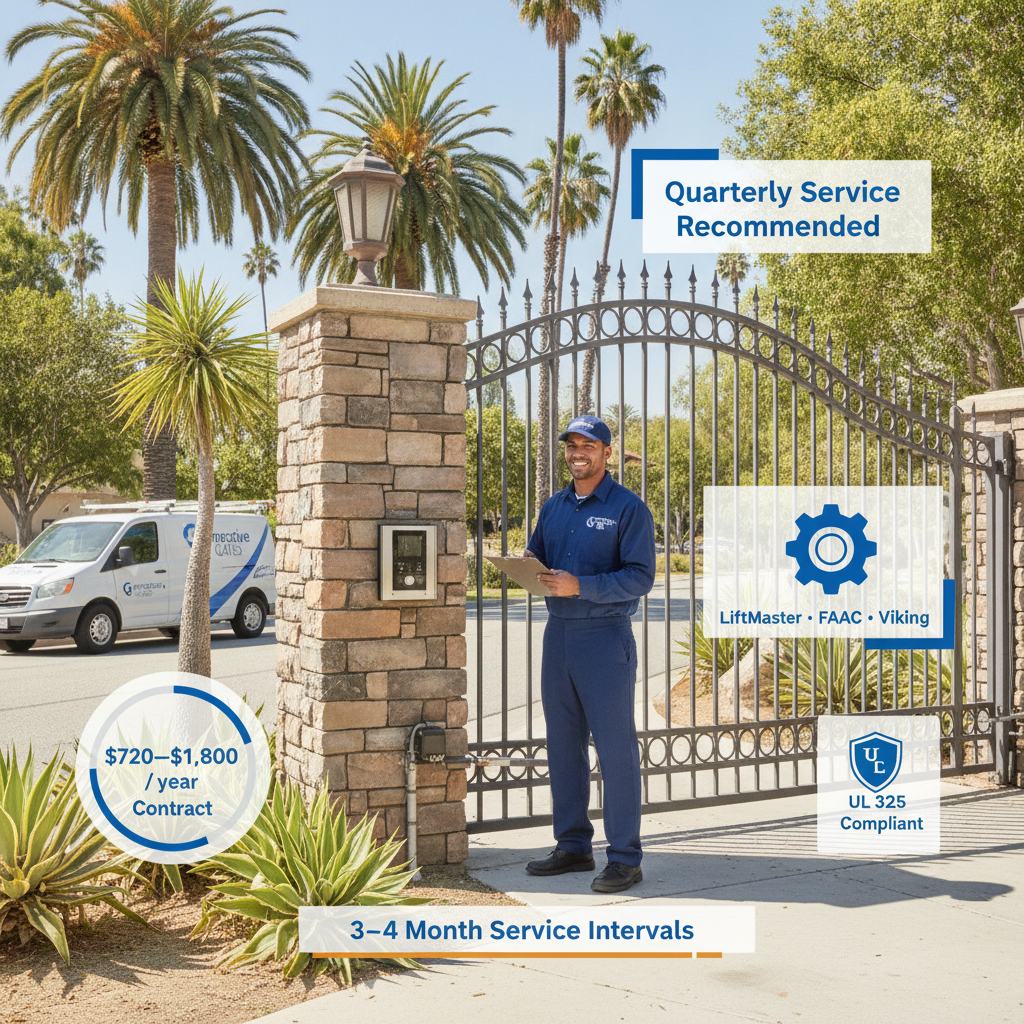
- Annual HOA gate maintenance contracts in Los Angeles run $480–$1,800 per gate depending on gate type, access-control complexity, and visit frequency.
- Most HOA gates need professional servicing every 3–4 months in Southern California due to heat, UV exposure, dust, and high daily cycle counts.
- A single residential-style HOA swing gate averages 80–150 cycles per day; a busy apartment or condo entry can exceed 300 cycles — tripling wear versus a private driveway.
- LiftMaster, FAAC, and Viking are the three most common HOA gate operator brands across L.A. communities; each has different service intervals and parts availability.
- Access-control components — keypads, intercoms, and loop detectors — account for 40–60% of all HOA gate service calls in Los Angeles metro.
- Neglecting lubrication alone can cut operator motor life from 10 years down to 4–6 years under high-cycle HOA conditions.
- Many L.A. County and City codes require annual documented gate safety inspections for multi-family properties, and some HOA insurance carriers now mandate written service records.
- Emergency after-hours gate repair calls in Los Angeles average $250–$550 per visit — a strong financial argument for preventive maintenance contracts.
Why Is HOA Gate Maintenance Different From a Private Driveway Gate?
If you manage or live in a gated community anywhere from Los Angeles to Laguna Beach or Rolling Hills, you already know that the gate at the front of your community is not just a convenience — it is the first line of security, a liability point, and a piece of shared infrastructure that every resident depends on every single day. HOA boards and property managers frequently search Google for questions like: How often should our HOA gate be serviced? What does an annual gate maintenance contract cost? Who is responsible when the gate breaks? This guide answers all of those questions with real 2026 numbers and local Los Angeles context.
The fundamental difference between an HOA gate and a private driveway gate is cycle volume. A single-family home gate might open and close 8–15 times per day. A gated community with 60 units can easily generate 150–300+ cycles daily. At that pace, wear accumulates fast, and deferred maintenance does not just shorten equipment life — it creates sudden, community-wide lockouts that generate angry calls to the board at 11 p.m. on a Sunday.
How Often Should an HOA Gate in Los Angeles Be Professionally Serviced?
The Southern California climate creates a specific set of maintenance demands that communities in cooler, wetter climates do not face to the same degree. Los Angeles summers push ambient temperatures past 90°F regularly, and in the San Fernando Valley or Inland-adjacent communities, ground-level heat near asphalt can stress gate operators significantly. UV exposure degrades rubber seals, wiring insulation, and painted finishes faster than almost any other U.S. metro. Meanwhile, the dry Santa Ana wind season deposits fine particulate matter into every hinge, gear rack, and relay board.
Given those realities, most experienced gate technicians serving the Los Angeles area recommend the following service cadence for HOA properties:
- High-cycle gates (150+ cycles/day): Quarterly professional service — every 3 months.
- Mid-cycle gates (60–149 cycles/day): Service every 4 months (3 visits per year).
- Lower-cycle gates (under 60 cycles/day, smaller HOAs): Semi-annual service — every 6 months.
- All HOA gates: A full annual safety inspection with documented checklist, regardless of cycle volume.
Quarterly servicing is not a upsell — it is actuarial math. At $120–$200 per preventive visit, you avoid the $800–$2,400 repair bills that come with a seized operator arm, a burned-out motor, or a shattered loop detector that brings vehicle traffic to a standstill during rush hour.
What Does a Professional HOA Gate Service Visit Actually Include?
A thorough maintenance visit by a qualified technician covers far more than squirting oil on a hinge. Here is what should be included in a professional HOA gate service call in 2026:
- Operator inspection: Check motor amp draw, capacitor condition, limit switches, and drive belt or gear-rack engagement. Replace worn drive belts ($35–$75 in parts) before they snap.
- Lubrication: Apply manufacturer-specified lubricant (typically a lithium-based grease) to hinges, rollers, gear racks, and pivot points. This single step has the largest impact on operator longevity.
- Safety reversal and entrapment testing: Verify that photo eyes, loop detectors, and edge sensors trigger proper reversal. Document test results for liability and code compliance.
- Access-control system check: Test keypad codes, intercom audio and video quality, remote transmitters, and any app-based or telephone-entry systems like the DoorKing 1837 or Liftmaster LA400.
- Loop detector calibration: Los Angeles pavement expands and contracts seasonally; loops can detune and cause ghost openings or failure to detect vehicles — recalibration takes 10–15 minutes and prevents costly misfires.
- Structural hardware check: Inspect hinges, posts, latch bolts, and gate frame welds for cracks or movement. Heavy ornamental iron gates common in Rolling Hills and Laguna Beach estates can weigh 800–1,400 lbs; hinge wear is the leading cause of catastrophic gate drop incidents.
- Control board and wiring inspection: Look for corrosion, loose terminals, and evidence of rodent damage — a real issue in hillside and canyon communities.
- Gate travel speed adjustment: Verify open and close times meet UL 325 requirements (typically 7-second minimum for pedestrian-clearance zones).
Pro Tip: Always request a written service report after each visit. L.A. County building officials, HOA insurers, and plaintiffs' attorneys in slip-and-fall or vehicle-entrapment cases will all ask for documented maintenance records. A company that cannot provide a signed, dated checklist is not giving you full value.
How Much Does HOA Gate Maintenance Cost in Los Angeles in 2026?
Pricing varies based on gate count, operator brand, access-control complexity, and contract structure. Here are real 2026 ranges for the Los Angeles metro:
- Single gate, semi-annual service contract: $480–$720 per year (2 visits).
- Single gate, quarterly service contract: $720–$1,100 per year (4 visits).
- Dual-gate entry (entry + exit operators), quarterly: $1,100–$1,800 per year.
- Per-visit rate (no contract): $180–$280 per visit for standard service.
- Emergency/after-hours call-out: $250–$550 per visit, plus parts.
- Annual safety inspection only (documented): $150–$250 for a standalone inspection.
Contract pricing almost always beats per-visit rates by 15–25% and guarantees priority scheduling — critical for HOA managers who cannot leave a community entry stuck open or stuck closed for two days waiting for a technician slot.
Which Gate Operator Brands Are Most Common in L.A. HOA Communities?
Brand matters for maintenance because parts availability and technician familiarity directly affect how fast and how affordably your gate gets serviced. In the Los Angeles metro as of 2026, these are the dominant operators found in HOA applications:
- LiftMaster / Elite Series (by Chamberlain Group): The most widely installed brand in mid-density HOAs, condos, and apartment complexes. The Elite Series CSL24UL (commercial slide) and SW Series (commercial swing) are workhorses. Parts are stocked locally, and most gate companies service them without ordering delays. Motor replacement: $550–$900 installed.
- FAAC (Italian-manufactured, U.S.-distributed): Extremely popular in luxury residential communities in Beverly Hills, Bel Air, Rolling Hills, and Laguna Niguel. Known for smooth, quiet operation. Service intervals are every 50,000–100,000 cycles per manufacturer spec. Control boards can be expensive ($280–$480) but are long-lived when maintained. FAAC 844 and 960 models dominate this segment.
- Viking Access Systems: A go-to for commercial HOA applications and high-cycle entry gates. The Viking Model K and Model Q operators are built for sustained daily use. They tolerate heat well but require quarterly lubrication without exception. Motor/gearbox replacement runs $650–$1,050 installed.
- Apollo Gate Operators: Common in smaller HOAs and townhome communities. The Apollo 1600 ETL swing operator is an entry-level commercial unit that is inexpensive to service but has a shorter design life (7–10 years at HOA cycle counts versus 12–15 for FAAC or Viking).
What Access-Control Components Need Maintenance at an HOA Gate?
The gate operator is only half the system. Access control — everything that decides who gets in and who does not — accounts for the majority of service calls at HOA properties. In 2026, a typical L.A. community gate entry stack includes:
- Telephone entry / video intercom systems: DoorKing, Aiphone, and Linear are the most common brands in Los Angeles HOAs. Intercom speakers corrode in coastal salt air (especially in San Clemente and Laguna Beach communities); speaker grilles and circuit boards should be inspected annually. System replacement: $1,800–$5,500 for a telephone-entry unit with directory.
- Keypads and card readers: HID proximity readers and coded keypads accumulate UV damage on button legends and moisture intrusion in membrane switches. Budget $80–$160 per unit for annual cleaning and code audit.
- Vehicle loop detectors: The inductive loops embedded in pavement detect vehicles for automatic exit. L.A.'s temperature swings and ground movement (earthquake activity) can crack loop wire insulation over time. Loop replacement: $350–$650 per loop including saw-cut and epoxy seal.
- Photo-eye safety sensors: Should be cleaned, aligned, and tested every service visit. Misaligned photo eyes are the leading cause of UL 325 safety non-compliance citations. Replacement pair: $120–$240 installed.
- Remote transmitters and app-based access: Community-wide re-codes should happen every 12–24 months or whenever a resident moves out and does not return a remote. Many HOAs are migrating to app-based Bluetooth/cellular access (Openpath, Brivo, or LiftMaster myQ) to eliminate physical transmitter management overhead.
Pro Tip: If your HOA has not audited its access code list in over two years, you likely have dozens of former residents, contractors, and vendors still holding active entry credentials. An access-control audit during a scheduled maintenance visit typically takes 30–60 minutes and costs nothing extra under a service contract — but the security value is significant.
What Local Codes and Liability Issues Should L.A. HOA Boards Know About?
Los Angeles County and City both enforce UL 325 standards for automated gate operators, which require functional entrapment protection, proper signage, and — for commercial-use gates (which includes most HOA entries) — inherently non-contact safety systems or monitored safety screens. Failure to maintain these systems in working order exposes the HOA to liability in vehicle-damage or personal-injury claims.
Several HOA insurance carriers writing policies in California now require documented annual inspection records as a condition of coverage. If your board cannot produce a signed maintenance report and a gate operator was involved in a property-damage event, you may face a coverage dispute. The documentation cost (included in any reputable service contract) is trivial compared to the risk.
Additionally, California Civil Code Section 4765 governs architectural changes within HOAs, but gate replacement or major modification at a common-area entry often requires board approval and may trigger a permit depending on scope. Routine maintenance does not require a permit, but full operator replacement or structural post work at a Los Angeles city location should be checked against local building department requirements.
In One Minute: HOA Gate Maintenance in Los Angeles 2026
HOA gates in Los Angeles face high cycle counts, extreme UV, summer heat, and coastal salt air that accelerate wear faster than private driveways. High-cycle community gates should be serviced quarterly; most others need 3 visits per year minimum. Annual contracts run $480–$1,800 per gate, far cheaper than the $250–$550 emergency calls that result from deferred maintenance. LiftMaster, FAAC, and Viking dominate the L.A. HOA market — all require lubrication, safety-sensor testing, and access-control audits at every visit. Documented service records are increasingly required by insurers and are essential for liability protection. See what a professionally maintained gate looks like in our project portfolio, or explore HOA and commercial gate solutions tailored for Los Angeles communities.
Frequently Asked Questions: HOA Gate Maintenance in Los Angeles
How often does an HOA gate in Los Angeles need to be serviced?
Most HOA gates in the Los Angeles area should be professionally serviced every 3–4 months due to high daily cycle counts, intense UV exposure, summer heat, and seasonal dust. High-traffic community entries with 150 or more cycles per day benefit most from quarterly service visits. Smaller HOAs with fewer than 60 daily cycles can manage with semi-annual visits, but all properties should have at least one full annual safety inspection with written documentation.
What does an HOA gate maintenance contract cost in Los Angeles in 2026?
HOA gate maintenance contracts in the Los Angeles metro range from $480–$720 per year for a single gate with semi-annual visits, up to $1,100–$1,800 per year for a dual-gate entry (entry and exit operators) on a quarterly schedule. Per-visit rates without a contract run $180–$280. Emergency after-hours calls average $250–$550 plus parts. Contract pricing typically saves 15–25% versus on-demand service and guarantees faster response times.
What gate operator brands are most common in L.A. HOA communities?
LiftMaster Elite Series, FAAC, Viking Access Systems, and Apollo are the four brands most frequently found at HOA entries across the Los Angeles metro in 2026. LiftMaster dominates mid-density condos and apartment complexes. FAAC is the preferred choice in luxury estates and hillside communities like Rolling Hills and Laguna Beach. Viking is common at high-cycle commercial HOA entries. All four brands require regular lubrication, safety testing, and access-control system verification.
Are HOA boards legally required to maintain their gate systems in Los Angeles?
Yes. All automated gate operators installed at HOA common-area entries in California must comply with UL 325 entrapment-protection standards, which require functioning photo eyes, loop detectors, or safety edges. Failure to maintain these systems in working order creates direct liability exposure for the HOA. Additionally, many California HOA insurance carriers now require written annual service records as a condition of coverage. Los Angeles County and City building codes may also require permits for gate replacement or significant modification.
What access-control components need maintenance at a community gate?
Access-control components requiring regular maintenance include telephone-entry and video-intercom systems (DoorKing, Aiphone, Linear), proximity card readers and coded keypads, vehicle loop detectors embedded in pavement, photo-eye safety sensors, and any app-based or cellular access systems. Each should be inspected, cleaned, tested, and — in the case of access credentials — audited for inactive or unauthorized users at least annually. These components account for 40–60% of HOA gate service calls in the L.A. area.
What happens if our HOA gate breaks down outside of business hours in Los Angeles?
Emergency after-hours gate repair calls in the Los Angeles metro average $250–$550 per visit before parts costs. A gate stuck in the open position is a security emergency; one stuck closed locks out residents and can block emergency vehicle access, a serious liability. HOAs on annual maintenance contracts typically receive priority emergency response and sometimes reduced after-hours rates. Preventive maintenance dramatically reduces the frequency of these events — most emergency calls trace back to lubrication failure, worn drive belts, or detuned loop detectors, all of which are caught and corrected during routine service visits.
Ready to Set Up a Maintenance Plan for Your Los Angeles Community?
Whether you manage a small townhome complex near Orange, a large gated community in Rolling Hills, or a coastal HOA in San Clemente, the right maintenance schedule protects your residents, your equipment, and your board's liability exposure. Review your options on our HOA and commercial gate page, browse completed community gate projects in our portfolio, or reach out to our team to discuss a service contract that fits your gate count, cycle volume, and budget. We will give you a straight answer — no pressure, no upsells.