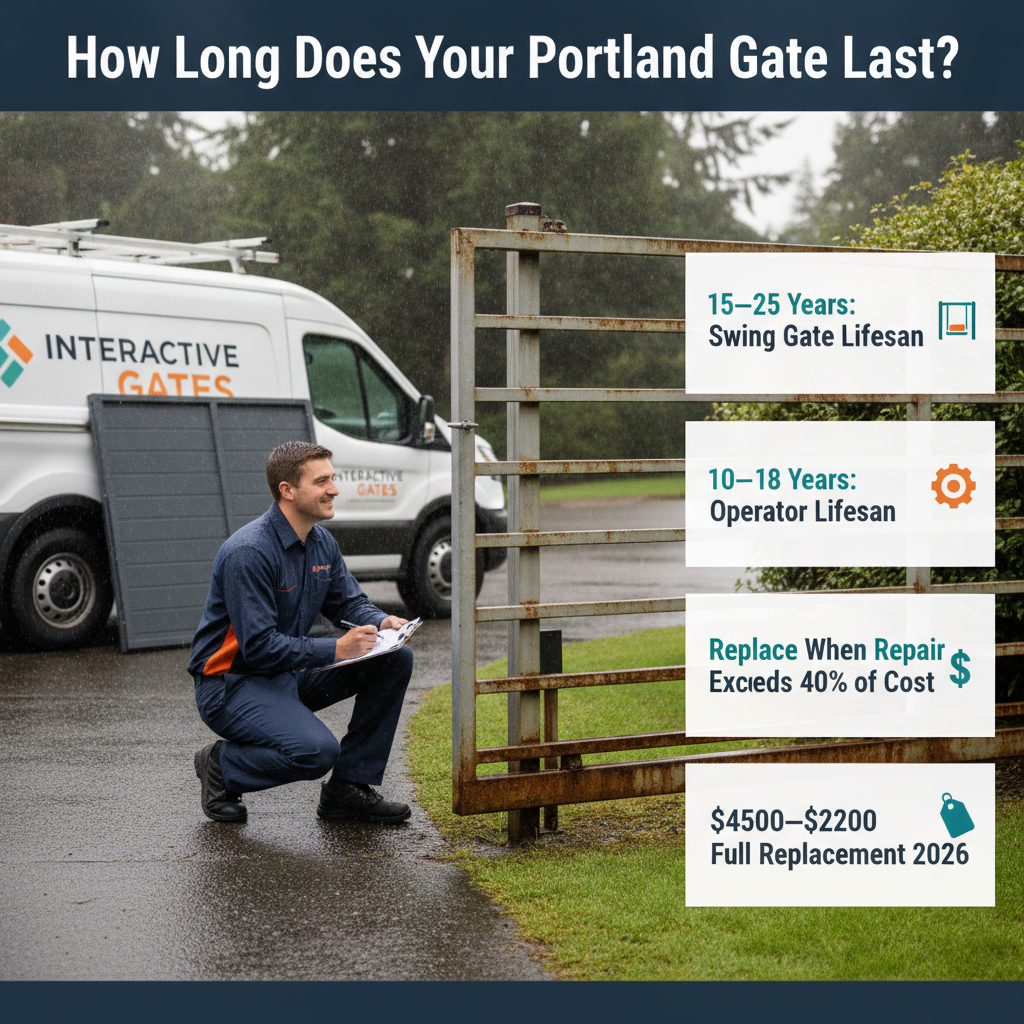
- Swing gates on residential lots typically last 15–25 years in Portland with proper annual maintenance.
- Slide/cantilever gates average 20–30 years on the mechanical side but rollers and tracks need service every 3–5 years due to Portland grit and rain.
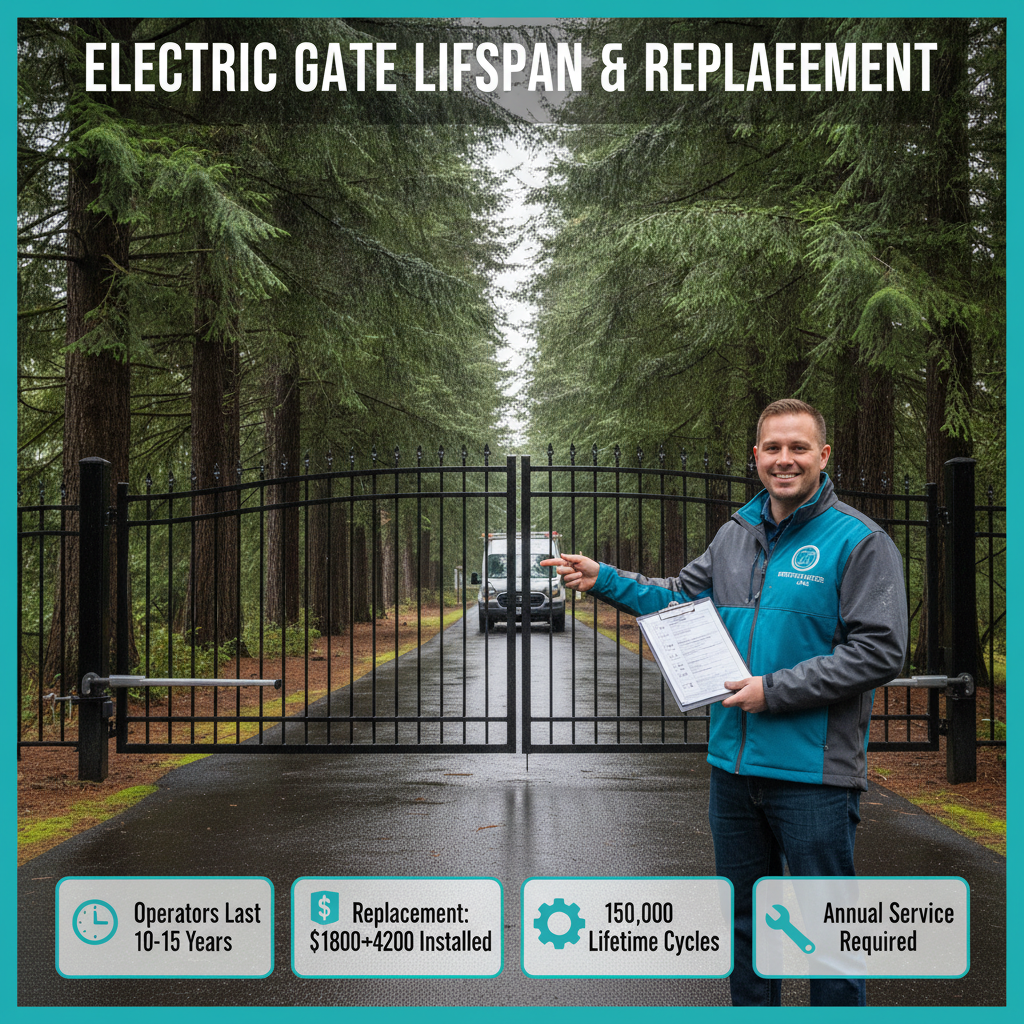
- Gate operators (motors) rated for 500,000 cycles last 10–18 years in Portland's climate when kept dry and lubricated.
- Wrought iron and steel gates need rust-inhibiting paint touch-ups every 2–3 years in Portland's wet season to reach their potential 30+ year lifespan.
- Aluminum gates are the lowest-maintenance option in Portland rain, but thinner gauges (under 0.125 in) can warp on wide openings over 14 ft after 8–12 years.
- Full gate replacement costs range from $4,500 to $22,000+ installed in the Portland metro in 2026, depending on material, width, and automation.
- Warning signs that replacement beats repair include rust penetrating the core, cracked welds at stress points, and operators that trip breakers more than twice a month.
- Portland's wet winters and mild freeze-thaw cycles are harder on gate hardware than temperature extremes — moisture ingress is the number-one lifespan killer here.
How Long Do Electric Gates Actually Last in Portland?
Homeowners in Portland, Lake Oswego, and Beaverton all ask the same thing before calling a gate company: How long will this thing last? When do I repair versus replace? And what's actually killing my gate faster than it should? These aren't vanity questions — a quality automated gate is a $6,000–$18,000 investment, and the answer changes depending on gate type, material, operator brand, and whether your property sits in the West Hills fog belt or the sunnier east side of Gresham. This guide gives you the honest numbers for 2026.
How Long Do Swing Gates Last in Portland?
Swing gates are the most common residential gate style in Portland neighborhoods like Dunthorpe, Eastmoreland, and the hillside lots above Lake Oswego. A properly installed single or dual swing gate made from steel or wrought iron can last 15–25 years as a structure, though the operator (motor) and hardware will need replacement sooner. Aluminum swing gates have a similar structural lifespan — often 20–25 years — with much lower rust risk. The structural weak point on a Portland swing gate isn't the metal itself; it's the hinge posts. Heavy clay soils throughout much of the Portland basin cause post heave and lean over time, putting asymmetric stress on hinges and the operator arm. Hinge replacement runs $180–$350 per hinge installed, and post re-setting in clay soil can run $600–$1,400 depending on depth and concrete work required. Swing gates also need 90–180 inches of clearance to open fully, which becomes a problem on steeper driveways in Portland's West Hills — a Portland installer can advise on whether a swing gate is viable on your specific slope before you commit.
Pro Tip: If your swing gate is dragging the driveway surface on open or close, don't just adjust the operator arm — check the hinge post for lean first. A leaning post is a structural issue that will re-appear no matter how many times you adjust the opener.
How Long Do Slide and Cantilever Gates Last in Portland?
Slide gates — especially cantilever-style, which don't touch the ground — are the go-to for commercial properties in Hillsboro's industrial corridors, Oregon City's mixed-use zones, and any residential lot with a sloped apron that makes swing gates impractical. Structurally, a commercial-grade steel cantilever gate can last 25–35 years. The mechanical components tell a different story. Rollers, carriages, and guide posts accumulate grit, leaves, and road debris at a higher rate in Portland's wet months (October through April). Unlubricated or contaminated rollers wear out in as few as 4–6 years; well-maintained ones on a residential property can go 10–15 years before replacement. Roller replacement averages $250–$550 per set installed in the Portland metro. Track-mounted (V-groove) slide gates are particularly vulnerable — Portland's freeze-thaw events, even the mild ones you get in Salem and Gresham, push grit into the track groove and accelerate wear. Cantilever gates avoid the ground track entirely, which is why they dominate well-built commercial installs and are worth the modest price premium on residential lots too.
How Long Do Gate Operators Last in Portland?
The motor is almost always the first component that needs replacement on any gate system. Operator lifespan is measured in cycles (one open + one close = two cycles, or sometimes counted as one, depending on the brand spec sheet). Here's how the major brands stack up in Portland's climate in 2026:
- LiftMaster SL3000 / SL595: Rated 500,000 cycles; real-world Portland lifespan 12–18 years on residential, 8–12 years on high-traffic commercial. MSRP $1,100–$2,200 for the operator unit; installed $1,800–$3,400.
- FAAC 760 / 844 series: Italian-made, sealed gearbox handles Portland humidity well. Rated 400,000–600,000 cycles; real-world 10–16 years residential. Installed $2,000–$3,800.
- Viking (HySecurity) Slide Driver 15: Built for commercial-grade duty, rated 1,000,000+ cycles. Overkill for most homes but ideal for Oregon City or Hillsboro commercial gates seeing 80+ cycles/day. Installed $3,500–$6,500.
- Apollo 1500 / 1550: Budget-friendly swing gate option, rated 300,000 cycles. Real-world Portland lifespan 8–12 years. Installed $900–$1,800.
- Elite (formerly Doorking) EL25: Mid-range swing gate operator, sealed against rain, rated 400,000 cycles. Real-world 10–14 years. Installed $1,400–$2,600.
Portland's rainfall — averaging 36–43 inches per year depending on whether you're in the West Hills rain shadow or on the east side — is less of a direct motor killer than condensation cycles inside uninsulated operator enclosures. Any operator installed in Portland without a sealed, waterproof housing and a rain shield over the enclosure vent will lose 3–5 years off its expected lifespan. Confirm your installer uses gasketed NEMA 4X-rated enclosures, especially for properties in Beaverton's lower-lying neighborhoods or near the Willamette River in Gresham.
Pro Tip: Schedule an annual operator inspection every October — right before the wet season hits. A technician can re-seal conduit penetrations, clear debris from the enclosure, and test the circuit board for moisture intrusion before it becomes a $2,000 repair in February.
How Does Portland's Climate Specifically Shorten Gate Lifespan?
Portland doesn't have the salt air of a coastal city, but it has something nearly as challenging for metal gates: persistent low-level moisture from October through May, combined with organic debris (pine needles, maple seeds, leaf tannins) that holds moisture against metal surfaces. Here's what that means by material:
- Wrought iron: Surface rust appears within 2–4 years on unprotected iron in Portland's climate. If rust penetrates through the wall thickness — typically 0.25–0.5 inches on quality wrought iron — replacement is necessary. Preventative touch-up painting every 2–3 years ($300–$700 DIY or professional) extends lifespan dramatically. A well-maintained wrought iron gate in Portland can realistically reach 30–40 years.
- Steel tube: More vulnerable than solid wrought iron because moisture that enters hollow tubes rusts from the inside out, invisibly. End caps and weep holes matter. Sealed, quality steel gates in Portland last 20–30 years; poorly sealed ones can develop structural corrosion within 10–15 years.
- Aluminum: Doesn't rust, making it the lowest-maintenance material for Portland rain. However, aluminum work-hardens over repeated stress cycles on wide openings, and thin-wall extrusions (under 0.125 inch wall thickness) can crack at weld joints after 8–15 years on gates wider than 14 feet. Powder coat fading is the main cosmetic issue — expect to repaint every 10–12 years. Overall structural lifespan: 20–30 years.
- Wood-framed with metal infill: Wood frames are increasingly rare on new electric gate installations in Portland but appear on older properties in Lake Oswego and the West Hills. Wood in Portland's climate typically requires replacement in 8–15 years regardless of finish — moisture infiltration at post connections and hinge points is unavoidable.
How Do I Know When to Repair vs. Replace My Portland Gate?
This is the question every property owner eventually faces. The answer isn't always obvious. Here's a practical framework used by gate technicians across the Portland metro:
- Repair is usually the right call when: the gate structure is sound, the operator is under 10 years old, the repair cost is under 40% of replacement cost, and the failure is a single component (circuit board, photo eye, keypad, spring).
- Replacement makes more financial sense when: the gate structure has rust penetrating through wall thickness, the operator is 12+ years old and parts availability is declining, you've paid for two or more major repairs in the past 18 months, or the gate style no longer meets your security or access-control needs.
- Immediate safety replacement is required when: the gate reversal system or safety edges have failed and the gate poses a crush hazard, welds at hinge or roller attachment points have cracked, or the gate has sagged enough that it physically contacts vehicles or pedestrians during operation.
In 2026, full gate-and-operator replacement costs in Portland range from $4,500 for a simple single-swing aluminum residential gate up to $22,000+ for a wide dual-swing wrought iron gate with keypad entry, intercom, and underground wiring. Mid-range residential projects — a 14-foot dual cantilever slide gate in powder-coated steel with a LiftMaster operator and keypad — typically run $9,500–$14,000 installed in the Portland metro. You can explore styles and get a visual sense of options using the Interactive Gates gate designer before committing to a site visit.
What Maintenance Schedule Maximizes Gate Lifespan in Portland?
Portland gate technicians generally recommend a two-service-per-year schedule for residential gates and quarterly visits for commercial or HOA properties. Here's what a residential annual cycle looks like in practice:
- Spring (March–April): Clean and re-lubricate rollers, hinges, and operator drive mechanism. Inspect welds and hinge points for stress cracks after winter. Test safety reversal and photo eyes. Check operator enclosure for moisture intrusion. Estimated cost: $150–$280 for a standard residential gate.
- Fall (October): Re-apply rust-inhibiting touch-up paint to any bare metal spots found during visual inspection. Re-seal conduit penetrations. Test battery backup. Tighten all hardware. Estimated cost: $150–$250, or combined with spring visit for $250–$450 annual package.
Properties in Salem and Oregon City that sit closer to agricultural areas deal with higher dust and pollen loads in summer, which can clog operator vents faster than Portland proper — consider adding a mid-summer blower cleaning of the operator enclosure as a third annual task at those locations.
In One Minute: Electric Gate Lifespan in Portland
Gate structures last 15–35 years depending on material, with aluminum requiring the least maintenance in Portland's wet climate and wrought iron lasting longest when kept painted. Operators last 10–18 years on residential properties, with sealed LiftMaster, FAAC, and Viking units performing best in Portland's humidity. The biggest lifespan killers are moisture in operator enclosures, rust in hollow steel tube from the inside out, and post heave from Portland's clay soils. Service twice a year ($250–$450/year), and budget for operator replacement around year 12–15. Full replacement runs $4,500–$22,000 installed in 2026 depending on scope. Repair when the structure is sound and repair cost is under 40% of replacement; replace when corrosion is structural, the operator is past its cycle rating, or safety systems have failed.
Frequently Asked Questions About Electric Gate Lifespan in Portland
How long does a typical residential electric gate last in Portland, Oregon?
A well-maintained residential electric gate in Portland lasts 15–25 years as a structure, depending on the material. Aluminum and quality wrought iron with regular rust treatment reach the high end; unsealed hollow steel tube in Portland's wet climate can begin developing structural corrosion in as few as 10–15 years. The operator (motor) typically needs replacement in 10–18 years, often before the gate itself. Annual maintenance visits costing $250–$450 per year are the single highest-leverage action to reach the upper end of those ranges.
What kills electric gates fastest in Portland's climate?
Moisture ingress is the primary lifespan killer in Portland — specifically, condensation inside operator enclosures, water entering hollow steel tube through unsealed welds or missing end caps, and organic debris (leaves, pine needles) holding moisture against metal surfaces. Portland's clay soils also cause post heave that stresses hinges and misaligns gates over time. Salt air is not a major factor in Portland, unlike coastal Oregon cities, but the combination of persistent winter rain and mild freeze-thaw cycles creates unique challenges for both structure and hardware.
Should I repair or replace my old Portland gate?
Repair makes sense when the gate structure is sound, the operator is under 10–12 years old, and the repair cost is under 40% of what full replacement would cost. Replacement is the smarter financial choice when you've had two or more major repairs in 18 months, the operator is past 12 years old with declining parts availability, or the gate has structural rust penetrating through the metal wall. A licensed gate technician can assess structural integrity in about 30–45 minutes on-site. You can start the conversation by visiting the Interactive Gates contact page to schedule a site evaluation.
What is the most durable gate material for Portland's rainy weather?
For pure weather resistance, aluminum is the lowest-maintenance material in Portland because it doesn't rust. However, thinner aluminum extrusions (under 0.125-inch wall) can fatigue on wide openings over time. For the longest overall lifespan (30–40 years), quality wrought iron with a consistent rust-inhibiting paint maintenance schedule wins — but only if you commit to touch-up painting every 2–3 years. Solid steel is mid-range: durable when properly sealed but vulnerable to inside-out rusting in hollow tube sections if end caps and weep holes are neglected.
How much does it cost to replace an electric gate in Portland in 2026?
Full replacement of a residential electric gate and operator in the Portland metro ranges from $4,500 for a basic single-swing aluminum gate to $22,000+ for a wide wrought iron dual-swing system with access control, intercom, and underground wiring. The most common mid-range residential project — a 14-foot cantilever slide gate in powder-coated steel with a LiftMaster operator and keypad — typically runs $9,500–$14,000 installed. Commercial and HOA installs start around $12,000 and scale up with width, traffic volume, and access-control complexity. You can browse project examples at the Interactive Gates portfolio to benchmark scope and style.
How often should I service my electric gate in Portland?
Portland homeowners should plan for two service visits per year: one in spring (March–April) to clean, lubricate, and inspect after the wet season, and one in early fall (October) to re-seal, touch up rust protection, and test battery backup before the next wet season. Each visit typically costs $150–$280, or $250–$450 as an annual service package. Commercial properties and HOA gate systems in Portland should move to quarterly visits given higher daily cycle counts.
Ready to Get a Professional Opinion on Your Portland Gate?
Whether your gate is showing early warning signs or you're simply planning ahead, talking to a local technician familiar with Portland's soils, climate, and permitting requirements makes a real difference. The residential gate services page covers what a full inspection and estimate process looks like. No high-pressure sales — just an honest look at what your gate needs and what it would cost to fix or replace it right.