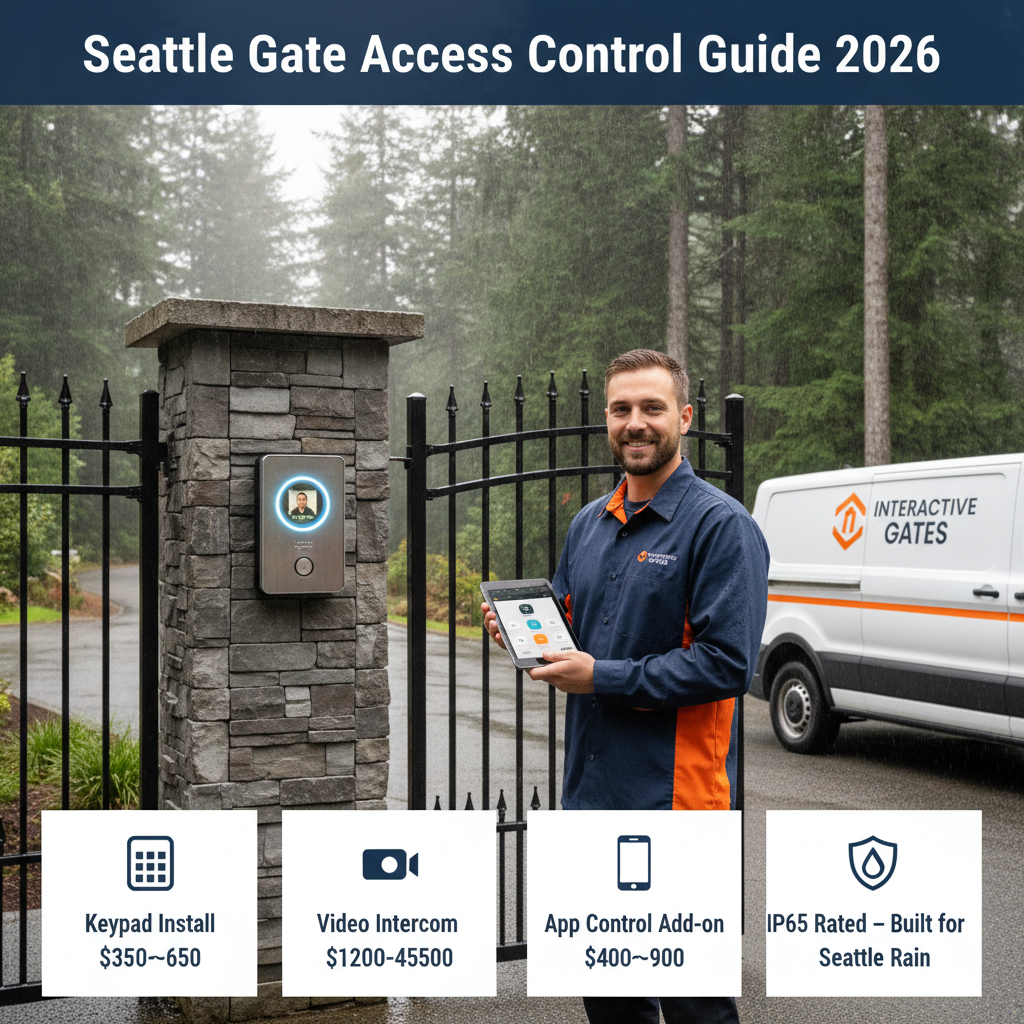
- Keypad entry systems start at $350–$650 installed for basic single-code units; smart keypads with rolling codes run $750–$1,400.
- App-controlled gate openers (LiftMaster myQ, FAAC Connect2, Viking Smart Access) add $400–$900 to a new install or upgrade cost in 2026.
- Video intercoms range from $1,200–$4,500 installed depending on screen size, camera resolution, and whether you add a cloud-recording subscription.
- Seattle's wet winters demand IP65-rated or better housings on all exterior keypads, cameras, and call boxes — unrated units fail within 12–18 months in the Puget Sound climate.
- HOA and multi-tenant properties in Bellevue, Tacoma, and Gig Harbor typically budget $6,000–$18,000 for full telephone-entry or cloud-managed systems serving 20–200 residents.
- UL 325 compliance is required on every motorized gate in Washington State — your access-control upgrade must not disable or bypass existing safety entrapment devices.
- Most residential installs are complete in one day; commercial telephone-entry or managed-access systems take 2–4 days depending on conduit runs and network setup.
- Battery backup is strongly recommended for Seattle properties — PUD and PSE outages spike every winter, and a $180–$320 backup module keeps your gate operational for 48–72 hours.
What Access Control System Do I Need for My Electric Gate in Seattle?
You just had an automatic gate installed — or you are about to — and now the real question hits: how does anyone actually get through it? Keypads, remotes, intercoms, phone apps, license-plate readers, Bluetooth fobs — the options in 2026 are wider than ever, and so is the price gap between them. Seattle homeowners in Magnolia or Queen Anne have very different needs than a 60-unit HOA community in Bellevue or a self-storage facility in Everett. This guide breaks down every major access-control option, what each costs in today's Seattle market, which brands hold up in Pacific Northwest weather, and how to match the right system to your property size and budget.
What Are the Main Types of Gate Access Control Available in Seattle in 2026?
There are five core categories you will encounter when shopping for gate access control in the Seattle metro:
- Keypad / PIN entry: The most common residential option. Users punch a code to open the gate. Basic single-code units cost $350–$650 installed. Smart keypads with rolling codes, multiple user codes, and timed-access schedules run $750–$1,400 installed. Popular brands: DoorKing 1506, LiftMaster 387LM, and Linear AK-11.
- Remote / key-fob transmitters: Usually bundled with the gate opener itself. A standard 4-button remote (LiftMaster 894MAX, FAAC XT4) costs $35–$65 per fob. Rolling-code systems prevent cloning. Good for single-family driveways; impractical for multi-tenant properties where residents come and go.
- Smartphone app control: LiftMaster's myQ platform, FAAC's Connect2 module, and Viking's Smart Access app let you open, close, and monitor your gate from anywhere. Hardware add-on cost: $400–$900. Monthly cloud subscriptions range from $0 (basic) to $25/month for full activity logs and video integration. Highly popular in newer Bellevue and Kirkland neighborhoods.
- Video intercom systems: A camera-equipped call station at the gate connects to an indoor monitor or smartphone app. Visitors press a button, you see and speak to them, then tap to open. Residential units (Doorbird D2101V, 2N IP Solo, Aiphone JO series) run $1,200–$2,800 installed. Commercial-grade units with cloud storage and multi-unit call routing cost $2,500–$4,500+ installed.
- Telephone entry / managed-access systems: The standard for HOAs, apartment complexes, and commercial properties. Residents are programmed into a directory; visitors call their unit from the keypad. The resident presses 9 (or a custom digit) to open. Systems like DoorKing 1837, Liftmaster CAPXLV, and Aiphone GT series handle 20–5,000 residents. Installed cost: $4,500–$18,000 depending on size and features.
Pro Tip: Do not choose your access-control system in isolation from your gate opener. LiftMaster openers pair natively with myQ; FAAC openers pair with Connect2. Mixing brands is possible but often requires an extra interface module ($150–$300) and can void warranty coverage on both units.
How Much Does Gate Access Control Cost to Install in Seattle in 2026?
Here is a realistic cost breakdown for the Seattle market in 2026, including labor. Labor rates for licensed gate technicians in King, Pierce, and Snohomish counties run $95–$145/hour.
- Basic keypad only (single-family home): $350–$650 all-in. Includes weatherproof keypad, programming, and wiring to existing operator.
- Smart keypad + app module (residential): $900–$1,800. Includes rolling-code keypad, myQ or equivalent app module, cloud setup, and 2 hours of labor.
- Video intercom (residential): $1,200–$2,800. Includes outdoor camera/call station, indoor monitor or app configuration, conduit, and wiring.
- Commercial video intercom: $2,500–$4,500. Adds multi-tenant call routing, higher-resolution camera, and vandal-resistant enclosure.
- Telephone entry system (HOA / multi-unit): $4,500–$18,000 depending on resident count, conduit length, and whether the property needs underground wiring trenched from the gate post to a central panel — common in hilly Gig Harbor and Snohomish developments.
- License plate recognition (LPR) add-on: $3,500–$8,000. Uses AI camera to open gate automatically for registered plates. Growing in popularity at upscale communities in Medina and Mercer Island.
- Battery backup module: $180–$320 installed. Non-negotiable in Seattle given winter storm outage frequency.
Which Access Control Brands Hold Up Best in Seattle's Rainy Climate?
Seattle averages 37–40 inches of rain per year, with sustained drizzle from October through April. Add the salt air near Puget Sound communities like Gig Harbor, Tacoma waterfront, and Edmonds, and you have a legitimately harsh environment for outdoor electronics. Here is how the leading brands perform:
- DoorKing (DKS): Built in the USA, widely used across Washington State. Keypads and telephone entry units carry IP54–IP65 ratings. The 1837 telephone entry system is a go-to for Seattle-area HOAs. Excellent long-term parts availability.
- LiftMaster / Chamberlain: The myQ ecosystem is the most seamless app experience available. The CAPXLV commercial entry system is UL 325 listed and handles up to 3,000 users. Residential keypads (387LM, 877MAX) are rated for outdoor use and hold up well in Puget Sound winters.
- 2N (Axis brand): Czech-made IP intercoms with IP69K ratings — the best weatherproofing in the residential-commercial intercom category. The 2N IP Solo and Verso are used extensively in Seattle tech-sector homes where remote video access and API integration matter.
- Doorbird: German-engineered, IP65-rated video doorbell/intercom hybrids. The D2101V integrates with Amazon Alexa, Google Home, and most smart-home hubs. Popular in Bellevue and Kirkland smart-home builds. Stainless steel faceplate resists corrosion.
- FAAC Connect2: Pairs specifically with FAAC gate operators (760, B614, etc.) and adds cloud monitoring and app control. IP54 rated. Better suited for covered installations; if your call station will sit fully exposed to Seattle rain, add a protective visor accessory ($45–$80).
- Aiphone: Japanese brand with a strong reputation for reliability. The Aiphone GT Series is widely installed in Seattle-area apartment and condo buildings. IP54 outdoor rating is adequate for covered entry points but marginal for fully exposed installations.
Pro Tip: Always ask your installer for the exact IP rating of any exterior component. IP65 means dust-tight and protected against water jets — the minimum we recommend for any uncovered Seattle installation. IP54 is fine only when the unit is under an overhang or canopy.
What Access Control System Is Right for My Property Type in Seattle?
The right system depends on three variables: number of users, how often strangers need legitimate access (deliveries, guests, contractors), and your budget. Here is a quick-match guide:
- Single-family home, 1–4 residents, rare guest access: Smart keypad + app control + 2–4 remotes. Budget $900–$1,800. This covers 90% of residential driveways in Auburn, Lynnwood, and Tacoma neighborhoods.
- Single-family home, frequent deliveries or Airbnb / short-term rental: Video intercom with smartphone app + temporary PIN codes on a smart keypad. Budget $2,000–$3,500. Lets you visually verify and remotely admit anyone without issuing permanent credentials.
- Small HOA or multi-tenant (5–30 units) in Bellevue or Gig Harbor: Telephone entry system (DoorKing 1506 or LiftMaster CAPXLV) + fob system for residents. Budget $4,500–$9,000. Residents get fobs; visitors call up from the directory.
- Large HOA or apartment complex (30–200+ units) in Everett or Tacoma: Cloud-managed telephone entry (DoorKing 1837 cloud, LiftMaster CAPXLV with BAS-1) + LPR for resident vehicles + video camera for audit trail. Budget $10,000–$25,000. Management can update the resident directory remotely without visiting the site.
- Commercial or industrial (self-storage, office park) in Snohomish or Auburn: Managed-access control panel with PIN + proximity card + LPR, all feeding into a cloud dashboard. Budget $8,000–$20,000+. Look for systems with activity-log exports for insurance and liability documentation.
Does My Access Control Upgrade Require a Permit in Seattle?
Adding or replacing access-control hardware on an existing permitted gate operator generally does not require a new building permit in Seattle, Bellevue, or most King County jurisdictions — it is considered like-for-like electrical work. However, three situations do trigger permit requirements: (1) you are installing a new gate operator alongside the access-control system, (2) the work involves trenching and new underground conduit (an electrical permit is required), or (3) your property is in a historic district such as Pioneer Square or Leschi. When in doubt, check with your local jurisdiction. Seattle property owners can verify online through the Seattle Department of Construction and Inspections (SDCI) portal. Bellevue and Everett both have online permit lookup tools as well. For commercial HOA projects, we always recommend pulling a permit — it protects the association from liability if an entrapment incident ever occurs.
How Long Does It Take to Install a Gate Access Control System in Seattle?
Residential smart keypad or app-control upgrades take 2–4 hours for an experienced technician. Video intercom installs typically run 4–8 hours depending on conduit routing through fence posts or brick pillars. Telephone-entry systems for small HOAs take 1–2 days. Large HOA and commercial systems with LPR cameras, underground conduit runs, and cloud-panel configuration typically require 2–4 days on site plus a programming session where the installer walks management through the admin dashboard. Gig Harbor and Snohomish properties with long driveway runs sometimes need an extra day for conduit trenching across gravel or sloped terrain.
In One Minute: Seattle Gate Access Control 2026
Basic keypad: $350–$650. Smart keypad with app: $900–$1,800. Video intercom: $1,200–$4,500. HOA telephone entry: $4,500–$18,000. Best brands for Seattle weather: DoorKing, LiftMaster, 2N, Doorbird — all IP65 or better for uncovered installs. Residential jobs finish in one day; HOA systems take 2–4 days. Always add a $180–$320 battery backup for winter outages. UL 325 compliance must be maintained through any upgrade. Permits are usually not required for access-control-only swaps but are required when new conduit is trenched or a new operator is installed. Match system complexity to user count: remotes + smart keypad for single-family, telephone entry + fobs for HOAs, cloud-managed LPR for large communities.
Frequently Asked Questions About Gate Access Control in Seattle
Can I add app control to my existing gate opener without replacing the whole unit?
In most cases, yes. If you have a LiftMaster, FAAC, Viking, or Elite operator installed in the last 8–10 years, there is likely a plug-in myQ, Connect2, or brand-specific smart module that adds app control for $400–$900 installed. Older or off-brand operators may need a universal relay interface ($150–$250 extra). A technician can assess compatibility in about 30 minutes on site.
What is the best video intercom brand for a Seattle home exposed to rain?
For fully exposed installations with no overhead cover, 2N (IP69K) and Doorbird (IP65, stainless housing) are the top performers. Both offer smartphone apps, cloud storage options, and solid third-party smart-home integration. Aiphone is excellent in covered locations. Avoid budget brands with IP44 or lower ratings — they typically fail within one to two Pacific Northwest winters.
How many user codes can a residential smart keypad hold?
Entry-level keypads hold 1–10 codes. Mid-range smart keypads (DoorKing 1506, LiftMaster 387LM) store 20–100 codes with timed-access scheduling. Commercial telephone-entry systems scale from 100 to 5,000+ user entries. For short-term rental properties or homes with many contractors and regular service providers, a system with at least 50 code slots and time-limited code capability is strongly recommended.
Does a gate access control upgrade require a permit in King County?
Swapping a keypad or adding an app module to an existing, already-permitted gate system generally does not require a permit in King County, Seattle, or Bellevue. If the project involves new underground conduit (electrical work), a new gate operator, or structural changes to the gate post, a permit is required. Always confirm with your local building department — rules vary slightly between incorporated cities and unincorporated King or Snohomish County.
How do HOA boards in Seattle manage gate access for residents who move in or out?
Modern cloud-based telephone-entry systems (DoorKing cloud, LiftMaster BAS-1, Verkada Access) let HOA managers add or delete resident entries, fobs, and PIN codes remotely from any web browser or mobile app — no on-site visit needed. This is a major operational upgrade over legacy systems that required a technician to reprogram the panel in person. Most HOA boards in Bellevue and Tacoma have migrated to cloud-managed systems specifically for this reason.
What happens to my gate access system during a power outage in Seattle?
Without a battery backup, most access-control systems default to either locked or unlocked depending on how the operator is configured — neither is ideal. A dedicated battery backup module ($180–$320 installed) keeps the opener and access-control hardware running for 48–72 hours on a single charge. Given that Seattle and the surrounding Puget Sound area regularly see multi-hour outages during winter windstorms, a battery backup is considered standard practice by most local installers, not an optional add-on.
Ready to Choose the Right Access Control System for Your Seattle Gate?
Whether you are upgrading a single-family driveway keypad in Auburn or planning a full cloud-managed telephone-entry system for a Tacoma HOA, the right system is the one that matches your user count, your climate exposure, and your management workflow — not just the one with the lowest sticker price. Browse recent local projects to see what systems similar Seattle-area properties have chosen, or use the gate designer tool to start visualizing your setup. When you are ready to talk specifics, reach out to the team — no pressure, just straight answers from people who install these systems in Pacific Northwest weather every day.