
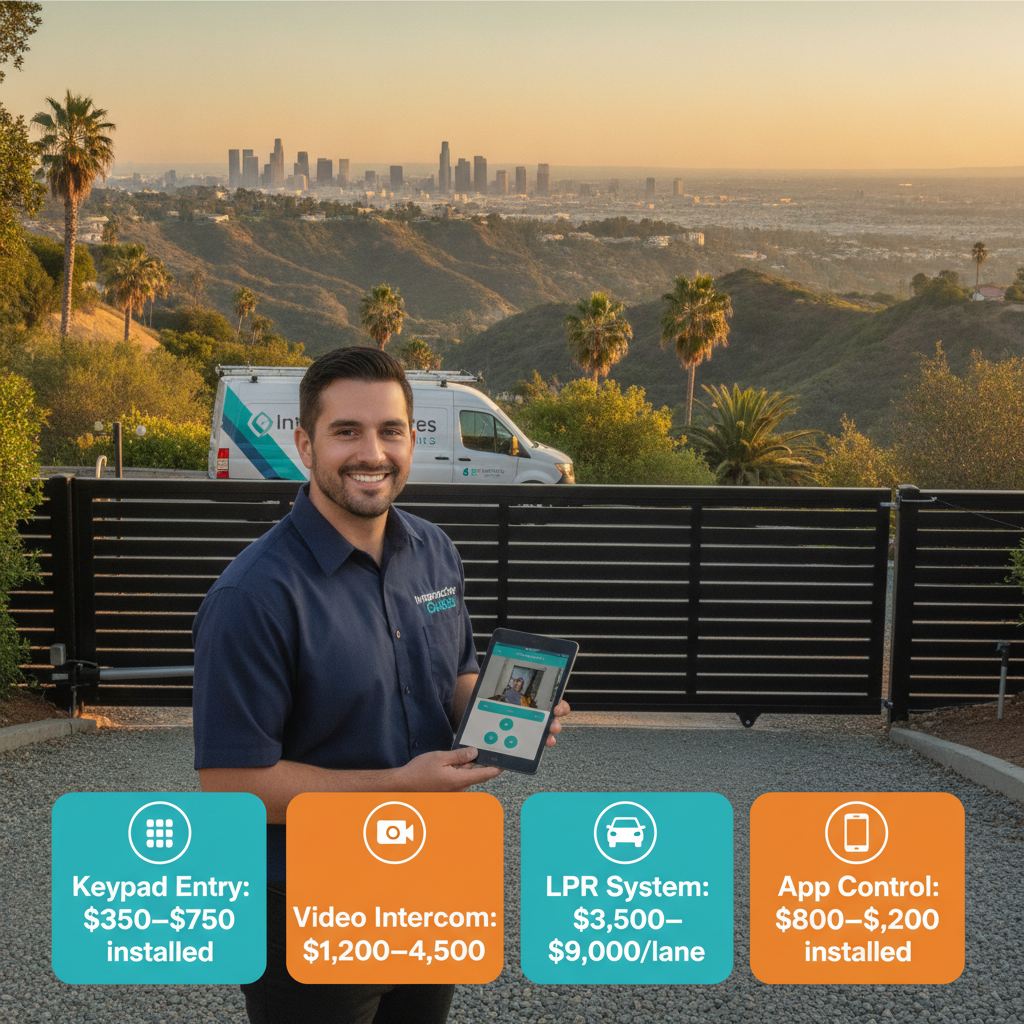
- Keypad entry systems start at $350–$650 installed for a single-family driveway in Los Angeles in 2026.
- Smart app-controlled access (LiftMaster myQ, FAAC Connect, DoorBird) runs $800–$2,200 installed depending on camera integration and panel complexity.
- Video intercoms are the top upgrade request in gated communities from Bel Air to Rancho Palos Verdes — expect $1,200–$4,500 per entry point installed.
- License plate recognition (LPR) systems for HOAs and commercial properties range from $3,500–$9,000 per lane in 2026.
- Solar-powered access panels are viable year-round in LA's climate and add $600–$1,400 to any system install.
- Rolling Hills Estates and Calabasas HOAs increasingly require UL-listed systems and dedicated backup power under updated CC&Rs in 2026.
- Most residential installs are completed in one day; multi-unit and HOA installs typically take 2–4 days depending on conduit runs.
- Cellular-connected systems eliminate the need for a landline — now the default choice for 70%+ of new LA-area gate installs.
What Access Control System Do I Actually Need for My Los Angeles Gate?
If you've typed 'best keypad for driveway gate Los Angeles,' 'video intercom for automatic gate,' or 'how do I control my gate with my phone,' you're in the right place. Access control is the brain of any electric gate — and in 2026, the options range from a $350 PIN keypad to a $15,000 multi-lane LPR system with cloud management. The right answer depends on whether you're a homeowner in Silver Lake, a property manager in Torrance, or an HOA board in Rolling Hills Estates. This guide breaks down every option with real 2026 prices, brand names, and LA-specific context.
What Are the Main Types of Gate Access Control Systems in 2026?
There are five core categories you'll encounter when upgrading or installing gate access control in the Los Angeles area:
- PIN keypads — standalone or networked, entry-level and reliable
- Key fob and card readers (RFID/proximity) — common in multi-unit residential and HOAs
- Video intercoms and two-way audio — now the standard expectation in Bel Air, Calabasas, and Palos Verdes
- Smart/app-controlled systems — LiftMaster myQ, FAAC Connect, ButterflyMX, DoorBird
- License plate recognition (LPR) — growing fast in gated communities and commercial properties
Most modern installs layer two or three of these together. A Silver Lake homeowner might run a LiftMaster myQ app paired with a PIN keypad for guests. A Calabasas HOA might run RFID fobs, an LPR lane, and a video intercom at a staffed guard-booth backup. Understanding what each layer costs — and what you actually need — saves you from both over-buying and under-protecting.
How Much Does a Keypad Entry System Cost for a Los Angeles Driveway Gate in 2026?
A standalone PIN keypad is still the most common entry point for residential gate access in LA. In 2026, installed costs break down like this:
- Basic wired keypad (Viking K-1EM, Linear, DKS DoorKing 1802): $350–$550 installed
- Backlit keypad with code management (DoorKing 1812, Liftmaster KPWR5): $500–$750 installed
- Networked keypad with remote code management (DoorKing 1837 with account management): $850–$1,400 installed
For a single-family home in areas like Los Angeles proper, Orange, or San Clemente, a wired keypad paired with the gate opener's built-in receiver covers 90% of use cases. The upgrade to a networked keypad starts making sense the moment you have more than 10 regular users or you rent the property and need to change codes remotely without a site visit.
Pro Tip: In coastal communities like Laguna Beach and San Clemente, specify a marine-grade or powder-coated keypad housing. Standard zinc-alloy housings corrode noticeably within 18–24 months from salt air. Viking and DoorKing both offer stainless-steel column kits for roughly $180–$300 extra — worth every dollar.
What Do Video Intercoms Cost for a Gate in Los Angeles in 2026?
Video intercoms have become table-stakes for homes above the $1.5M mark in neighborhoods like Bel Air, Holmby Hills, and Rolling Hills. But they're increasingly showing up in mid-range residential installs throughout the Valley and South Bay too. Here's the 2026 installed pricing:
- Single-channel video intercom, wired (DoorBird D1101V, 2N IP Solo): $1,200–$2,000 per entry point
- Wi-Fi video intercom with app answer (DoorBird D2101V, Remo+): $1,400–$2,400 installed
- Commercial-grade multi-tenant intercom (ButterflyMX, Aiphone GT series, 2N Helios): $2,500–$4,500 per entry point
- Intercom with on-site display panel inside the home: add $400–$900 for indoor monitor
DoorBird is the dominant brand in LA residential installs right now because it integrates natively with Apple HomeKit, Google Home, and most smart home ecosystems. The D2101V lets a homeowner in Rolling Hills answer a gate call from a phone in New York and issue a one-time open command — genuinely useful for housekeepers and deliveries. ButterflyMX dominates multi-unit and HOA installs because it requires zero hardware in individual units: residents download an app and answer calls on their smartphones. Monthly software fees for ButterflyMX run $70–$200/month depending on unit count, so HOA boards should factor that into long-term budgets.
How Does Smart App Gate Control Work and What Does It Cost in LA in 2026?
App-controlled gate access means you can open, close, monitor, and manage your gate from any smartphone — no landline, no on-site panel required. In 2026, the three dominant platforms in the Los Angeles market are:
- LiftMaster myQ — the most widely installed; works with LiftMaster and Chamberlain openers natively. The myQ Smart Garage and Gate Hub retails for $99; professional programming adds $150–$250. Real-time alerts, open/close history, auto-close timers. Best for residential swing and slide gates.
- FAAC Connect / FAAC RP 868 — preferred in higher-end installs and by HOAs using FAAC operators (common on heavy cantilever slide gates). App-based management of up to 2,000 user credentials. System cost: $400–$900 installed on top of the operator.
- Viking Access / Viking Connect — gaining traction in commercial and gated community applications; supports Wiegand readers, LPR integration, and cloud-based credential management. Pricing starts at $600 for the controller module plus integration labor.
Cellular-connected systems — which use an LTE SIM instead of your home Wi-Fi or a landline — are now the default in new LA installs. They cost $30–$60/month in cellular service fees but eliminate the single biggest failure point older systems had: a cut phone line dropping your gate access entirely. For a vacation home in Laguna Beach or a rental property in Orange, that reliability is worth the monthly cost without question.
What Is RFID and Key Fob Access Control and When Does It Make Sense?
RFID (Radio Frequency Identification) proximity cards and key fobs are the workhorse of multi-family residential and HOA gate access in LA. Each resident gets a fob or card programmed to their unit; lost or terminated credentials can be deactivated instantly from a management portal without changing codes for everyone. Installed pricing in 2026:
- Single-lane RFID reader with 50 fobs: $900–$1,800 installed
- Multi-lane system with management software (HID, Farpointe, Lenel): $2,500–$6,000 per lane
- Replacement fobs: $8–$25 each depending on format
The big names in LA HOA installs are HID Global (the ISONAS and Edge readers), Farpointe Data, and DoorKing's 1837 system, which is so widespread in Southern California that most gate technicians can program it in their sleep. For an HOA community in Rolling Hills or a gated apartment complex in Orange, RFID paired with a video intercom at visitor lanes is the current best-practice configuration.
Is License Plate Recognition Worth It for an LA Property in 2026?
License plate recognition has moved from luxury to legitimate consideration for properties with high vehicle throughput — large HOAs, commercial lots, mixed-use developments. The camera reads a vehicle's plate, matches it against a whitelist, and triggers the gate automatically — no fob, no app tap, no stopping at a keypad. In 2026, LA-area installed costs run:
- Single-lane LPR entry system (Genetec, OpenALPR, Plate Recognizer cloud): $3,500–$6,000
- Dual-lane (entry and exit) LPR: $6,000–$9,000
- LPR with cloud management dashboard: add $80–$200/month SaaS fee
Read speed is now reliable to 35 MPH in bright California light — nighttime reads require IR-equipped cameras, which are standard in any properly spec'd 2026 install. For an HOA that has had repeated fob-copying or credential-sharing issues, LPR eliminates the problem almost entirely: your plate IS your credential and you can't lend it to a friend the way you can a fob.
Pro Tip: LPR works best when paired with a secondary entry method (keypad or intercom) for guests and delivery vehicles. A guest with no registered plate still needs a way in — a simple PIN keypad lane or intercom handles that without staffing a booth. Budget an extra $500–$1,000 to add a guest lane alongside your LPR install.
Can I Power My Gate Access System With Solar in Los Angeles?
Yes — and LA is one of the best markets in the country to do it. With 280+ sunny days per year, even a modest solar panel keeps gate openers and access control panels running without a grid connection. Installed solar kit pricing in 2026:
- Basic solar kit (20W panel + sealed AGM battery for single opener): $600–$950 installed
- Mid-range kit (40W panel + lithium battery, supports opener + keypad + camera): $1,000–$1,600 installed
- Full solar access system (100W+ array, supports intercom + LPR + dual operators): $2,500–$4,500 installed
LiftMaster's SRUSOL3 solar kit and Viking's SLK series are the most common in LA residential installs. For rural lots in areas like the Malibu canyons or the hills above Laguna Beach where trenching conduit from the house to the gate would cost $2,000–$5,000 alone, solar access control pays for itself before the first service call.
What Access Control System Does an HOA in Los Angeles Actually Need in 2026?
For community associations — whether you're a board member in Rolling Hills Estates or a property manager overseeing a gated complex in Orange — the access control spec checklist in 2026 looks like this:
- Resident entry: RFID fob or app-based credential (no shared codes)
- Visitor entry: video intercom with app-answer capability for residents
- Delivery/service vehicles: virtual keys or one-time PIN generation
- Backup entry: secondary keypad or guard-call button
- Audit trail: cloud-based log of every entry event, 90-day minimum retention
- Backup power: sealed AGM or lithium battery good for 72+ hours without grid power
Updated CC&Rs in several Calabasas and Rolling Hills HOAs now specify UL-listed access hardware and annual access-log audits as part of their security compliance language. If your community is approaching a governing document rewrite, it's worth having a gate contractor review the technical specs before they're locked in — vague language like 'electronic access system' creates problems when it's time to bid the work. See our HOA and commercial gate page for more on community-scale systems, or browse completed projects to see what comparable communities have installed.
How Long Does Access Control Equipment Last in the LA Climate?
Los Angeles is gentler on electronics than Portland or Seattle — no sustained freeze cycles, no relentless rain. But coastal salt air (Laguna Beach, San Clemente, Rancho Palos Verdes) and intense UV exposure degrade housings, wiring insulation, and camera lenses faster than inland areas. Realistic lifespans in 2026:
- Wired keypads: 10–15 years inland, 6–10 years coastal without marine-grade housing
- RFID readers: 10–15 years; reader boards outlast fobs (replace fobs every 5–7 years as a fleet)
- Video intercom cameras: 5–8 years before lens clarity and IR performance degrade noticeably
- App-connected controllers/hubs: 6–10 years hardware lifespan; software support windows vary by brand
- LPR cameras: 7–12 years with annual lens cleaning in dusty or marine environments
In One Minute: Los Angeles Gate Access Control in 2026
A PIN keypad runs $350–$750 installed and covers most single-family driveways. Video intercoms run $1,200–$4,500 per entry point and are now expected in higher-end LA neighborhoods. Smart app control (LiftMaster myQ, FAAC Connect) costs $800–$2,200 installed and works over cellular — no landline needed. RFID fob systems start at $900 for residential and scale to $6,000+ for HOA multi-lane setups. LPR costs $3,500–$9,000 per lane and is growing fast in gated communities. Solar power is viable year-round in LA and costs $600–$4,500 depending on system size. Most residential installs complete in one day; HOA and commercial work takes 2–4 days. The right system layers two or three of these options rather than relying on a single entry method.
Frequently Asked Questions: Gate Access Control in Los Angeles
Do I need a permit to install a gate access control system in Los Angeles?
The access control system itself — keypads, intercoms, readers — typically does not require a separate permit in LA County or most incorporated cities. However, if installation involves new conduit trenching, electrical panel connections, or structural column work, those elements may require an electrical or building permit depending on your city. Always confirm with your local building department; cities like Beverly Hills and Santa Monica have their own review processes that can differ from LA County's general guidelines.
What is the best app-controlled gate system for a Los Angeles home in 2026?
LiftMaster myQ is the most widely supported option for residential properties — it integrates with Apple HomeKit, Google Assistant, and Amazon Alexa, and your installer's familiarity with the platform means faster troubleshooting. DoorBird video intercoms are the top pick when you want video plus app control in one unit. For properties with multiple operators or an HOA structure, FAAC Connect and Viking Access offer more robust credential management at the cost of a steeper setup investment.
Can a gate access system work during a power outage in Los Angeles?
Yes, if it's properly designed. Every access control system should have a battery backup — typically a sealed AGM or lithium battery sized for at least 72 hours of standby and normal-use cycling. Cellular-connected systems remain online during outages as long as the battery holds. Solar systems with adequate battery storage can run indefinitely through a Southern California outage. Systems that rely on your home Wi-Fi router will lose connectivity when the router loses power unless you have a UPS on the router as well.
How many users can a residential gate keypad handle in Los Angeles?
Entry-level keypads like the Viking K-1EM hold 1 code shared by all users. Mid-range systems like the DoorKing 1812 handle 10–100 individual codes. Networked systems like the DoorKing 1837 or FAAC Connect controller handle 500–2,000+ individual credentials and allow remote management from a web portal. For a rental property or a home with frequent service vendors, a system that issues and expires individual codes is worth the extra $300–$500 over a single shared PIN.
Is a video intercom required for gated communities in Los Angeles?
There is no universal state or county mandate requiring video intercoms for private gated communities in California as of 2026. However, many HOAs in Rolling Hills, Calabasas, and similar communities have written video intercom requirements into their CC&Rs or architectural standards. More practically, insurance carriers for high-value gated communities increasingly ask about access logging and visitor verification capabilities at renewal — and a video intercom with cloud log is the clearest answer to both questions.
How do I get a quote for gate access control in Los Angeles?
The fastest path is to have a technician do a site walk — gate type, conduit access, distance from power source, number of entry points, and your typical daily user count all affect the spec. You can also start by designing your gate setup with our online visualizer to get a sense of configuration before scheduling an in-person visit. For a full consultation and written estimate, visit our contact page or our residential gate page to reach our Los Angeles team directly.
Ready to Upgrade Your Gate Access?
Whether you're a homeowner in Laguna Beach who wants a video intercom you can answer from your phone, or an HOA board in Rolling Hills looking to move from shared key fobs to a fully logged LPR system, the right starting point is a straightforward conversation about your property and your daily use patterns. Our team installs and services access control systems across the greater Los Angeles area — from Orange to San Clemente to LA proper. Reach out through our contact page when you're ready for a no-pressure site assessment.


